Every south-african company faces mounting pressure to innovate faster and deliver better results. In a world where market shifts can happen overnight, methods that once worked are now slowing teams down. Over 60 percent of global businesses have adopted Agile development to keep pace with rapid change. Understanding how Agile reshapes teamwork and drives real value gives south-african businesses a powerful edge in staying relevant and leading their industries.
Table of Contents
- Defining Agile Development For Modern Businesses
- Popular Agile Frameworks And Core Processes
- Key Principles Of Agile Software Delivery
- Benefits Agile Brings To South African Enterprises
- Overcoming Common Agile Adoption Challenges
Key Takeaways
| Point | Details |
|---|---|
| Agile Methodology | Agile development enables businesses to respond swiftly to changing market demands through iterative and incremental processes. |
| Framework Selection | Choosing the right Agile framework, like Scrum or Kanban, is crucial for aligning with team needs and project complexities. |
| Cultural Transformation | Successful Agile implementation requires commitment to a collaborative culture and continuous improvement across the organisation. |
| Overcoming Challenges | Proactive change management and targeted training are essential to address resistance and ensure effective Agile adoption. |
Defining Agile Development for Modern Businesses
Modern businesses require dynamic methodologies that respond rapidly to changing market conditions. Agile development emerges as a transformative approach enabling organisations to build software and deliver value with unprecedented flexibility. Research indicates that Agile methodology fundamentally reshapes how teams conceptualise, design, and implement digital solutions.
At its core, Agile development represents a collaborative, iterative framework where cross-functional teams work in short cycles called sprints, continuously adapting to evolving customer requirements. Unlike traditional waterfall methodologies, Agile prioritises incremental progress, customer feedback, and rapid product iterations. Organisations implementing Agile approaches can expect significant improvements in project transparency, team productivity, and overall product quality.
Key characteristics of Agile development include:
- Iterative and incremental product development
- Continuous customer collaboration
- Rapid response to changing market demands
- Emphasis on team empowerment and self-organisation
- Focus on delivering working solutions quickly
Pro Tip: Start Small Strategy: Begin Agile implementation with a single team or project to build organisational understanding and momentum before scaling across your entire business.
Practical Implementation: Agile is not just a methodology but a mindset that requires commitment from leadership and team members. Successful adoption involves training, cultural transformation, and a willingness to embrace continuous improvement.
Popular Agile Frameworks and Core Processes
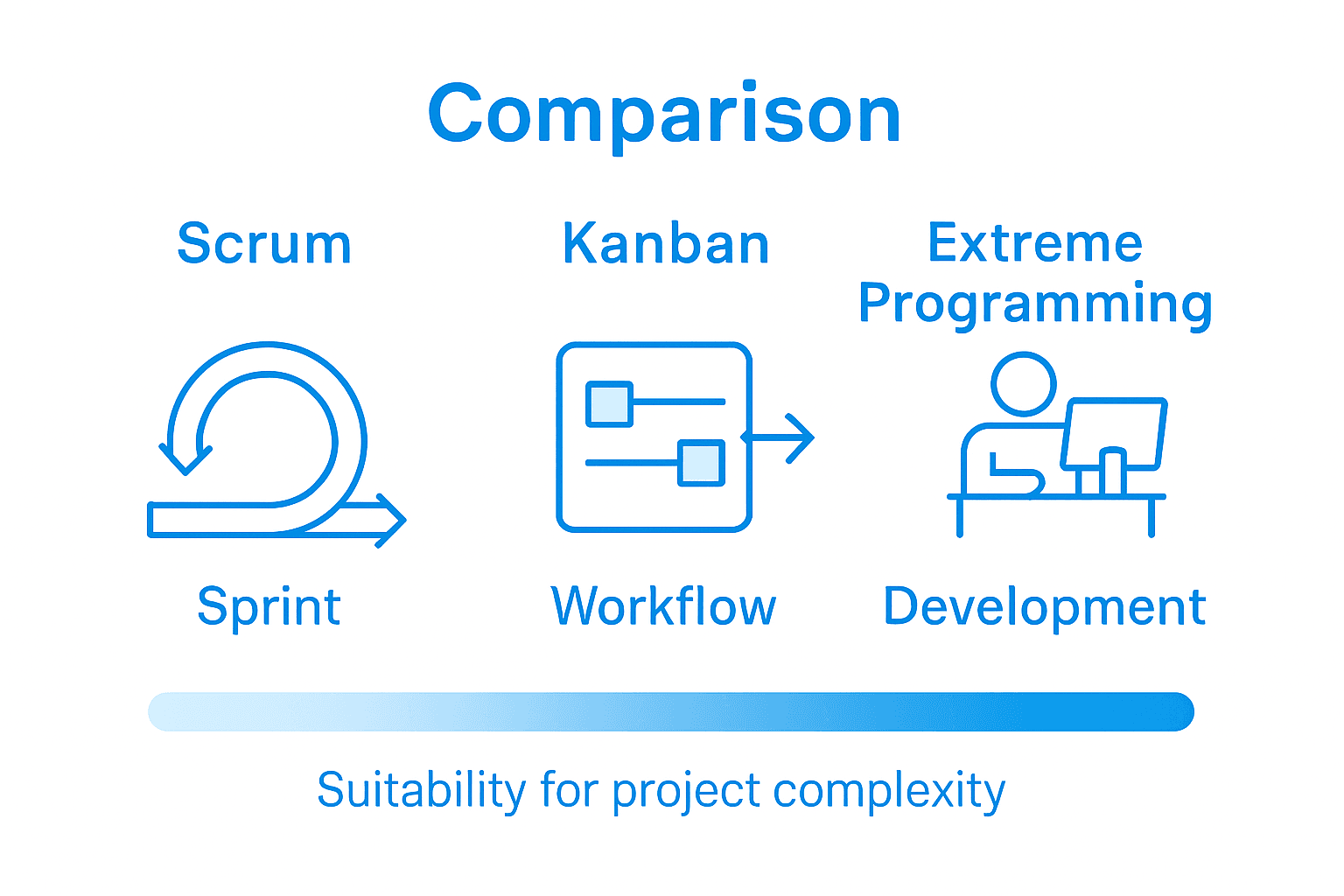
Agile methodologies encompass multiple frameworks that help organisations streamline their product development and project management processes. Comparing different Agile frameworks reveals unique approaches that cater to diverse business needs and project complexities. Understanding these frameworks enables teams to select the most appropriate method for their specific operational requirements.
Scrum stands out as the most widely adopted Agile framework, characterised by its structured yet flexible approach. Key elements of Scrum include:
- Regular sprint planning meetings
- Daily stand-up discussions
- Sprint reviews and retrospectives
- Defined roles: Product Owner, Scrum Master, and Development Team
Kanban, another popular framework, focuses on visualising workflow and limiting work in progress. Its key principles involve:
- Continuous delivery
- Real-time communication
- Flexible planning processes
- Visual task management boards
Additional notable Agile frameworks include Extreme Programming (XP), which emphasises technical excellence, and Crystal, known for its adaptability to different project sizes and complexities. Each framework shares core Agile principles while offering unique implementation strategies.
The following table offers a comparative overview of key Agile frameworks relevant to South African businesses:
| Framework | Main Focus | Structure & Roles | Typical Use Case |
|---|---|---|---|
| Scrum | Iterative sprints | Product Owner, Scrum Master | Software development teams |
| Kanban | Continuous workflow | Flexible team roles | Operations and support teams |
| Extreme Programming (XP) | Technical excellence | Developer-centric practices | Projects needing high code quality |
| Crystal | Adaptability & scalability | Varies by project size | Diverse business project types |
Pro Tip: Framework Selection Strategy: Evaluate your team’s specific needs, project complexity, and organisational culture before selecting an Agile framework to ensure optimal implementation and team alignment.
Implementation Insight: Successful Agile framework adoption requires more than selecting a methodology. It demands cultural transformation, ongoing training, and a commitment to continuous improvement and collaborative working practices.
Key Principles of Agile Software Delivery
Agile software delivery represents a revolutionary approach to building digital solutions that prioritise flexibility, collaboration, and continuous improvement. Core Agile principles fundamentally transform how teams conceptualise, develop, and deliver software products, moving beyond traditional linear development methodologies.
The fundamental principles of Agile software delivery centre on customer-centric and adaptive approaches. Key characteristics include:
- Prioritising customer collaboration over rigid contract negotiations
- Welcoming changing requirements, even late in the development process
- Delivering working software frequently, typically in short iterations
- Maintaining close, daily cooperation between business stakeholders and development teams
- Building projects around motivated individuals and providing supportive environments
These principles manifest through several critical practices that distinguish Agile from traditional methodologies. Continuous integration, regular feedback loops, and incremental development ensure that software evolves in alignment with actual user needs. Teams embrace transparency, regularly demonstrating working product increments and soliciting direct feedback to guide subsequent development cycles.

Pro Tip: Feedback Integration Strategy: Establish structured feedback mechanisms that allow stakeholders to provide input at the end of each sprint, ensuring continuous alignment between product development and user expectations.
Implementation Insight: Successful Agile software delivery requires more than following a set of practices. It demands a cultural shift towards collaboration, transparency, and a genuine commitment to iterative learning and continuous improvement.
Benefits Agile Brings to South African Enterprises
Digital transformation in South African businesses demands adaptive methodologies that respond quickly to market changes. Comprehensive research on organizational management demonstrates how Agile approaches can dramatically enhance operational efficiency and competitive positioning for local enterprises.
The primary benefits of Agile methodology for South African businesses include:
- Accelerated product development cycles
- Enhanced team collaboration and communication
- Improved customer satisfaction through responsive delivery
- Reduced project risks and implementation costs
- Greater flexibility in responding to market disruptions
South African enterprises increasingly recognise that Agile is more than a project management technique. Enterprise cloud migration strategies complement Agile approaches, enabling businesses to create more resilient, scalable digital infrastructures. By embracing iterative development, organisations can quickly adapt to technological shifts and changing customer expectations, maintaining a competitive edge in rapidly evolving markets.
Pro Tip: Cultural Adaptation Strategy: Invest in comprehensive Agile training and create an organizational culture that celebrates continuous learning and adaptive problem-solving.
Implementation Insight: Successful Agile adoption requires more than implementing new processes. It demands a fundamental mindset shift towards collaboration, transparency, and continuous improvement across all levels of the organisation.
Below is a summary of how Agile principles deliver tangible business value in the South African context:
| Agile Principle | Business Benefit | Example in Practice |
|---|---|---|
| Customer collaboration | Boosted client satisfaction | Frequent feedback sessions |
| Embracing change | Improved market competitiveness | Rapid updates to product features |
| Frequent delivery | Early value realisation | Regular software releases |
| Empowered teams | Enhanced productivity | Teams self-managing project tasks |
Overcoming Common Agile Adoption Challenges
Agile transformation requires strategic navigation through complex organisational challenges. Large-scale Agile development research reveals multiple critical obstacles that businesses must proactively address to ensure successful implementation and sustainable digital innovation.
Common challenges in Agile adoption include:
- Resistance to cultural change
- Misalignment between traditional hierarchical structures and Agile principles
- Inadequate training and understanding of Agile methodologies
- Difficulty in scaling Agile practices across entire organisations
- Inconsistent implementation and interpretation of Agile frameworks
Digital adoption strategies highlight that successful Agile implementation demands more than technical knowledge. Organisations must invest in comprehensive change management, focusing on developing an adaptive mindset that embraces continuous learning, transparent communication, and collaborative problem-solving. The transition requires leadership commitment, targeted training programmes, and creating environments that encourage experimentation and incremental improvement.
Pro Tip: Change Management Strategy: Create cross-functional Agile transition teams responsible for driving cultural transformation, providing ongoing support, and addressing implementation challenges proactively.
Implementation Insight: Overcoming Agile adoption challenges is not about perfect execution, but about fostering a culture of continuous learning, adaptability, and collaborative problem-solving across all organisational levels.
Embrace Agile Development with Tailored Digital Solutions
Modern South African businesses face challenges such as resistance to cultural change and the need for rapid, iterative delivery methods as highlighted in Agile development methodology. If you aim to overcome obstacles like misalignment and incomplete Agile adoption, creating a flexible and collaborative environment is essential. Key Agile concepts like iterative sprints, empowered teams, and continuous customer collaboration must be paired with expert support to truly transform your digital strategy.
At Cloud Fusion, we understand these pain points and offer customised web and software development solutions designed to align with Agile principles. Our services help you accelerate product delivery while maintaining high standards and adaptability. Whether you need bespoke web applications or scalable cloud-based platforms, explore how our web design and development quotation can jumpstart your Agile journey. Don’t just adapt to change – lead it today with expert guidance and innovative digital frameworks.
Ready to drive your digital success with Agile methodologies? Visit Cloud Fusion to get a personalised consultation and start transforming your business now.
Frequently Asked Questions
What is Agile development methodology?
Agile development is a collaborative, iterative framework that allows cross-functional teams to develop software and deliver value rapidly by adapting to changing customer requirements.
What are the key principles of Agile software delivery?
The key principles of Agile software delivery include prioritising customer collaboration, welcoming changing requirements, delivering working software frequently, maintaining close cooperation between stakeholders and teams, and empowering individuals within supportive environments.
How can Agile methodology benefit businesses?
Agile methodology can enhance product development cycles, improve team collaboration, boost customer satisfaction through better responsiveness, reduce project risks and costs, and provide greater flexibility in adapting to market changes.
What are some common challenges in adopting Agile practices?
Common challenges in Agile adoption include resistance to cultural change, misalignment with traditional hierarchical structures, inadequate training in Agile methodologies, difficulties in scaling Agile across organizations, and inconsistent implementation of Agile frameworks.
Recommended