TL;DR:
- Many business owners believe awards indicate high-quality agencies, but they often do not reflect a firm’s ability to build effective brand identities for specific businesses. Effectiveness relies on strategic clarity, consistent design, data-informed decisions, and ongoing support, not just accolades or visual appeal. Evaluating agencies with a focus on client outcomes, tailored processes, and long-term partnerships leads to better branding and business results.
Many business owners assume that a trophy cabinet full of industry accolades is the clearest signal of an agency’s quality. This assumption is understandable but strategically risky. Awards measure creative excellence within specific campaign contexts, yet they tell you very little about whether an agency can build a consistent, recognisable, and commercially effective brand identity for your specific business. The real challenge lies in knowing which signals to trust and which questions to ask before you commit your brand to a creative partner. This guide gives you a structured, practical framework for making that decision with confidence.
Table of Contents
- What makes a creative design agency effective?
- How to evaluate creative design agencies: key criteria and questions
- Awards, benchmarks, and real-world effectiveness: the truth about agency accolades
- Partnering for custom branding and digital identity: real agency fit
- What most businesses get wrong when choosing a creative design agency
- Take the next step: start with expert creative partnership
- Frequently asked questions
Key Takeaways
| Point | Details |
|---|---|
| Awards are not outcomes | Creative awards signal innovation but do not guarantee improved branding or business results. |
| Fit over flash | Choose agencies that align with your vision and customize solutions, not just those with accolades. |
| Compare beyond portfolios | Use a structured evaluation framework to assess creativity, strategy, and client fit. |
| Collaboration drives value | Active partnership and transparent communication turn creative work into real brand performance. |
| Apply benchmarks judiciously | Use creative rankings as a guide, but always validate an agency’s ability to deliver your specific outcomes. |
What makes a creative design agency effective?
The first distinction worth drawing is between creative output and strategic brand impact. An agency can produce visually stunning work that wins industry recognition but fails to move the needle on customer retention, brand recall, or market positioning. Effectiveness in branding is not purely aesthetic. It is measurable, outcome-oriented, and deeply tied to how well an agency understands your business model, your audience, and your competitive landscape.
High-performing creative design agencies share several core characteristics that go well beyond a polished portfolio. These include clarity in communication from the very first brief, consistency in applying design systems across every touchpoint, and a commitment to data-driven creativity where visual decisions are informed by audience research and performance metrics. When you engage with creative agency innovation at this level, the work produced does more than look good. It functions as a strategic business asset.
Here are the core traits to look for when assessing agency effectiveness:
- Strategic clarity: The agency asks probing questions about your business goals, not just your aesthetic preferences.
- Consistent design language: They demonstrate how they maintain visual and tonal consistency across web, print, and digital channels.
- Data-informed decisions: Creative choices are supported by audience insights, testing, and performance analysis.
- Transparent processes: They define deliverables, timelines, and revision protocols at the outset.
- Cultural and industry fit: They show evidence of working with businesses in adjacent sectors or facing similar challenges.
Awards can serve as a useful external signal. However, as noted in World Creative Rankings 2026, creative award benchmarks can be used as an external, data-driven proxy for creative performance, but they measure awards outcomes and not necessarily brand identity effectiveness or conversion and retention directly.
Key insight: The most effective agencies are not always the most decorated. They are the ones who ask the right questions, listen actively, and build solutions around your business reality rather than their own creative ambitions.
Pro Tip: Before shortlisting any agency, review at least three client case studies where the brief was similar to yours. Ask specifically what business metrics improved and over what time period. Strong brand credibility and conversions do not happen by accident. They are the result of deliberate, strategic creative work.
How to evaluate creative design agencies: key criteria and questions
Understanding what to look for is critical, but how do you separate talk from true capacity? This section provides a practical evaluation framework that moves beyond gut feel and into structured, objective assessment.
Before you engage any agency, define your desired outcomes with precision. Are you looking to improve brand consistency across digital channels? Increase direct conversions from a rebrand? Establish a new digital identity that supports market expansion? Each of these goals requires different skills and methodologies. Building brand identity that actually performs in the market requires agencies who understand your specific outcome context, not just general design capability.
Follow this numbered evaluation process to assess agencies objectively:
- Define your outcome first. Document what success looks like in measurable terms before you approach any agency.
- Review relevant case studies. Look for projects where the client’s challenge resembles yours in scale, industry, or brand maturity.
- Assess their discovery process. Strong agencies invest in understanding your audience and competitive context before producing any creative work.
- Evaluate their methodology. Ask how they approach brand architecture, design systems, and cross-channel consistency.
- Probe their measurement approach. How do they track the effectiveness of their branding work post-delivery?
- Assess ongoing support capacity. Brand work is iterative. Ensure the agency can support you beyond the initial project.
As the World Creative Rankings 2026 data shows, you should use external benchmarks for creative performance as a signal of creative excellence, but validate fit for your specific outcome, whether that is branding for clarity and consistency or campaign-level award performance.
The table below compares key evaluative dimensions to guide your shortlisting process:
| Dimension | Awards and rankings | Case studies | Client fit | Methodology | Ongoing support |
|---|---|---|---|---|---|
| What it measures | Creative industry recognition | Real-world project outcomes | Sector and goal alignment | Process rigour and approach | Long-term partnership capacity |
| Reliability for branding | Low to moderate | High | High | High | High |
| Questions to ask | Which programmes and what year? | What changed for the client? | Have they worked in your sector? | How do they structure discovery? | What does post-launch support look like? |
| Red flags | Awards from low-tier programmes | Vague outcome descriptions | No relevant sector experience | Ad hoc, unstructured process | Project-only, no retainer option |
Understanding corporate identity design impact is a critical dimension often underweighted in early agency evaluations. Corporate identity is not just a logo. It is the full visual and communicative language your business uses to build trust and recognition.
Pro Tip: Request a credentials presentation and ask the agency to walk you through a project where the client’s initial brief changed significantly. How they handled ambiguity and pivoted their approach reveals far more about their capability than any polished pitch deck.
Awards, benchmarks, and real-world effectiveness: the truth about agency accolades
With a strong criteria checklist in place, let us demystify awards and creative benchmarks so you can interpret them with confidence rather than over-reliance.
The scale of global creative benchmarking is substantial. The World Creative Rankings 2026 analyses 2,278 campaigns from 1,459 advertisers working with 1,076 agencies across 81 countries and 22 major award programmes. This is an impressive data set, and it reflects genuine creative talent across the industry. However, it is critical to understand what these rankings actually measure.
Awards programmes typically evaluate creativity, originality, and production quality. They are judged by panels of industry peers, not by brand managers measuring customer acquisition or retention. This means a campaign that wins a prestigious award may have been created for a context that bears little resemblance to your brand’s needs, audience profile, or business goals.
Here is what award recognition can and cannot tell you:
What awards do signal:
- Creative capability and production quality
- Industry credibility and peer recognition
- Experience working at scale on complex briefs
- Ability to generate attention and cultural relevance
What awards do not reliably signal:
- Consistency in applying brand systems over time
- Effectiveness in your specific industry or audience segment
- Ability to manage long-term brand identity projects
- Alignment with your business objectives and budget constraints
The table below provides a direct comparison between award metrics and measurable brand outcomes:
| Award metric | What it reflects | Corresponding business metric | Who measures it |
|---|---|---|---|
| Campaign creativity score | Aesthetic and conceptual quality | Brand awareness lift | Market research panels |
| Award programme tier | Industry prestige | Customer acquisition rate | CRM and analytics platforms |
| Number of awards won | Creative volume | Net Promoter Score change | Client satisfaction surveys |
| Jury commendation | Peer recognition | Conversion rate improvement | Web and campaign analytics |
The practical takeaway is that award wins should raise an agency to your longlist, not your shortlist. The shortlist should be determined by how well the agency addresses your specific brief and demonstrates relevant experience. To understand how improving digital conversions connects to brand investment, you need partners who track performance at every stage of the customer journey. Award programmes simply do not measure that dimension.
Critical perspective: An agency with fewer awards but a disciplined process for conversion rate optimisation may deliver substantially more business value than a heavily decorated agency whose strengths lie in campaign spectacle rather than sustained brand performance.
Partnering for custom branding and digital identity: real agency fit
Interpreting recognition and rankings is helpful, but the end goal is a lasting partnership that delivers actual business value. The mechanics of how you engage and manage that relationship are just as important as the selection process itself.

A successful agency partnership for custom brand design solutions begins well before any creative work is produced. It starts with a structured briefing process that communicates your brand’s current position, target audience, competitive context, and measurable goals. Agencies that skip this discovery phase and move straight into visual concepts are, frankly, building on an unstable foundation.
As noted by the World Creative Rankings 2026, creative award benchmarks measure awards outcomes and not necessarily brand identity effectiveness or conversion and retention directly. This reinforces why your brief and your measurement framework must be defined internally before you hand anything over to an agency.
Follow these principles for building a productive creative partnership:
- Prepare a detailed brand brief. Include audience personas, competitor positioning, tone of voice guidelines, and clear success metrics.
- Establish communication checkpoints. Agree on regular review milestones at concept, draft, and final delivery stages.
- Assign a single internal point of contact. Fragmented feedback from multiple stakeholders creates confusion and delays.
- Define revision boundaries. Agree on the number of revision rounds upfront to protect both timelines and budgets.
- Measure outcomes at 30, 60, and 90 days. Track brand recall, website engagement, and conversion data after the work goes live.
- Treat the relationship as iterative. Brand identity evolves. The best partnerships continue well beyond the initial project delivery.
Aligning your brand vision with the agency’s creative process is not a one-time event. It is an ongoing conversation. Businesses that invest in brand strategies for businesses as a long-term programme rather than a once-off project consistently achieve stronger brand equity and more coherent digital identities.
Pro Tip: At the project kickoff, ask your agency to define three to five key performance indicators (KPIs) that they will use to evaluate the success of the branding work. If they cannot answer this question confidently, that is a significant warning sign about their strategic maturity.
What most businesses get wrong when choosing a creative design agency
Having laid out practical frameworks, let us take a step back and challenge some common but risky decision-making habits that we observe in businesses across industries.
The most common mistake is conflating visual sophistication with strategic effectiveness. A beautifully produced pitch or a multi-award-winning showreel creates a powerful emotional impression, and that impression often overrides rational evaluation criteria. Business owners make their decision in the presentation room rather than in the results data. This is understandable. But it is not strategic.
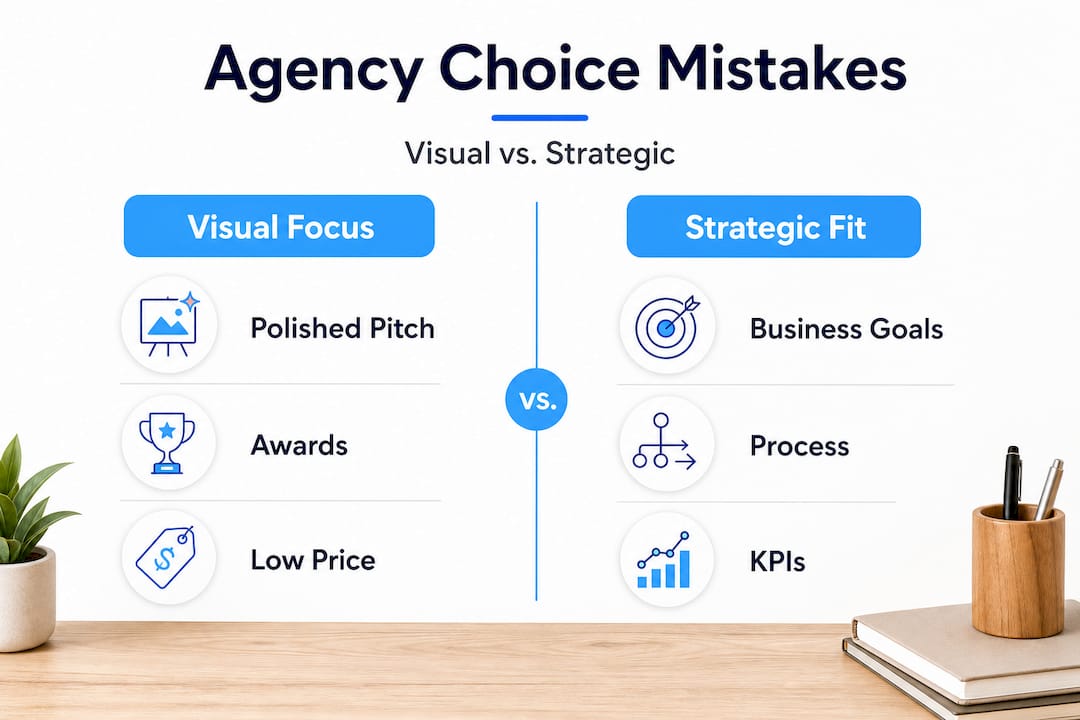
The second most common mistake is prioritising price over process. Budget constraints are real, and cost is always a legitimate factor. However, choosing the cheapest option without interrogating the agency’s methodology almost always results in a brand identity that needs to be redone within two years. The cost of that cycle is always greater than investing properly at the start.
There is a third, less discussed mistake: overweighting brand identity expertise as demonstrated through credentials and underweighting it as demonstrated through listening. The agencies that deliver the most durable brand outcomes are almost always the ones who spend more time asking questions than making declarations. Their creative confidence is grounded in understanding, not assumption.
The World Creative Rankings 2026 make it clear: use external benchmarks as a signal of creative excellence, but validate fit for your specific outcome. That principle should anchor every agency selection decision your business makes.
Business-first agencies consistently outperform creatively-first agencies in long-term client satisfaction and measurable ROI. They ask about your sales cycle. They want to understand your customer journey. They design with your business model in mind, not their portfolio. Prioritise partners who demonstrate that alignment from the very first conversation.
Take the next step: start with expert creative partnership
Armed with strategic criteria and real-world insight, you can now take action with partners who put your business vision first. Cloudfusion delivers custom branding, web development, and digital identity solutions designed around your specific business objectives. From initial brand strategy through to full digital implementation, the team brings together creative expertise and technical capability to build brand assets that perform. Whether you are launching a new identity, refreshing an existing brand, or integrating digital and physical touchpoints, Cloudfusion tailors its approach to your industry, audience, and growth stage. Explore the portfolio, review client outcomes, and request a tailored consultation to begin building a brand that generates lasting commercial value.
Frequently asked questions
Do creative awards guarantee better business results?
No, creative awards measure campaign excellence but do not directly reflect improvements in brand identity or business outcomes. As World Creative Rankings 2026 confirms, award benchmarks measure awards outcomes and not necessarily brand identity effectiveness or conversion and retention directly.
How can I judge if a creative agency is the right fit for my brand?
Assess their track record with similar clients, their ability to understand your goals, and their willingness to customise solutions rather than relying solely on portfolio awards. Per the World Creative Rankings 2026, use award benchmarks as a signal but validate fit for your specific branding outcome.
What questions should I ask before hiring a creative design agency?
Ask about their discovery process, how they measure post-delivery brand performance, recent examples relevant to your sector, and how they tailor strategies to your unique business model and audience.
Why is collaboration with a creative agency critical for branding success?
Active partnership ensures your brand vision, values, and commercial goals are fully understood before any creative work begins, reducing costly revisions and ensuring the final output is strategically aligned.
Can a creative agency help with both branding and digital identity?
Yes, many end-to-end creative design agencies offer integrated services covering brand strategy, visual identity, and digital asset development, ensuring consistency across all customer touchpoints.
Recommended