

Choosing a UX website design agency in 2026
Discover how to choose the right UX website design agency in 2026. Get key insights to elevate your online presence and boost conversions.
Start reading
TL;DR:
- Many business owners mistakenly trust polished portfolios, but agency process and outcome alignment matter most.
- Evaluating agencies with a focus on discovery, designer meet-and-greets, case rationale, and measurable goals reduces risks.
Most business owners assume that any UX website design agency with a polished portfolio will deliver results. That assumption is expensive. The reality is that agencies vary enormously in process, capability, and how well they understand your specific business context. For South African SMBs competing in increasingly digital markets, the difference between the right agency and the wrong one is often the difference between a website that converts and one that just looks decent. This guide covers what these agencies actually do, how to evaluate them, what to pay, and how to get the most from the relationship once you’ve signed.
Table of Contents
- Key takeaways
- What a UX website design agency actually does
- How to choose the right UX agency
- Pricing and engagement models compared
- Working effectively with your agency
- Trends shaping UX agencies in 2026 and beyond
- My perspective on choosing the right agency
- How Cloudfusion approaches UX website design
- FAQ
Key takeaways
| Point | Details |
|---|---|
| Define outcomes first | Specify at least two measurable goals before approaching any agency to drive accountability. |
| Use paid discovery sprints | A 2 to 4 week sprint reveals how an agency actually solves problems before you commit fully. |
| Understand pricing models | Subscription and project-based models each suit different needs; compare them against your timeline. |
| Meet the actual designer | Asking to meet your assigned lead designer filters out mismatches early in the process. |
| Local context matters | South African SMBs need agencies that understand mobile usage patterns and local payment flows. |
What a UX website design agency actually does
There is a meaningful distinction between a graphic designer, a UI designer, and a full UX website design agency. Graphic designers create visual assets. UI designers focus on interface elements. A user experience agency combines research, strategy, information architecture, interaction design, and testing into a process that shapes how your visitors think, feel, and act on your website.
The core UX design services that these agencies typically offer include:
- User research and persona development — qualitative and quantitative methods to understand who your visitors are and what they need
- Wireframing and information architecture — structuring content and user flows before any visual design begins
- Interactive prototyping — clickable, testable models built in tools like Figma or Adobe XD
- Usability testing — real users interacting with designs to surface friction before launch
- Responsive and mobile-first design — building for the full range of screen sizes your audience uses
- Interaction design — micro-animations, transitions, and feedback that make an interface feel alive and intuitive
In 2026, leading agencies also offer custom website UX packages built on platforms like Webflow or WordPress, where design and development are delivered together. Top UX agencies combine responsive design, custom branding, unlimited revisions, and fast progress updates in a single engagement. The key deliverables you should expect are documented user flows, tested prototypes, a design system, and measurable performance benchmarks tied to your goals.
How to choose the right UX agency
This is where most business owners go wrong. They evaluate agencies on aesthetics and price, when they should be evaluating on process and outcome alignment. Here is a structured approach that changes the quality of your decision.
-
Define concrete, measurable outcomes before you send a single brief. Successful clients specify at least two measurable outcomes they expect within three months post-launch. “We want something more modern” is not a brief. “We want to reduce our checkout abandonment rate from 68% to below 50% within 90 days” is.
-
Ask about their discovery process. Any credible professional UX design firm will run a structured discovery phase before producing a single wireframe. If an agency skips this or cannot explain how they translate research into design decisions, treat that as a serious warning sign.
-
Meet the designer who will actually work on your project. Meeting your assigned designer before you sign filters out mismatches between agency reputation and individual capability. Agencies sometimes pitch senior talent and deliver junior work.
-
Request case studies with rationale, not just screenshots. You want to understand what problem was identified, what design decisions were made, and what the measurable outcome was. A portfolio without that context tells you nothing about an agency’s thinking.
-
Run a paid discovery sprint first. A 2 to 4 week paid sprint delivers problem framing, user insights, and wireframes tied to actual research. It is the most reliable way to assess an agency’s communication, problem-solving, and quality before committing to a full engagement. Budget between R8,000 and R25,000 for this phase depending on scope.
-
Watch for red flags. Agencies that skip discovery or cannot name a single thing that went wrong on a past project are telling you something important about their process maturity.
Pro Tip: When you review an agency’s web design consultancy approach, ask them directly: “What would cause this project to fail?” Agencies with real process experience will have a clear, specific answer. Agencies without it will give you a reassuring non-answer.
Pricing and engagement models compared
Pricing in the UX design market is genuinely confusing because the models vary so significantly. Understanding the difference upfront saves you from making a commitment that does not fit your business.
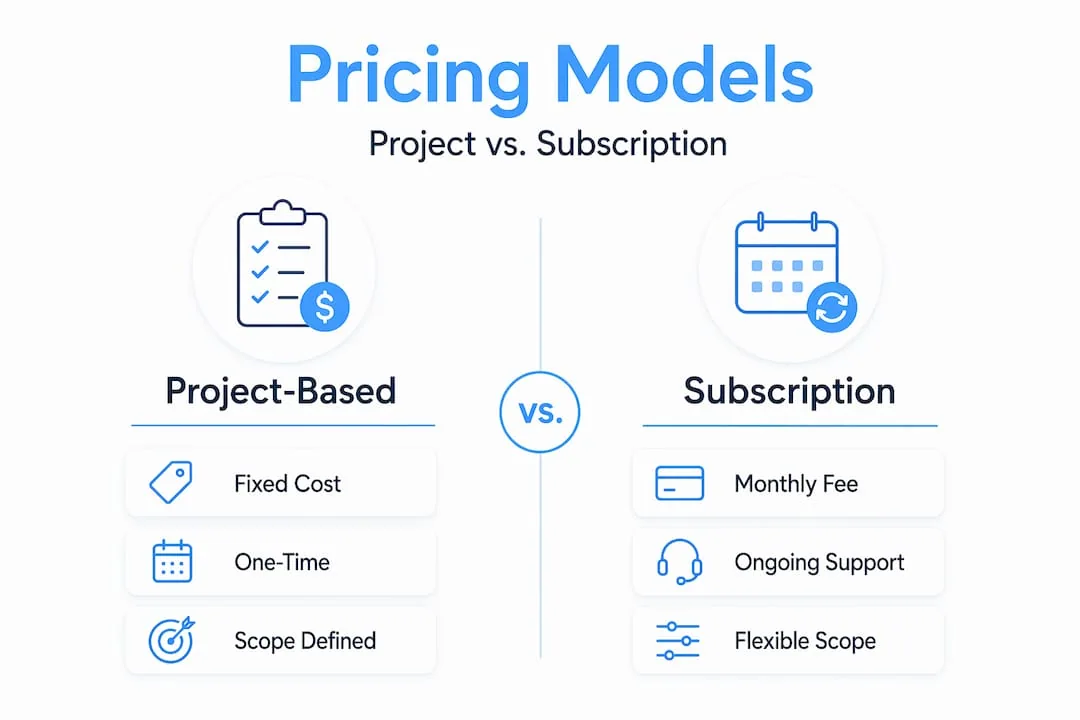
| Model | Typical cost range | Best suited for | Key trade-offs |
|---|---|---|---|
| Project-based | R50,000 to R250,000+ | Defined scope, one-off launches | Fixed scope, change requests cost extra |
| Monthly retainer | R15,000 to R80,000/month | Ongoing design needs, product teams | Requires clear ongoing workload |
| Subscription-based | $500 to $5,000+/month | SMBs needing flexibility | Queue-based, not always dedicated |
| Day rate / sprint | R5,000 to R15,000/day | Discovery phases, specific problems | Short-term focus only |
Subscription-based UX design pricing starts as low as $500 per month for entry-level plans and can exceed $5,000 for dedicated specialist support. For South African SMBs, this model is particularly relevant because it removes the large upfront project cost and replaces it with a predictable monthly expense that scales with your needs.
Flexible subscription models lower barriers for SMBs to access ongoing, high-quality design support compared to traditional agency pricing. The trade-off is that most subscription services operate a request queue, meaning you may not always have immediate, dedicated access to a designer. If you need a complex website built to a deadline, a project-based engagement remains the more appropriate structure.
Pro Tip: When comparing quotes, ask each agency to itemise what is included in their monthly or project fee. Revision rounds, usability testing, and design system documentation are often excluded from base quotes and added at a premium later.
Working effectively with your agency
Signing with the right agency is step one. Getting real value from that relationship requires deliberate effort on your side too. The businesses that see the best outcomes from UX design engagements are not passive clients.
The practical behaviours that make the biggest difference include:
- Establish a single point of contact on your side. Multiple stakeholders giving conflicting feedback is one of the most common causes of scope creep and delayed timelines.
- Define KPIs before the project starts, not after. Agree on which metrics will determine whether the design is working: conversion rate, bounce rate, average session duration, or specific funnel completion rates.
- Participate actively in discovery and testing. Your knowledge of your customers is data the agency cannot get anywhere else. Show up for workshops, review research findings, and contribute to usability test sessions.
- Create a structured revision process. Specify how many rounds of revisions are included, what constitutes a revision versus a scope change, and how feedback should be submitted to avoid confusion.
- Measure post-launch, not just at launch. Concrete UX design decisions directly affect business metrics, but those effects often take four to eight weeks to stabilise after launch. Build a 90-day review into your agreement.
Communication cadence matters more than most business owners expect. Weekly progress updates, even brief ones, prevent the kind of misalignment that results in expensive rework. Agree on the communication channel, the update frequency, and what escalation looks like if the project falls behind.
Trends shaping UX agencies in 2026 and beyond
The UX agency market is shifting in ways that directly affect which agencies are worth partnering with.
| Trend | What it means for your decision |
|---|---|
| AI-assisted design tools | Verify that agencies use senior design reviews to gatekeep AI-generated outputs |
| Subscription agency models | Increasing access for SMBs to ongoing UX support without large project commitments |
| Multi-platform UX | Agencies need capability across web, mobile, and emerging voice or AI-driven interfaces |
| AEO and GEO optimisation | UX and content structure increasingly influence how AI search tools surface your site |
| Local market adaptation | South African SMBs need agencies that understand local payment flows, mobile-first usage, and regulatory context |
The AI point deserves specific attention. Many agencies claim AI integration as a selling point, but human oversight, particularly senior designer review of AI-generated artefacts, is what maintains brand consistency and quality. Ask any prospective agency exactly how they use AI tools and who reviews the outputs.
My perspective on choosing the right agency
I’ve watched business owners make the same mistake repeatedly. They spend weeks reviewing portfolios and comparing pricing, then sign with the agency that presented best. Six months later, they have a website that looks good in a screenshot but does not actually solve their business problem.
What changed how I assess agencies was starting from outcomes. Not “we need a new website” but “we need 30 more qualified leads per month from organic traffic within six months.” That specificity forces the agency to demonstrate whether their process can actually produce that result. Agencies with genuine process competence lean into that conversation. Agencies without it deflect.
The discovery sprint insight is the one most business owners miss. I’ve seen clients treat it as an unnecessary upfront cost, then commit to a R200,000 engagement with an agency they barely know. A R15,000 sprint that reveals misalignment is one of the best investments you can make. It is not a delay. It is due diligence.
Subscription models, used well, are genuinely democratising access to good design for smaller businesses. The caveat is that they work best when you have a clear, ongoing stream of design needs rather than a single large project. Match the model to your actual situation.
If you are looking for an agency that understands both the technical and business dimensions of great UX design, Cloudfusion is worth a conversation.
— Anton
How Cloudfusion approaches UX website design
Cloudfusion delivers custom web development and UX design services built specifically for South African SMBs that need more than a template site. The approach combines structured discovery, research-led design, and development on proven platforms, with flexible engagement options to suit both project-based and ongoing design needs. Cloudfusion’s team understands local market realities: mobile-first user behaviour, South African payment integrations, and the performance requirements of local hosting environments. If you are ready to see what a purposeful, outcome-focused UX process looks like in practice, give us a shout. We will review your current site, ask the right questions, and put together a tailored approach that fits your goals and your budget.
FAQ
What does a UX website design agency actually deliver?
A UX website design agency delivers user research, wireframes, interactive prototypes, tested designs, and a design system, all tied to specific business outcomes rather than aesthetic preferences alone.
How much does professional UX design cost in South Africa?
Project-based engagements typically range from R50,000 to R250,000 depending on scope, while subscription-based UX design services start from approximately $500 per month for entry-level plans.
How do I know if an agency is the right fit before signing?
Commission a paid discovery sprint lasting two to four weeks. This reveals how the agency frames problems, communicates under pressure, and translates research into design, before you commit to a full engagement.
What red flags should I watch for when evaluating agencies?
Watch for agencies that skip the discovery phase, present case studies without explaining their rationale, or cannot clearly name what could go wrong on your specific project.
Should South African SMBs use subscription-based UX services?
Subscription models suit SMBs with ongoing design needs and limited upfront budgets, but project-based engagements remain more appropriate for defined, deadline-driven website builds.