

Conversion Rate Optimisation: Boosting Ecommerce Sales Impact
Discover conversion rate optimisation for ecommerce. Learn proven strategies, CRO metrics, common mistakes, and practical steps to drive online sales growth.
Start reading
Every mid-sized E-commerce brand eventually faces the challenge of turning browsers into buyers. The pressure to drive online sales keeps growing as digital touchpoints multiply and customer expectations rise. Understanding the core principles of conversion rate optimisation gives you tools to design seamless experiences, address decision barriers, and guide customers from first click to checkout more effectively than ever.
Table of Contents
- Core Principles Of Conversion Rate Optimisation
- Types Of CRO Goals For Ecommerce Sites
- Key Metrics And Tools For Measuring CRO
- Essential Strategies For Improving Conversions
- Common Pitfalls And Mistakes To Avoid
- Practical CRO Implementation For Global Brands
Key Takeaways
| Point | Details |
|---|---|
| Data-Driven Decision Making | Successful CRO relies on quantitative and qualitative insights to understand user behaviour and make informed changes. |
| User Experience Optimisation | Designing user-friendly interfaces reduces friction and enhances the likelihood of conversion. |
| Continuous Experimentation | Implementing A/B testing and iterating based on results is crucial for refining digital experiences. |
| Holistic Approach | Integrating multiple channels and developing a deep understanding of customer motivations enhances conversion rates. |
Core principles of conversion rate optimisation
Conversion Rate Optimization (CRO) represents a strategic approach to improving digital performance by systematically enhancing user experience and driving more meaningful interactions. At its core, CRO moves beyond simplistic metrics to understand complex user psychology and create targeted digital experiences that convert potential customers into actual buyers.
The fundamental principles of CRO revolve around several critical strategies:
- Data-driven decision making: Using quantitative and qualitative insights to understand user behaviour
- User experience optimization: Designing intuitive interfaces that reduce friction in the customer journey
- Continuous experimentation: Implementing systematic A/B testing and iterative improvements
- Psychological understanding: Leveraging cognitive triggers that influence purchasing decisions
Successful CRO requires a holistic view that integrates multiple digital channels. Digital retailers must create seamless interactions across touchpoints, ensuring consistent messaging and experience from initial awareness through final conversion. This approach demands deep understanding of customer segments, their motivations, and the specific barriers preventing them from completing desired actions.

Strategic implementation involves mapping the entire customer journey, identifying potential drop-off points, and developing targeted interventions. Retailers need sophisticated tracking mechanisms to monitor user behaviour, analyse conversion funnels, and rapidly iterate based on empirical evidence.
Pro tip: Implement micro-conversions tracking to understand incremental user engagement and build a more comprehensive optimization strategy.
Types of CRO goals for ecommerce sites
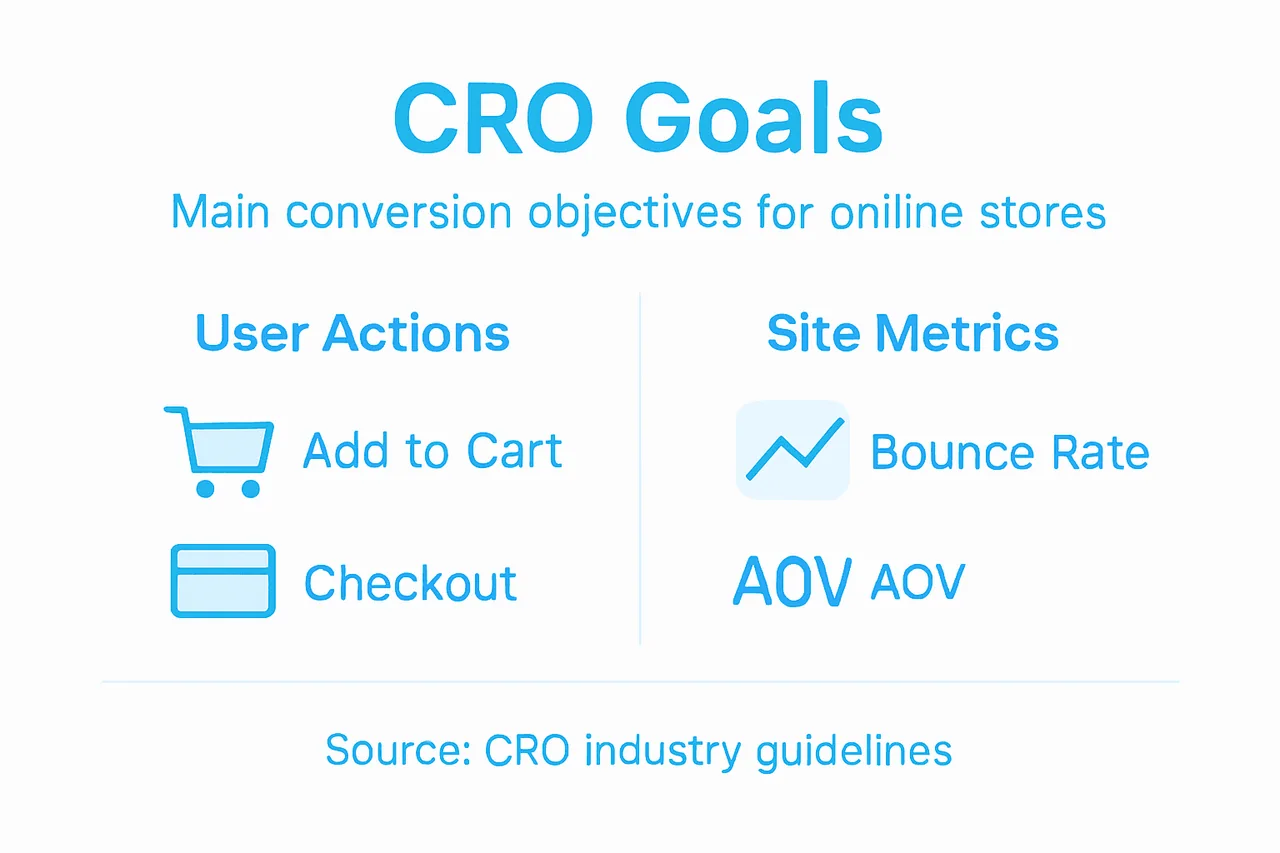
E-commerce conversion rate optimization (CRO) encompasses a diverse range of strategic objectives designed to transform website visitors into active customers. Structured iterative models focus on systematically improving user interactions and driving meaningful digital engagement.
The primary types of CRO goals for e-commerce sites include:
- Transaction Completion: Increasing the percentage of visitors who finalise purchases
- Signup Conversion: Encouraging user registration and account creation
- Cart Abandonment Reduction: Minimising the number of potential customers who leave without purchasing
- Product Page Engagement: Improving interaction rates with product details and features
- Email List Growth: Expanding subscriber base for future marketing communications
Customer decision-making optimization involves understanding seven critical elements that influence purchasing behaviour: catalyst, persuasion, usability, interactivity, trust, aesthetics, and marketing mix. These elements work together to create a comprehensive approach to improving conversion rates.
Successful e-commerce sites develop nuanced strategies that address specific barriers preventing customers from completing desired actions. This requires sophisticated tracking mechanisms, detailed user behaviour analysis, and continuous experimentation to refine the digital experience.
Pro tip: Implement granular analytics to track micro-conversions and identify precise points of user friction in your e-commerce funnel.
Key metrics and tools for measuring CRO
Converting website visitors into customers requires a comprehensive approach to measuring performance through sophisticated conversion rate optimization (CRO) metrics. Rigorous testing strategies provide critical insights into user behaviour and website effectiveness.
The most essential CRO metrics include:
- Conversion Rate: Percentage of visitors completing desired actions
- Bounce Rate: Proportion of users leaving the site immediately
- Average Order Value (AOV): Total revenue divided by number of transactions
- Cart Abandonment Rate: Percentage of users who add items but do not complete purchase
- Customer Lifetime Value (CLV): Total projected revenue from a single customer
Comprehensive measurement tools help analyse user interactions through multiple sophisticated approaches. These include advanced analytics platforms, heatmap generators, user session recordings, and A/B testing software that track both quantitative and qualitative data points.
Effective CRO measurement demands a holistic approach that combines statistical analysis with deep user experience understanding. Digital marketers must develop nuanced strategies that translate raw data into actionable insights, continuously refining website performance and user engagement.
Here’s how key CRO metrics translate into business impact:
| Metric | What It Measures | Direct Business Impact |
|---|---|---|
| Conversion Rate | Success of calls to action | Increased sales revenue |
| Bounce Rate | User engagement quality | Reduced wasted spend |
| Average Order Value | Value per transaction | Higher profitability |
| Cart Abandonment Rate | Lost purchase opportunities | Recover missed sales |
| Customer Lifetime Value | Total customer worth | Strategic marketing growth |
Pro tip: Implement cross-platform analytics to create a unified view of user interactions across different digital touchpoints.
Compare these CRO strategies for optimal effect:
| Strategy Type | Primary Focus | Typical ROI Timeline |
|---|---|---|
| A/B Testing | Data-driven improvements | 1-3 months |
| Personalisation | User relevance & engagement | 2-6 months |
| UX/UI Redesign | Smoother navigation | 3-9 months |
| Behavioural Analytics | Identifying friction points | Immediate to ongoing |
Essential strategies for improving conversions
Successful conversion optimization requires a multidimensional approach that goes beyond surface-level website modifications. Neuro web design principles reveal how strategic psychological interventions can significantly enhance user engagement and purchase likelihood.
Key strategies for improving conversion rates include:
- User Interface Optimization: Designing intuitive, frictionless navigation
- Persuasive Design Techniques: Implementing visual cues that guide user decisions
- Trust Signal Enhancement: Displaying security badges, testimonials, and social proof
- Personalisation: Creating tailored experiences based on user behaviour
- Streamlined Checkout Process: Reducing steps and eliminating unnecessary form fields
Integrating behavioural economics helps understand how subtle design interventions can nudge users towards desired actions. Advanced strategies leverage artificial intelligence to predict user preferences and create dynamically adaptive experiences that resonate with individual customer segments.
Successful conversion strategies demand continuous experimentation, combining data-driven insights with deep psychological understanding. Digital marketers must develop agile approaches that balance technical optimization with genuine user-centric design principles.
Pro tip: Conduct regular user experience audits to identify and systematically eliminate conversion barriers across your digital platform.
Common pitfalls and mistakes to avoid
Converting website visitors requires sophisticated strategic planning, and understanding potential mistakes can significantly improve conversion optimization efforts. Structured experimentation frameworks help identify and mitigate common conversion rate optimization (CRO) challenges before they impact business performance.
The most critical pitfalls in conversion optimization include:
- Insufficient Data Analysis: Failing to deeply understand user behaviour patterns
- Lack of Systematic Testing: Implementing changes without rigorous experimental controls
- Ignoring Qualitative Insights: Relying exclusively on quantitative metrics
- Overlooking User Experience: Prioritising aesthetic design over functional usability
- Inconsistent Messaging: Creating disconnects between marketing promises and website experience
Limited organizational experimentation cultures often prevent businesses from effectively improving their digital performance. Small and medium enterprises particularly struggle with adopting comprehensive CRO strategies due to resource constraints and low data literacy.
Successful conversion optimization demands a holistic approach that integrates quantitative analysis, user psychology, and continuous learning. Digital teams must develop adaptable strategies that balance technical implementation with genuine user-centric design principles.
Pro tip: Develop a cross-functional CRO team that combines data analysts, user experience designers, and marketing specialists to create comprehensive optimization strategies.
Practical CRO implementation for global brands
Implementing conversion rate optimization (CRO) for global brands requires a sophisticated, multi-layered approach that transcends traditional digital marketing strategies. Structured iterative frameworks enable organisations to systematically gather insights, form hypotheses, and execute comprehensive experimental strategies across diverse digital ecosystems.
Key components of practical global CRO implementation include:
- Enterprise-Level Experimentation: Developing scalable testing programs
- Market-Specific Personalization: Adapting experiences to regional preferences
- Cross-Cultural User Experience Design: Understanding nuanced behavioural differences
- Advanced Analytics Integration: Leveraging AI and machine learning insights
- Regulatory Compliance Management: Ensuring adherence to international digital standards
Global brands must strategically align their CRO efforts with overarching business objectives, maintaining a delicate balance between technological innovation and ethical design principles. This approach demands creating adaptable digital platforms capable of delivering personalized experiences at scale while respecting diverse cultural contexts.
Successful implementation requires building robust, flexible infrastructure that can quickly iterate and respond to emerging user behaviour patterns. Digital teams must cultivate a culture of continuous experimentation, combining data-driven insights with deep understanding of regional market nuances.
Pro tip: Create a centralised CRO knowledge base that captures insights from different global markets to inform cross-regional optimization strategies.
Unlock Your E-commerce Potential with Expert Web Solutions
Converting visitors into loyal customers is at the heart of every successful e-commerce business. This article highlights crucial challenges such as optimising user experience, reducing cart abandonment, and implementing continuous experimentation to drive meaningful conversions. Key pain points include overcoming friction in the customer journey, understanding complex user psychology, and leveraging data-driven strategies to improve conversion rates. Address these challenges effectively by embracing intuitive web design, personalised digital experiences, and robust analytics.
Empower your digital transformation with Cloud Fusion’s tailored web development. Our bespoke solutions are crafted to enhance your site’s usability and boost your conversion rates by integrating best practices in CRO outlined in this article. From optimised user interfaces to scalable web platforms designed for performance and adaptability, we deliver comprehensive support that aligns with your business goals. Don’t let friction points hold your business back Take the first step towards smarter digital engagement today by exploring our web design and development quotations and partnering with a team that understands the science behind conversion. Visit Cloud Fusion now to transform visitor interactions into lasting customer relationships.
Frequently Asked Questions
What is conversion rate optimisation (CRO) in e-commerce?
Conversion rate optimisation (CRO) is a strategic approach aimed at improving a website’s performance and increasing the percentage of visitors who complete desired actions, such as making a purchase or signing up for a newsletter. It involves analysing user behaviour, refining user experiences, and employing data-driven methodologies.
How can I reduce cart abandonment rates on my e-commerce site?
To reduce cart abandonment rates, consider streamlining the checkout process by minimising the number of steps and eliminating unnecessary form fields. Additionally, enhancing trust signals like security badges and displaying clear shipping information can ultimately encourage users to finalise their purchases.
What key metrics should I track for effective CRO?
Key metrics for effective CRO include the conversion rate, bounce rate, average order value (AOV), cart abandonment rate, and customer lifetime value (CLV). Monitoring these metrics helps identify areas for improvement and assess the impact of optimisations on business performance.
How can I implement A/B testing in my e-commerce strategy?
Implement A/B testing by creating two versions of a webpage (A and B) with slight variations, then measure user interactions and conversion rates for both. This allows you to determine which version performs better and make informed adjustments to enhance your e-commerce platform’s effectiveness.