TL;DR:
- Most businesses mistake logos and visual assets for complete brands, but a true brand reflects audience perception and trust.
- Brand building agencies serve as strategic partners, using research, digital analysis, and architecture to drive revenue and loyalty.
Most businesses invest in a logo, select a colour palette, and assume their brand is set. This is one of the most costly misconceptions in modern marketing. A brand is not a visual asset. It is the sum total of how your audience perceives, trusts, and chooses you over competitors. A professional brand building agency understands this distinction at a strategic level, deploying research, architecture, digital measurement, and multi-channel activation to create brand equity that directly drives revenue, loyalty, and long-term business growth.
Table of Contents
- What is a brand building agency and what do they do?
- Modern brand measurement: Beyond vanity metrics
- Strategic brand architecture: Structuring your brand for impact
- Bringing brand strategy to life: Real-world agency frameworks
- Why most branding advice falls short—and what actually works
- Partner with a brand building agency for results that last
- Frequently asked questions
Key Takeaways
| Point | Details |
|---|---|
| Branding is strategic | A brand building agency delivers more than visuals by linking identity to measurable business value. |
| Measure what matters | Rely on newer metrics like share of search and brand sentiment alongside classic KPIs for real brand growth. |
| Architecture shapes impact | Strong brand architecture clarifies, unifies, and amplifies your message across audiences and channels. |
| Integrated frameworks win | Combining digital, creative, and business strategies turns brand investment into market results. |
What is a brand building agency and what do they do?
A brand building agency is not simply a design studio that produces logos and style guides. These agencies function as strategic partners, combining market research, consumer psychology, digital analytics, and creative execution to shape how your target audience perceives your organisation. Their mandate extends well beyond aesthetics, reaching into positioning, messaging, digital presence, and measurable business outcomes.
Understanding digital branding explained is a useful starting point, because modern brand agencies operate at the intersection of creative and digital strategy. They assess your current brand perception, identify gaps between how you see your brand and how your audience experiences it, and then design systematic interventions to close those gaps.
The strategic services a reputable brand building agency delivers typically include:
- Brand research and audience analysis: Qualitative and quantitative studies to map perception, identify competitive positioning, and understand buyer motivations.
- Brand strategy and positioning: Defining the brand’s core purpose, values, differentiators, and messaging hierarchy.
- Visual identity systems: Logo, typography, colour, imagery, and usage standards that reinforce strategic positioning.
- Digital presence development: Website design and development, content strategy, and social media frameworks.
- Brand activation and rollout: Coordinated campaigns across digital, physical, and experiential touchpoints.
- Measurement and reporting: Ongoing tracking of brand health metrics tied to business KPIs.
The link between design and business growth is where agencies genuinely earn their value. When a brand strategy is correctly executed, it directly influences lead quality, conversion rates, customer retention, and pricing power. Effective work on improving digital presence is one channel through which these outcomes are achieved.
“Brand-building work is increasingly measured with digital brand perception proxies and business outcomes rather than relying on vanity metrics, with research proposing constructs like share of search, digital brand awareness, and digital brand sentiment as more meaningful indicators of true brand equity.”
This shift in measurement philosophy reflects a matured understanding of what brand building actually means in a competitive digital landscape.
Modern brand measurement: Beyond vanity metrics
Here is something that often surprises business owners: the metrics most commonly used to evaluate brand performance are among the least reliable indicators of actual brand strength. Follower counts, post impressions, and page likes feel tangible, but they reveal very little about whether your brand is genuinely influencing purchase decisions, commanding premium pricing, or building lasting customer loyalty.
Research confirms that current digital-only metrics are inadequate for measuring true brand equity, and proposes frameworks that include constructs like share of search, digital brand awareness, and digital brand sentiment. These constructs are far more predictive of brand performance because they measure actual audience behaviour and perception rather than passive engagement.
The table below illustrates the critical difference between vanity metrics and meaningful brand equity constructs:
| Vanity metric | What it actually measures | Brand equity construct | What it truly measures |
|---|---|---|---|
| Social media followers | Audience size at a point in time | Share of search | Relative brand interest vs. competitors |
| Post likes and reactions | Content engagement | Digital brand sentiment | Positive or negative perception in online discourse |
| Page views | Traffic volume | Digital brand awareness | Unprompted recall and recognition online |
| Email open rate | List engagement | Brand consideration | Active intention to purchase or engage |
| Ad impressions | Reach | Share of voice | Competitive presence across all media |
The practical implication for your business is significant. If your agency reports exclusively on vanity metrics, you may be funding activity that looks impressive in a monthly report but contributes minimally to revenue growth or competitive positioning. Understanding measuring brand awareness correctly is essential before committing budget to brand campaigns.
Blending these advanced constructs with core business KPIs, such as cost per acquisition, customer lifetime value, and net promoter score, creates a measurement ecosystem that ties every brand investment to a traceable commercial outcome. Resources focused on digital solutions for growth further highlight how integrated measurement frameworks outperform siloed reporting.
Reviewing branding best practices for your industry will help you understand which constructs are most relevant to your specific growth objectives.
Pro Tip: Before engaging a brand building agency, define your top three business KPIs and make clear that all brand measurement frameworks must demonstrate a traceable link to these metrics. Agencies that cannot make this connection are likely to deliver aesthetically pleasing work with limited commercial impact.
Strategic brand architecture: Structuring your brand for impact
Brand architecture is the strategic framework that defines how your various brands, product lines, and services relate to each other and communicate to different audience segments. It is one of the most powerful and most overlooked tools available to growing businesses.

Brand architecture strategy reveals that parent and sub-brand relationships can materially affect how your offerings are categorised and communicated, with best-practice frameworks emphasising that architecture should reflect the desired relationships between brands and their audiences. In other words, the structure you choose is not a back-office administrative decision. It is a strategic driver of perception and growth.
There are three primary architecture models that agencies work with:
| Architecture model | Structure | Best suited for | Example scenario |
|---|---|---|---|
| Branded house | Single master brand covers all products | Cohesive brand with complementary offerings | A consulting firm with multiple service divisions |
| House of brands | Each product operates as its own brand | Distinct audiences with different perceptions | A conglomerate with unrelated consumer products |
| Endorsed brands | Sub-brands linked to a parent brand | Expanding while leveraging existing equity | A technology company launching a sub-product range |
Choosing the wrong architecture model can confuse customers, dilute brand equity, and complicate your marketing spend. Agencies use a structured discovery process to arrive at the right model for your business. This process typically unfolds in the following sequence:
- Stakeholder interviews: Internal alignment on brand vision, values, and growth ambitions.
- Competitive audit: Mapping how competitors structure their brand portfolios and identifying differentiation opportunities.
- Audience segmentation analysis: Understanding which customer segments interact with which parts of your offering.
- Architecture modelling: Evaluating branded house, house of brands, and endorsed options against your strategic goals.
- Recommendation and validation: Presenting a recommended model with supporting rationale, then testing with representative audience samples.
- Implementation planning: Defining how the chosen architecture will be expressed across digital and physical touchpoints.
For businesses targeting brand identity strategies that scale with growth, architecture is the foundation. Every campaign, product launch, and market expansion decision is simplified when your brand architecture is clearly defined. Exploring brand design frameworks can provide additional context on how structure and design work together.
Bringing brand strategy to life: Real-world agency frameworks
Understanding strategy in theory is one thing. Watching it deployed systematically across an organisation is where the real learning happens. Top brand building agencies follow structured deployment frameworks that ensure strategy is not lost between the boardroom and the customer-facing touchpoints.
The best approaches combine digital brand equity constructs with business KPIs, creating a feedback loop where creative output is continually refined based on measurable brand and commercial performance.
A typical agency deployment framework moves through four stages:
Discovery. The agency conducts deep-dive research covering brand perception audits, competitor analysis, audience profiling, and internal stakeholder alignment sessions. This stage eliminates assumptions and grounds strategy in evidence.
Creative development. Positioning, messaging architecture, and visual identity are developed and stress-tested against the strategic brief. The creative output at this stage is not subjective. Each element is evaluated against its ability to reinforce the positioning strategy and resonate with the defined audience.
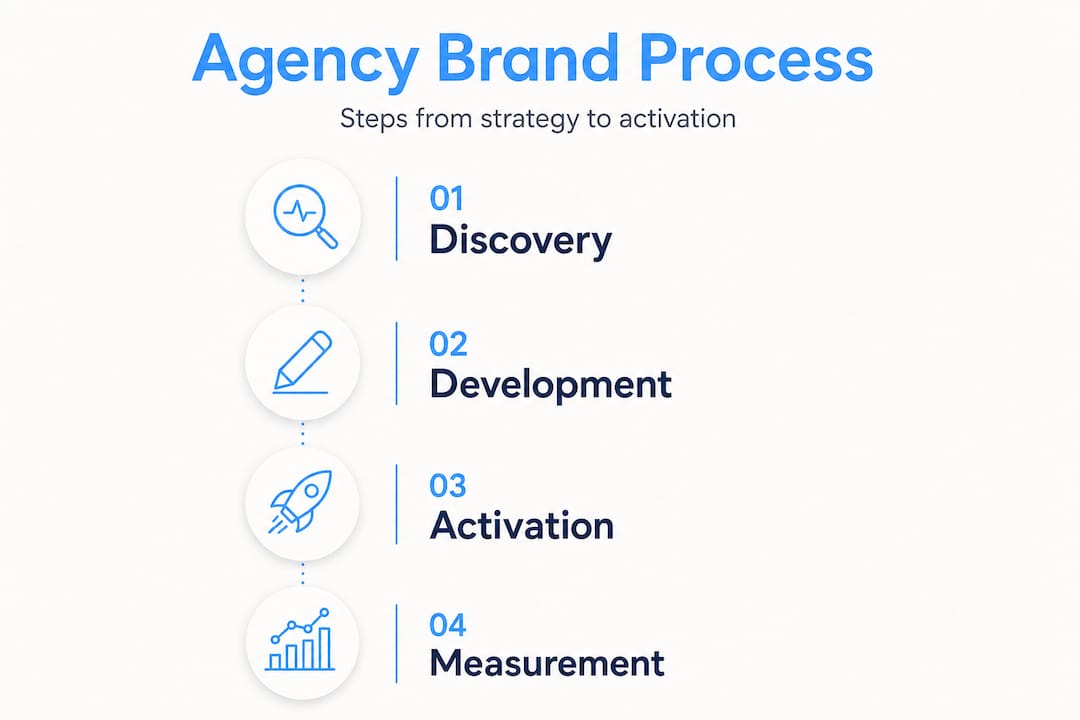
Activation. The brand is launched or relaunched across all relevant channels in a coordinated sequence. This includes digital platforms, physical environments, sales collateral, and any experiential touchpoints relevant to the audience. Exploring online brand strategies provides practical guidance on digital channel sequencing.
Measurement and optimisation. Brand health metrics and business KPIs are tracked on a defined cadence. Sentiment analysis, share of search movements, and conversion data are reviewed together to identify where the brand is gaining or losing traction.
Common agency deliverables across these stages include:
- Brand strategy document including positioning statement, messaging hierarchy, and tone of voice guidelines
- Visual identity system with comprehensive usage standards
- Digital brand guidelines optimised for web, social, and mobile environments
- Launch campaign creative for paid, owned, and earned media channels
- Brand health dashboard integrating perception metrics with business KPIs
- Quarterly brand performance review reports
Reviewing essential brand strategies and practical business growth advice from industry practitioners reinforces the importance of systematic deployment over ad hoc execution.
Pro Tip: Insist that your agency presents a measurement framework before creative work begins, not after the campaign launches. Agencies that tie creative output to measurable KPIs from the outset deliver significantly better commercial results than those who report on metrics retrospectively.
Why most branding advice falls short—and what actually works
Most branding advice you encounter online focuses on one of two things: making your brand look good, or growing your follower count. Neither of these objectives, pursued in isolation, generates sustainable commercial value. This is the uncomfortable truth that most guides omit.
Fixating on design alone produces organisations with beautiful brands that nobody chooses. Fixating on social metrics produces organisations with large audiences that generate minimal revenue. The businesses that build genuinely powerful brands do something different. They align strategy, architecture, and measurement into a single system where each element reinforces the others.
Research is unambiguous on this point. Combining digital brand equity constructs with business KPIs consistently leads to more effective brand-building than either approach in isolation. Yet the majority of agencies still present brand performance dashboards that are dominated by engagement metrics with no direct line to revenue.
What this means practically is that you need to demand more from any agency you engage. Ask them how they measure share of search. Ask them how sentiment data is integrated with your sales pipeline. Ask them which specific brand metrics have a demonstrated correlation with customer acquisition cost in your category. Agencies that cannot answer these questions confidently are optimising for presentation rather than performance.
The other gap in conventional branding advice is the undervaluation of brand architecture. Most small to mid-sized businesses have never formally mapped their brand structure, yet the decisions they make intuitively about how products and services are named, grouped, and communicated have enormous consequences for audience clarity and marketing efficiency. A well-structured brand architecture reduces confusion, focuses messaging, and significantly lowers the cost of introducing new offerings to existing customers.
Applying branding best practices with architecture and measurement as the foundation, rather than as afterthoughts, is what separates brands that grow from brands that simply exist.
Partner with a brand building agency for results that last
Cloudfusion delivers end-to-end branding services that connect strategy, creative execution, and business performance into a single integrated approach. Whether you are repositioning an established organisation or building a brand from the ground up, the focus is always on measurable outcomes, not aesthetics alone. Cloudfusion’s expertise extends across custom web development and digital infrastructure, ensuring your brand is activated consistently across every platform your audience encounters. From strategy workshops and identity design through to website deployment and web hosting packages that keep your digital presence performing at scale, Cloudfusion provides the full-service capability that growing businesses require. Contact the team today to start with a review of your current brand and a clear-eyed assessment of where the strategic opportunities lie.
Frequently asked questions
What makes a strong brand building agency?
Top agencies blend strategy, creative services, and advanced measurement to connect brand identity with real business results, with the best approaches combining digital brand equity constructs with business KPIs for demonstrably better outcomes.
How do agencies measure brand-building success today?
They use metrics like share of search, brand sentiment, and digital awareness because current digital-only metrics are inadequate and these constructs provide a far more accurate picture of true brand equity than social followers or likes.
What is brand architecture and why does it matter?
Brand architecture is how parent and sub-brands are structured to clarify offerings and strengthen audience connection, and architecture decisions can materially affect how offerings are categorised, communicated, and ultimately chosen by customers.
Why shouldn’t I focus only on the logo or visuals?
Focusing only on visuals misses strategic alignment and measurement, since current digital metrics alone are inadequate and true brand value requires combining design with business KPIs and advanced perception constructs.
How can a brand building agency grow my business?
A skilled agency structures your brand, activates it across channels, and ties every creative decision to growth metrics, with best practice frameworks combining architecture, multi-channel strategy, and business KPIs to generate sustainable commercial performance.
Recommended