TL;DR:
- Choosing the right custom software agency is essential for strategic alignment, governance, and long-term success.
- A qualified agency manages the entire project lifecycle, focusing on structured processes, data governance, and adaptable delivery methods.
- Effective evaluation relies on assessing process maturity, strategic fit, proven outcomes, and the agency’s capacity to support evolving business needs.
Most organisations assume that assembling a team of skilled developers is the primary determinant of custom software success. That assumption is costly. The agency you choose shapes not only the quality of the code produced, but the alignment of technology to your business strategy, the robustness of your governance model, and your organisation’s capacity to adapt as requirements evolve. This guide dismantles the “any developer will do” myth by walking business decision-makers through a structured, expert-informed framework for evaluating and selecting a custom software agency that genuinely drives operational efficiency and sustainable digital transformation.
Table of Contents
- Understanding what a custom software agency does
- Key criteria for evaluating a custom software agency
- Agile methodologies and best practices in custom software delivery
- Embedding AI and managing data in custom software solutions
- Strategic questions to ask before partnering with a custom software agency
- A seasoned perspective: What most decision-makers miss when hiring a custom software agency
- Connect with proven custom software experts
- Frequently asked questions
Key Takeaways
| Point | Details |
|---|---|
| Evaluate agency fit | Assess agencies on strategy, execution, and alignment with your business goals—not just coding skills. |
| Prioritize governance | Strong governance and process rigor prevent most delivery failures and drive sustainable success. |
| Demand agile quality | Emphasize agencies with agile, test-first practices and adaptability for ongoing improvements. |
| Address AI-specific risks | For AI projects, insist on structured data, clear guardrails, and early proof of value before scaling. |
| Ask strategic questions | Use targeted questions to reveal agency strengths, weaknesses, and true delivery capability upfront. |
Understanding what a custom software agency does
Now that the stakes are clear, it is essential to understand what sets custom software agencies apart from conventional development resources.
A custom software agency is not simply a group of developers for hire. It is a full-service delivery organisation that translates ambiguous business challenges into precisely architected, scalable technology solutions. Unlike off-the-shelf software vendors or generalist freelance developers, a custom agency manages the entire project lifecycle, from the initial discovery phase through to post-launch support and continuous improvement.
Understanding the full scope of what these agencies offer is critical, because you are not just procuring code. You are procuring a structured process, strategic thinking, and organisational capability. Explore business problems solved by custom software to understand why this distinction matters so profoundly for your bottom line.
Core capabilities you should expect from a qualified custom software agency include:
- Business discovery and requirements gathering: Translating operational challenges into documented, validated software requirements
- UX/UI design: Creating intuitive interfaces that reduce user friction and drive adoption
- Software architecture design: Defining system structure for scalability, security, and integration readiness
- Full-stack development: Building both client-facing and server-side components using appropriate technology stacks
- Quality assurance and testing: Applying test-first methodologies to reduce defects before deployment
- System integration: Connecting your custom solution with existing ERP, CRM, or third-party platforms
- Governance and change management: Maintaining oversight throughout the project lifecycle
- Deployment and ongoing support: Ensuring operational stability after go-live
Gartner frames the custom software development services vendor landscape using Magic Quadrant criteria of “Ability to Execute” and “Completeness of Vision.” This dual-axis framework is instructive. An agency that excels technically but lacks strategic vision will struggle to align its output with your long-term business direction. Both dimensions matter equally when selecting a partner.
Key criteria for evaluating a custom software agency
With a clear understanding of what custom software agencies offer, you can begin comparing vendors based on crucial evaluation criteria.
Delivery failures often stem from early alignment and governance issues rather than coding alone. This single insight should reframe how you conduct your evaluation. Technical capability is a baseline, not a differentiator. What separates high-performing agencies is how they govern projects, how they align to your strategy, and how mature their delivery processes are.
Use the following comparison framework to structure your evaluation:
| Evaluation criteria | What to assess | Why it matters |
|---|---|---|
| Process maturity | Documented delivery methodology, change management | Reduces risk of scope creep and project failure |
| Ability to execute | Portfolio quality, team experience, past timelines | Indicates delivery reliability and technical depth |
| Vision alignment | Strategic fit, understanding of your industry | Ensures technology decisions support long-term goals |
| Governance model | Reporting structure, escalation protocols | Protects investment and maintains accountability |
| Previous work | Case studies, client references, industry relevance | Validates claims and reduces selection risk |
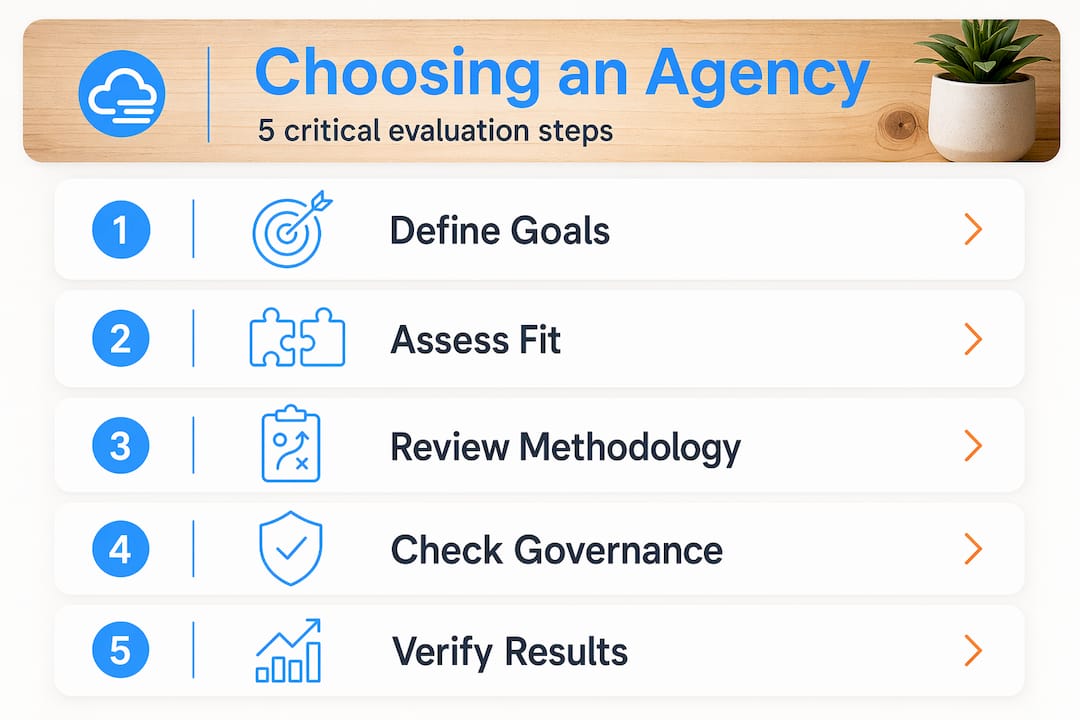
To apply this framework effectively, follow these steps:
- Request a written summary of the agency’s delivery methodology before any proposal is submitted
- Review at least three portfolio projects in detail, focusing on problem definition and measurable outcomes
- Ask each shortlisted agency to explain how they handled a project that did not go according to plan
- Evaluate responses to governance questions: who owns decisions, how are changes logged, and how are risks escalated?
- Assess cultural and strategic fit during initial meetings, not just technical credentials
Explore how custom software services drive efficiency and growth in practice, which provides useful context for what measurable outcomes should look like when a strong agency delivers on its commitments.
Pro Tip: When assessing technical credibility, ask specifically for evidence of test-first practices and modular architecture decisions in past projects. Agencies that prioritise these practices from day one tend to produce solutions that adapt well to changing requirements, reducing your total cost of ownership significantly.
Agile methodologies and best practices in custom software delivery
Once you have identified top agencies, the next layer of due diligence involves understanding how they approach delivery and quality.
Agile is no longer a differentiator. It is an expectation. What matters now is how an agency goes beyond the fundamentals of Scrum or Kanban to build delivery frameworks tailored to your specific project complexity, organisational culture, and risk profile.
Core Agile principles that your agency must demonstrate in practice:
- Delivering working software in short, frequent increments rather than large, infrequent releases
- Maintaining continuous collaboration between business stakeholders and the development team
- Responding to changing requirements even late in the development cycle
- Prioritising customer-facing value over technical perfection in isolation
- Conducting retrospectives to improve the team’s process on an ongoing basis
The limits of standard Scrum frameworks become apparent in complex enterprise projects. Agencies that rigidly apply a single methodology without adapting it to the project’s unique constraints often produce technically sound software that is strategically misaligned. The best agencies design their delivery approach around your organisation’s decision-making speed, governance requirements, and change tolerance.
Gartner’s Agile guidance emphasizes delivering working software frequently, test-first practices, and agile architecture. These three pillars are directly connected: frequent delivery keeps the product aligned to real business needs, test-first practices reduce defect debt, and agile architecture ensures the system can evolve without costly rewrites.
“Delivering working software frequently, combined with test-first development and adaptable architecture, is the foundation of sustainable software delivery.” — Gartner Agile Software Development guidance
If your future digital roadmap includes AI-powered capabilities, understanding how to drive business growth with custom AI web applications is valuable context when evaluating whether an agency’s Agile practices can support those ambitions. Additionally, the custom software guide for business efficiency in 2026 provides a broader strategic lens for understanding where process maturity fits into your transformation agenda.
Pro Tip: During agency interviews, ask for a concrete example of a time they adapted their delivery process mid-project to suit a client’s organisational constraints. How they answer reveals far more about their maturity than any methodology certification they hold.
Embedding AI and managing data in custom software solutions
Beyond core methodology, today’s digital projects often demand advanced AI and data capabilities that introduce new complexities and risks.

AI-enabled software is not simply more powerful software. It is fundamentally dependent on the quality, structure, and governance of the data feeding it. An agency that approaches AI as a feature to be added late in the development cycle will almost certainly deliver a solution that underperforms or introduces unacceptable operational risk.
Gartner Peer Community highlights that AI relies on clean, structured inputs, defined AI guardrails and data governance frameworks, protected data environments, and Proof of Concept (PoC) validation before full deployment. These are not optional enhancements. They are fundamental prerequisites for AI success.
Gartner’s top strategic trends for 2025 and beyond include embedding AI into the software engineering lifecycle “from design to deployment” and adding robust governance and security practices as core architectural concerns. This signals a significant shift: AI readiness must be designed into your solution from the outset, not bolted on after launch.
| AI and data best practice | What it means in practice | Red flag if absent |
|---|---|---|
| Structured data inputs | Data pipelines are clean, validated, and consistently formatted | AI outputs will be unreliable or misleading |
| Data governance framework | Clear ownership, access controls, and quality standards | Regulatory exposure and poor decision-making |
| Security architecture | Encryption, access management, and audit trails | Data breaches and compliance failures |
| PoC validation | Small-scale test before full commitment | Expensive failures discovered too late |
| Ongoing model monitoring | Post-deployment performance tracking | Degraded AI performance over time |
When evaluating agencies for AI-enabled projects, your checklist must include:
- Evidence that the agency conducts data readiness assessments before beginning AI development
- A defined approach to AI guardrails and ethical use policies
- Experience integrating AI features with existing enterprise data infrastructure
- Documented PoC methodology and how findings inform the full build decision
Understanding the importance of PoC in software procurement is particularly relevant here, as a well-structured proof of concept dramatically reduces investment risk on complex AI projects.
If your organisation is also grappling with the foundational layer of data quality, reviewing guidance on data management challenges in custom software will help you frame the right questions. And if AI-driven growth is a strategic priority, the perspective on AI website development for business growth offers useful strategic framing.
Strategic questions to ask before partnering with a custom software agency
Equipped with best practices, the last step is to ask the right questions during your agency selection process.
The way an agency responds to well-formed questions tells you more than any proposal document. Vague answers, deflection, or overconfidence in untested areas are warning signals that deserve careful consideration before you commit.
Essential questions every decision-maker should ask before signing:
-
How do you conduct your discovery and scoping process? Look for evidence of structured workshops, stakeholder mapping, and requirements validation. Agencies that skip or rush discovery almost always create misalignment that surfaces later as expensive change requests.
-
Can you walk us through your governance structure for a project of this complexity? You need clear answers about decision-making authority, change request management, escalation paths, and reporting cadence.
-
How do you approach test-first development and quality assurance? Strong agencies should describe specific practices like behaviour-driven development or automated regression testing, not simply assure you that “testing is important.”
-
How have you managed scope changes in previous projects? This question reveals process maturity. Look for structured change control rather than informal negotiation.
-
What is your approach to data governance and AI readiness? For custom software that includes AI, procurement should treat data governance, input quality, security, and validated PoCs as part of the core solution definition.
-
How do you structure your architecture to allow for future scalability and integration? The answer should reference modular design, API-first thinking, and clear documentation standards.
-
Can you provide references from clients in a similar industry or with comparable project complexity? Industry-specific experience accelerates discovery and reduces the risk of costly misunderstandings.
Knowing how to leverage the right tools for structured data inputs is also worth discussing with prospective agencies, particularly when your project involves complex data pipelines or AI-driven analytics. Finally, understanding how to unlock ROI with custom development services gives you a sharper lens for evaluating whether an agency’s pricing and scope genuinely maps to measurable business value.
A seasoned perspective: What most decision-makers miss when hiring a custom software agency
Before concluding, here is a candid perspective few guides share, shaped by real-world project outcomes.
Most technology project failures are not technical failures. They are alignment failures. The pattern repeats consistently: a business leader selects an agency based on an impressive portfolio and a competitive price, only to discover six months into the engagement that the agency built exactly what was specified, not what was actually needed. The specification, it turns out, was never properly interrogated.
The uncomfortable truth is that many organisations invest more energy evaluating developer credentials than they do understanding their own business requirements. You cannot expect an agency, no matter how skilled, to solve a problem that has not been clearly defined. The best agencies will push back, ask difficult questions, and slow the project down before it accelerates, because that discipline upfront is what prevents catastrophic misalignment later.
Treat your selection process as a strategic exercise, not a procurement exercise. The right agency should challenge your assumptions about what the software needs to do, not simply confirm them. If an agency’s initial response is to proceed immediately to a proposal without a meaningful discovery conversation, that is a significant red flag regardless of their technical reputation.
We have seen organisations improve business workflow dramatically not because they hired the most technically accomplished agency, but because they selected a partner who invested in understanding the operational context first. The technical excellence followed naturally from that foundation of genuine business understanding.
Selection is a strategic move. Treat it accordingly, and your investment will compound over time rather than erode under the weight of rework and misalignment.
Connect with proven custom software experts
Armed with clarity and actionable strategies, you are ready to take the next step in selecting an agency that drives real impact.
At Cloudfusion, we approach every engagement with the kind of structured discovery, governance rigour, and technical depth that this guide describes. Whether you are building a custom enterprise platform, integrating AI capabilities into your operations, or modernising legacy systems, our team brings both the strategic alignment and execution capability your project demands. Browse our custom web development portfolio to see how we have delivered measurable outcomes for businesses across industries. If your roadmap includes mobile-first solutions, explore our mobile app development capabilities to understand the full scope of what a committed digital partner can deliver.
Frequently asked questions
What makes a custom software agency different from ordinary developers?
Custom software agencies offer end-to-end expertise that extends well beyond writing code, including business discovery, process governance, UX design, and strategic alignment. Gartner evaluates vendors on both ability to execute and completeness of vision, reflecting that technical delivery and strategic direction are equally important dimensions.
Why is governance important when working with a custom software agency?
Strong governance establishes clear accountability, manages change effectively, and prevents the misalignment that most commonly causes project failure. Delivery failures stem from early alignment and governance breakdowns rather than technical shortcomings, making this a priority from day one.
How should we approach selecting an agency for projects with embedded AI?
For AI projects, your evaluation must prioritise structured data readiness, defined governance frameworks, and a mandatory proof of concept before full build commitment. AI relies on structured inputs and validated PoCs, and agencies that cannot demonstrate this discipline should not be trusted with AI-enabled projects.
What are some red flags when evaluating a custom software agency?
Key red flags include skipping or rushing discovery, providing vague answers about testing or data governance, lacking relevant industry experience, and presenting a proposal without first understanding your business context in depth.
How do agencies ensure adaptability for changing business needs?
High-performing agencies design adaptability into the project from the start, using Agile delivery frameworks, test-first development, and modular architectures that support iterative change. Gartner’s Agile guidance emphasises adaptability and test-first practices as foundational to sustainable software delivery.
Recommended