Most landing pages fail to convert because they miss the mark with their intended audience. For any South-African business aiming to stand out online, knowing exactly who you want to reach is non-negotiable. When you tailor your strategy to clear goals and audience needs, results quickly follow. With the right steps, you can turn basic web traffic into real customers and unlock a pathway to measurable growth.
Table of Contents
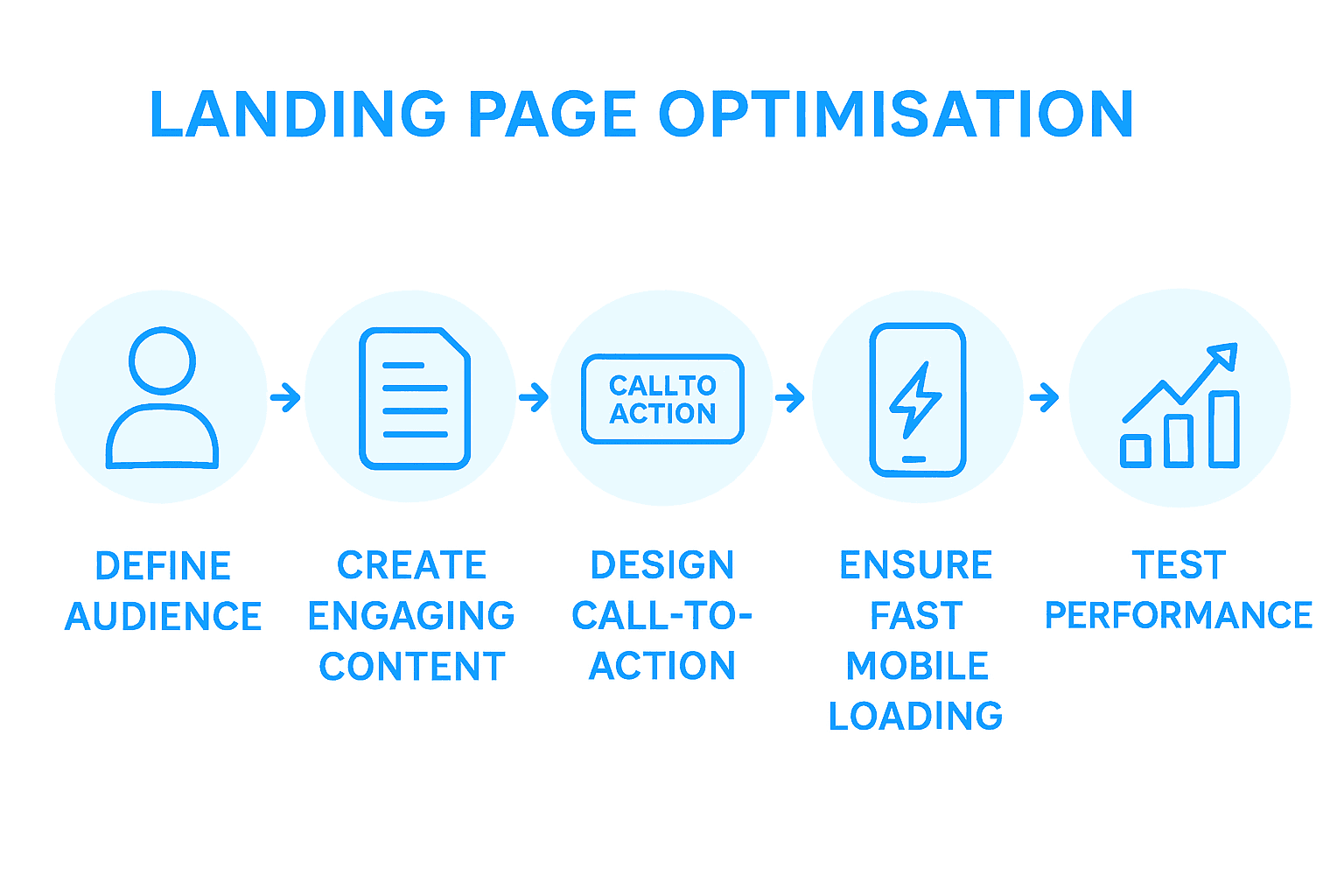
- Step 1: Define Target Audience And Goals
- Step 2: Craft Compelling Page Content And Layout
- Step 3: Implement Persuasive Calls-To-Action
- Step 4: Optimise Loading Speed And Mobile Responsiveness
- Step 5: Test And Measure Landing Page Performance
Quick Summary
| Key Point | Explanation |
|---|---|
| 1. Define Audience Persona | Create a detailed profile of your ideal customers, including their challenges and motivations, to enhance targeting on your landing page. |
| 2. Use Compelling Content and Design | Develop engaging headlines and visuals that communicate your value proposition clearly and guide users to take action. |
| 3. Implement Strong Calls-to-Action | Design call-to-action buttons that are visually appealing and include action-oriented language to prompt user engagement. |
| 4. Ensure Mobile Responsiveness | Optimize your landing page for mobile devices to maintain functionality and user satisfaction across different platforms. |
| 5. Continuously Test Performance | Regularly conduct A/B tests and utilize analytics to refine your landing page based on real user behaviour and preferences. |
Step 1: Define target audience and goals
Understanding your target audience is like creating a precise roadmap for your landing page’s success. When you craft content specifically for a defined audience, you dramatically increase the chances of converting visitors into customers.
Start by developing a comprehensive audience persona that goes beyond basic demographics. Consider their pain points, desires, professional challenges, and online behaviour. Ask yourself: Who exactly are you trying to reach? What specific problems does your product or service solve for them? Research their typical online interactions, preferred communication styles, and decision making patterns. This means diving deep into understanding not just who they are, but how they think and what motivates their choices.
To crystallise your goals, create specific measurable outcomes. Instead of vague aspirations like “increase sales,” define precise targets such as “generate 50 qualified leads per month” or “achieve a 25% conversion rate from landing page visitors.” By focusing on the audience’s core needs and preferences, you transform your landing page from a generic information display into a targeted conversion engine.
Pro tip: Create a one-page audience persona document with crystal clear details about your ideal customer, including their job role, primary challenges, and specific goals they want to achieve.
Step 2: Craft compelling page content and layout
Creating a landing page that captures attention and drives conversions requires a strategic blend of compelling content and intuitive design. Your goal is to craft an experience that immediately speaks to your target audience and guides them seamlessly towards taking action.
Start by developing powerful headlines and visual elements that engage visitors. Your headline should communicate the core value proposition within seconds, using clear language that resonates with your audience’s specific needs. Complement this with high-quality images that are not just decorative but actually illustrate your product or service’s benefits. Visual appeal plays a critical role in capturing visitors’ attention, so invest time in selecting graphics that are professional, relevant, and emotionally compelling.
Structure your content using a logical flow that guides users through a narrative. Begin with a strong opening that addresses their primary pain point, then gradually introduce your solution. Use concise paragraphs, break up text with subheadings, and ensure plenty of white space to prevent overwhelming visitors. Your form should be simple and prominent, asking only for essential information. Include trust signals like client testimonials, security badges, and clear value propositions to reduce potential friction and increase credibility.
Pro tip: Conduct A/B testing on different headline variations, imagery, and layout designs to continuously refine your landing page’s performance and understand what resonates most with your target audience.
Step 3: Implement persuasive calls-to-action
Creating a powerful call-to-action represents the critical moment where visitor interest transforms into actual engagement. Your call-to-action is the bridge between curiosity and conversion.
Effective calls-to-action must be strategically designed to guide visitors toward specific actions. They should be visually striking yet clear and concise, using action-oriented language that creates a sense of urgency and value. Think beyond generic phrases like “Click Here” and craft messages that speak directly to the user’s motivations such as “Get My Free Consultation” or “Unlock Exclusive Insights.” Position your call-to-action prominently where visitors naturally pause and consider their next step typically above the page fold and surrounded by sufficient white space to draw maximum attention.

Designing user-friendly form interfaces and compelling headlines plays a crucial role in supporting your call-to-action. The surrounding context should build anticipation and reinforce the value proposition. Use contrasting colours that stand out from your page design, ensure the button is large enough to be easily tapped on mobile devices, and maintain consistent messaging that aligns with the expectations you’ve set in your page content. Remember that your call-to-action is not just a button but a psychological trigger that must overcome a visitor’s natural hesitation.
Pro tip: Create multiple variations of your call-to-action and conduct split testing to determine which specific wording, colour, and placement generates the highest conversion rates for your target audience.
Step 4: Optimise loading speed and mobile responsiveness
Mobile responsiveness and rapid loading times are no longer optional extras but critical components of a successful landing page. Your website’s performance directly impacts user experience, search engine rankings, and ultimately your conversion rates.
Optimising website performance requires strategic content reduction and efficient media management. Start by compressing images without sacrificing quality using tools that can reduce file sizes by up to 70%. Eliminate unnecessary scripts and plugins that slow down your page loading, and leverage browser caching to store static elements locally. Focus on minimising HTTP requests by combining CSS and JavaScript files, and consider using lightweight frameworks that prioritise speed and efficiency.
Responsive web design demands a comprehensive approach to mobile user experience. Implement a mobile-first design strategy where your layout adapts seamlessly across different screen sizes. Utilise flexible grid systems, responsive images, and media queries to ensure your content looks crisp and functions perfectly on smartphones, tablets, and desktop computers. Pay special attention to touch targets making buttons and interactive elements large enough for comfortable mobile interaction. Test your landing page rigorously across multiple devices and network conditions to guarantee a consistent, smooth experience for every potential customer.
Pro tip: Use free performance testing tools like Google PageSpeed Insights to regularly audit your landing page and identify specific areas for speed and responsiveness improvement.
Step 5: Test and measure landing page performance
Measuring your landing page’s performance is the critical final step that transforms your design from a static webpage into a dynamic conversion machine. Understanding how visitors interact with your page provides invaluable insights for continuous improvement.
A/B testing offers a systematic approach to understanding landing page effectiveness. Create two versions of your landing page with a single variable changed such as headline wording, button colour, or image placement. Split your traffic between these versions and track key metrics like click-through rates, time on page, and conversion percentages. Use robust analytics tools to collect precise data and identify which version performs better. Statistical significance is crucial here dont make decisions based on minimal sample sizes or short testing periods.
Landing page tests provide critical validation for your marketing hypotheses. Track metrics beyond simple conversion rates such as bounce rate, scroll depth, and user engagement. Google Analytics and specialised conversion tracking tools can help you understand user behaviour in granular detail. Pay attention to how different audience segments interact with your page look for patterns in age groups, device types, and traffic sources. This data allows you to create increasingly targeted and effective landing pages that speak directly to your ideal customers needs and motivations.
Pro tip: Implement a continuous testing cycle where you regularly run small experiments and incrementally improve your landing page based on real user data and behaviour.
Below is a comparison of two common landing page optimisation methods:
| Method | Approach | Suitable Use Case | Potential Drawback |
|---|---|---|---|
| A/B Testing | Compare two variations at a time | Testing specific elements | Requires substantial traffic volume |
| Multivariate | Test multiple elements simultaneously | Analysing complex interactions | Can be challenging to interpret |
Here’s a summary of key elements essential for a high-converting landing page:
| Element | Purpose | Business Impact |
|---|---|---|
| Audience Persona | Identify target customers and their motivations | Improves message relevance |
| Compelling Headlines | Capture attention and communicate main benefits | Increases visitor engagement |
| Persuasive Call-to-Action | Direct users towards taking a specific action | Boosts conversion rates |
| Mobile Responsiveness | Ensure functionality on all device types | Expands reach and satisfaction |
| Performance Testing | Validate versions and optimise user experience | Drives continuous improvement |
Unlock Higher Conversions with Expert Landing Page Solutions
Optimising landing pages for higher conversions means addressing challenges like defining your target audience, crafting compelling content, and creating persuasive calls-to-action that drive results. If you struggle with slow loading speeds or poor mobile responsiveness, your visitors may leave before engaging fully. The article highlights crucial goals such as improving message relevance, increasing visitor engagement, and boosting conversion rates through continuous testing and strategic design.
At Cloud Fusion, we specialise in delivering custom web development and design services tailored to your business needs. We help you build landing pages that not only capture attention quickly but also guide your visitors smoothly towards taking action. Our expertise ensures your site is fast, mobile-friendly and aligned with your audience’s motivations for maximum impact. Explore how our web design and development solutions can transform your online presence and convert browsers into loyal customers.
Ready to elevate your landing page performance? Visit Cloud Fusion’s landing page service now for a personalised quotation and start optimising your digital success today.
Frequently Asked Questions
How can I define my target audience for my landing page?
To define your target audience, create a detailed audience persona that includes their challenges, needs, and online behaviours. Focus on understanding their motivations and how your product or service solves their specific problems.
What elements should I include in my landing page to drive higher conversions?
Essential elements for high conversions include compelling headlines, persuasive calls-to-action, and trust signals like testimonials. Structure your content clearly and ensure a visually appealing layout to engage visitors immediately.
How do I create effective calls-to-action for my landing page?
Craft calls-to-action that are action-oriented and highlight the value they’ll provide, such as “Get My Free Consultation”. Place these prominently in your layout where visitors are likely to notice them and A/B test different phrases to see which performs best.
What are the best practices to improve loading speed on my landing page?
To improve loading speed, optimise images by compressing them, reduce unnecessary scripts, and leverage browser caching. Aim for a loading time of under three seconds to enhance user experience and boost conversion rates.
How can I measure the performance of my landing page effectively?
Use A/B testing to compare different versions of your landing page by changing one element at a time. Track key metrics like click-through rates and conversion percentages to gather insights and continuously optimise your page.
Why is mobile responsiveness important for my landing page?
Mobile responsiveness ensures that your landing page functions well on all devices, enhancing user experience and accessibility. Adopt a mobile-first design approach to cater to users on smartphones and tablets, improving overall engagement and conversion rates.
Recommended