

How to Secure Customer Data for IT Managers Globally
Learn how to secure customer data with practical, step-by-step actions designed for IT managers. Protect data and ensure global compliance effectively.
Start reading
Every IT manager faces constant pressure to defend customer data from increasingly sophisticated cyber attacks. The challenge goes beyond simple software updates, demanding a deep understanding of your systems and regulatory obligations. By focusing on a thorough risk analysis and reinforcing each layer of your security approach, you can build stronger defences and demonstrate your commitment to global data protection standards.
Table of Contents
- Step 1: Assess Current Data Security Measures
- Step 2: Implement Robust Access Controls
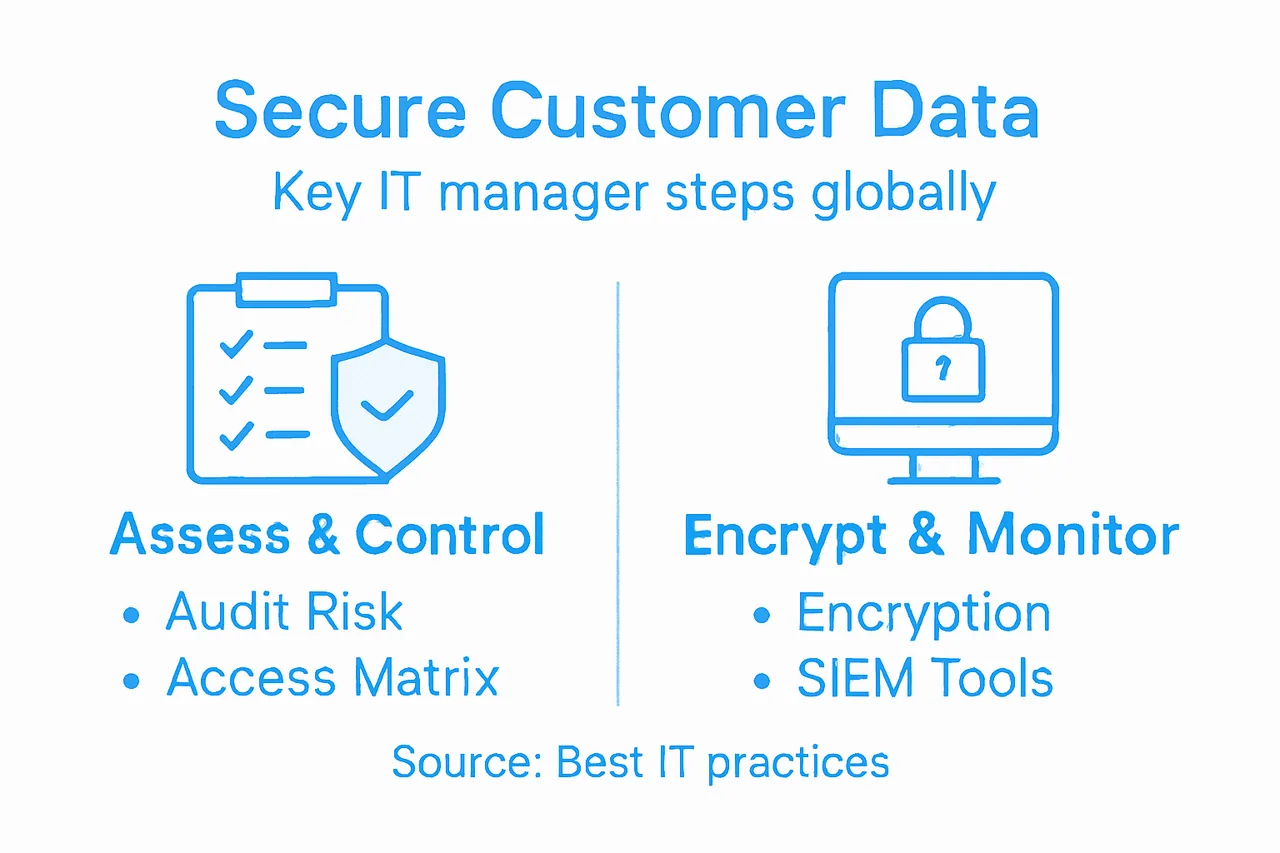
- Step 3: Apply Advanced Encryption Methods
- Step 4: Monitor Systems for Suspicious Activity
- Step 5: Verify Compliance with Regulations
Quick Summary
| Key Insight | Explanation |
|---|---|
| 1. Conduct a Comprehensive Security Assessment | Regularly evaluate your existing security measures to identify vulnerabilities and improve data protection strategies. |
| 2. Implement Robust Access Controls | Establish clear user permissions and authentication protocols to prevent unauthorized access to sensitive data. |
| 3. Apply Advanced Encryption Methods | Use sophisticated encryption strategies for data in transit and at rest to safeguard customer information. |
| 4. Monitor Systems for Suspicious Activity | Continuously monitor network activities to detect unusual behaviours and potential threats before they escalate. |
| 5. Verify Compliance with Regulations | Ensure adherence to data protection regulations through regular audits and updates to maintain lawful data handling. |
Step 1: Assess Current Data Security Measures
Successfully securing customer data begins with a thorough assessment of your existing security infrastructure. This critical first step helps IT managers understand potential vulnerabilities and develop targeted strategies to strengthen data protection.
To conduct a comprehensive security assessment, start by performing a detailed risk analysis across your organisation’s data ecosystem. This involves systematically examining how customer data is collected, stored, transmitted, and managed. Cybersecurity best practices recommend several key evaluation techniques:
- Map all data storage locations and access points
- Identify current encryption methods for data at rest and in transit
- Review access control mechanisms and user authentication protocols
- Assess existing software and hardware security configurations
- Document potential vulnerabilities in current systems
When evaluating your security measures, focus on understanding the complete data lifecycle management strategy. This means examining how data moves through your organisation from creation to deletion. Key considerations include:

Here’s a summary of key assessment areas and their impact on data security:
| Assessment Focus | Purpose | Business Impact |
|---|---|---|
| Data Flow Mapping | Identify all data movement paths | Reveals hidden vulnerabilities |
| Access Controls Review | Evaluate user and admin permissions | Helps prevent unauthorised access |
| Encryption Methods | Check protection for data at rest/in transit | Reduces risk of data breaches |
| Backup & Recovery | Ensure resilience of stored data | Minimises downtime after incidents |
| Secure Deletion | Verify data destruction processes | Prevents post-deletion recovery attempts |
- Classify data based on sensitivity levels
- Determine clear data ownership and governance protocols
- Minimise unnecessary data collection
- Implement robust backup and recovery procedures
- Establish secure data deletion processes
Comprehensive security assessment is not a one-time event but a continuous process of monitoring, updating, and improving your organisation’s data protection strategies.
Pro tip: Conduct a quarterly security audit to ensure your data protection measures remain current and effective against emerging cyber threats.
Step 2: Implement Robust Access Controls
Securing customer data requires establishing comprehensive access control mechanisms that limit and monitor who can view, modify, or interact with sensitive information. By implementing strategic access controls, IT managers can significantly reduce the risk of unauthorised data exposure and potential security breaches.
To develop robust access controls, start by implementing identity management protocols that define clear user permissions and authentication requirements. This involves creating a systematic approach to managing digital identities within your organisation:
- Define user roles with specific access levels
- Establish granular permission settings for different data types
- Implement multi-factor authentication (MFA)
- Create unique user credentials for each team member
- Set up automatic access revocation for terminated employees
Effective access control strategies require ongoing management and regular review. Your approach should include:
Compare types of access control and their strengths:
| Access Control Type | Main Feature | Best Use Case |
|---|---|---|
| Role-Based Access (RBAC) | Assigns permissions by role | Large teams with distinct functions |
| Attribute-Based Access | Uses user data attributes | Dynamic permissions for complex needs |
| Discretionary (DAC) | Owner decides permissions | Flexible control in small groups |
| Mandatory (MAC) | Policy-based restrictions | Highly sensitive environments |
- Conduct periodic access audits
- Monitor user login activities and access patterns
- Implement real-time access tracking
- Use role-based access control (RBAC) principles
- Develop clear policies for temporary and permanent access changes
Access control is not about restricting users but about enabling secure, efficient data management while protecting sensitive information.
Pro tip: Develop a comprehensive access management matrix that automatically flags unusual access patterns or potential security anomalies.
Step 3: Apply Advanced Encryption Methods
Protecting customer data requires implementing sophisticated encryption strategies that safeguard information across multiple platforms and transmission channels. Advanced encryption transforms sensitive data into unreadable formats, ensuring that even if unauthorised parties intercept the information, they cannot comprehend its contents.
Begin by implementing robust cybersecurity protocols that cover encryption for data both in transit and at rest. Your encryption strategy should encompass multiple layers of protection:
- Select industry-standard encryption algorithms
- Implement end-to-end encryption for all data transfers
- Use strong encryption keys with complex generation methods
- Rotate encryption keys periodically
- Maintain secure key management infrastructure
Your comprehensive encryption approach should address different data scenarios:
- Encrypt data during transmission using TLS protocols
- Apply AES encryption for stored data
- Use different encryption standards for various data sensitivity levels
- Implement database-level encryption
- Secure backup systems with equivalent encryption standards
Effective encryption is not just a technical requirement but a fundamental trust mechanism between your organisation and its customers.
Pro tip: Regularly conduct independent encryption audits to verify the integrity and effectiveness of your encryption mechanisms.
Step 4: Monitor Systems for Suspicious Activity
Detecting potential security threats requires continuous, comprehensive system monitoring that identifies and responds to unusual network behaviours before they escalate into significant data breaches. Proactive surveillance is your first line of defence in protecting customer information from sophisticated cyber threats.
Cybersecurity monitoring strategies should encompass multiple layers of technological and analytical approaches. Implement a robust monitoring framework that includes:
- Deploy advanced intrusion detection systems (IDS)
- Establish real-time log analysis mechanisms
- Configure automated alert systems
- Track user and system behaviour patterns
- Monitor network traffic for anomalous activities
Your comprehensive monitoring approach should follow these systematic steps:
- Set baseline performance and security metrics
- Implement continuous network scanning
- Create detailed incident response protocols
- Use machine learning for anomaly detection
- Conduct regular security penetration testing
Effective system monitoring is not just about detecting threats, but understanding the evolving landscape of potential cybersecurity risks.
Pro tip: Invest in integrated security information and event management (SIEM) tools that provide centralised, comprehensive threat visibility across your entire digital infrastructure.
Step 5: Verify Compliance with Regulations
Ensuring regulatory compliance is a critical responsibility for IT managers who handle customer data across diverse international legal landscapes. Navigating the complex web of data protection regulations requires a systematic and thorough approach to verify that your organisation meets all necessary legal requirements.
Understand the nuanced requirements for international data transfer regulations to maintain legal and secure data management. Your compliance verification strategy should encompass:
- Map applicable regional data protection laws
- Conduct comprehensive legal compliance audits
- Document data transfer and storage processes
- Maintain detailed risk assessment records
- Implement region-specific data handling protocols
Your comprehensive compliance verification process should include:
- Identify all relevant regulatory frameworks
- Create a compliance tracking system
- Develop standardised documentation templates
- Establish regular internal compliance reviews
- Train staff on regulatory requirements
Compliance is not a one-time checklist but a continuous commitment to protecting customer data and maintaining organisational integrity.
Pro tip: Develop a centralised compliance management dashboard that provides real-time tracking of regulatory requirements across different jurisdictions.
Strengthen Your Customer Data Security with Tailored Digital Solutions
Securing customer data is no easy task for IT managers faced with complex data lifecycles, advanced encryption requirements and strict regulatory compliance. The challenges of implementing risk analysis, robust access controls and continuous system monitoring demand customised and scalable digital infrastructure that keeps your organisation ahead of evolving cyber threats. If the thought of maintaining encryption key management or enforcing multi-factor authentication concerns you, you are not alone.
At CloudFusion, we understand these critical pain points and offer bespoke web development and design services designed to integrate advanced security features seamlessly into your digital platforms. Our expertise in custom software solutions coupled with cloud-based hosting ensures your data remains protected with industry best practices. Take control of your data protection strategy and comply confidently with international laws by partnering with a technology provider committed to innovation and security.
Ready to transform your digital infrastructure with trusted, scalable security measures tailored to your needs? Explore how CloudFusion can help safeguard your customer data and elevate your business performance today. Visit our web design and development quotation page and start securing your future now.
Frequently Asked Questions
How can I assess the current data security measures in my organisation?
To assess your current data security measures, perform a risk analysis across your organisation’s data ecosystem. Map all data storage locations, identify encryption methods, and review access controls, aiming to have this initial assessment completed within 30 days.
What are the best practices for implementing access controls for customer data?
Establish comprehensive access controls by defining user roles and permission settings, and implement multi-factor authentication. Review these access controls regularly, ideally on a quarterly basis, to ensure only authorized personnel have access to sensitive information.
How can I effectively encrypt customer data?
To effectively encrypt customer data, use industry-standard encryption algorithms for both data at rest and in transit. Implement end-to-end encryption for all data transfers and re-evaluate your encryption practices every six months to maintain security.
What methods can I employ to monitor systems for suspicious activity?
Deploy advanced intrusion detection systems and implement real-time log analysis to continuously monitor for unusual activity on your systems. Establish a clear incident response protocol, and conduct a review of your monitoring systems every few months to ensure effectiveness.
How do I ensure compliance with international data protection regulations?
To ensure compliance, identify all relevant data protection laws that apply to your organisation, and conduct regular compliance audits. Develop a compliance tracking system to address these regulations, reviewing it every quarter to adapt to any regulatory changes.