TL;DR:
- Modern mobile design is accessible, costs less, and delivers measurable ROI for all business sizes.
- Prioritize user-centric design and continuous optimization to increase retention, engagement, and trust.
- Choosing the right frameworks and maintaining ongoing performance and security are critical for success.
Many business leaders assume that building a powerful mobile solution requires enormous budgets, months of delays, or an in-house engineering team the size of a small department. That assumption is costing enterprises real competitive ground. Modern mobile design and development has evolved into a structured, accessible discipline that delivers measurable ROI for businesses of every scale, from agile startups to established enterprises. This guide breaks down the process, the technology choices, the user experience principles, and the performance standards that separate good mobile solutions from transformative ones. If mobile is not yet central to your digital strategy, the following sections will change how you think about it.
Table of Contents
- Why mobile design and development matters for business
- The mobile design and development process explained
- Choosing the right frameworks and technologies
- Critical factors for outstanding user experience
- Optimizing mobile app performance and security
- Our perspective: Why a user-first mindset beats flashy features
- Scale your growth with expert mobile design and development
- Frequently asked questions
Key Takeaways
| Point | Details |
|---|---|
| Mobile-first drives growth | Prioritizing mobile design and development accelerates user engagement and sets businesses apart from competitors. |
| Framework choice matters | Selecting native, hybrid, or cross-platform technology directly impacts costs, speed, and long-term success. |
| User experience is crucial | Focusing on intuitive, accessible experiences boosts retention and satisfaction for mobile users. |
| Continuous improvement pays off | Regular updates and optimizations keep mobile solutions secure, high-performing, and aligned with user needs. |
Why mobile design and development matters for business
The shift to mobile-first digital experiences is not a trend. It is a structural change in how customers, employees, and partners interact with businesses. Across retail, financial services, healthcare, and logistics, users now expect seamless, fast, and intuitive mobile interactions as a baseline, not a differentiator. Businesses that fail to meet this expectation lose users to competitors who do.
Effective mobile design solves three persistent business challenges. First, it drives user retention by reducing friction at every touchpoint, making it easier for customers to complete purchases, access services, or engage with content. Second, it increases revenue by shortening the path from intent to transaction. Third, it streamlines internal processes by giving teams mobile tools that reduce manual effort and accelerate decision-making.
The numbers are compelling. Mobile app engagement data shows that companies leveraging modern mobile apps gain up to 35% more user engagement, a figure that translates directly into measurable business outcomes. This is not reserved for large enterprises. Startups and mid-sized businesses are capturing the same gains by investing in well-designed, purpose-built mobile solutions.
Beyond engagement metrics, mobile design shapes brand perception. A polished, responsive app signals credibility and operational maturity. A clunky or outdated mobile experience, by contrast, erodes trust faster than almost any other digital touchpoint. Users form opinions within seconds of opening an app, and those opinions are sticky.
“Mobile apps are vital for engaging users and driving business growth.” The businesses winning in their categories are those treating mobile design as a strategic asset, not an afterthought.
Key business benefits of investing in mobile design and development:
- Higher customer retention through frictionless user journeys
- Increased conversion rates from streamlined purchase and service flows
- Stronger brand differentiation in competitive markets
- Improved operational efficiency through mobile-enabled internal tools
- Richer data collection for informed business decisions
Pro Tip: Prioritise seamless user flows from the onboarding screen onwards. Users who struggle in the first 60 seconds rarely return, so the onboarding experience is your highest-leverage retention investment.
Now that you understand the business stakes, let’s demystify the process behind effective mobile solutions.
The mobile design and development process explained
Building a mobile solution that delivers on its business promise requires more than writing code. It demands a disciplined process that aligns technical execution with strategic intent at every stage. Understanding this process equips you, as a decision-maker, to ask the right questions, set realistic expectations, and protect your investment.
The mobile app process explained follows a clear sequence that, when executed well, ensures projects deliver on time and meet defined business goals. Here are the core stages:
- Discovery and strategy — Define the problem, identify target users, map competitive context, and establish measurable success criteria. Your role here is to articulate vision and business requirements with precision.
- UX/UI design — Translate strategy into wireframes, prototypes, and visual designs. This is where user flows, information architecture, and brand identity converge.
- Development — Engineers build the front-end interface and back-end logic, integrating APIs, databases, and third-party services as required.
- Quality assurance and testing — Rigorous testing across devices, operating systems, and network conditions to identify and resolve defects before launch.
- Deployment — Release to app stores or enterprise distribution channels, with monitoring configured from day one.
- Ongoing optimisation — Post-launch analytics, user feedback loops, and iterative improvements that continuously raise performance and engagement.
Agile methodology underpins most modern mobile projects. Rather than delivering everything at once after months of development, agile teams release in short cycles called sprints, typically two weeks long. This approach gives you regular visibility into progress, enables course corrections before they become costly, and allows ROI tracking from early in the project lifecycle.
Your involvement does not end at the brief. Business leaders who stay engaged through design reviews and user testing sessions consistently see better outcomes than those who hand off and wait for a finished product.
Pro Tip: Involve real users in prototype testing before a single line of production code is written. Discovering a navigation flaw at the wireframe stage costs a fraction of what it costs to fix after development.
Choosing the right frameworks and technologies
After understanding the process, the next critical step is making technology choices that align with your business vision. The framework and technology stack you select will shape your app’s performance, development cost, time to market, and long-term maintainability. Getting this decision right requires clarity on your priorities.
Top app frameworks vary significantly in how they balance performance, cost, and flexibility. The three primary approaches are native, hybrid, and cross-platform development.

| Approach | Best for | Key advantage | Key trade-off |
|---|---|---|---|
| Native (iOS/Android) | High-performance, feature-rich apps | Maximum performance and platform integration | Higher cost, separate codebases |
| Hybrid | Rapid prototyping, budget-conscious builds | Faster development, single codebase | Limited access to device features |
| Cross-platform (React Native, Flutter) | Scalable enterprise apps | Near-native performance, shared codebase | Some platform-specific customisation needed |
Factors that should drive your framework decision include:
- Budget and timeline — Cross-platform frameworks reduce development time and cost significantly compared to maintaining two native codebases.
- User base — If your users are split evenly between iOS and Android, cross-platform is often the most efficient path.
- Existing infrastructure — Your current back-end systems, APIs, and cloud environment influence which frameworks integrate most cleanly.
- Future scalability — Choose a stack that your development team can maintain and extend as your business grows.
The app vs website comparison is equally important. Mobile apps excel when you need offline functionality, push notifications, or deep device integration. Mobile websites are more appropriate when broad accessibility and lower initial investment are the priorities. Many enterprises benefit from both, serving different user segments through each channel.
For deeper context on the mobile app development insights shaping framework choices in 2026, the landscape increasingly favours cross-platform solutions for their balance of quality and efficiency.
Critical factors for outstanding user experience
Now that you have chosen the technology foundation, the real differentiator is the quality of user experience. Technology is the vehicle. User experience is what determines whether users stay, return, and advocate for your product.
User-friendly mobile apps consistently demonstrate that user-centric design is directly linked to higher engagement and retention. The principles that separate outstanding apps from forgettable ones are not complex, but they require disciplined application.
| UX principle | Business impact | Common failure |
|---|---|---|
| Simplicity | Faster task completion, lower abandonment | Too many features on one screen |
| Accessibility | Broader user reach, regulatory compliance | Small text, poor colour contrast |
| Speed | Higher retention, lower bounce rates | Unoptimised images, excessive API calls |
| Clear navigation | Reduced support costs, higher satisfaction | Inconsistent menu structures |
Top pitfalls to avoid in mobile UX design:
- Cluttered interfaces that overwhelm users with too many choices simultaneously
- Slow load times caused by uncompressed assets or inefficient data fetching
- Inconsistent navigation patterns that force users to relearn interactions across screens
- Neglecting accessibility standards, which excludes users and creates legal exposure
- Ignoring platform-specific design conventions that users expect on iOS versus Android
For teams serious about mobile design mastery, the most important discipline is treating user feedback as a continuous input, not a one-time validation exercise. The apps that sustain high engagement are those that iterate relentlessly based on real usage data.
Pro Tip: Instrument your app with analytics from launch day. Knowing exactly where users drop off in a flow is worth more than any amount of internal opinion about what users want.
Optimizing mobile app performance and security
Even with a stellar user experience, excellence depends on continuous optimisation for speed and safety. Performance and security are not launch-day checkboxes. They are ongoing operational disciplines that protect your users, your data, and your business reputation.
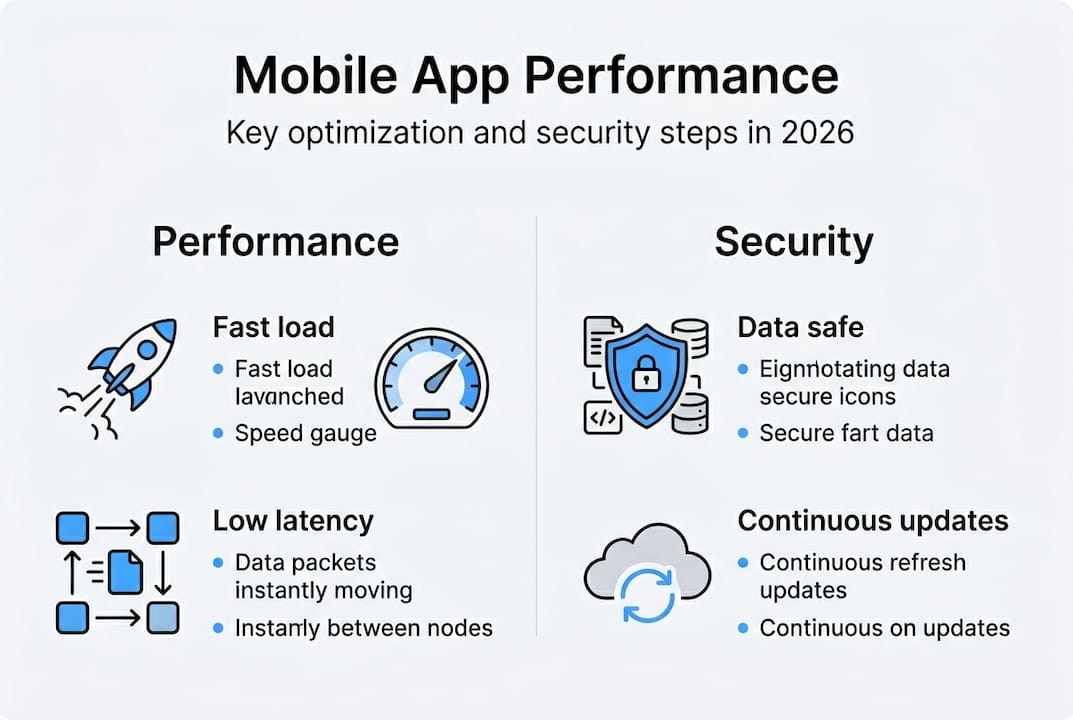
Speed matters more than most businesses realise. A one-second delay in app response time can reduce conversions by measurable percentages, and users who encounter repeated slowness abandon apps permanently. Improving app performance requires a proactive approach that addresses both front-end rendering and back-end efficiency.
Effective performance and security practices include:
- Code optimisation — Eliminate redundant processes, minimise bundle sizes, and implement lazy loading to reduce initial load times
- Load balancing — Distribute server traffic intelligently to prevent bottlenecks during peak usage periods
- Encryption — Protect all data in transit and at rest using current encryption standards, particularly for apps handling financial or personal information
- Regular patching — Apply security updates promptly to close vulnerabilities before they can be exploited
- Proactive monitoring — Use real-time monitoring tools to detect anomalies, crashes, and performance degradation before users report them
- Penetration testing — Conduct regular security assessments to identify weaknesses in your app’s defences
“Ongoing optimisation is crucial for app performance and data security.” Businesses that treat post-launch maintenance as optional routinely face avoidable failures that damage user trust and incur significant remediation costs.
For broader guidance on mobile applications advice covering performance benchmarks and security frameworks, the consistent message from enterprise deployments is clear: invest in monitoring infrastructure before you need it, not after an incident forces your hand.
Our perspective: Why a user-first mindset beats flashy features
Having covered the best practices, let’s challenge a popular trend in the industry. There is a persistent belief in enterprise technology circles that the most feature-rich mobile solution wins. Businesses invest heavily in AI-powered recommendations, augmented reality integrations, and complex gamification systems, then wonder why engagement metrics remain flat.
Our experience working with business clients across industries tells a different story. The mobile solutions that consistently outperform are not the most technically impressive. They are the most purposeful. They solve a specific user problem with clarity and reliability, and they improve incrementally based on real feedback rather than internal assumptions.
Chasing the latest framework or feature set without grounding decisions in user research is a costly distraction. User-centric mobile design disciplines, including structured usability testing, feedback loops, and data-driven iteration, consistently deliver stronger long-term ROI than feature launches driven by competitive anxiety.
Simplicity, reliability, and disciplined adaptation are not limitations. They are the strategic foundations of every successful mobile product we have seen. Build for your users first, and the business results follow.
Scale your growth with expert mobile design and development
For decision-makers ready to translate these insights into mobile-driven results, here is how you can take action. CloudFusion offers end-to-end mobile app development services tailored to businesses of every size, from focused startups to complex enterprise environments. Our approach combines strategic discovery, rigorous UX design, and scalable technical architecture to deliver solutions that perform from day one. Browse our custom development portfolio to see how we have helped organisations across industries build mobile products that drive measurable growth. When you are ready to move from strategy to execution, our team is equipped to guide you through every stage of the process.
Frequently asked questions
What is the typical timeline for a mobile design and development project?
Most enterprise mobile projects take 3 to 6 months from discovery to launch, with timeline variance driven by project complexity, integration requirements, and the speed of stakeholder feedback cycles. Structured processes, as outlined in the complete development guide, keep projects on track.
Are cross-platform apps suitable for large businesses?
Yes. Leading frameworks such as Flutter and React Native enable robust, scalable cross-platform apps that reduce development costs while maintaining the quality standards large organisations require. Framework selection should always be driven by your specific scalability and performance requirements.
How often should mobile apps be updated?
High-performing apps are typically updated every 4 to 8 weeks to introduce improvements, resolve emerging issues, and maintain security. Consistent update cycles, as highlighted in app performance guidance, are a hallmark of mature, enterprise-grade mobile products.
What’s the main difference between mobile apps and mobile websites for business?
Mobile apps deliver deeper engagement, offline functionality, and richer device integration, making them ideal for frequent-use scenarios. Mobile websites offer broader accessibility and lower initial investment. The app vs website decision depends on your user behaviour patterns and strategic objectives.
Do I need a different design for iOS and Android?
Best practice is to adapt interface elements to each platform’s design guidelines while maintaining consistent brand identity across both. User-centric design principles account for platform-specific conventions that users expect, ensuring your app feels native on every device.
Recommended
- Responsive Design Importance for Business Success in 2025
- Responsive Design Importance for Business Success in 2025
- Responsive Design Importance for Business Success in 2025
- Best Web Development Practices for Business Growth 2025
- Why Optimising for Mobile Is Crucial in Technical SEO - SEO Agency London | e-Commerce Specialists | Viaduct Generation