TL;DR:
- Most digital transformation failures occur because companies treat it as technology procurement rather than a phased change programme.
- A thorough assessment of technology, processes, culture, and skills is essential before starting, taking 4 to 16 weeks.
- Successful transformation requires measurable objectives, prioritising quick wins, piloting in scope, and continuous improvement for lasting change.
Step by step digital transformation is the proven process of systematically planning, prioritising, and executing technological and organisational change to achieve measurable business outcomes. Most organisations that fail at digital transformation do not fail because they chose the wrong software. They fail because they treat the process as technology procurement rather than a sequenced change programme. High failure rates consistently trace back to missing a strategic, phased approach. This guide gives business leaders a clear digital transformation framework to follow, from readiness assessment through to continuous improvement, with practical advice grounded in how South African enterprises actually operate.
What prerequisites are essential before starting digital transformation?
The single most important step in any digital change process is an honest assessment of where your organisation stands today. Skipping this phase is the primary reason programmes derail. Approximately 70% of digital transformation programmes that face significant delays are linked to underinvesting in the initial assessment phase. That statistic means the majority of failures are preventable with proper groundwork.
A thorough readiness assessment covers four dimensions:
- Technology baseline: Audit your current systems, integrations, and technical debt. Identify what can be extended and what must be replaced.
- Process maturity: Map your core business processes and flag where manual workarounds, duplication, or bottlenecks exist.
- Culture and change readiness: Gauge how open your teams are to new ways of working. Resistance at this level kills programmes faster than any technical issue.
- Skills inventory: Identify capability gaps between what your people can do now and what the target state requires.
Assessment typically takes 4–16 weeks depending on organisational complexity. Rushing it builds the entire programme on inaccurate baselines, which causes expensive corrections mid-execution. Stakeholder mapping and leadership alignment must happen during this window, not after. Every executive sponsor needs to understand the scope, the risks, and their personal accountability before a single initiative launches.
Pro Tip: Run a structured digital maturity survey across departments before your first leadership workshop. The gaps between how executives and frontline staff perceive current capabilities are often the most revealing data point in the entire assessment.

Understanding what digital transformation means for your specific business context shapes every decision that follows.
How do you define a clear transformation vision and strategic objectives?
A transformation vision that cannot be measured cannot be managed. Vague digital-first statements consistently lead to programme failure because they create no accountability. Your vision must be specific, tied to business outcomes, and testable against real data.
Strong transformation objectives look like this:
- Reduce customer onboarding time from 14 days to 3 days within 18 months.
- Increase digital self-service adoption from 20% to 65% of transactions by the end of year two.
- Cut manual data entry errors by 80% through process automation within 12 months.
- Achieve a Net Promoter Score improvement of 15 points by migrating to a unified customer platform.
Each objective names a metric, a target, and a timeframe. That structure forces honest conversations about what is achievable and what resources are required. Vague goals like “become more digital” or “improve the customer experience” produce no such accountability.
Executive sponsorship is non-negotiable at this stage. The vision must be communicated widely and consistently, from board level to team leads. When middle management hears conflicting messages about priorities, momentum collapses within months.
Pro Tip: Tie each transformation objective directly to a line item in your business strategy. If an objective cannot be linked to revenue growth, cost reduction, risk mitigation, or customer retention, question whether it belongs in the programme at all.
A well-structured digital strategy for business gives your vision the commercial grounding it needs to survive budget cycles and leadership changes.
How do you prioritise transformation initiatives logically?
Prioritisation separates organisations that build momentum from those that stall after the first quarter. The impact-versus-effort matrix is the most practical framework for sequencing your initiatives. It plots each initiative on two axes: the business value it delivers and the effort required to execute it.
The four quadrants produce a clear sequencing logic:
- Quick wins (high impact, low effort): Execute these first. They prove ROI, build organisational confidence, and secure continued investment.
- Strategic projects (high impact, high effort): Plan these carefully with phased milestones. They define the long-term capability of the programme.
- Fill-ins (low impact, low effort): Schedule these opportunistically. They are useful but should not consume priority resources.
- Thankless tasks (low impact, high effort): Deprioritise or eliminate these. They drain capacity without meaningful return.
Prioritising via an impact-effort matrix drives better sequencing and stronger business momentum. The practical implication is that your first 90 days should focus almost entirely on quick wins that demonstrate tangible value to sceptical stakeholders.
| Initiative type | Sequencing priority | Example |
|---|---|---|
| Quick win | First | Automate a single high-volume manual report |
| Strategic project | Second, phased | Replace legacy CRM with integrated platform |
| Fill-in | Opportunistic | Standardise file naming conventions |
| Thankless task | Deprioritise | Rebuild a rarely-used internal tool |
Data-driven prioritisation also makes it easier to secure stakeholder buy-in. When you can show a leadership team that a specific initiative delivers measurable value at manageable cost, the conversation shifts from “should we do this?” to “how quickly can we start?”
What are best practices for piloting and scaling digital initiatives?
Execution is where most digital transformation roadmap steps either prove their value or expose their weaknesses. The principle that governs this phase is simple: test before you scale. Phased transformation with pilots reduces risk and improves adoption compared to immediate full-scale rollouts. That is not a preference. It is a structural advantage that limits the blast radius of any incorrect assumption.
A well-run pilot has three non-negotiable elements:
- A defined scope: One business unit, one geography, or one customer segment. Not the whole organisation.
- Clear success criteria: Agreed in advance. If the pilot cannot tell you whether it succeeded or failed, it was not designed properly.
- A fixed timeframe: Typically 6–12 weeks. Open-ended pilots drift and lose organisational attention.
Once a pilot meets its success criteria, scaling requires a playbook. Document what worked, what failed, what the team learned, and what the next cohort needs to know before they start. This playbook becomes the institutional knowledge that makes each subsequent rollout faster and cheaper than the last.
Change management and training are not optional additions to this phase. They are the phase. Technology adoption fails when people do not understand why the change is happening or how it affects their daily work. Structured training, clear communication, and visible leadership support are the three factors that determine whether adoption sticks.
Continuous optimisation turns transformation from a time-limited project into a permanent improvement function. Build review cycles into your programme governance from day one.
Pro Tip: Assign a dedicated change champion in each business unit before the pilot launches. This person is not a technical expert. They are a trusted peer who can answer “what does this mean for my job?” questions in real time.
| Pilot phase | Key activity | Success indicator |
|---|---|---|
| Design | Define scope, metrics, and timeline | Signed-off brief with measurable targets |
| Execute | Run pilot with change support | Adoption rate meets agreed threshold |
| Review | Assess results against criteria | Clear go/no-go decision documented |
| Scale | Deploy playbook to next cohort | Rollout time shorter than pilot |
What common pitfalls should you avoid during digital transformation?
The most expensive mistake in any digital change process is treating it as a technology procurement exercise. Executives who focus on tools rather than sequenced change programmes consistently produce programmes that go live on time but fail to deliver business value. The technology works. The organisation does not change. The investment is wasted.
Watch for these warning signs during execution:
- Assessment was skipped or compressed: You will encounter this as mid-programme surprises, integration failures, and scope creep that nobody can explain.
- Leadership commitment is inconsistent: When executives stop attending steering committees, teams interpret it as the programme losing priority.
- Milestones are activity-based, not outcome-based: Completing a system migration is an activity. Reducing processing time by 40% is an outcome. Track outcomes.
- Change management was treated as a communications task: Sending an email about a new system is not change management. Structured training, feedback loops, and visible leadership behaviour are.
“Digital transformation fails not because organisations lack technology, but because they lack the governance, sequencing, and cultural commitment to make change stick. The organisations that succeed treat transformation as a permanent capability, not a one-time project.”
Governance structures matter more than most leaders expect. A clear programme office, defined decision rights, and regular milestone reviews keep the programme honest. Without them, initiatives drift, accountability blurs, and momentum dies quietly before anyone calls it a failure.
Key takeaways
Successful digital transformation requires a sequenced approach: assess your baseline, define measurable objectives, prioritise by impact and effort, pilot before scaling, and build continuous improvement into your governance from the start.
| Point | Details |
|---|---|
| Assessment is non-negotiable | Skipping the 4–16 week assessment phase is the leading cause of programme failure. |
| Vision must be measurable | Tie every objective to a specific metric, target, and timeframe to create real accountability. |
| Prioritise quick wins first | Use an impact-effort matrix to sequence initiatives and prove ROI early in the programme. |
| Pilot before scaling | Test in a defined scope with clear success criteria before rolling out to the full organisation. |
| Treat change management as core | Technology adoption fails without structured training, communication, and leadership commitment. |
What I have learned about digital transformation in South African businesses
Working with South African enterprises across multiple sectors, the pattern I see most often is this: organisations invest in the right technology and then wonder why nothing changed. The honest answer is almost always that the human and process side of the programme received a fraction of the attention and budget that the technology did.
South African businesses face a specific set of pressures that make this worse. Connectivity constraints, skills shortages in certain regions, and the cost of downtime in sectors like retail and logistics mean that the margin for error during rollout is genuinely smaller than in markets with more forgiving infrastructure. That context makes the case for phased pilots even stronger here than it is globally.
The organisations I have seen succeed share one characteristic: they treated their first transformation initiative as a learning exercise, not a performance. They expected to adjust. They built review cycles in from the start. They chose a trusted technology partner who understood both the technical and the organisational dimensions of the work.
Incremental wins matter enormously in this market. A single successful pilot that cuts a manual process from three days to four hours does more for programme credibility than any executive presentation. It gives your teams evidence that the change is real, that it works, and that the next phase is worth their effort.
Patience and pragmatism are not weaknesses in a transformation programme. They are the qualities that separate the organisations that finish from the ones that stall.
— Anton
How Cloudfusion supports your digital transformation programme
Cloudfusion works with South African businesses at every stage of the digital change process, from initial planning through to full-scale deployment. Whether you need custom web development to replace a legacy platform, or mobile app development to extend your digital reach to customers on the move, the team builds solutions that fit your specific business context. Cloudfusion also provides secure web hosting and cloud file storage to underpin the platforms you build. If you are ready to map out your next phase, give us a shout and let’s chat about your project.
FAQ
What is step by step digital transformation?
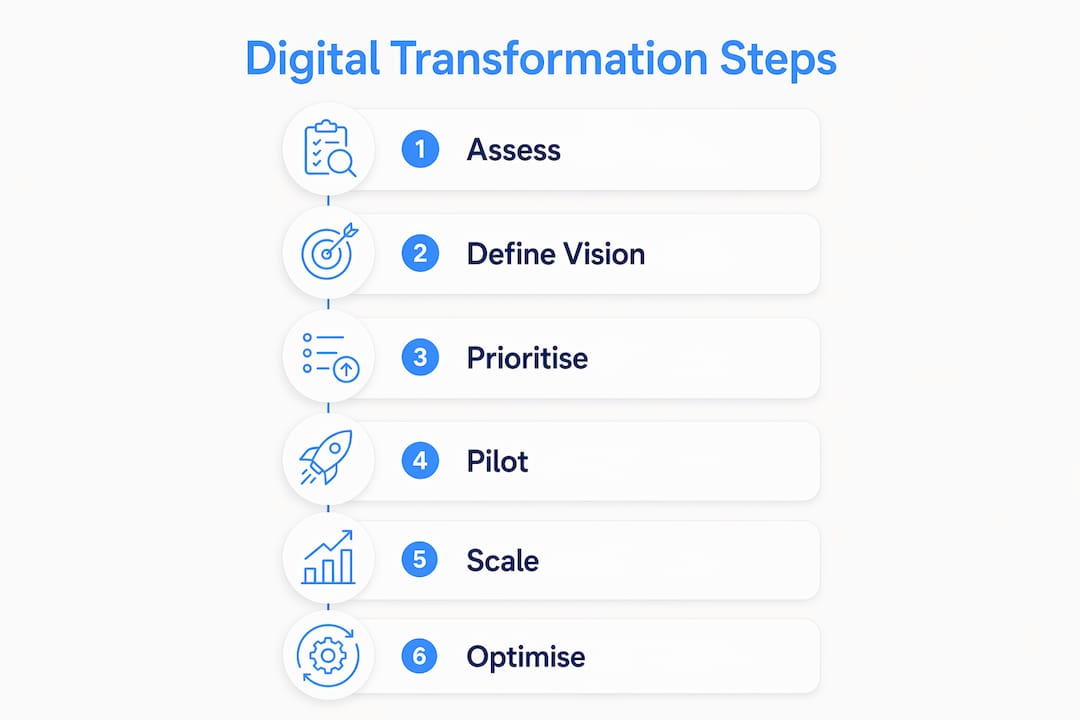
Step by step digital transformation is a structured, sequenced approach to changing how a business operates using technology. It covers assessment, vision setting, prioritisation, piloting, scaling, and continuous improvement as distinct phases.
Why do most digital transformation programmes fail?
Approximately 70% of programmes that face significant delays skipped or underinvested in the initial assessment phase. Treating transformation as technology procurement rather than strategic change management is the other primary cause.
How long does a digital transformation assessment take?
The assessment phase typically takes 4–16 weeks depending on the size and complexity of the organisation. Rushing it produces inaccurate baselines that cause expensive corrections later.
What is an impact-effort matrix in digital transformation?
An impact-effort matrix plots each initiative by the business value it delivers against the effort required to execute it. It helps leaders sequence quick wins first to build momentum before tackling complex, high-effort projects.
How do you know when a pilot is ready to scale?
A pilot is ready to scale when it meets the success criteria agreed before it launched, within the defined timeframe. Document the lessons learned in a playbook before deploying to the next business unit or cohort.
Recommended