TL;DR:
- Digital market expansion involves using existing products to reach new online audiences in different regions or demographics. It offers low risk and cost-effective growth by leveraging digital channels without developing new offerings. Success depends on focused channel selection, local adaptation, measurable goals, and continuous testing.
Digital market expansion is defined as the strategy of growing your business by taking existing products or services into new online markets through targeted digital channels and audience segmentation. Unlike new product development, this approach does not require you to build something new. Instead, it uses what you already have and finds new buyers for it. Positioned in the Ansoff Matrix between market penetration and product diversification, market development extends your total addressable market by targeting new geographies, demographics, or industry segments. For South African business owners and marketing professionals, this distinction matters enormously because it means growth without the cost and risk of starting from scratch.

What is digital market expansion and why does it matter?
Digital market expansion is the practice of entering new markets using digital technology and online channels, without changing your core product or service. The standard industry term for this is market development, and it sits at the intersection of digital marketing growth and business strategy. Understanding both terms gives you credibility with investors, partners, and your own team.
The core appeal is risk reduction. Market development reduces product risk by leveraging existing offerings to reach new audiences, making it a lower-risk approach than new product development. That means your R&D budget stays intact while your revenue potential grows. For a business already generating sales in one region or demographic, this is the most capital-efficient growth path available.
Digital channels make this strategy accessible to businesses of all sizes. A manufacturer in Johannesburg can reach buyers in Cape Town, Nairobi, or London using the same website and a well-targeted paid search campaign. The technology infrastructure already exists. The question is whether your strategy is built to use it well.
What are the main strategies and channels for digital expansion?
Channel selection is the single most consequential decision in any digital expansion effort. Digital strategy is a set of decisions about channels, audiences, and customer journeys rather than a collection of isolated tactics. Get this wrong and your budget disappears with little to show for it.
The primary digital channels for market expansion include:
- Search marketing (SEO and paid search): Captures demand that already exists in a new market. Best for geographic expansion where buyers are actively searching for your category.
- Email marketing: Builds direct relationships with new audience segments at low cost. Works well when you have a clear value proposition and a way to grow a list in the new market.
- Social media marketing: Reaches new demographics where they spend time. Platform choice depends on the target audience. LinkedIn works for B2B segments; Instagram and TikTok work for consumer audiences.
- Content marketing: Builds authority in a new market over time. Slower to show results but produces compounding returns.
- Influencer and affiliate marketing: Accelerates trust in unfamiliar markets by borrowing the credibility of established local voices.
The critical mistake most businesses make is trying to use all of these at once. Mastery of 2–3 primary channels that align with the target audience consistently outperforms broad-spectrum efforts. This principle is sometimes called the 3-3-3 rule: three core messages, three primary channels, and three measurable outcomes. It forces discipline and prevents the budget dilution that kills most expansion attempts.
| Channel | Best for | Key advantage | Typical timeline |
|---|---|---|---|
| Paid search | Geographic expansion | Immediate visibility | Days to weeks |
| SEO and content | Long-term authority | Compounding traffic | 3–12 months |
| Email marketing | Demographic segments | Direct, low-cost reach | Weeks to months |
| Social media | Consumer and B2B audiences | Audience targeting precision | Weeks to months |
| Influencer marketing | New regional markets | Rapid trust building | Campaign-dependent |
Pro Tip: Before committing budget to any channel, map where your target audience in the new market actually spends time online. Assumptions based on your existing market are frequently wrong.
How does digital expansion reduce risk compared to other growth methods?
The Ansoff Matrix places market development as a middle-ground strategy. It carries more risk than simply selling more to your existing customers, but significantly less risk than developing new products or diversifying into new industries. For most growing businesses, this makes it the most rational next step.
Here is why the risk profile is lower than alternatives:
- No product validation risk. Your product already works. You are testing whether a new audience wants it, not whether the product itself is viable.
- Lower development costs. You are not funding an R&D cycle. Investment goes into marketing, localisation, and channel testing rather than engineering.
- Faster feedback loops. Digital channels produce measurable data within days or weeks. You can test buyer behaviour in a new market and gain insights that strengthen your core market approach without committing to a full-scale launch.
- Reversibility. If a new market does not respond, you can pull back without writing off a product investment.
The remaining risks are real but manageable. Buyer behaviour in a new market may differ significantly from what you expect. Resource allocation across multiple markets can stretch a small team. And the assumption that what works in your home market will work elsewhere is frequently incorrect. High-performing digital marketing strategies align channels with business objectives and adapt continuously to changing customer behaviour. That adaptability is what separates successful expansion from expensive failure.
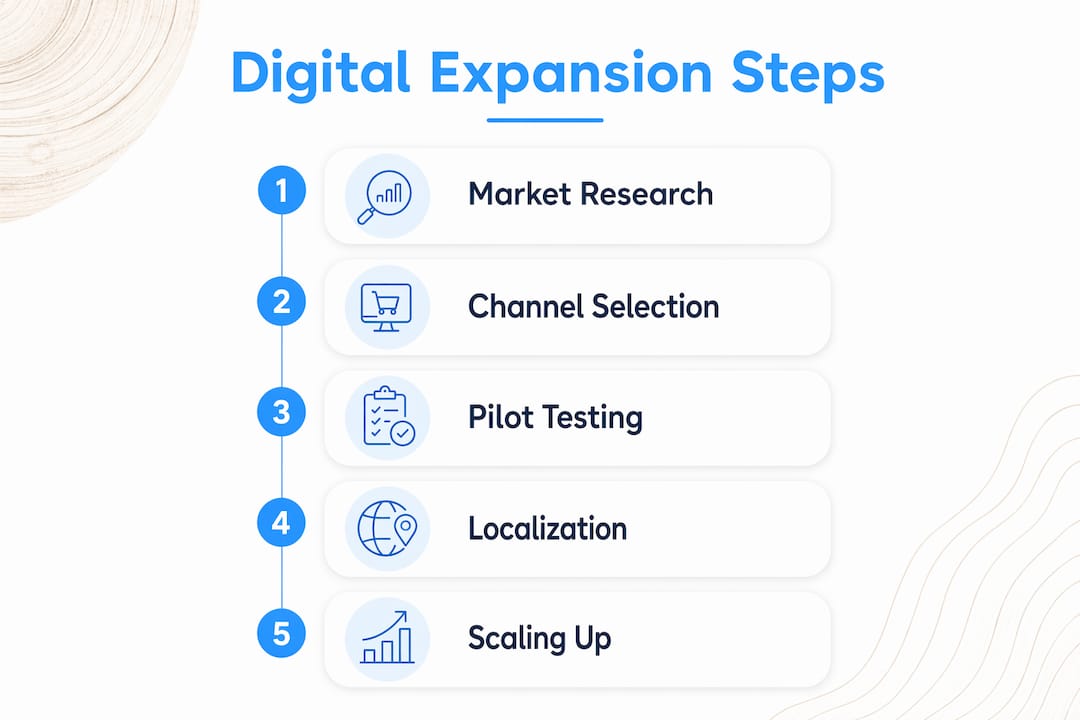
Pro Tip: Run a 90-day pilot in any new market before scaling. Set three specific, measurable outcomes upfront. If two of the three are not met, reassess the channel mix before increasing spend.
What are the key challenges in executing digital expansion?
Execution is where most digital expansion plans break down. The strategy looks clean on paper. The reality is messier.
Digital literacy and cultural adaptation
Assuming your existing digital approach translates directly to a new market is a common and costly error. Localisation and technology adaptation are critical to competing effectively in new markets. This means more than translating your website. It means adapting your messaging to local cultural norms, ensuring your site loads fast on the devices your new audience uses, and pricing in a way that reflects local purchasing power.
Channel effectiveness mismatch
Channel effectiveness depends on local audience preferences and behaviours. A channel that drives strong results in Gauteng may be irrelevant in a new international market. Businesses that assume popular channels work universally waste significant budget before realising the mismatch. Research the channel habits of your target audience before spending.
Competitor landscape misunderstanding
Competitor analysis for market expansion needs to go beyond surface-level monitoring to include performance metrics and audience engagement data. Knowing who your competitors are is not enough. You need to understand what is working for them, where their audiences engage, and where the gaps are. That analysis is what produces genuine differentiation rather than imitation.
The best practices that consistently produce results in digital expansion are:
- Start with research, not assumptions. Validate buyer behaviour data before committing budget. Use tools like Google Trends, social listening platforms, and local market reports.
- Focus on measurable outcomes. Define what success looks like in concrete terms before the campaign launches. Vanity metrics like impressions and follower counts do not pay salaries.
- Avoid being everywhere. Concentrate resources on the 2–3 channels most likely to reach your new audience. Depth beats breadth every time.
- Test before scaling. Run small, time-bound pilots. Measure results against your predefined outcomes. Scale only what works.
- Adapt your technology. Ensure your website performs well on the devices and connection speeds common in the new market. A slow-loading site is a conversion killer regardless of how good your marketing is.
What do real-world digital expansion examples teach us?
Real examples cut through theory and show what digital expansion actually looks like in practice.
Amazon’s entry into India is the most cited example of geographic market development via digital channels. Amazon leveraged digital platforms to tap new regional audiences in a market with distinct buyer behaviour, infrastructure challenges, and competitive dynamics. The key lesson is that Amazon did not simply replicate its US model. It adapted pricing, logistics partnerships, and its digital interface to local conditions. The product remained the same. Everything around it changed.
For smaller businesses, the lessons are equally instructive:
- A South African software company expanding into East Africa needs to consider mobile-first design, given the dominance of smartphone browsing in those markets.
- A professional services firm targeting a new industry segment can use LinkedIn content marketing and targeted paid campaigns to build credibility before making direct sales contact.
- A consumer goods brand entering a new demographic can test influencer partnerships in that segment before committing to full-scale paid media.
Using IoT, AI, and big data helps MSMEs improve efficiency and market access, particularly in creative industries expanding internationally. This is not just a large-enterprise story. Technology gives smaller businesses access to the same data-driven expansion tools that once required enterprise budgets. The barrier to entry for digital expansion has dropped significantly, and that shift benefits South African SMEs directly. For practical guidance on digital tools for SMEs, the fundamentals apply regardless of business size.
The consistent thread across successful examples is iteration. No business gets digital expansion right on the first attempt. The ones that succeed treat it as a learning process, not a one-time campaign. Advanced digital marketing for expansion uses iterative testing of messaging, channel mix, and creative assets driven by continuous monitoring of market-specific conversion metrics.
Key takeaways
Digital market expansion succeeds when businesses apply disciplined channel focus, localise their approach for each new market, and measure outcomes against predefined business goals rather than vanity metrics.
| Point | Details |
|---|---|
| Core definition | Market development uses existing products to reach new geographies, demographics, or industry segments digitally. |
| Channel discipline | Focus on 2–3 primary channels aligned with your new audience rather than spreading budget across all platforms. |
| Risk advantage | Digital expansion carries lower risk than new product development because the product is already validated. |
| Localisation is non-negotiable | Adapting messaging, pricing, and technology to local conditions determines whether expansion succeeds or fails. |
| Measure business outcomes | Track conversion metrics and revenue impact, not impressions or follower counts, to assess expansion performance. |
What most businesses get wrong about digital expansion
Here is something I see repeatedly when working with businesses planning their first digital expansion: they treat it as a marketing project rather than a strategic business decision. They brief an agency, approve a budget, and wait for results. That approach almost always underdelivers.
The businesses that expand successfully treat digital market expansion as an iterative, data-driven process. They define what winning looks like before they spend a rand. They pick two or three channels and go deep rather than spreading thin. And they resist the temptation to copy what their competitors appear to be doing, because copying competitors without strategic insight results in wasted marketing budgets. What you see on the surface of a competitor’s digital presence rarely reflects what is actually working for them.
The South African context adds a specific layer of complexity. Our market has significant digital literacy variation across regions and demographics. A campaign that performs well in urban Johannesburg may need substantial rethinking for a secondary city audience. That is not a reason to avoid expansion. It is a reason to research before you spend.
The businesses I have seen succeed at digital expansion share one habit: they build measurement into the plan from day one. Not as an afterthought. Not as a reporting exercise. As the foundation of every decision. If you cannot measure it, you cannot improve it. And if you cannot improve it, you are just spending money and hoping.
For a deeper look at enterprise digital marketing strategies, the principles of disciplined channel focus apply at every business size.
— Anton
How Cloudfusion supports your digital expansion goals
Cloudfusion works with South African businesses that are serious about growing their digital reach into new markets. Whether you need a custom-built website designed to perform in a new geographic market, a mobile application that engages a new audience segment, or fast and reliable hosting that keeps your digital presence available as your traffic grows, Cloudfusion has the technical depth to deliver it. The team understands the South African market and the specific challenges of expanding beyond it. Give us a shout to chat about your project goals and what a well-executed digital expansion could look like for your business.
FAQ
What is digital market expansion in simple terms?
Digital market expansion is the process of taking your existing products or services to new audiences using online channels, without creating new products. It targets new geographies, demographics, or industry segments.
How is digital market expansion different from digital marketing?
Digital marketing is the set of tactics you use to reach audiences online. Digital market expansion is a business growth strategy that uses those tactics to enter markets you do not currently serve.
How many channels should a business use for digital expansion?
Focus on 2–3 primary channels that align with your new target audience. Spreading budget across too many channels at once produces weaker results than going deep on a focused selection.
What is the biggest risk in digital market expansion?
The biggest risk is assuming your existing market knowledge applies directly to the new market. Buyer behaviour, channel preferences, and cultural context vary significantly. Research and localisation reduce this risk substantially.
How do I know if my digital expansion is working?
Define three to five measurable business outcomes before you launch, such as qualified leads, conversion rates, or revenue from the new market. Track these metrics monthly and adjust your channel mix based on what the data shows.
Recommended