TL;DR:
- Digital merchandising uses data, AI, and personalization to optimize product presentation and increase sales online. It involves strategic product placement, real-time inventory updates, and personalized recommendations to enhance customer experience and conversion rates. Effective implementation requires continuous manual oversight combined with AI automation to adapt to changing business needs.
Digital merchandising is the strategic, data-driven presentation of products across digital channels, using behavioural data, AI, and personalisation to influence buying decisions and increase e-commerce sales. Where traditional retail relies on physical shelf placement and store layout, digital merchandising turns your website into a dynamic, curated selling environment. The discipline covers everything from homepage product sequencing and category page logic to search result ranking and personalised recommendations. For retail and e-commerce professionals, understanding what is digital merchandising is the first step toward converting more visitors and growing revenue in a competitive online market.
What is digital merchandising and what does it actually cover?
Digital merchandising is the industry term for the full commercial strategy behind how products appear, rank, and perform across your online store. It goes well beyond visual presentation. According to DTL Merchandising, digital merchandising covers pricing logic, inventory prioritisation, behavioural data, personalisation engines, search optimisation, and campaign planning. Visual merchandising, by contrast, focuses only on how products look. That distinction matters because teams that treat digital merchandising as a design task consistently underperform those who treat it as a commercial function.
The core components of a digital merchandising strategy include:
- Product placement logic: Which products appear above the fold on category pages, in search results, and on the homepage. Placement directly affects what customers see first and what they buy.
- AI and behavioural personalisation: Algorithms that adjust product displays based on browsing history, session context, and real-time signals. This is critical because over 90% of e-commerce visitors are anonymous and cannot be targeted using past purchase data.
- Pricing and promotional logic: Dynamic pricing, discount badging, and promotional content placement that responds to inventory levels and campaign calendars.
- Cross-sell and upsell prompts: Product recommendations placed at the cart, product detail page, and checkout stages to increase average order value.
- Search and filter optimisation: Ensuring that search results surface the most commercially relevant products, not just the most keyword-matched ones.
Pro Tip: Treat your homepage the way a physical retailer treats a shop window. Use AI-powered automation to continuously test and update what appears there, rather than setting it once and leaving it static for weeks.
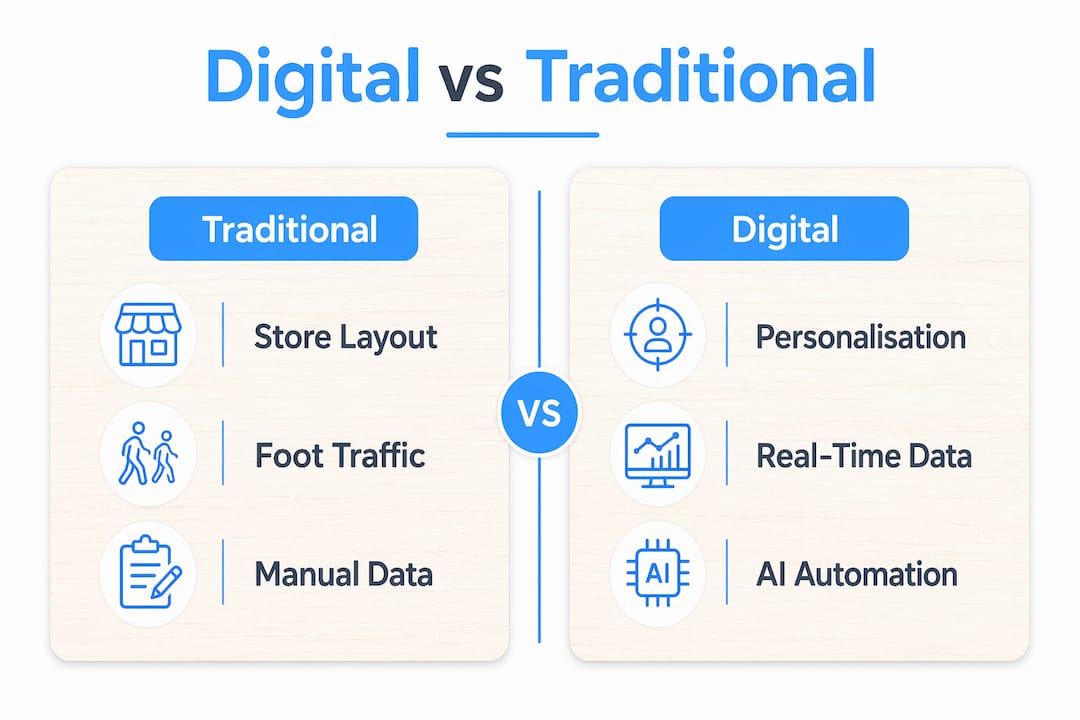
The difference between digital and traditional merchandising also shows up in data access. Physical retail relies on foot traffic counts and sales reports. Digital merchandising gives you session-level behavioural data, click-through rates, and real-time inventory signals. That data advantage is only useful if your merchandising strategy is built to act on it.
How does digital merchandising affect conversion and revenue?
Poor product discoverability accounts for up to 21% of abandoned shopping sessions. That figure means a significant portion of your lost revenue is not a pricing or marketing problem. It is a merchandising problem. When customers cannot find what they are looking for quickly, they leave. Effective digital merchandising directly reduces that abandonment by surfacing the right products at the right moment.
“Digital merchandising turns websites into dynamic, curated shopping experiences rather than static catalogues. This transformation is key to driving conversion and ongoing e-commerce growth.” — DTL Merchandising
The benefits of digital merchandising extend beyond conversion rate. Cross-sell and upsell placements, when positioned correctly, increase average order value without requiring additional traffic. Personalised product recommendations, powered by behavioural signals, create a shopping experience that feels relevant rather than generic. That relevance builds trust and repeat visits. For South African e-commerce businesses, where customer acquisition costs are rising, retaining and converting existing visitors carries significant commercial weight.
Personalisation is where the performance gap between good and average digital merchandising is widest. Behavioural signals and zero-party data allow merchandising engines to personalise experiences for anonymous visitors without requiring a login. A visitor browsing running shoes gets a different homepage experience than one browsing formal wear. That contextual relevance, delivered at scale, is what separates high-converting stores from average ones.
The conversion improvement from better merchandising compounds over time. Each product placement decision, each search ranking adjustment, and each cross-sell prompt contributes to a cumulative lift in revenue. For a mid-sized South African online retailer, even a modest improvement in conversion rate translates into meaningful incremental revenue across thousands of monthly sessions.
How to implement digital merchandising effectively
The most effective digital merchandising strategies combine AI automation with structured manual oversight. Neither works well alone. Here is a proven framework for building and maintaining a high-performing merchandising operation.
1. Apply the 40/30/20/10 tiering rule to category pages
The 40/30/20/10 framework allocates above-the-fold grid space by product type. Forty percent goes to hero products, your highest-margin or best-converting lines. Thirty percent goes to volume drivers, products with consistent demand. Twenty percent goes to new arrivals, and ten percent goes to promotional items. This structure prevents your category pages from becoming a random feed of whatever the algorithm ranks highest.
2. Build a weekly manual override calendar
Manual pinning overrides are non-negotiable for campaigns, seasonal drops, and supplier-funded promotions. Purely automated systems lack the strategic flexibility to respond to business priorities. A weekly calendar review, where your merchandising team checks performance data and applies overrides, keeps your AI-driven system aligned with commercial goals.
3. Integrate real-time inventory data
Promoting out-of-stock products is one of the fastest ways to damage customer trust and inflate bounce rates. Your merchandising engine must connect to live inventory data so that unavailable products are automatically deprioritised or removed from featured placements. This is a technical integration requirement, not just a process one.
4. Use visual merchandising elements strategically
High-quality images, short product videos, and interactive 3D views improve engagement on product detail pages. These elements are not decoration. They reduce purchase hesitation and lower return rates by setting accurate expectations. Prioritise them for your hero product tier first.

5. Optimise search ranking logic separately from category logic
Search results need their own merchandising rules. A customer searching for “black sneakers” expects relevance, but your business may also want to surface high-margin options or clear slow-moving stock. Balancing relevance with commercial intent in search ranking is a distinct discipline within digital merchandising.
| Merchandising element | Primary goal | Key metric to track |
|---|---|---|
| Category page product grid | Conversion rate by position | Click-through rate per slot |
| Homepage featured products | Engagement and first purchase | Bounce rate and add-to-cart rate |
| Search result ranking | Relevance plus margin | Search conversion rate |
| Cross-sell and upsell prompts | Average order value | Attachment rate |
| Promotional placements | Campaign revenue | Revenue per visitor |
Pro Tip: Do not rely solely on historical sales volume to rank products. A product that sold well last month but is now low in stock will frustrate customers and waste prime placement. Always factor in current inventory depth when setting ranking logic.
Understanding e-commerce automation is useful here. Automation handles the volume of decisions no team can make manually, but it needs guardrails. Your weekly review process is that guardrail.
Digital merchandising vs. traditional merchandising: what is the real difference?
The difference between digital and traditional merchandising is not just the channel. It is the entire operating model.
| Dimension | Traditional merchandising | Digital merchandising |
|---|---|---|
| Data source | Sales reports, foot traffic counts | Real-time behavioural data, session context |
| Personalisation | Static displays for all customers | Dynamic, individualised product experiences |
| Speed of change | Days or weeks to update displays | Instant, automated adjustments |
| Inventory integration | Manual stock checks | Real-time inventory feeds |
| Performance measurement | Weekly or monthly sales data | Session-level conversion analytics |
Physical retail merchandising relies on store layout, shelf height, and visual cues to guide customers. Digital merchandising uses algorithms, data signals, and technology to do the same job, but at a scale and speed that physical retail cannot match.
E-commerce marketing and digital merchandising are also frequently confused. Marketing drives traffic to your store through brand promotion, paid media, and SEO. Merchandising converts that traffic once visitors arrive. Both are necessary, but they solve different problems. A well-funded marketing campaign that sends visitors to a poorly merchandised store will underperform. The two functions must work together.
The personalisation challenge is where digital merchandising most clearly separates itself from traditional retail. A physical store cannot change its layout for each customer who walks in. A digital store can, and should, present a different experience to a first-time visitor than to a returning customer with a known browsing history. That capability is the defining advantage of digital merchandising done well.
Key takeaways
Digital merchandising is the commercial engine behind every high-converting online store, combining AI automation, behavioural data, and structured manual oversight to turn product pages into revenue-generating assets.
| Point | Details |
|---|---|
| Core definition | Digital merchandising covers pricing logic, inventory, personalisation, and search, not just visual design. |
| Anonymous visitor challenge | Over 90% of e-commerce visitors are anonymous, requiring behavioural data for personalisation. |
| Discoverability drives abandonment | Poor product discoverability causes up to 21% of abandoned shopping sessions. |
| Use the 40/30/20/10 rule | Allocate category page space by product tier to maximise conversion and margin. |
| Combine AI with manual oversight | Weekly manual overrides keep automated systems aligned with business priorities. |
Why I think most e-commerce teams are getting digital merchandising wrong
After working with e-commerce businesses across South Africa and beyond, the most common mistake I see is treating digital merchandising as a one-time setup task. Teams configure their product ranking logic during a platform launch, then leave it running untouched for months. The algorithm keeps working, but the business keeps changing. New stock arrives, campaigns launch, and margins shift. The merchandising logic does not know any of that unless someone tells it.
The second mistake is over-relying on automation without understanding what it is optimising for. Most out-of-the-box merchandising algorithms optimise for click-through rate or historical sales volume. Neither of those metrics is the same as profitability. I have seen stores consistently surface their lowest-margin products at the top of category pages because those products had the best historical click data. The fix is straightforward: build margin and inventory depth into your ranking signals. But you have to know to look for the problem first.
The third issue is ignoring the anonymous majority. Anonymous visitors make up the overwhelming share of any online store’s traffic. If your personalisation strategy only activates for logged-in customers, you are leaving most of your conversion opportunity untouched. Real-time session context, such as what a visitor has browsed in the current session, is a powerful signal that does not require a login. Use it.
For South African retailers specifically, the local market rewards relevance and trust. Customers are price-conscious and quick to abandon a store that feels generic or disorganised. A well-merchandised store signals competence. That signal matters more here than in markets where brand loyalty is stronger.
— Anton
How Cloudfusion builds e-commerce sites that merchandise effectively
Effective digital merchandising starts with the right technical foundation. Cloudfusion builds custom e-commerce websites designed to support real-time inventory integration, AI-driven product ranking, and personalised shopping experiences from the ground up. The team understands that a well-designed store is not just visually appealing. It is commercially structured to convert. If you are building a new online store or rearchitecting an existing one to support better merchandising, give us a shout. We will help you get the technical and commercial structure right from the start.
FAQ
What is digital merchandising in simple terms?
Digital merchandising is the practice of deciding which products appear where on your online store, using data and technology to maximise sales. It covers product placement, search ranking, personalisation, and promotional logic.
How does digital merchandising differ from e-commerce marketing?
Marketing drives traffic to your store. Digital merchandising converts that traffic by presenting the right products to the right visitors at the right moment. Both are necessary but solve different problems.
Why does product discoverability matter so much?
Poor discoverability causes up to 21% of abandoned shopping sessions. When customers cannot find what they want quickly, they leave without buying.
What is the 40/30/20/10 rule in digital merchandising?
The 40/30/20/10 rule allocates category page space: 40% to hero products, 30% to volume drivers, 20% to new arrivals, and 10% to promotional items. It structures product placement for maximum commercial impact.
How do you personalise for anonymous visitors?
Effective personalisation for anonymous visitors uses real-time session behaviour and zero-party data signals rather than login history. This allows dynamic product displays without requiring customers to create an account.
Recommended