Most tech teams underestimate how over 50 percent of digital initiatives fail due to poor user understanding. For south-african UX researchers and digital marketing managers, clear definitions and accurate methods matter more than ever. Many still confuse UX research with basic usability tweaks, but its impact reaches much deeper. This guide brings clarity to what UX research really involves, challenges old misconceptions, and spotlights strategies that help international mid-sized companies connect with real users for lasting results.
Table of Contents
- Defining Ux Research And Common Misconceptions
- Types Of Ux Research And Key Methods
- How Ux Research Informs Product Design
- Costs, Risks, And Business Implications
- Alternatives And Complementary Approaches
Key Takeaways
| Point | Details |
|---|---|
| Importance of UX Research | UX research goes beyond usability testing; it provides a deep understanding of user motivations and experiences. |
| Diverse Research Methods | A combination of qualitative and quantitative approaches yields comprehensive insights that inform design decisions. |
| Impact on Product Design | Integrating user research into the design process ensures that products meet actual user needs and enhances overall user satisfaction. |
| Business Value | Investing in UX research mitigates risks, reduces costs associated with product failures, and strengthens competitive positioning. |
Defining UX Research and Common Misconceptions
User experience (UX) research represents a systematic approach to understanding how users interact with digital products, services, and interfaces. Unlike simplistic assumptions, UX research goes far beyond surface-level design improvements. Researchers globally recognise UX as a complex, multi-dimensional discipline that explores the intricate emotional, cognitive, and behavioural aspects of user interactions.
Common misconceptions often reduce UX research to mere usability testing or interface design. In reality, UX research is a comprehensive investigation that examines users’ motivations, pain points, expectations, and overall experience. This holistic approach involves qualitative and quantitative methods such as interviews, surveys, contextual observations, and advanced analytical techniques to generate deep insights into user behaviour and preferences.
The core objective of UX research is to bridge the gap between user needs and product design. By systematically gathering and analysing user data, researchers help organisations develop more intuitive, engaging, and user-centric digital solutions. This process involves understanding not just what users do, but why they do it, uncovering hidden patterns and underlying psychological factors that influence user interactions.

Pro tip: Always approach UX research with genuine curiosity and empathy, recognising that each user’s experience is unique and multifaceted.
Types of UX Research and Key Methods
UX research encompasses a diverse range of methodological approaches designed to capture comprehensive insights into user behaviour and experience. Researchers categorise these methods across multiple dimensions, including qualitative versus quantitative, attitudinal versus behavioural, and generative versus evaluative techniques. Understanding these classifications helps researchers select the most appropriate methods for specific research objectives.
Qualitative Research Methods offer in-depth, narrative-driven insights into user experiences. These include techniques such as:
- User interviews
- Contextual observations
- Ethnographic studies
- Open-ended surveys
- Focus group discussions
Quantitative Research Methods, conversely, provide statistical and measurable data about user interactions. Key approaches involve:
- Online surveys with structured questions
- Web analytics
- A/B testing
- Usability testing with measurable metrics
- Click-stream analysis
The strategic selection of research methods depends on specific project goals, target audience, and available resources. Effective UX researchers often combine multiple approaches to create a holistic understanding of user needs, preferences, and pain points. This multi-method approach ensures more robust and nuanced insights that can drive meaningful product improvements.
Pro tip: Always triangulate your research findings by using multiple complementary methods to validate and enrich your understanding of user experiences.
To highlight how different research methods contribute unique strengths to UX projects, see the comparison below:
| Research Type | Typical Insights Generated | When to Use |
|---|---|---|
| Qualitative | In-depth motivations and attitudes | Early-stage discovery or ideation |
| Quantitative | Statistical patterns and trends | Validating design decisions at scale |
| Mixed Methods | Comprehensive, balanced view | Strategic product improvements |
How UX Research Informs Product Design
UX research serves as a critical bridge between user needs and product development, transforming abstract user insights into concrete design strategies. Comprehensive research methodologies enable designers to uncover profound user requirements and translate them into actionable design specifications, ensuring that digital products genuinely solve real-world user challenges.
The product design process typically involves multiple stages where UX research provides strategic guidance:
- Discovery Phase: Understanding user context, pain points, and motivations
- Conceptualisation: Generating design hypotheses based on research insights
- Prototyping: Creating initial design solutions informed by user research
- Validation: Testing design concepts against actual user expectations and behaviours
- Refinement: Iteratively improving design based on continuous user feedback
By systematically integrating research findings, design teams can make evidence-based decisions that minimise assumptions and reduce the risk of developing products misaligned with user needs. This approach transforms UX research from a peripheral activity into a core strategic tool that directly influences product architecture, feature prioritisation, and overall user experience design.
Pro tip: Always document your research insights comprehensively and share them across design, development, and product management teams to ensure holistic understanding and alignment.
Costs, Risks, and Business Implications
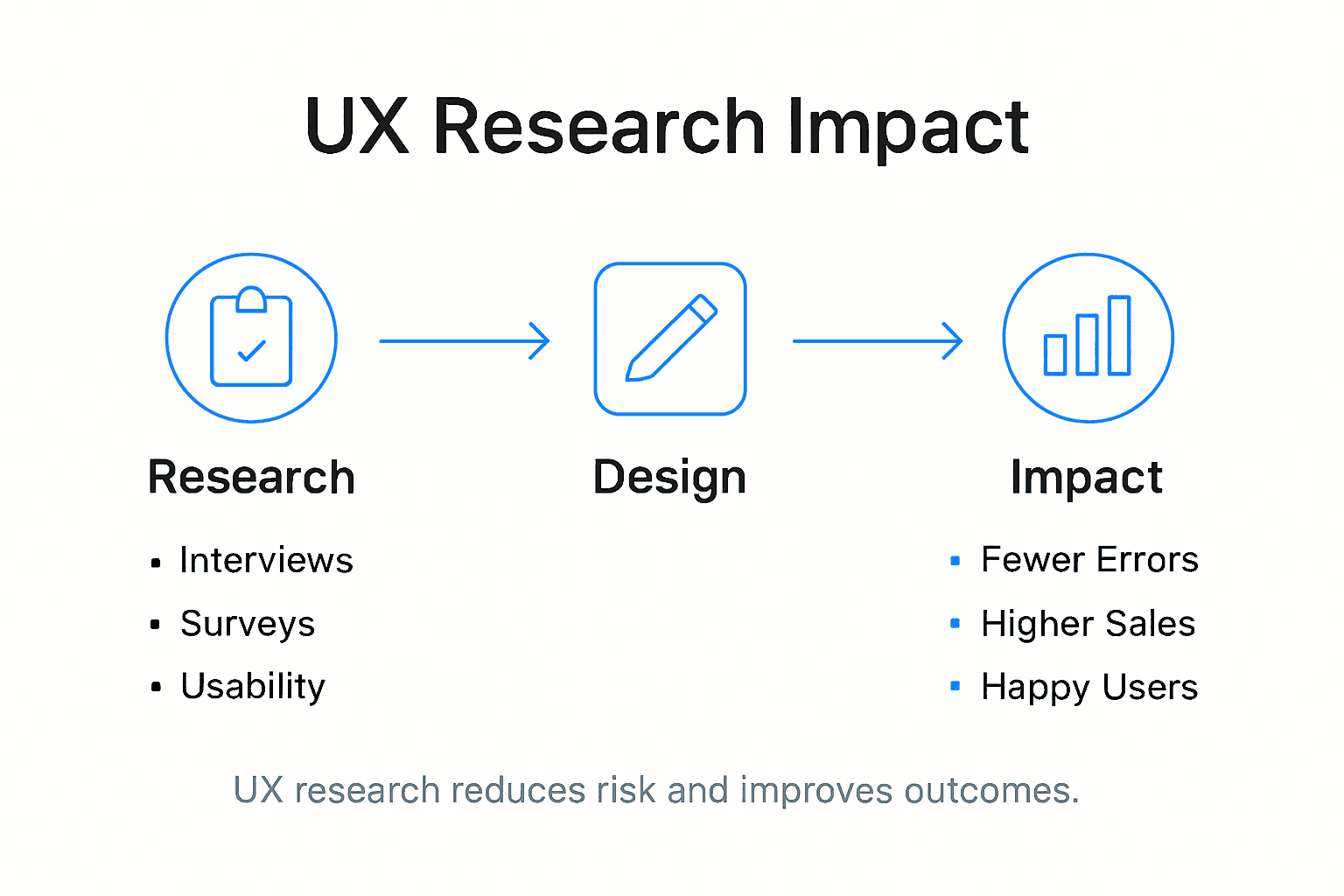
UX research represents a strategic investment with measurable financial implications for organisations seeking to develop successful digital products. The UX Research Business Impact Framework reveals how systematic research can generate substantial returns by preventing costly post-launch redesigns and improving user satisfaction, transforming research from an expense into a critical business asset.
The financial risks of neglecting UX research are significant and multifaceted:
- Product Failure Costs: Poorly designed products can result in complete market rejection
- Development Rework: Retrofitting products after launch is exponentially more expensive than research-driven design
- Customer Acquisition Expenses: Ineffective user experiences increase customer churn and acquisition costs
- Reputation Damage: Subpar digital products can permanently harm brand perception
- Competitive Disadvantage: Organisations without user-centric design struggle to retain market share
Businesses must view UX research as a risk mitigation strategy that directly impacts bottom-line performance. By investing in systematic user understanding, companies can reduce development uncertainties, align products more closely with market needs, and create more compelling digital experiences that drive user engagement and loyalty.
Pro tip: Calculate your potential UX research ROI by comparing the costs of research against the estimated expenses of post-launch product modifications and potential market failure.
Here’s a summary of business impacts associated with a strong UX research practice:
| Business Impact Area | Positive Outcome | Risk If Neglected |
|---|---|---|
| Cost Efficiency | Reduces post-launch fixes | Expensive rework required |
| User Satisfaction | Boosts retention rates | Increased customer churn |
| Market Position | Enhances competitive edge | Lost market share |
| Brand Reputation | Supports positive image | Risk of reputation damage |
Alternatives and Complementary Approaches
UX research is not a monolithic discipline but a flexible approach with multiple methodological alternatives that can be strategically combined or substituted depending on project constraints, resources, and specific objectives. While traditional UX research methods remain powerful, organisations increasingly explore innovative techniques that complement or augment standard approaches.
Alternative and complementary UX research strategies include:
- Rapid Prototyping: Creating quick, low-fidelity mockups to test user interactions
- Guerrilla Research: Conducting fast, low-cost user interviews in public spaces
- Analytical Data Mining: Leveraging existing user behaviour data from web analytics
- Competitive Benchmarking: Studying user experiences in similar digital products
- Contextual Inquiry: Observing users in their natural environment and workflow
- Remote Unmoderated Testing: Using digital platforms for distributed user feedback
These alternative approaches offer flexibility for organisations with limited budgets or tight timelines. By mixing traditional and innovative research methods, teams can develop a nuanced understanding of user needs while maintaining cost-effectiveness and research agility. The key is selecting methods that provide meaningful insights without overwhelming project resources or compromising research quality.
Pro tip: Don’t view research methods as rigid frameworks, but as adaptable tools that can be creatively combined to unlock deeper user understanding.
Unlock the Power of UX Research for Your Digital Success
Understanding the complexities of UX research is vital to building digital products that genuinely resonate with your users. As the article highlights, bridging the gap between user needs and product design reduces costly post-launch fixes and enhances customer satisfaction. If your business is facing challenges like ineffective user engagement or costly redesigns, embracing a user-centric approach informed by solid UX research is the key.
At Cloudfusion, we specialise in transforming these insights into scalable, custom web solutions tailored to your unique business requirements. Discover how our Web Design and Development Quotation service integrates UX research principles to create intuitive and impactful digital experiences. Don’t let poor user experience hold your business back. Start your journey to a stronger online presence and improved user satisfaction today by requesting your personalised web design and development quotation or contacting us directly at Cloudfusion. Act now to stay ahead in a competitive digital landscape.
Frequently Asked Questions
What is UX research?
UX research is a systematic approach to understanding how users interact with digital products and services. It investigates the emotional, cognitive, and behavioural aspects of user experiences to inform design decisions.
Why is UX research important for product design?
UX research is crucial as it bridges the gap between user needs and product design, ensuring that digital solutions are intuitive and user-centric. It helps identify user pain points and motivations, directly influencing design strategies.
What are the different types of UX research methods?
There are two primary types of UX research methods: qualitative methods, such as user interviews and focus groups, which provide in-depth insights, and quantitative methods, like online surveys and A/B testing, which yield statistical data on user interactions.
How does UX research contribute to business success?
Investing in UX research can lead to cost savings by preventing post-launch redesigns, enhancing customer satisfaction, and improving retention rates. This strategic investment helps align products with user needs, potentially boosting market share and brand reputation.
Recommended