TL;DR:
- Mobile applications serve as operational infrastructure, providing businesses with direct, always-on communication channels to customers and teams. They offer superior user experiences through features like push notifications, offline access, and native device integration, outperforming mobile-responsive websites. Building an app should be driven by specific business goals, such as improving engagement or internal efficiency, rather than for marketing purposes alone.
A mobile application is a purpose-built software tool that gives businesses a direct, always-on channel to their customers and internal teams. Unlike a website, a mobile app lives on a customer’s device, works offline, and communicates through push notifications without requiring the customer to open a browser. Customer acquisition, revenue growth, and brand visibility are the top three goals businesses cite when deciding to build an app. Understanding why businesses need mobile apps starts with recognising that apps are not marketing add-ons. They are operational infrastructure, and the companies that treat them that way consistently outperform those that do not.
Why businesses need mobile apps instead of just a website
The most common misconception is that a mobile-responsive website covers the same ground as a native app. It does not. Native apps provide smoother, more convenient user experiences because they tap directly into device hardware and operating system features that a browser cannot fully access.
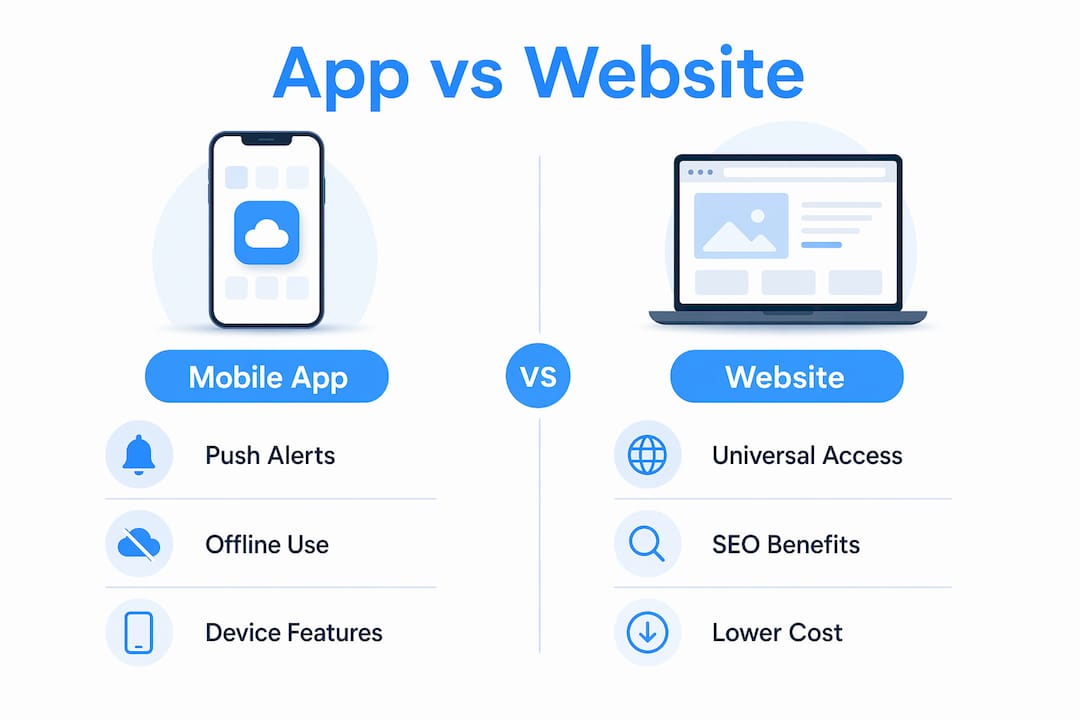
The practical difference shows up in four specific capabilities:
- Push notifications: Apps send real-time alerts directly to a customer’s lock screen. A website cannot do this without the customer actively visiting it.
- Offline access: Native apps cache data locally, so customers can browse products, complete forms, or access their account even without an internet connection.
- Native device integration: Apps use the camera, GPS, biometrics, and accelerometer natively. This enables features like QR code scanning, location-based offers, and fingerprint login.
- Faster load times: Native apps run compiled code on the device rather than downloading and rendering HTML from a server on every visit.
The table below shows where each approach holds a clear advantage.
| Feature | Mobile app | Mobile-responsive website |
|---|---|---|
| Push notifications | Yes, direct to lock screen | No |
| Offline functionality | Yes, with cached data | Limited |
| Camera and GPS integration | Full native access | Restricted via browser |
| Load speed | Fast, compiled on device | Dependent on connection |
| Loyalty and booking features | Deep integration possible | Basic forms only |
| App store discoverability | Yes | No |
Pro Tip: Build your app’s core features around the one or two device capabilities your customers use most. A logistics business gains the most from GPS and camera integration. A retail brand gains the most from push notifications and loyalty programmes. Do not build every feature at once.
Large companies invest in mobile apps as core infrastructure integrated with operations, logistics, and customer experience rather than as standalone marketing tools. South African businesses of all sizes are following the same pattern, particularly in retail, healthcare, and financial services.
How do mobile apps improve customer engagement and retention?
Apps build stronger customer relationships because they create a persistent, personalised presence on a customer’s device. A website visit is a single transaction. An app is an ongoing relationship.
The most effective engagement mechanisms available through mobile apps include:
- Personalised push notifications: Timed messages based on customer behaviour, location, or purchase history drive repeat visits. A clothing retailer can notify a customer when an item they viewed goes on sale.
- Loyalty programmes: Points, rewards, and tier-based benefits are far easier to manage and redeem through an app than through a website or physical card.
- Appointment and order management: Customers book, reschedule, and track orders without calling or emailing, which reduces friction and increases satisfaction.
- In-app analytics: Every tap, scroll, and purchase generates data. Businesses use this data to refine product offerings, improve navigation, and personalise future communications.
Push notifications and loyalty programmes increase customer engagement and provide valuable user data that businesses can act on immediately. That data advantage compounds over time. The longer a customer uses your app, the more accurately you can predict what they want next.
Pro Tip: Keep push notifications relevant and infrequent. Sending more than two or three notifications per week without clear personalisation causes customers to disable them or delete the app entirely. Relevance always beats volume.
Localisation also matters significantly in the South African market. Apps that support multiple languages, display prices in Rands, and reflect local cultural context see higher adoption rates than generic international versions.
In what ways do mobile apps enhance operational efficiency?
Apps are not only customer-facing tools. Many of the strongest returns on app investment come from internal operational improvements. Apps integrated with internal systems reduce manual tasks and enhance workforce collaboration across departments.
Consider what this looks like in practice for a mid-sized South African business:
- A field sales team uses an app to log customer visits, update CRM records, and submit orders in real time, eliminating paper forms and end-of-day data entry.
- A warehouse team manages stock levels through an app connected to the inventory system, receiving automatic alerts when items fall below reorder thresholds.
- A customer support team handles queries through an in-app chat function that logs every interaction, reducing response times and improving resolution rates.
- A management team views live sales dashboards on mobile, making faster decisions without waiting for weekly reports.
Custom mobile apps tailored to local market needs improve competitiveness and customer service for South African businesses across industries. The efficiency gains are not theoretical. They show up in reduced labour costs, faster turnaround times, and fewer errors caused by manual processes.
Cross-platform frameworks like React Native and Flutter allow businesses to build a single codebase that runs on both iOS and Android. This reduces development time and ongoing maintenance costs without sacrificing the native performance that makes apps effective.

When should a business build an app versus using a website or PWA?
Not every business needs a native mobile app right now. A 2026 survey shows 28% of companies find websites sufficient and do not need a mobile app. That figure is worth taking seriously. Building an app for the wrong reasons wastes budget and development time.
The right question is not “should we have an app?” but “does an app directly support a specific business goal?”
| Decision factor | Lean towards a native app | Lean towards a website or PWA |
|---|---|---|
| Customer visit frequency | Daily or weekly usage expected | Occasional, transactional visits |
| Need for push notifications | Yes, critical for engagement | Not required |
| Offline functionality required | Yes | No |
| Device hardware integration | Camera, GPS, biometrics needed | Not needed |
| Budget and timeline | Sufficient for development and maintenance | Limited resources |
| Retention and loyalty goals | Core business objective | Secondary priority |
Progressive Web Apps (PWAs) meet many business needs but lack full native capabilities like deep push notifications and device integration. A PWA is a sensible starting point for businesses testing whether their customers will engage with an app experience before committing to full native development.
Pro Tip: Before commissioning a native app, run a three-month experiment with a PWA or a lightweight web-based tool. Measure how often customers return, how long they spend, and whether they complete key actions. That data makes your app investment decision far more defensible.
The businesses that get the most value from apps are those that align the investment with a measurable goal, whether that is reducing customer churn, cutting internal processing time, or growing repeat purchase revenue.
Key takeaways
Mobile apps deliver their strongest returns when businesses treat them as operational infrastructure rather than marketing tools, aligning every feature with a specific customer or workflow goal.
| Point | Details |
|---|---|
| Apps outperform websites on key features | Push notifications, offline access, and device integration give apps a clear functional edge over responsive websites. |
| Engagement compounds over time | Loyalty programmes and in-app analytics generate customer data that improves personalisation with every interaction. |
| Operational gains are significant | Integrating apps with internal systems reduces manual work, speeds up decisions, and cuts errors across teams. |
| Not every business needs an app now | 28% of companies find websites sufficient; build an app only when it directly supports a measurable business goal. |
| PWAs offer a lower-risk entry point | Test customer engagement with a Progressive Web App before committing to full native app development. |
My honest view on apps and South African business growth
I have worked with enough South African businesses to know that the biggest mistake is not failing to build an app. It is building an app without a clear answer to the question: “What specific problem does this solve for our customers or our team?”
Businesses often arrive with a list of features inspired by what large international brands have done. The result is an app that tries to do everything and does nothing particularly well. User experience and intuitive navigation are the deciding factors in whether customers adopt an app or abandon it after the first session. A focused app with three features that work perfectly will always outperform a bloated app with fifteen features that feel clunky.
The local market context also matters more than most business owners expect. South African customers are price-sensitive and data-conscious. An app that consumes excessive mobile data or requires a strong LTE connection to function will lose users fast, particularly outside major urban centres. Designing for lower-bandwidth conditions is not a compromise. It is a competitive advantage in this market.
My advice is to start with your highest-friction customer interaction and build the app around solving that one problem well. Get that right, measure the results, and then expand. The businesses I have seen succeed with apps are the ones that treat the first version as a learning tool, not a finished product.
— Anton
How Cloudfusion helps businesses build apps that actually work
Cloudfusion builds custom mobile applications for South African businesses across retail, healthcare, logistics, and professional services. Every project starts with a clear understanding of your business goals and customer behaviour, not a template. The team handles everything from UX design and development through to integration with your existing systems and post-launch support. If you are weighing up whether a native app, a PWA, or a custom web development solution is the right fit for your business, give us a shout and let’s chat about your project.
FAQ
Why do businesses need mobile apps in 2026?
Mobile apps give businesses a direct communication channel to customers through push notifications, loyalty programmes, and personalised experiences that websites cannot fully replicate. They also improve internal operations by integrating with inventory, sales, and support systems.
What are the main benefits of mobile apps for businesses?
The core benefits include higher customer retention through loyalty programmes, real-time engagement via push notifications, faster internal workflows, and access to detailed user behaviour data that improves decision-making.
How do mobile apps improve customer engagement?
Apps use push notifications, personalised offers, and in-app loyalty rewards to bring customers back repeatedly. Each interaction generates data that businesses use to make future communications more relevant.
Should every business build a mobile app?
No. A 2026 survey found that 28% of businesses find a website sufficient for their needs. An app makes sense when your customers visit frequently, when you need push notifications or offline access, or when internal workflow efficiency is a clear goal.
What is the difference between a native app and a PWA?
A native app is built specifically for iOS or Android and has full access to device hardware like the camera, GPS, and biometrics. A Progressive Web App runs in a browser and covers basic app-like functionality but lacks full native capabilities, making it a lower-cost starting point for businesses testing the concept.
Recommended