TL;DR:
- Custom software is designed to meet a company’s unique operational needs, offering better process alignment and security than off-the-shelf options. It grows with your business without increasing per-user costs and provides faster updates and greater control over your technology roadmap. Businesses with specialized workflows, rapid growth, sensitive data, or integration needs benefit most from choosing custom development over packaged solutions.
Custom software is defined as bespoke software developed specifically to meet a company’s unique operational requirements, offering functionality, security, and growth potential that off-the-shelf products cannot replicate. The question of why companies choose custom over packaged software comes down to one core reality: generic tools are built for the average business, not yours. The global custom software development market is forecast to grow at a 22.6% CAGR from 2025 to 2030. That figure reflects a clear shift in how businesses view technology investment. Cloudfusion works with South African companies every day that have outgrown packaged tools and need software built around their actual workflows, not the other way around.
What specific advantages does custom software offer businesses?
Custom software aligns completely with your existing business processes. You do not adapt your operations to fit the tool. The tool fits your operations. This distinction matters enormously for specialist teams, high-volume workflows, and businesses with compliance obligations.
The core advantages of custom software include:
- Process alignment: Your software mirrors your actual workflows, removing the friction that generic tools introduce. Specialised workflows create friction with generic tooling, which directly reduces productivity.
- Predictable maintenance costs: Custom software has a flatter cost curve over time compared to SaaS, which grows more expensive as your user count increases.
- Bespoke security controls: Custom software provides higher security controls than packaged offerings, which is critical for businesses handling sensitive financial, medical, or personal data.
- Faster iteration: Dedicated development teams resolve bugs and ship feature updates aligned with your company strategy, not a vendor’s release schedule.
- Competitive differentiation: When your software does something your competitors’ tools cannot, that gap becomes a business advantage that is difficult to replicate.
Custom software also grows with your business without triggering per-user licence fees. A packaged SaaS product charges you more as you hire more people. A custom system does not. That cost structure becomes a significant advantage once your team reaches a certain size.
Pro Tip: Before committing to any software decision, map your five most critical daily workflows. If a packaged tool cannot handle at least four of them without workarounds, custom development is worth a serious evaluation.

How do packaged software solutions differ from custom ones in terms of cost and adaptability?
Packaged software is cheaper upfront. That is its primary selling point, and for many small businesses or simple use cases, it is a perfectly valid choice. The trade-offs appear as your business grows or your needs become more specific.
| Factor | Packaged software | Custom software |
|---|---|---|
| Upfront cost | Lower | Higher |
| Ongoing licence fees | Scales with users | Fixed or predictable |
| Workflow fit | Requires process compromise | Built to your process |
| Customisation depth | Limited by vendor | Unlimited |
| Security controls | Standardised | Bespoke |
| Upgrade risk | Vendor-controlled | You control the roadmap |
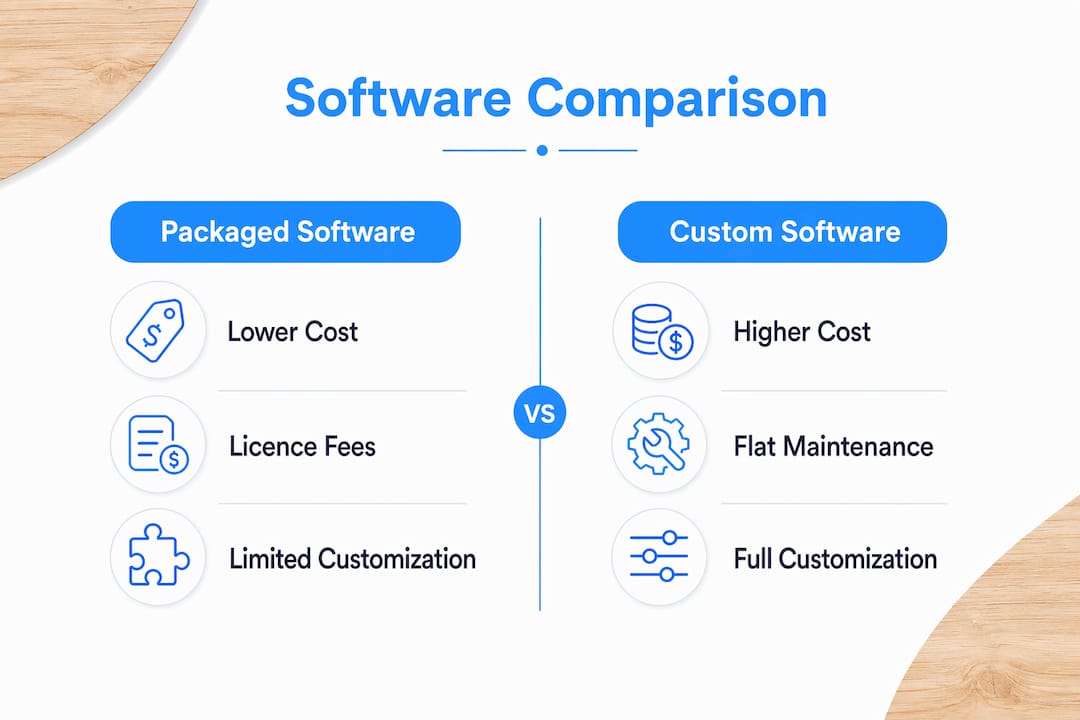
SaaS vendors limit customisation to protect their standard upgrade paths. Every modification you make to a packaged system risks breaking future updates. Vendor support is also not designed for bespoke configurations, which means your IT team carries the burden of maintaining those changes.
Packaged software often forces businesses to change their internal processes to match the software’s logic rather than the other way around. For a business with standard workflows, this is manageable. For a business with specialised operations, it creates compounding inefficiency over time.
The hidden cost of packaged software is rarely discussed upfront. Integration fees, third-party connector tools, and the staff time spent working around limitations all add to the total cost of ownership. Custom software’s total cost of ownership often becomes more favourable after a few years, particularly for businesses scaling their user count rapidly.
Pro Tip: When evaluating packaged software, ask the vendor for a five-year cost projection that includes per-user fees, integration costs, and upgrade charges. Compare that number against a custom development quote before deciding.
Which business scenarios are best suited for custom software?
Not every business needs custom software. The decision depends on the nature of your workflows, your growth trajectory, and how much your software needs to differentiate you from competitors. Six workload patterns consistently point toward custom development as the better choice.
-
High-volume, domain-specific workflows. When your team processes large volumes of specialised tasks daily, generic tools create friction at every step. Large-scale analytics and high-throughput data processing are workloads where custom builds deliver a durable competitive edge.
-
Rapid user or transaction growth. If your business is scaling quickly, per-user SaaS fees become a significant cost driver. Custom software does not penalise you for growth.
-
Sensitive data and compliance requirements. Businesses in financial services, healthcare, or legal sectors face strict data protection obligations. Bespoke security controls and compliance-aligned architecture are far easier to achieve in custom-built systems.
-
Deep integration with existing systems. When your operations depend on legacy systems, proprietary databases, or multiple data sources, packaged software rarely integrates cleanly. Custom development connects everything without compromise.
-
Unique user experience requirements. If your competitive advantage depends on how your team or your customers interact with your software, a generic interface will always limit you. Custom UX design built around your users’ actual behaviour drives measurable productivity gains.
-
Long-term product ownership. Businesses that want full control over their software roadmap, without dependence on a vendor’s priorities or pricing decisions, benefit from owning their codebase outright.
The advantages of custom software development are most visible in scenarios where the gap between what packaged tools offer and what the business actually needs is wide and growing.
How should South African companies approach the custom vs. packaged software decision?
South African businesses face a specific set of considerations that global software vendors rarely account for. Local compliance requirements, currency volatility affecting SaaS subscription costs in rands, and the need for local support all influence the decision.
A practical evaluation framework covers five areas:
- Workflow specialisation: Assess how unique your core processes are. If your workflows are standard, packaged software may serve you well. If they are specialist or proprietary, custom development is the stronger choice.
- Growth trajectory: Project your user count and transaction volume over three to five years. Calculate what your SaaS licence fees will look like at that scale and compare it against a custom build.
- Security and compliance: South African businesses in regulated industries must align with the Protection of Personal Information Act (POPIA) and sector-specific requirements. Bespoke security and compliance controls are easier to implement and audit in custom systems.
- Vendor dependency risk: Packaged software ties your operations to a vendor’s roadmap, pricing decisions, and support priorities. Custom software removes that dependency entirely.
- Local support and cultural fit: A development partner who understands the South African market, operates in your time zone, and speaks your business language delivers better outcomes than a distant vendor with a generic support ticket system.
Cloudfusion partners with South African businesses to evaluate these factors honestly and build software that fits the business, not the other way around. You can read more about how custom software addresses business needs to see how this evaluation plays out in practice.
Key takeaways
Custom software delivers the strongest return when your workflows are specialist, your growth is rapid, or your competitive advantage depends on unique functionality that packaged tools cannot provide.
| Point | Details |
|---|---|
| Cost curve advantage | Custom software maintenance costs stay flat as user count grows, unlike SaaS licence fees. |
| Workflow alignment | Custom software is built around your processes, not the other way around. |
| Security and compliance | Bespoke systems offer higher security controls and are easier to align with POPIA requirements. |
| Vendor independence | Custom software gives you full control over your roadmap without dependence on a vendor’s priorities. |
| Decision trigger | Evaluate custom development when packaged tools require significant process compromise or integration workarounds. |
The real cost of “good enough” software
Here is something I have observed consistently working with South African businesses across different sectors: the companies that delay custom development rarely save money. They spend it differently, on workarounds, integrations, staff training for tools that do not quite fit, and eventually on migration costs when the packaged solution hits its ceiling.
The misconception I encounter most often is that custom software is a luxury. It is not. It is a capital decision, similar to buying equipment that fits your production line rather than renting equipment designed for someone else’s. The upfront cost is real, but the compounding efficiency gains and the absence of per-user fee escalation change the financial picture significantly within two to three years.
What I find particularly important for South African businesses is the localisation factor. A development partner who understands local compliance, local infrastructure constraints, and local business culture does not just write better code. They ask better questions during the scoping phase, which means the software solves the right problems from day one. That is where the real productivity gains come from, not from the technology itself, but from how precisely it is designed around the people using it daily.
If you are evaluating your options, the benefits of investing in custom software are worth reading before you commit to a packaged solution that may cost you more in the long run.
— Anton
Cloudfusion builds software that fits your business
Cloudfusion specialises in custom web development for South African businesses that have outgrown generic tools or need software built precisely around their operations. Whether you are dealing with specialist workflows, compliance requirements, or growth that is pushing your current system to its limits, the team at Cloudfusion can help you evaluate your options and build a solution that works for the long term. Give us a shout to chat about your project. We will assess your current setup, identify where packaged software is holding you back, and outline what a custom build would look like for your specific context.
FAQ
What is custom software development?
Custom software development is the process of designing and building software specifically for a single organisation’s unique requirements. Unlike packaged software, it is not sold to multiple businesses and is not constrained by a vendor’s standard feature set.
Why do companies choose custom over packaged software?
Companies choose custom software when their workflows are too specialised for generic tools, when growth makes per-user licence fees unsustainable, or when competitive advantage depends on unique functionality. The global market growth rate of 22.6% CAGR from 2025 to 2030 reflects how widely businesses are reaching this conclusion.
Is custom software more expensive than packaged software?
Custom software has higher upfront development costs, but its maintenance costs do not scale with user growth the way SaaS licence fees do. For growing businesses, the total cost of ownership often favours custom software within two to three years.
What are the main risks of packaged software?
The main risks are vendor dependency, limited customisation, and rising licence costs at scale. Heavy customisation of packaged software also risks breaking future upgrades, leaving your IT team to maintain unsupported configurations.
How do I know if my business needs custom software?
Your business needs custom software when packaged tools require significant process compromises, when integration with existing systems is incomplete, or when your security and compliance requirements exceed what a standard product can provide.
Recommended