TL;DR:
- Custom software is purpose-built technology that addresses a company’s specific operational needs and workflows. It offers advantages like precise workflow alignment, full control, integration with existing systems, and long-term cost savings. Investing in custom solutions supports business growth, reduces inefficiencies, and creates valuable proprietary assets.
Custom software is purpose-built digital technology designed to address a corporation’s specific operational needs, workflows, and growth objectives. Unlike off-the-shelf products, bespoke software encodes your unique business logic directly into the system. The custom software development market is projected to grow at a 22.6% CAGR from 2025 to 2030. That figure reflects a clear shift: corporations worldwide are choosing tailored solutions over generic platforms because the business case for fit, control, and adaptability is now undeniable. This guide explains why corporations need custom software and what decision-makers must understand before committing to that investment.
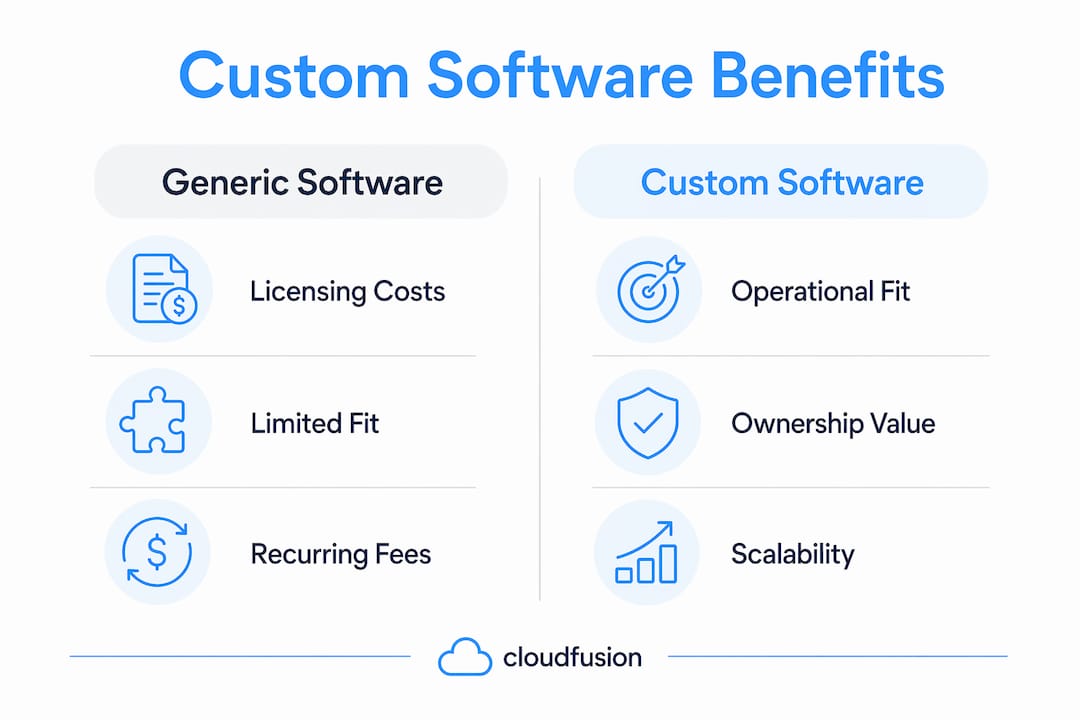
What are the strategic advantages of custom software for corporations?
Custom software fits your business workflows precisely, eliminating the workarounds that generic platforms force on your teams. Off-the-shelf products are built for the broadest possible audience. Your corporation’s processes are not average, and forcing them into a standard mould creates friction, duplication, and inefficiency.
The core advantages of tailored software for corporations include:
- Exact workflow alignment. The software is built around how your teams actually work, not how a vendor assumes they work.
- Full ownership and control. You own the codebase, the data, and the roadmap. No vendor can change pricing, discontinue features, or restrict access.
- Deep system integration. Custom solutions connect directly with your existing ERP, CRM, or financial systems without the compatibility compromises that generic tools require.
- Reduced manual effort. Automating company-specific processes cuts data entry errors and frees staff for higher-value work.
- Proprietary competitive advantage. Your software becomes a capability your competitors cannot replicate by purchasing the same product.
Custom software also reduces reliance on multiple software licences, avoiding recurring SaaS fees and hidden subscription costs. Over time, ownership lowers total cost of technology compared to perpetual licence payments.
Pro Tip: Before scoping a custom build, map every manual workaround your teams currently use. Each workaround is a direct cost you can eliminate and a clear requirement for your development brief.
How does custom software support business scalability and long-term growth?
Custom software grows with your corporation rather than constraining it. Generic platforms impose user limits, data caps, and feature restrictions that become expensive obstacles as your business expands. A tailored solution is architected from the start to handle your growth trajectory.
The path to scalable software through a custom build follows a logical progression:
- Identify the critical bottleneck first. Start with the single workflow causing the most friction. Solving it delivers immediate value and generates user feedback that shapes the next phase.
- Build for your data volumes, not average volumes. Generic platforms throttle performance at scale. Custom architecture handles your specific transaction loads and reporting demands.
- Design for multi-location operations. South African corporations with branches across provinces or regions need cloud-connected systems that work consistently regardless of location.
- Iterate based on real usage. Iterative development focused on key bottlenecks first reduces time-to-value and post-launch over-scoping risks. Each release improves on actual user behaviour, not assumptions.
- Future-proof through modularity. A modular architecture allows new capabilities to be added without rebuilding the core system, protecting your technology investment over years.
South African corporations increasingly pursue custom solutions to overcome fragmented systems and dispersed data across locations and platforms. Integrating multi-site operations requires software designed for cloud connectivity and tailored process flows.
Pro Tip: Resist the urge to build everything at once. A focused first release that solves one real problem will always outperform an ambitious build that takes 18 months and misses the mark on half its features.
What operational challenges do corporations overcome by investing in custom software?
Corporations that rely on generic software typically accumulate a patchwork of disconnected tools. Each tool solves one problem but creates new ones: duplicated data, inconsistent reporting, and staff spending hours reconciling information between systems.

Business processes outgrow generic software capabilities, leading to inefficiencies like duplicated data entry and slow reporting. Employees resort to spreadsheets and manual workarounds when their tools cannot keep up. Custom software eliminates these failure points by design.
The operational gains corporations typically achieve include:
- Elimination of data silos. A single, integrated system replaces multiple disconnected platforms, giving every department access to the same accurate data.
- Accurate, real-time reporting. Decision-makers get dashboards and reports built around their actual KPIs, not the generic metrics a vendor chose to include.
- Improved customer experience. Personalised digital experiences improve customer retention and operational responsiveness beyond standard platform constraints.
- Tailored security protocols. Custom solutions embed company-specific security measures beyond generic standards, which is critical for industries handling sensitive data or compliance requirements.
| Challenge | Generic software outcome | Custom software outcome |
|---|---|---|
| Workflow mismatch | Manual workarounds and errors | Processes built to match actual workflows |
| System integration | Partial or costly third-party connectors | Native integration with existing systems |
| Reporting accuracy | Generic metrics, manual exports | Real-time dashboards built to your KPIs |
| Data security | Standard vendor protocols | Company-specific security and compliance controls |
| Scalability | User and data limits hit growth ceiling | Architecture designed for your growth trajectory |
When is custom software the smarter choice over off-the-shelf and SaaS options?
The decision is not always straightforward. Off-the-shelf and SaaS products are genuinely good choices for standard business functions like email, payroll, or basic accounting. The case for custom software becomes clear in specific situations.
Custom software is the right choice when your business logic is genuinely unique. If your processes cannot be configured within a standard platform without significant compromise, you are already paying a hidden cost in inefficiency. The question is whether you pay it indefinitely through workarounds or resolve it once through a tailored build.
You can explore whether custom software addresses your specific challenges by mapping the gap between what your current tools do and what your business actually needs. That gap has a rand value. When the cost of the gap exceeds the cost of building, the investment decision becomes straightforward.
Custom software acts as a proprietary platform encoding unique company logic and data, increasing in value over time unlike SaaS operating costs. A SaaS subscription is a recurring expense with no residual value. Custom software is an asset that appreciates as it is refined and integrated more deeply into your operations. Understanding the difference between free and paid software models helps clarify why ownership matters for long-term cost planning.
The risk to manage is over-scoping. Corporations that attempt to build a complete enterprise platform in one project frequently face delays, budget overruns, and poor adoption. The most successful custom builds start with a focused scope addressing one critical need, then expand through iteration.
Key takeaways
Custom software is a proprietary business asset that grows in value with each iteration, delivering operational fit, ownership, and competitive differentiation that generic platforms cannot match.
| Point | Details |
|---|---|
| Fit over features | Custom software matches your exact workflows, eliminating costly workarounds and manual processes. |
| Ownership builds value | Unlike SaaS subscriptions, custom software is an asset you own and control, appreciating over time. |
| Start focused, then scale | Begin with one critical bottleneck, iterate on real feedback, and expand the system progressively. |
| Integration eliminates silos | Tailored solutions connect your existing systems natively, delivering accurate, real-time data across the business. |
| Security by design | Custom builds embed company-specific security protocols, reducing risk beyond what generic platforms offer. |
Custom software as a corporate asset: my honest assessment
After working with South African corporations across multiple industries, the pattern I see most often is this: businesses wait too long to invest in custom software, then try to build too much at once when they finally do. Both mistakes are expensive.
The corporations that get the most value from custom builds treat the software as a product, not a project. They assign an internal owner, they release early, and they iterate based on what users actually do. The first version is never perfect. That is not the point. The point is that it is yours, it solves a real problem, and it gets better every quarter.
Here is what I find most decision-makers underestimate: the compounding value of ownership. Every improvement you make to a custom system adds to an asset your business controls. Every rand you spend on a SaaS subscription adds to a vendor’s revenue with no residual value to you. Over a five-year horizon, that difference is significant for most corporations.
The other insight worth sharing is about local context. South African businesses face infrastructure challenges, connectivity variability, and compliance requirements that global SaaS vendors do not prioritise. A locally developed custom solution, built by a team that understands the South African operating environment, will handle those realities far better than a platform designed for markets with different constraints.
My recommendation: identify your single most painful operational bottleneck, cost it honestly, and use that number to justify a focused first build. You will have a working system faster than you expect, and a foundation you can build on for years.
— Anton
How Cloudfusion helps corporations build software that works for them
Cloudfusion builds custom web development solutions for South African corporations that need software aligned with their specific processes, not adapted from a generic template. The team works with decision-makers to scope focused builds that deliver real value quickly, then supports iterative growth as business needs evolve. From complex system integrations to tailored reporting platforms, Cloudfusion brings both technical depth and local market understanding to every project. If your current tools are holding your business back, give us a shout and let’s chat about what a purpose-built solution could do for your operations.
FAQ
What is custom software development?
Custom software development is the process of building digital applications designed specifically for one organisation’s workflows, data requirements, and business logic. It differs from off-the-shelf software, which is built for general use across many businesses.
How much does custom software cost in South Africa?
Custom software costs vary widely based on complexity, scope, and the development team engaged. A focused first build addressing one core workflow typically costs significantly less than a full enterprise platform, and Cloudfusion provides detailed scoping and pricing before any commitment.
How long does it take to build custom software?
A focused custom build targeting one critical workflow can be completed in as little as two to four months. Larger, more complex systems take longer, but iterative development means you receive working software in stages rather than waiting for a complete system.
When should a corporation choose custom software over SaaS?
Custom software is the better choice when your business logic is unique, when generic platforms require significant workarounds, or when recurring licence costs over three to five years exceed the cost of a tailored build. The importance of tailored software becomes clear when you calculate the true cost of your current inefficiencies.
Does custom software require ongoing maintenance?
Custom software requires ongoing maintenance to address updates, security patches, and new feature development. This is typically managed through a support agreement with your development partner, and the cost is far lower than the recurring fees of equivalent SaaS platforms.
Recommended