TL;DR:
- Custom CMS platforms are essential for international businesses because they improve site performance, governance, and security tailored to specific regional needs. They enable faster load times, better content control, and stronger security, which lead to increased revenue and operational efficiency. Investing in a custom CMS typically yields measurable returns within 18 to 24 months through savings and performance benefits.
A custom content management system (CMS) is defined as a purpose-built platform engineered to match an organisation’s exact workflows, integration requirements, and global content complexity. Generic platforms force your business to adapt to their constraints. A tailored CMS adapts to yours. For international businesses managing content across multiple regions, languages, and regulatory environments, that distinction is not a preference. It is a necessity. Understanding why international businesses need custom CMS starts with recognising that off-the-shelf solutions were built for the average use case, and global operations are anything but average.
Why international businesses need custom CMS: the performance case
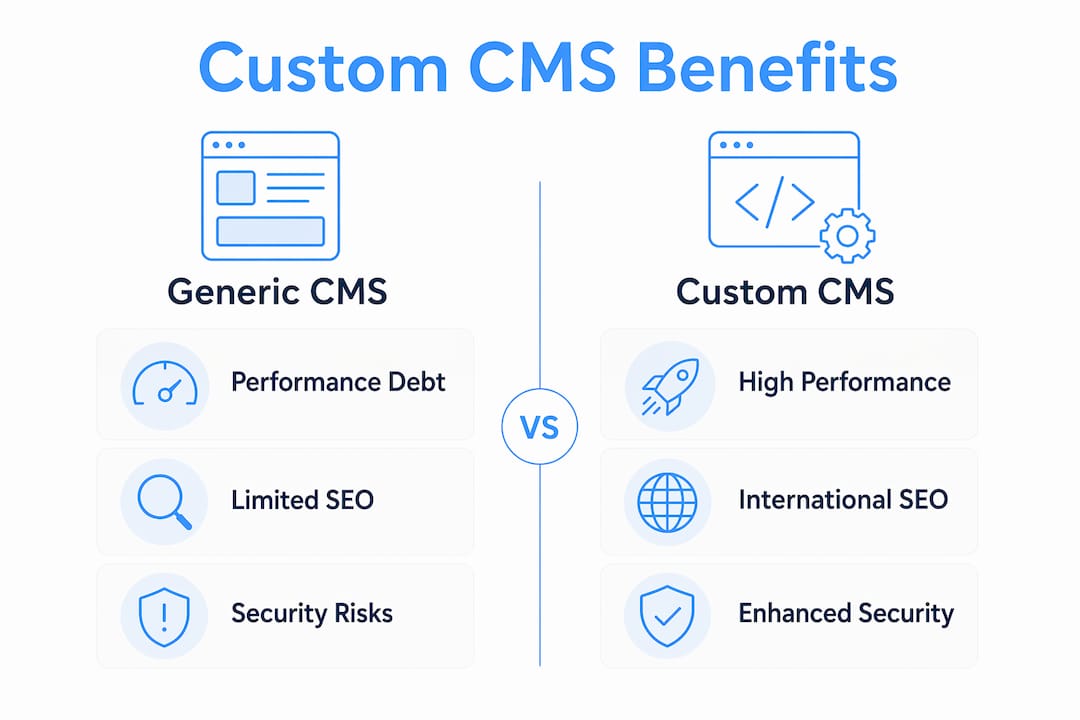
Site performance is the first place where generic platforms fail international businesses. A custom CMS can score 95+ on Google Lighthouse versus around 60 for generic platforms. That gap translates directly into revenue. A one-second delay in mobile page load can reduce conversions by up to 20%. For a business operating across five or ten markets, that loss compounds at every regional touchpoint.
Generic platforms carry performance debt by design. They ship with bloated plugin architectures, shared codebases, and template structures built for flexibility rather than speed. A custom CMS carries only the code your business actually uses. The result is leaner page weights, faster server responses, and consistent performance regardless of where your users are connecting from.
The benefits of custom CMS on conversion rates are particularly visible in emerging markets where mobile connectivity is variable. South African businesses expanding into sub-Saharan Africa, for example, serve users on 3G connections where every kilobyte matters. A tailored platform can be built with progressive loading, image compression pipelines, and regional CDN routing baked in from day one.
Key performance advantages of a custom CMS include:
- Lighthouse scores consistently above 90, compared to 60 or lower on generic platforms
- Faster time-to-first-byte through server-side rendering tuned to your infrastructure
- Reduced plugin overhead by replacing third-party extensions with native functionality
- Regional CDN integration for consistent load times across geographically dispersed markets
- Mobile-first architecture designed for variable connectivity environments
Pro Tip: Before commissioning a custom CMS build, run a Google Lighthouse audit on your current platform. Document your baseline scores across three to five key markets. This gives your development partner a measurable target and makes the ROI case concrete from the start.
How do you govern content across multiple regions?
Content governance is the part of international CMS management that most businesses underestimate. Schema and operational decay can happen within 30 days without a formal governance structure. That means your content model, translation workflows, and locale hierarchies can fall apart faster than most IT managers expect.

A custom CMS solves this by embedding governance directly into the platform architecture. Roles, permissions, translation SLAs, and approval chains are not bolted on as afterthoughts. They are first-class features of the system design. The result is that your editorial teams in Johannesburg, London, and São Paulo all operate within the same governance framework, even when they have different levels of autonomy.
The most effective approach to multi-region content governance follows a structured sequence:
- Define content ownership by locale, brand, and content type before writing a single line of code
- Document translation SLAs specifying turnaround times, review cycles, and fallback languages
- Establish locale conflict protocols to resolve disputes when regional teams override global defaults
- Build approval chains into the CMS workflow engine so content cannot publish without the correct sign-offs
- Assign a content operations lead per region who owns the governance document and updates it quarterly
Operational governance documentation is more critical to CMS success than the platform choice itself. This is a counterintuitive finding, but it holds up in practice. The best custom CMS in the world will degrade without clear ownership and documented processes.
Custom CMS platforms also support what practitioners call sync agents and localisation agents. A sync agent pushes approved global content to regional instances automatically. A localisation agent flags content that requires regional adaptation before it can publish. These mechanisms enforce brand consistency without removing local editorial autonomy. The importance of a tailored CMS becomes clearest here: generic platforms cannot replicate this level of workflow precision without expensive, fragile third-party integrations.
What are the integration and security advantages of a custom CMS?
Integration reliability separates custom CMS platforms from generic alternatives in a way that most decision-makers only discover after a painful production failure. Custom CMS platforms allow two-way API connections that are tested, monitored, and owned internally. Generic plugin-based integrations are built by third parties, updated on their schedule, and broken by platform version changes outside your control.
For international businesses, this matters because your CMS must connect to ERPs, CRMs, pricing engines, and localisation platforms simultaneously. A custom integration layer is designed around your specific data contracts. It does not rely on a plugin author maintaining compatibility with your ERP version.
A custom CMS lacks a public codebase, which means attackers cannot study its architecture in advance. WordPress powers 43% of websites and is the most targeted platform by automated attacks precisely because its codebase is public and its vulnerabilities are well-documented. A custom CMS removes that attack surface entirely.
Security by obscurity is not the only protection a custom CMS provides. Your development team can implement authentication protocols, data encryption standards, and access controls that match your specific compliance requirements. For businesses operating under GDPR in Europe, POPIA in South Africa, or PDPA in Southeast Asia, data privacy compliance requirements differ by jurisdiction. A custom CMS can enforce the correct rules per locale automatically, rather than relying on manual processes or generic compliance plugins.
The integration and security advantages of a custom CMS for international businesses include:
- Private codebase that reduces exposure to automated vulnerability scanning
- Custom authentication aligned to your identity provider and access policies
- Jurisdiction-aware data handling that routes and stores data according to local regulations
- Monitored API integrations with alerting and fallback logic built in
- No third-party plugin dependencies that introduce unvetted code into your production environment
How does custom CMS support expansion into new markets?
Entering a new market with a generic CMS typically means a forced rewrite. You hit the platform’s limits on URL structures, metadata schemas, or content models, and the only path forward is rebuilding. Multi-tenant CMS architectures reduce per-brand costs by reusing models, assets, and code, enabling faster market entry without those forced rewrites. That is a direct cost and time saving that compounds across every new country you enter.
The Global Content OS model, used by organisations managing over 100 brands simultaneously, demonstrates how central governance and local autonomy can coexist. A master content stack holds global templates, brand assets, and approved content models. Regional stacks inherit from the master but can override specific elements for local relevance. This architecture breaks the binary trap of either rigid centralisation or chaotic fragmentation.
International SEO and UX require correct URL structures, hreflang tags, and metadata schemas to ensure visibility in each target market. Generic platforms often handle these inconsistently, particularly when managing more than three or four locales. A custom CMS can enforce correct technical SEO implementation as a platform-level rule, not a per-editor responsibility.
| Capability | Generic CMS approach | Custom CMS approach |
|---|---|---|
| New market launch | Manual reconfiguration, often a rebuild | Template inheritance from master stack |
| SEO per locale | Plugin-dependent, inconsistent | Platform-enforced hreflang and metadata |
| Brand consistency | Style guides enforced manually | Content model constraints enforced by system |
| Asset reuse | Duplicated across instances | Centralised asset library with regional permissions |
| Compliance per region | Manual process or third-party plugin | Jurisdiction-aware logic built into the platform |
The custom software development advantages extend beyond the CMS itself. When your CMS is built as part of a broader digital ecosystem, it connects naturally to your mobile applications, marketing automation tools, and digital advertising platforms. Businesses that invest in eCommerce advertising performance alongside a well-structured CMS see compounding returns, because fast, well-governed content feeds better ad targeting and higher quality scores.
Businesses typically recoup their custom CMS investment within 18–24 months through lower licensing fees, reduced external developer costs, and faster page load revenue benefits. That timeline shortens further when the platform supports multiple markets from a single codebase.
Key takeaways
Custom CMS platforms are the pragmatic choice for international businesses when generic platforms create operational friction, security exposure, or content governance failures that cost more to work around than to solve properly.
| Point | Details |
|---|---|
| Performance drives revenue | Custom CMS scores 95+ on Google Lighthouse versus 60 for generic platforms, directly improving conversion rates. |
| Governance prevents decay | Without documented workflows and SLAs, multi-language CMS schemas degrade within 30 days. |
| Security is structural | A private codebase removes the attack surface that makes generic platforms the primary target for automated attacks. |
| Multi-tenant architecture saves cost | Reusing models and assets across regions reduces per-market launch costs and eliminates forced rewrites. |
| ROI is measurable | Businesses recover custom CMS investment within 18–24 months through licensing savings and performance gains. |
The real cost of getting this wrong
Most businesses I speak with frame the custom CMS decision as a cost question. They compare the upfront build cost against a monthly SaaS subscription and conclude the generic platform wins. That calculation ignores the operational cost of working around a platform that was not built for your use case.
Here is what I have seen consistently: businesses that deploy generic CMS platforms for international operations spend the first 12 months building workarounds. They add plugins to handle translation workflows. They write custom scripts to manage locale-specific pricing. They hire developers to patch security vulnerabilities introduced by third-party extensions. By month 18, the total cost of those workarounds exceeds what a custom build would have cost.
The governance piece is where the real damage happens. Content production velocity doubles when approval chains and business logic are embedded in the platform. When they are not, editorial teams spend time on process management instead of content creation. That is a hidden cost that never appears on a platform comparison spreadsheet.
My honest recommendation is this: if your business operates in more than two markets, manages more than one language, or integrates your CMS with an ERP or CRM, the question is not whether you need a custom CMS. The question is how long you can afford to delay it. The benefits of a custom website extend well beyond aesthetics. They reach into your operational efficiency, your security posture, and your ability to move quickly when a new market opportunity appears.
— Anton
Cloudfusion’s custom web development for international businesses
Cloudfusion builds custom web development solutions for businesses that have outgrown generic platforms. The team designs CMS architectures that handle multi-region content governance, two-way API integrations, and jurisdiction-aware compliance from the ground up. Every build is tailored to your workflows, not the other way around. Cloudfusion works with South African businesses expanding internationally and with global organisations that need a reliable local development partner. If your current CMS is creating friction rather than removing it, give us a shout. Let’s chat about your project and build something that actually fits your operation.
FAQ
What is a custom CMS?
A custom CMS is a content management system built specifically for a business’s unique workflows, integrations, and content requirements, rather than adapted from a generic off-the-shelf platform.
How does a custom CMS improve international SEO?
A custom CMS enforces correct hreflang tags, URL structures, and locale-specific metadata at the platform level, ensuring consistent search visibility across every target market.
Is a custom CMS more secure than generic platforms?
A custom CMS uses a private codebase, which removes the publicly documented vulnerabilities that make generic platforms the primary target for automated attacks.
How long does it take to see ROI from a custom CMS?
Businesses typically recoup their custom CMS investment within 18–24 months through savings on licensing fees, reduced developer costs, and revenue gains from faster page load times.
When does a business actually need a custom CMS?
A custom CMS becomes the practical choice when a business manages complex workflows, fragile third-party integrations, or content across multiple languages and regions that generic platforms cannot handle without expensive workarounds.
Recommended