TL;DR:
- Custom software is tailored applications built around a startup’s unique workflows to create proprietary competitive advantages. It offers a perfect process fit, full ownerhip of IP, and reduces long-term costs compared to generic tools, especially during growth. Most startups benefit from a hybrid approach, combining off-the-shelf solutions with custom systems once their business model is validated.
Custom software is defined as bespoke, purpose-built applications designed specifically around a startup’s unique business processes, rather than adapted from a generic product built for the broadest possible market. Understanding why startups need custom software comes down to one core reality: your workflows, your competitive advantage, and your growth trajectory are not generic. Off-the-shelf tools are built for the average business. If your startup is doing something genuinely different, average tools will hold you back. Custom software gives you a system that fits your processes exactly, creates proprietary intellectual property (IP) that investors value, and grows with your business without the constraints of a third-party vendor’s product roadmap.
What are the key benefits of custom software for startups?
Custom software delivers a 100% process fit, compared to the 70–90% fit typical of off-the-shelf solutions. That gap matters more than it sounds. The 10–30% of your workflow that a generic tool cannot handle forces your team into manual workarounds, duplicate data entry, and disconnected systems. These inefficiencies compound daily.
The core benefits of tailored software solutions for startups include:
- Process alignment. Every screen, workflow, and automation is built around how your team actually works, not how a vendor assumes you work.
- Proprietary IP. Custom builds encode your unique workflows into software that belongs entirely to you. Investors treat this as evidence of a durable, defensible business model.
- No vendor dependency. You are not subject to price increases, feature deprecations, or a vendor shutting down. You own the product roadmap.
- Security and compliance control. You define the data architecture, access controls, and compliance requirements from day one, rather than inheriting a vendor’s decisions.
- Automation at depth. Generic tools automate common tasks. Custom software automates the specific, high-value tasks unique to your business model.
The benefits of custom software extend beyond efficiency. When your software encodes a workflow that competitors cannot easily replicate, it becomes a moat. That is the difference between a tool and a strategic asset.
Pro Tip: Document your unique workflows before any development begins. The clearer your process map, the faster and cheaper your build will be, and the more precisely the software will fit your actual needs.

How does custom software compare to off-the-shelf solutions for startups?
The custom software vs off-the-shelf decision is rarely straightforward. Cost is the most visible factor, but total cost of ownership (TCO) over 3–5 years often tells a different story. TCO over 3–5 years can favour custom software once you account for licensing fees, integration costs, and the staff time spent managing workarounds.
Off-the-shelf tools have genuine advantages. They deploy in days or weeks, require no development budget upfront, and are maintained by the vendor. For commodity functions like email, accounting, or HR administration, they are the right choice. The problem arises when a startup tries to run a differentiated, complex workflow through a tool designed for the average business.
| Criteria | Off-the-shelf | Custom software |
|---|---|---|
| Deployment speed | Days to weeks | 3–18 months depending on scope |
| Process fit | 70–90% typical fit | 100% fit to your workflows |
| Upfront cost | Low to moderate | MVP typically R900,000+ |
| Long-term TCO | Increases with scale and integrations | Decreases relative to value over time |
| IP ownership | None, vendor owns the product | Full ownership of source code and IP |
| Flexibility | Limited to vendor’s roadmap | Fully modifiable at any time |
Hidden costs of off-the-shelf software include re-keying data between disconnected systems, staff time spent on partial solutions, and the compounding friction of tool mismatches. These costs are invisible on a subscription invoice but very visible on your team’s productivity.
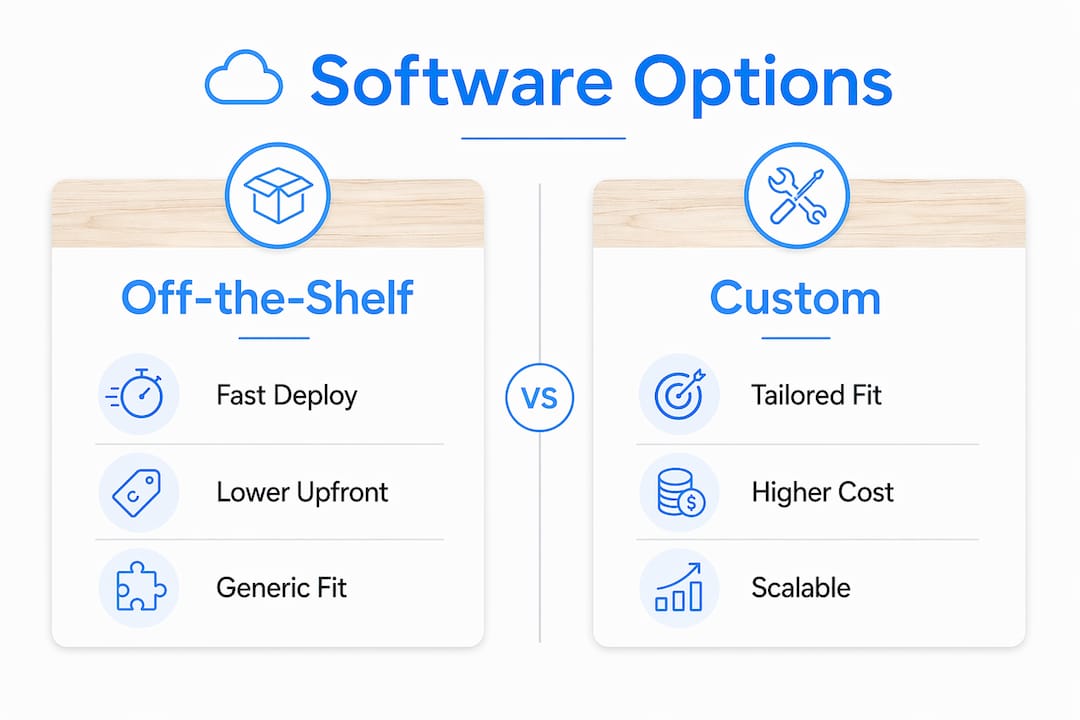
The most practical approach for most startups is a hybrid architecture. Hybrid strategies use off-the-shelf tools for commodity functions and custom software for the workflows that define your competitive advantage. This keeps costs manageable while protecting the parts of your business that matter most.
When is the right time to invest in custom software?
Timing is the most consequential decision in the custom software development process. Building too early wastes capital on a product that may need to be rebuilt once your business model is validated. Building too late means your growth is constrained by tools that were never designed for your scale.
The right time to invest in custom software is when the following conditions are true:
- Your business model is validated. You have paying customers and a repeatable process. You are not still searching for product-market fit.
- Monthly operational costs exceed the amortised cost of a custom build. When monthly costs from subscriptions, integrations, and manual workarounds exceed the monthly amortised cost of a custom solution over 24–36 months, the financial case for building is clear.
- Your workflows are genuinely unique. If your process fits the standard 80% use case that off-the-shelf tools serve, you do not need custom software yet. If your workflow is the differentiator, you do.
- You are hitting growth ceilings. Your current tools cannot handle your transaction volumes, user numbers, or data complexity without significant manual intervention.
- Integration costs are escalating. You are paying for multiple point solutions that do not talk to each other, and the integration work is becoming a full-time job.
Pro Tip: Before committing to a full custom build, validate your core workflows with no-code or low-code tools. Once you know exactly what you need, the custom build will be faster, cheaper, and more accurate.
Founders often build custom software too early, before their processes are stable enough to encode in software. A Minimum Viable Product (MVP) approach, starting with the most critical workflow and expanding from there, reduces this risk significantly. MVP development typically costs between R900,000 and R1.4 million and takes 3–12 months, depending on complexity.
How do startups successfully build custom software?
The difference between a custom software project that delivers long-term value and one that becomes a costly liability is almost always architectural discipline. Developing architecture before coding is critical, particularly in complex domains like FinTech and HealthTech, where solutions built without this discipline risk becoming unsustainable within 24 months.
Successful custom software builds share these characteristics:
- Architecture designed for scale. Key architectures should handle 10x current loads from day one. Rebuilding a system because it cannot handle growth is one of the most expensive mistakes a startup can make.
- Agile development with stakeholder involvement. Agile with dedicated cross-functional teams ensures flexibility and quality. Founders should be involved in sprint reviews, not just the final handover.
- Full IP and source code ownership. Owning 100% of the source code and documentation prevents vendor lock-in and keeps your product roadmap in your hands.
- Cross-functional teams. A complete team includes frontend developers, backend developers, QA engineers, and DevOps specialists. Gaps in any of these roles create technical debt.
- Documentation from day one. Code without documentation is a liability. Future developers, including your own hires, need clear documentation to maintain and extend the system.
The table below outlines the key roles in a custom software development team and their primary responsibilities.
| Role | Primary responsibility |
|---|---|
| Frontend developer | User interface, user experience, and client-side logic |
| Backend developer | Server-side logic, APIs, database architecture |
| QA engineer | Testing, bug identification, quality assurance |
| DevOps specialist | Deployment pipelines, infrastructure, monitoring |
| Project manager | Stakeholder communication, sprint planning, delivery |
Understanding how custom software addresses specific business needs at each stage of growth helps founders make better decisions about team composition and project scope.
Key takeaways
Custom software is a strategic investment that pays off when your workflows are unique, your business model is validated, and your growth ambitions exceed what generic tools can support.
| Point | Details |
|---|---|
| Process fit matters | Custom software delivers 100% workflow fit versus 70–90% from off-the-shelf tools. |
| IP is a business asset | Custom builds create proprietary IP that investors value as evidence of a defensible business. |
| Timing is critical | Invest in custom software after validating your business model, not before. |
| Hybrid approaches work | Use off-the-shelf for commodity functions and custom software for your competitive workflows. |
| Architecture first | Design for 10x current load from day one to avoid costly rebuilds during growth phases. |
The real value of custom software is what it prevents
Most founders evaluate custom software by asking what it will do for them. The more important question is what it will prevent. Generic tools force your team to adapt to software. Custom software adapts to your team. That distinction sounds subtle, but over two to three years, it determines whether your operations scale cleanly or fracture under the weight of workarounds.
I have seen startups spend more on integrations, manual data fixes, and staff time managing tool gaps than they would have spent on a focused custom build. The cost of friction is real, and it compounds quietly until it becomes a crisis. The founders who get this right are the ones who treat their software as a core business decision, not an IT procurement task.
The other thing worth saying plainly: custom software is both a defensive and an offensive investment. Defensively, it protects your processes from easy replication by competitors. Offensively, it lets you move faster, automate deeper, and serve your customers in ways that generic tools simply cannot support. That combination is why investors pay attention when a startup owns its technology stack outright.
The hybrid approach is where most mature startups land, and it is the right call. Do not build what you can buy cheaply. Do build what defines you. The efficiency gains from custom software are most visible in the workflows you own completely, not the ones you share with every other business on a SaaS platform.
— Anton
Cloudfusion builds custom software for startups that mean business
Cloudfusion works with South African startups to design and build software that fits their exact workflows, not a vendor’s template. The approach starts with architecture, not code, so the systems we build handle growth without expensive rewrites. Founders retain full ownership of their source code and IP from day one. Whether you need a web platform, a mobile application, or a full-stack system built around your unique processes, Cloudfusion has the cross-functional teams to deliver it. Have a look at our custom web development portfolio to see what we have built, or give us a shout to chat about your startup’s software needs.
FAQ
What is custom software development for startups?
Custom software development is the process of building bespoke applications designed specifically for a startup’s unique workflows and business model. Unlike off-the-shelf tools, custom software is owned entirely by the startup and can be modified at any time.
How much does custom software cost for a startup?
An MVP typically costs between R900,000 and R1.4 million, with enterprise platforms reaching significantly more depending on complexity. Development timelines generally span 3–18 months based on scope.
When should a startup choose custom software over off-the-shelf?
A startup should choose custom software when its workflows are genuinely unique, monthly operational costs exceed the amortised cost of a custom build over 24–36 months, or when off-the-shelf tools are creating growth ceilings.
Does custom software give startups a competitive advantage?
Custom software encodes your unique workflows into proprietary IP that competitors cannot easily replicate. Investors also treat owned technology as evidence of a durable, defensible business model.
What is a hybrid software approach for startups?
A hybrid approach uses off-the-shelf tools for commodity functions like email and accounting, and custom software for the workflows that define your competitive advantage. Most mature startups adopt this architecture to balance cost and differentiation.
Recommended