

Business Continuity Planning: Safeguarding E-commerce Operations
Business continuity planning protects e-commerce uptime, ensures cloud-based resilience, and minimises financial risk. Learn types, strategies and costs.
Start reading
A single disruption can turn a thriving online store into a costly headache for IT managers and business continuity planners. Keeping essential operations running smoothly—from sales platforms to supplier communications—matters more than wishful thinking once trouble strikes. This guide brings clarity to what business continuity means for e-commerce, outlining proven strategies and cloud features that help South African, British, and American teams maintain service, protect reputation, and navigate regulatory challenges when crises hit.
Table of Contents
- Defining Business Continuity For E-commerce
- Key Types Of Continuity Planning
- Core Features Of Cloud-Based Solutions
- Tailoring Plans To E-commerce Needs
- Legal, Compliance And Cost Implications
- Risks To Avoid And Common Pitfalls
Key Takeaways
Point | Details |
|---|---|
Comprehensive Continuity Planning | E-commerce businesses need a robust continuity strategy to stay operational during disruptions, focusing on critical functions like sales, inventory, and customer communication. |
Involve the Whole Organisation | Continuity planning should not be solely an IT concern; all departments must be engaged to ensure a collaborative and effective response during crises. |
Regular Testing is Essential | Continuity plans must be tested regularly to identify weaknesses and ensure that all team members understand their roles in a crisis. |
Adapt Plans to Unique E-commerce Needs | Tailor continuity strategies to the specific vulnerabilities of e-commerce operations, including compliance with relevant regulations and dependencies on suppliers. |
Defining Business Continuity For E-commerce
Business continuity for e-commerce isn’t just about having a backup plan when things go wrong. It’s a comprehensive approach to keeping your online business operational even when crises hit. When a cyberattack takes down your servers, a supplier fails to deliver, or a natural disaster strikes your warehouse, a solid continuity plan is what separates thriving businesses from those that collapse. At its core, business continuity is strategic preparation that enables your organisation to respond effectively to disruptions whilst maintaining essential operations.
For e-commerce businesses specifically, continuity planning means identifying and protecting the functions that matter most to your survival. These critical functions typically include sales platform uptime (your website must be accessible), supply chain resilience (stock needs to keep flowing), inventory protection (your product data is irreplaceable), fulfilment continuity (orders must still ship), and customer communication (people need to know what’s happening). Unlike disaster recovery, which focuses narrowly on restoring IT systems after they fail, business continuity takes a broader view across your entire organisation. It asks: what happens to your warehouse operations, your customer service team, your payment processing, and your logistics when disaster strikes? A thorough plan covers all departments and supply chain segments because a gap anywhere means your entire operation can grind to a halt.
The process starts with a business impact analysis. This is where you sit down and honestly assess which functions would cause the most damage if they went offline. How long can your website be down before you lose critical revenue? What happens if your inventory management system fails for a day? If your email goes down, can customers still reach you? These questions force you to think beyond IT and consider the human and operational side of continuity. You’re mapping dependencies, identifying single points of failure, and working out which processes absolutely cannot stop.
What makes this different from other business planning is that continuity planning acknowledges reality. Crises will happen. Your job isn’t to prevent every possible disaster, which is impossible anyway. Your job is to make sure that when something goes wrong, you can keep serving your customers, protect your reputation, and maintain stakeholder trust. For businesses handling sensitive customer data, there’s also the compliance angle. Regulators expect you to have plans in place. Putting effort into continuity planning now means you’re not scrambling when a crisis forces your hand.
Here’s an overview of critical business functions and their continuity impacts for e-commerce:
Business Function | Common Threat | Continuity Impact | Key Mitigation Strategy |
|---|---|---|---|
Sales platform uptime | Cyberattack | Lost revenue | Redundant hosting, fast failover |
Supply chain resilience | Supplier delay | Stock shortages | Multiple suppliers, backup vendors |
Inventory management | System failure | Overselling/underselling | Automated backups, manual processes |
Fulfilment operations | Logistics outage | Delivery disruptions | Alternate couriers, manual dispatch |
Customer communication | Email outage | Reputation damage | Multi-channel updates, phone trees |
Pro tip: Start your continuity planning by identifying your top three revenue-generating functions and the maximum amount of downtime each can tolerate before your business suffers material harm. This forces you to prioritise ruthlessly rather than trying to protect everything at once.
Key Types Of Continuity Planning
Not all continuity plans look the same, and that’s by design. Different types of plans address different operational needs, and understanding which ones apply to your e-commerce business helps you build a robust protection strategy. The main distinction lies in scope and focus. Some plans concentrate on keeping specific operations running, whilst others deal with broader organisational governance or resource management. For e-commerce businesses, knowing these differences means you can allocate your planning efforts where they matter most.
The most relevant plan type for your e-commerce operation is continuity of operations planning, commonly called COOP. This focuses squarely on maintaining your essential functions during a crisis. For an online retailer, that means keeping your website live, processing customer orders, managing your inventory, and fulfilling shipments even when normal operations are disrupted. COOP involves detailed risk assessments and business impact analyses to identify which processes cannot stop without causing severe damage. Think of it as your front-line defence. When a server fails or a logistics partner goes down, your COOP tells you exactly how to keep serving customers. Beyond COOP, organisations also develop continuity of administration plans, which manage how resources get allocated during disruptions, and continuity of governance plans that ensure decision-making structures remain intact. For most mid-sized e-commerce businesses, COOP is where you’ll invest the bulk of your effort, but understanding how administration and governance fit into the bigger picture prevents dangerous gaps.
E-commerce continuity planning also benefits from short-term and long-term adaptation strategies. Short-term adaptations are your immediate responses when something goes wrong right now. If your warehouse loses power, can you manually process orders from a backup location? If your primary payment processor fails, do you have a secondary gateway activated? These are tactical moves that keep you operational for hours or days. Long-term strategies are different. They involve building flexibility into your infrastructure and processes so you can weather extended disruptions. This might mean diversifying your suppliers, establishing relationships with backup fulfilment partners, or investing in multi-year strategic planning frameworks that anticipate future risks. The strongest e-commerce continuity plans weave both together—quick tactical responses for immediate crises and strategic structural changes that reduce vulnerability over time.
Your communication framework deserves special attention within these plan types. During a crisis, stakeholders need to know what’s happening. Your team needs clear escalation procedures. Customers need honest updates about order status. Suppliers need to understand your requirements. A robust continuity plan includes alternative communication channels for each of these audiences. If your email goes down, you need phone trees or backup messaging systems. If your website is offline, you need social media protocols to reach customers. This isn’t glamorous work, but it’s the difference between controlled disruption and panic. Building these communication pathways into your plan structure—whether they’re part of your COOP or administration continuity plan—ensures information flows even when normal channels fail.
Pro tip: Map your three plan types (operations, administration, and governance) onto your actual organisational structure, then assign ownership to specific people. Continuity plans that sit in a folder gathering dust are worthless; plans owned by real people with clear responsibilities actually get tested and improved.
Below is a comparison of the three main continuity planning types for e-commerce:
Planning Type | Primary Focus | Responsible Department | Example Scenario |
|---|---|---|---|
Operations (COOP) | Essential function delivery | Operations/IT | Website recovery after outage |
Administration | Resource reallocation | Administration/Finance | Emergency funding activation |
Governance | Decision structure resilience | Executive/Legal | Crisis leadership succession |
Core Features Of Cloud-Based Solutions
Cloud-based solutions have become essential infrastructure for e-commerce continuity planning because they solve real problems that traditional on-premises systems cannot. The key is understanding what actually makes cloud solutions powerful for your business. It’s not just about storing data somewhere else. The core features of cloud computing work together to create an environment where your business can scale rapidly, respond to crises, and maintain operations even when unexpected disruptions occur. These features form the backbone of modern business continuity strategies.
The most important feature for continuity planning is scalability. Your business doesn’t operate at a constant load. During peak seasons like Black Friday or Christmas, traffic to your e-commerce site might spike 300 percent in hours. Traditional servers purchased for average capacity would collapse under that load. Cloud infrastructure automatically scales to meet demand. When traffic drops, you scale back down. This elastic capacity means you can handle crises better too. If a competitor goes offline, you can suddenly absorb their customers without your own site crashing. On-demand self-service is equally vital. Your teams need to spin up new servers, databases, or storage without waiting for approval meetings or vendor lead times. When you need backup systems activated immediately during an outage, you cannot afford to wait weeks. Cloud platforms let authorised personnel provision resources in minutes. Resource pooling means cloud providers share infrastructure across thousands of customers, which reduces costs dramatically compared to maintaining duplicate servers yourself. This efficiency matters when you’re trying to fund multiple layers of backup infrastructure for continuity.

Rapid elasticity works hand-in-hand with scalability but focuses on speed. Your system doesn’t just scale, it scales fast. If your primary database server fails, your backup automatically takes over in seconds rather than hours. If a payment gateway goes down, traffic routes to your secondary provider instantly. Broad network access ensures your infrastructure is accessible from anywhere through standard internet connections. During a crisis, your team might be distributed across different locations. Your backup systems need to be reachable. Your customers need access to your website from their homes, offices, and mobile devices. Cloud solutions provide this accessibility globally with built-in redundancy. Additionally, robust security features like multi-factor authentication, encryption, and continuous monitoring protect your infrastructure and customer data from threats that could themselves become crises requiring continuity activation.
Beyond these core technical features, cloud solutions excel at compliance and regulatory management. Financial and consumer protection regulations often require documented backup procedures and disaster recovery capabilities. Cloud providers maintain compliance certifications and audit trails automatically. When regulators ask to see your continuity procedures, you have documented evidence built into the platform itself. This transforms compliance from a headache into a competitive advantage. Another often-overlooked feature is integration capability. Your e-commerce continuity plan involves multiple systems: payment processors, inventory management, fulfilment software, accounting platforms, and customer relationship systems. Cloud solutions integrate more smoothly with each other than traditional systems. This means when you activate backup procedures, all your systems switch together rather than requiring manual coordination. For mid-sized e-commerce operations, this integration significantly reduces the chaos during actual crises.
Pro tip: When evaluating cloud providers, specifically test how quickly you can restore from backups and activate failover systems. Ask for restoration time guarantees in writing and verify they’ve actually tested these procedures recently, not just documented them theoretically.
Tailoring Plans To E-commerce Needs
Generic business continuity plans fail because e-commerce operates differently from traditional retail or manufacturing. Your continuity strategy must account for the specific vulnerabilities, dependencies, and operational realities of selling online. A standard continuity plan might focus on protecting a physical location or manufacturing process, but e-commerce threats are distributed across digital systems, global supply chains, and customer-facing technology. Building a plan tailored to your actual business means identifying what keeps money flowing through your operation and protecting those elements ruthlessly.
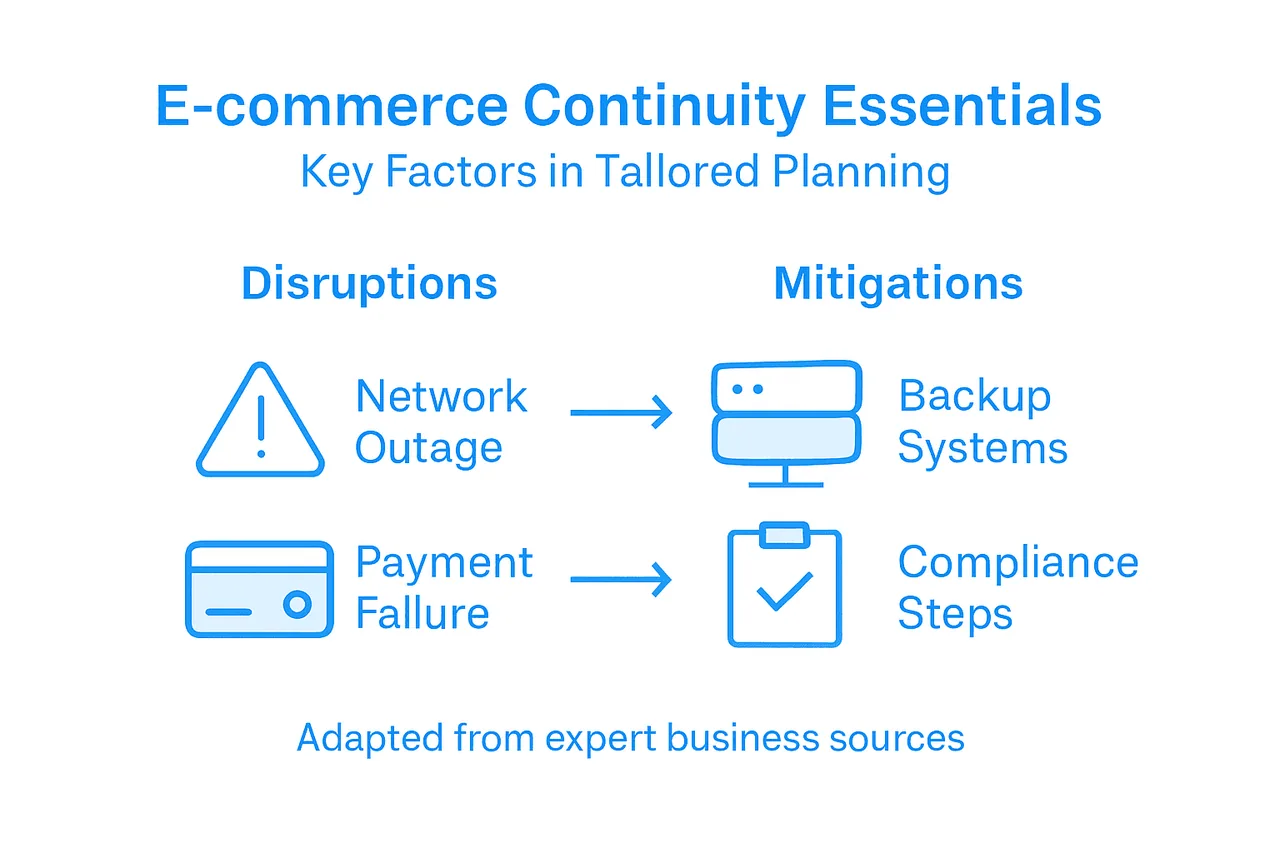
Start by mapping your e-commerce ecosystem honestly. You depend on internet connectivity, so network outages are existential threats. Your payment processing is critical, which means vulnerabilities in payment gateways or processor failures can stop revenue overnight. Inventory management systems must remain accurate because overselling during a crisis destroys customer trust permanently. Your website and mobile application are your storefront, so downtime directly translates to lost sales. Customer data security matters because breaches damage reputation and trigger regulatory consequences. Fulfilment and logistics are equally vital because customers accept delayed delivery but they cannot accept no delivery at all. When tailoring your plan, you must recognise that e-commerce ecosystems comprise multiple interdependent pillars including ICT infrastructure, payment solutions, trade facilitation, legal frameworks, and skills. A failure in any pillar cascades through your entire operation. Your continuity plan needs specific recovery procedures for each pillar rather than generic “restore everything” instructions.
Second, understand your unique regulatory landscape. E-commerce businesses handling payments in South Africa must comply with financial regulations. If you collect customer data, you must comply with Protection of Personal Information legislation. If you operate internationally, you might need to meet European GDPR requirements or other regional laws. Your continuity plan must ensure these compliance requirements persist even during disruptions. This isn’t just about avoiding fines, though that matters. It means your backup systems must maintain the same security and audit standards as your primary systems. Your disaster recovery procedures must be documented and testable. Your data backups must be encrypted and geographically distributed. These aren’t optional features you add if budget allows, they’re foundational to a continuity plan that actually works. Different e-commerce models also have different continuity requirements. A dropshipping business depends almost entirely on supplier relationships, so your plan focuses on supplier diversification and communication. A warehousing business needs physical redundancy and backup fulfilment locations. A digital product business needs secure backup storage and transaction recording. Your tailored plan matches your specific business model.
Third, involve your entire team in tailoring the plan to reality. Your IT team knows technical vulnerabilities you might miss. Your warehouse manager knows which manual processes can keep orders moving if systems fail. Your customer service team understands how customers react to crises. Your finance person knows cash flow requirements during disruptions. Plans created by committees in isolated offices tend to be theoretical and useless. Plans created by diverse teams who understand operations tend to be practical and actually work. Test your tailored plan regularly with scenario exercises. If your payment processor fails, can your team activate the backup? Can you actually process orders manually if your website goes down? Can your warehouse fulfil orders without the inventory system? These aren’t theoretical questions. Running through actual scenarios reveals gaps in your tailored plan before a real crisis exposes them.
Pro tip: Create a one-page crisis decision tree specific to your business showing which continuity procedures activate for different scenarios: payment failure, website outage, warehouse disruption, data loss, or cyberattack. Laminate it and keep copies at each decision-maker’s desk so people know exactly what to do when panic sets in.
Legal, Compliance And Cost Implications
Business continuity planning is not optional for e-commerce businesses operating in regulated environments. Regulatory bodies increasingly mandate formal continuity plans to protect critical operations and sensitive data. For South African e-commerce businesses, this means compliance with the Protection of Personal Information Act, financial regulations if you process payments, and potentially international standards if you sell across borders. Non-compliance carries real penalties. Fines can reach millions of rands. Worse, regulators can prohibit you from operating entirely. Beyond regulatory fines, failed continuity during crises exposes you to civil lawsuits from customers harmed by data breaches or operational failures. Your insurance policies likely have specific continuity and disaster recovery requirements. If you cannot demonstrate a tested continuity plan in place, your insurer might refuse to pay claims when disaster strikes. This transforms continuity planning from a cost into a necessity.
The compliance landscape varies by industry and geography. E-commerce businesses handling payment card data must comply with Payment Card Industry standards, which explicitly require documented backup and recovery procedures. Businesses serving customers internationally might need to meet General Data Protection Regulation requirements, which mandate specific data protection and incident response procedures. South African financial services regulators expect continuity plans that can restore operations within defined timeframes. Healthcare e-commerce platforms serving medical products face even stricter requirements. The compliance requirements force specific design decisions. Your backup systems must use the same encryption standards as primary systems. Your testing procedures must be documented and auditable. Your data retention meets legal requirements even in backups. Your incident response procedures must align with regulatory notification timelines. Regulatory mandates for business continuity compliance increasingly shape how organisations must structure their continuity planning, with auditable records demonstrating ongoing commitment to resilience across sectors.
Cost implications cut both directions. Investing in continuity infrastructure requires significant upfront spending. Quality cloud hosting with redundancy costs more than budget hosting. Backup systems duplicating your primary infrastructure double your infrastructure costs. Automated failover technology requires specialist implementation. Testing procedures consume management time and sometimes require production-like environments. Staff training on continuity procedures takes time away from normal operations. For mid-sized e-commerce businesses, annual continuity spending might reach R50,000 to R200,000 depending on scale and complexity. That’s real money. However, the cost of not having continuity is far worse. A single day of website downtime for a mid-sized e-commerce business might cost R100,000 or more in lost sales alone. Add customer acquisition cost from lost customers, refund processing expenses, reputational damage, and regulatory fines. A cyberattack requiring data restoration might cost millions. Supplier failures affecting inventory might cost more. The mathematics favour investing in continuity. It’s insurance that actually pays dividends by preventing disasters rather than just covering them.
When building your business case for continuity investment, calculate your actual maximum tolerable downtime for each critical function. If your website can be down 2 hours maximum before revenue damage exceeds R50,000, then R50,000 is your acceptable loss threshold. Infrastructure that prevents 2-hour outages becomes economically justified. If payment processing failure causes R200,000 in losses per hour, backup payment processors paying R5,000 monthly become bargains. Document these calculations. They justify continuity spending to finance managers and board members who initially see only costs. Include regulatory compliance requirements in your business case. Mandatory compliance transforms discretionary spending into required spending. Include contractual obligations. If you have service level agreements with customers promising 99.9% uptime, continuity infrastructure becomes contractually necessary. Present the full picture: compliance costs, operational costs of failure, contractual penalties, reputational damage, and customer acquisition costs from lost trust.
Pro tip: Request explicit continuity and disaster recovery requirements from your cloud provider in writing and insist on inclusion in service level agreements with specific recovery time objectives and recovery point objectives measured in hours or minutes, not days.
Risks To Avoid And Common Pitfalls
Most e-commerce businesses that fail during crises do not lack continuity plans. They have plans. The plans simply do not work when needed. This happens because they make predictable, avoidable mistakes. Understanding these pitfalls before you build your continuity strategy means you can construct something that actually functions rather than something that looks impressive in a filing cabinet. The most dangerous pitfall is building a plan that is theoretically compliant but practically useless. You create detailed procedures that nobody understands, assigns to nobody, and tests never. When crisis hits, people scramble to find the plan, cannot follow it, and make ad hoc decisions that often worsen the situation. Compliance-driven plans that ignore operational reality are particularly dangerous because they create false confidence. Your auditors approve the plan. Your board approves the plan. Your team has never read it.
Another critical mistake is treating continuity planning as purely an IT problem. Business leaders delegate the entire task to their IT department, who naturally focus on technical recovery. They ensure backups are configured, failover systems are tested, and recovery procedures are documented. But continuity needs multi-departmental involvement. Your finance team needs to know how to manage cash flow when normal accounting systems fail. Your customer service team needs to understand how to communicate with customers using backup channels. Your warehouse team needs to know which manual processes keep orders moving if the inventory system goes offline. Your procurement team needs backup supplier contacts when primary suppliers fail. Common continuity pitfalls include neglecting workforce training, overlooking real-world operational dynamics, and creating plans that exist only on paper without regular testing or communication. Organisations that involve all departments from the beginning build plans that actually work because every team understands their role and has practiced executing it.
Testing represents another dangerous gap. Many businesses establish continuity plans but never test them. They assume that because the procedures are documented, they will work. This is catastrophically wrong. Testing reveals that your backup data centre connection is slower than expected. Testing reveals that your team does not know how to activate backup systems. Testing reveals that critical procedures depend on one person who is on holiday. Testing reveals that your backup payment processor has different API requirements than your primary processor. Testing reveals that your recovery time estimates were optimistic by hours. If you have never tested your plan, you do not actually have a plan. You have fiction. Best practice means conducting tabletop exercises annually where your team walks through scenarios, and conducting live failover tests at least every two years where you actually activate backup systems and process real transactions through them. These tests are uncomfortable. They expose failures. That is the point. Failures discovered during tests can be fixed. Failures discovered during actual crises destroy your business.
Third-party risks represent a category of pitfalls many organisations overlook completely. Your continuity depends on suppliers, cloud providers, payment processors, and logistics partners. If these third parties fail, your continuity plan might not matter. You need documented backup relationships with alternative suppliers and processors. You need service level agreements specifying their recovery commitments and your ability to test them. You need communication procedures for when third parties fail. You need financial reserves to activate expensive backup solutions quickly if needed. Many e-commerce businesses assume their cloud provider has continuity figured out and never ask questions. Ask questions. Demand written recovery time guarantees. Demand the right to conduct failover testing. Demand geographic redundancy specifications. Demand backup contact numbers for crisis situations. If your provider cannot answer these questions clearly, you have not actually mitigated third-party risk. You have merely transferred your risk to a provider who might not share your commitment to continuity.
Finally, avoid the mistake of building your plan once and then ignoring it. Business continuity planning is continuous, not a one-time project. Your business changes. Your systems change. Your team changes. Your suppliers change. Your plan must evolve with these changes. Review and update your plan annually at minimum. Update it whenever you change critical systems or suppliers. Update it when team members responsible for continuity leave and are replaced. Update it when you expand into new geographic markets or product categories. Outdated plans are worse than no plans because they provide false confidence while directing people toward procedures that no longer apply. Schedule regular plan reviews. Assign ongoing ownership. Make continuity planning a standard business practice, not a compliance checkbox.
Pro tip: Conduct your first continuity test with a small, non-critical function rather than your entire operation, then build confidence and complexity from there, ensuring your team actually learns from early tests before attempting full-scale failover exercises.
Secure Your E-commerce Future with Expert Digital Solutions
Business continuity planning is vital for safeguarding your e-commerce operations against disruptions like cyberattacks, supplier delays, and system failures. The article highlights crucial pain points such as maintaining website uptime, supply chain resilience, and seamless customer communication. Your online business cannot afford downtime or lost revenue. It demands a tailored approach that integrates scalable cloud infrastructure, rapid failover capabilities, and multi-channel communication strategies to keep your business running smoothly in any crisis.
Harness the power of customised digital solutions that align perfectly with your continuity needs. At CloudFusion we offer expert web design and development services crafted to strengthen your sales platform uptime and optimise your inventory and fulfilment systems. Our cloud-based services provide the rapid elasticity, robust security, and integration capabilities critical for resilient e-commerce operations. Don’t wait until disruption hits. Take control with a robust digital foundation and a tested continuity plan today. Explore how you can secure your online presence by requesting a personalised web design and development quotation now and future-proof your business with reliable, scalable technology at CloudFusion.
Frequently Asked Questions
What is business continuity planning for e-commerce?
Business continuity planning for e-commerce involves strategically preparing to maintain essential operations and serve customers during crises, such as cyberattacks, supply chain disruptions, or natural disasters.
How do I identify critical functions for my e-commerce business continuity plan?
Begin by assessing which functions would cause the most significant impact if they failed. Focus on elements like website uptime, supply chain resilience, inventory accuracy, fulfilment continuity, and customer communication while assessing the maximum tolerable downtime for each function.
What are the differences between continuity of operations planning and other continuity plans?
Continuity of operations planning (COOP) focuses specifically on maintaining essential functions during a crisis, while continuity of administration and continuity of governance plans address resource allocation and decision-making structures, respectively.
How can cloud-based solutions enhance my e-commerce business continuity plan?
Cloud-based solutions offer scalability, on-demand self-service, rapid elasticity, and broad network access, which help your e-commerce business adapt quickly to disruptions while ensuring data security and compliance with regulatory standards.