

Decision Making Frameworks – Powering Digital Transformation
Decision making frameworks help IT managers in e-commerce optimise digital transformation, reduce risk and streamline project delivery. Explore key models, real-world use cases and pitfalls.
Start reading
Project decisions in e-commerce rarely wait for the perfect moment, and uncertainty can turn even routine tasks into major debates. For IT managers leading digital transformation, the difference between costly mistakes and successful adoption often comes down to using the right decision-making frameworks. These frameworks turn complexity into clear, repeatable steps, helping teams balance speed and rigour in a fast-moving world. Here, you’ll find ways to bring structure and alignment to your next technology or business choice.
Table of Contents
- Core Concepts Of Decision Making Frameworks
- Major Types And Their Business Relevance
- How Frameworks Drive Digital Adoption
- Roles, Responsibilities And Critical Pitfalls
- Comparisons And Choosing The Best Approach
Key Takeaways
| Point | Details |
|---|---|
| Importance of Decision-Making Frameworks | Frameworks provide clarity, structure, and verification, transforming vague problems into actionable decision processes. |
| Types of Frameworks | Different frameworks (Normative, Descriptive, Practical) serve specific decision-making needs, depending on urgency and complexity. |
| Enhancing Digital Transformation | Structured frameworks accelerate decision cycles, reduce risks, and align teams, vital for effective digital adoption. |
| Accountability and Roles | Clear roles within decision frameworks prevent conflicts and ensure that one person is accountable for outcomes, facilitating faster decisions. |
Core concepts of decision making frameworks
Decision-making frameworks structure how you approach complex choices. They transform vague business problems into systematic, solvable processes.
At their core, frameworks do three things: they clarify what you’re deciding, they reduce uncertainty, and they create accountability. Without a framework, decisions often feel arbitrary or driven by whoever speaks loudest in the room.
What frameworks actually do
Frameworks synthesise essential concepts into something actionable. Rather than starting from scratch each time, you’re applying proven thinking patterns. Think of it like having a mental checklist that prevents you from missing critical factors.
Decision making involves selecting among alternatives under real constraints. Your framework helps you define those constraints upfront instead of discovering them halfway through implementation.
Good frameworks serve three distinct purposes:
- Clarity – Everyone understands what problem you’re solving and why it matters
- Structure – You follow a repeatable process instead of random analysis
- Verification – Built-in checks catch errors before they become expensive mistakes
Three types of decision frameworks
Frameworks fall into three categories, each suited to different situations:
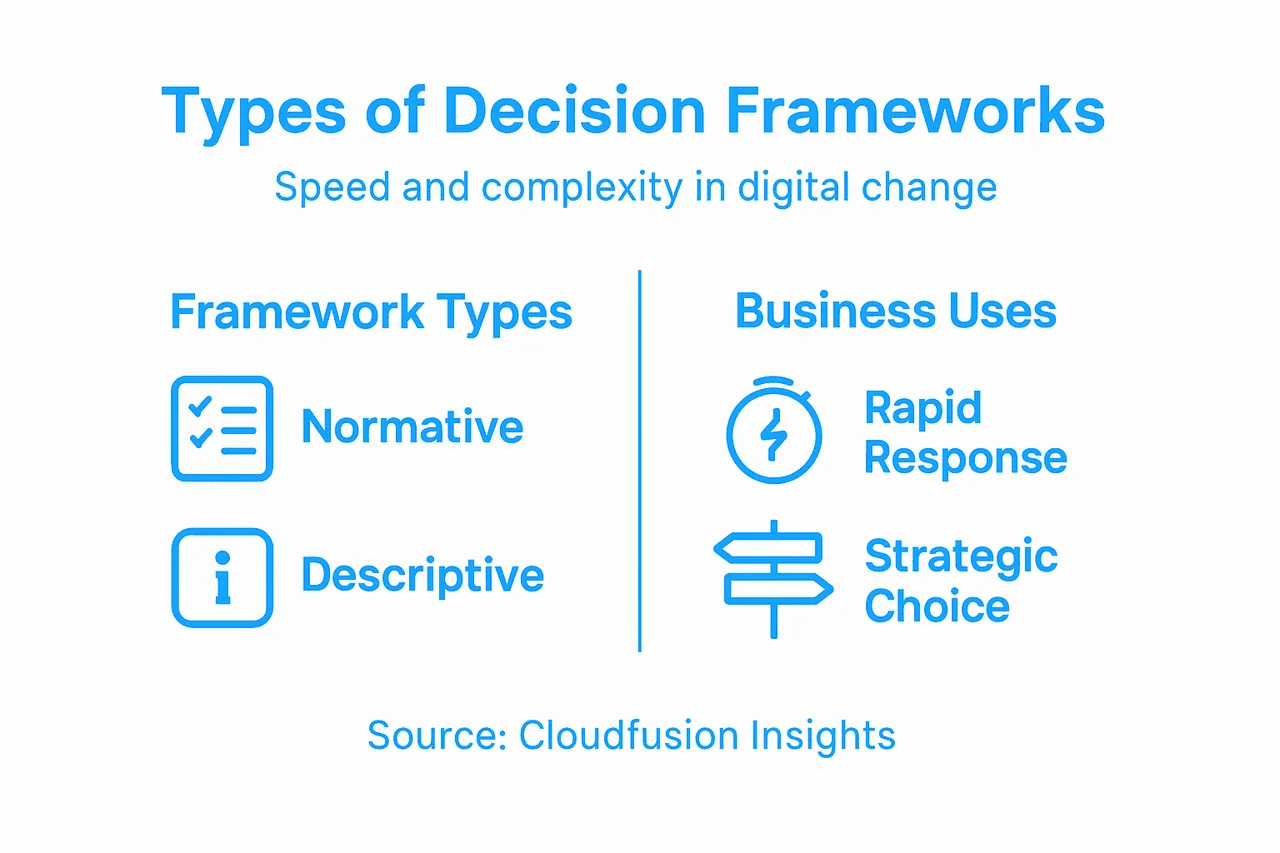
Normative frameworks describe the ideal decision—what a perfectly rational person should do. These include expected utility and Bayesian updating. They’re mathematically sound but rarely match reality.

Descriptive frameworks explain how people actually decide. They account for heuristics, biases, and bounded rationality. You use these to understand why teams choose what they choose.
Practical frameworks focus on defining objectives, structuring uncertainties, and implementing error checks. These are what you’ll use daily for e-commerce and digital transformation decisions.
Below is a comparison of the main decision-making frameworks, highlighting their core focus and best-use scenarios:
| Framework Type | Main Focus | Typical Use Case |
|---|---|---|
| Normative | Ideal, rational decisions | Strategic planning, investment |
| Descriptive | Real-world decision behaviour | Analysing team choices |
| Practical | Actionable business choices | E-commerce, routine operations |
Practical frameworks aren’t perfect, but they’re infinitely better than making decisions based on gut feeling alone.
Why they matter for digital transformation
Digital transformation isn’t one decision—it’s hundreds of them. Which technology stack? Which vendor? Which features first? Without a framework, you’ll waste time debating the same issues repeatedly.
Frameworks compress decision cycles. Instead of discussing whether to prioritise security, your framework already places it in your evaluation criteria. That clarity speeds up meetings dramatically.
For mid-sized e-commerce businesses, frameworks reduce the cost of wrong decisions. A bad technology choice costs roughly R 400 000 to R 2 million to fix when discovered six months in. Structured decision-making catches those risks early.
Pro tip: Start your next decision by writing down exactly what success looks like before exploring options. This single step prevents 60% of bad decisions because you’ve already defined your constraints.
Major types and their business relevance
Different decision frameworks suit different situations. Picking the right one depends on how complex your decision is, how fast you need to move, and what your business environment looks like.
You won’t use the same framework for choosing a vendor as you would for responding to a market crisis. Understanding which framework fits which scenario keeps your team focused and efficient.
Frameworks for speed and agility
When decisions must happen quickly—like responding to a competitor’s price drop or handling a security incident—you need rapid-response frameworks.
The OODA loop (Observe, Orient, Decide, Act) cycles through decisions in days or hours instead of weeks. You gather information, process it through your business lens, make a choice, and move. Then you repeat.
This works brilliantly for e-commerce during peak seasons or when market conditions shift suddenly. Your team stays ahead because they’re cycling through decisions faster than competitors.
PDCA (Plan, Do, Check, Act) supports continuous improvement. You test small changes, measure results, adjust, and scale what works. It’s perfect for optimising website conversions or refining your digital marketing approach.
Strategic frameworks for complex decisions
Decision-making frameworks serve different business needs depending on complexity and urgency. For major strategic choices—like entering a new market or overhauling your technology platform—you need comprehensive approaches.
PrOACT (Problem, Objectives, Alternatives, Consequences, Trade-offs) forces deep evaluation. You explicitly define what success looks like before exploring solutions. This prevents the costly mistake of solving the wrong problem brilliantly.
SWOT, PESTLE, and Porter’s Five Forces help you scan your environment and understand competitive positioning. SWOT assesses your internal strengths and weaknesses against external opportunities and threats. PESTLE examines political, economic, social, technological, legal, and environmental factors that affect your business.
For e-commerce specifically, these frameworks reveal threats like new regulations or technological disruption before they become crises.
The table below contrasts popular decision tools, outlining their strengths and applicability for e-commerce:
| Framework | Key Strength | Best for |
|---|---|---|
| OODA | Speed and adaptability | Fast competitor response |
| PDCA | Iteration and learning | Continuous improvement |
| PrOACT | Comprehensive analysis | Strategic technology moves |
| SWOT | Internal/external scan | Market positioning |
| PESTLE | Broader environment | Regulatory risk assessment |
The quantitative and qualitative blend
Modern decision-making combines data analytics with human insight. Your framework should incorporate both.
Quantitative analysis gives you:
- Predictive models showing likely outcomes
- Data analytics revealing patterns in customer behaviour
- Financial projections proving return on investment
Qualitative insights bring:
- Team experience from previous projects
- Customer feedback explaining the “why” behind numbers
- Market intuition that data hasn’t captured yet
The best decisions blend what the data shows with what your experienced team knows from working in the trenches.
Neither numbers nor intuition alone works anymore. Your framework must force you to use both.
Pro tip: Before selecting a framework, write down your decision deadline and complexity level. Quick, simple decisions use OODA or PDCA; complex strategic choices need PrOACT or SWOT. Match the tool to the situation, not the other way around.
How frameworks drive digital adoption
Frameworks aren’t just planning tools—they’re adoption accelerators. When your organisation lacks a structured approach to digital decisions, people resist change because they don’t understand the logic behind it.
A good framework shows your team why you’re investing in new technology, how it connects to business goals, and what success looks like. That clarity converts resistance into momentum.
Creating alignment across your organisation
Digital transformation fails when different teams have different priorities. Finance wants cost control. Operations wants efficiency. Marketing wants customer insights. Without a framework, these teams pull in separate directions.
Frameworks create a shared language. Everyone evaluates options using the same criteria. Suddenly, the vendor decision that marketing pushes becomes a conversation about profit margins and resource allocation instead of a conflict.
Structured decision-making frameworks assess investments in digital technologies to drive competitive advantage. They identify which levers—like profit orientation and resource allocation—accelerate adoption while balancing risk and economic outcomes.
For e-commerce businesses, this means your entire team operates from one playbook rather than competing agendas.
Overcoming resistance through transparency
People fear digital adoption because change feels risky. Your framework reduces that fear by making decisions transparent and repeatable.
When employees see the evaluation criteria upfront, they understand they’re not being replaced—they’re being retrained. When customers see structured decisions behind your digital strategy, they trust you more.
Data-driven governance frameworks enhance decision-making by emphasising stakeholder engagement and cultural shifts towards continuous improvement. This breaks down silos and resistance to change that typically derail digital projects.
Your IT team knows why cloud infrastructure was chosen over on-premises servers. Your support team understands why you selected that specific customer management platform. Transparency builds buy-in.
Accelerating decision velocity
Frameworks compress implementation timelines. Instead of debating the same factors repeatedly, you cycle through decisions faster and move forward.
This matters enormously in digital transformation. Market conditions shift monthly. Competitors launch new features weekly. Without frameworks, your decision process takes three months while competitors adapt in three weeks.
Key benefits include:
- Faster vendor selection – Evaluation criteria already defined
- Quicker tech stack decisions – Risk and performance factors pre-assessed
- Clearer ROI calculations – Success metrics established upfront
- Reduced scope creep – Objectives frame what stays in and what stays out
Organisations using structured frameworks make digital decisions 40% faster than those debating every choice from scratch.
Speed matters because digital transformation isn’t a single project—it’s continuous evolution.
Building organisational learning
When you apply the same framework repeatedly, your team learns what works. Each decision improves the next one. You build institutional knowledge about which technologies perform well in your specific context.
Frameworks create feedback loops. You document why you chose solution A over solution B. Six months later, when solution A underperforms, you understand why and adjust faster.
This compounds over time. Your organisation becomes better at digital adoption with each iteration because the framework captures and codifies what you’ve learned.
Pro tip: Document your decision framework in writing and share it with your entire team before your next major digital choice. This single step reduces decision meetings by 50% because everyone already knows how you’ll evaluate options.
Roles, responsibilities and critical pitfalls
Clear roles make or break decision frameworks. When nobody knows who decides, who advises, and who implements, your framework becomes another meeting rather than a decision engine.
The problem gets worse in larger organisations where decision authority gets scattered across departments. You need explicit clarity on who holds decision power, who provides input, and who executes.
Understanding RACI and its limitations
The RACI framework assigns roles as Responsible, Accountable, Consulted, and Informed. It’s a classic tool, but it fails regularly because teams misuse it.
Responsible means you do the work. Accountable means you own the outcome. Consulted means you provide input. Informed means you get updates after the decision.
The problem emerges when too many people claim accountability. You end up with five people who each think they’re deciding, leading to conflict and delays.
The RACI framework often falls short due to unclear deciders and poor stakeholder orchestration. Common pitfalls include too many stakeholders with voting rights, unclear input timing, and disempowerment of delegated decision-makers.
For e-commerce platforms, this might mean your operations manager, CTO, and CFO all think they’re deciding which payment gateway to implement. Nothing gets decided.
Critical pitfalls that derail decisions
Watch for these patterns in your organisation:
- Too many decision-makers – When six people have veto power, nothing moves
- Unclear input timing – People don’t know when feedback is due, so they comment after decisions are made
- Missing escalation protocols – No defined path when stakeholders disagree
- Weak data governance – Nobody owns data quality, leading to distrust of analytics
- Resistance to change – People default to existing systems because new frameworks feel uncertain
Resistance kills more digital projects than technical problems. Your framework must address this explicitly through transparency and stakeholder engagement.
Lack of clarity about who owns accountability creates another common failure. One manager implements a decision whilst another manager thought it was still being debated.
Building accountability the right way
One person must own each decision. Not a committee. One person accountable for the outcome.
That person consults widely but decides alone. They own success and failure. This creates urgency and prevents endless deliberation.
Effective decision-making responsibilities involve clear data governance, analytics leadership, stakeholder collaboration, and institutional culture fostering. Successful frameworks emphasise accountability, ethical standards, and continuous professional development to mitigate risks like biased decisions and poor communication.
For your tech stack decision, designate one technical lead as accountable. That person consults with security, operations, and finance—but they decide. If the choice fails, they own it.
Managing cross-functional tensions
Digital transformation creates natural tension between departments. Security wants restrictive controls. Development wants flexibility. Customer service wants user-friendly features.
The secret isn’t eliminating tension—it’s making tension explicit and resolving it through shared criteria, not politics.
Your framework should define how to weight these competing needs upfront. If security gets 30% weighting and development gets 40%, everyone knows that going in.
This prevents the vendor selection where security blocks a platform until the final meeting, wasting weeks of evaluation.
Pro tip: Before your next major decision, name one person as the decision owner and give them written authority to decide. Then build your evaluation criteria with input from other departments. This single change reduces decision time by 35% because people stop trying to veto after the decision is made.
Comparisons and choosing the best approach
No single decision framework works for every situation. A framework perfect for rapid market response fails when you need deep strategic evaluation. Your job is matching the framework to your specific problem.
Choosing the right approach depends on three factors: how complex your decision is, how much uncertainty you face, and how much time you have. Get these wrong and you’ll either spend months on a simple choice or make a strategic decision in an hour.
Framework selection criteria
Start by assessing your decision context honestly. Ask yourself these questions:
- How much time do you have before you must decide?
- How many stakeholders need input, and how aligned are they?
- Do you have solid data, or are you working with incomplete information?
- Will this decision affect your entire strategy, or just one project?
A vendor selection for a single project needs different thinking than choosing your entire technology platform. The second affects your company for five years.
Choosing the best framework depends on decision context including complexity, uncertainty, and decision-makers’ expertise. Frameworks vary from prescriptive normative models to heuristic and intuitive methods, and hybrid approaches integrating multiple frameworks offer adaptability in handling real-world decisions.
For e-commerce businesses, this means you might use OODA loop for competitor response decisions but PrOACT for your annual technology roadmap.
Matching frameworks to your situation
Here’s a quick matching guide:
- Quick decisions with high stakes – Use OODA loop or rapid PDCA
- Strategic, complex choices – Use PrOACT or comprehensive SWOT analysis
- Ongoing optimisation – Use PDCA for continuous improvement
- Market positioning decisions – Use Porter’s Five Forces or PESTLE
- Technology selection – Use weighted scoring with PrOACT structure
Speed matters, but rushing a strategic decision creates bigger problems than moving slowly. Your framework should force you to slow down when necessary.
The case for hybrid approaches
In practice, the best organisations don’t pick one framework—they blend several. You might use SWOT to identify what matters, then apply PDCA to test assumptions, then structure final choices with PrOACT.
Hybrid approaches adapt to real-world complexity. Pure frameworks often feel artificial because they ignore nuance.
No single decision-making framework universally fits all organisational contexts. Decision-makers must weigh factors such as strategic alignment, environmental volatility, stakeholder engagement, and data availability. Framework integration and customisation are recommended to optimise decision quality, agility, and stakeholder buy-in.
Your custom approach might look like: Start with Porter’s Five Forces to understand competitive pressure, then use weighted scoring to evaluate vendors against criteria you’ve defined, then apply PDCA to monitor the chosen solution’s performance.
Balancing rigour with speed
Analytical rigour takes time. Stakeholder engagement takes time. But skipping either causes failures.
Your framework must balance analytical depth with practical speed. For most e-commerce decisions, that means spending 20% of your time on evaluation and 80% on implementation and monitoring.
The goal isn’t perfect analysis—it’s good-enough analysis made fast enough that you can adapt before conditions change.
Market conditions shift. Customer needs evolve. A framework that takes three months to conclude misses the actual opportunity.
Customising for your organisation
Your framework won’t match another company’s exactly because your constraints differ. A startup with five people decides differently than a 500-person enterprise.
Document what works for you. If you find that PrOACT works well but you always skip certain steps, eliminate those steps officially. Make your framework match your reality, not theory.
Customisation increases buy-in because your team sees themselves in the process. A framework imposed from corporate headquarters gets ignored.
Pro tip: Create a one-page decision framework guide for your organisation that maps decision types (quick/complex/strategic) to specific approaches. Share it widely and use it consistently. This prevents teams from inventing their own processes and creates organisational learning across projects.
Empower Your Digital Transformation with Structured Decision-Making Solutions
Struggling with complex digital decisions that slow down your business progress is common. This article highlights critical concepts like clarity, accountability, and speed in decision-making frameworks which can dramatically reduce costly mistakes and accelerate digital adoption. Whether you face challenges in selecting the right technology stack or managing competing priorities across teams, the right framework backed by expert execution makes all the difference.
At Cloudfusion we specialise in delivering custom, scalable digital solutions that align with your decision frameworks for sharper, faster outcomes. Our Web Design and Development Quotation service ensures that your website and software projects are built with strategic clarity and technical excellence. Combining our expertise in cloud hosting, branding, and digital marketing means your business decisions transform into measurable results.
Are you ready to stop debating and start deciding with confidence Let us partner with you to design and implement digital solutions tailored to your unique business goals. Visit Cloudfusion now and discover how applying structured frameworks combined with our technology expertise can propel your digital transformation forward today.
Frequently Asked Questions
What are decision-making frameworks?
Decision-making frameworks are structured approaches that help you tackle complex choices by clarifying the problem, reducing uncertainty, and creating accountability in the decision-making process.
How do decision-making frameworks benefit digital transformation?
They provide clarity and structure, allowing teams to make faster, more informed decisions, thereby reducing the risk and costs associated with poor technological choices during digital transformation.
What types of decision frameworks are commonly used in business?
The three main types are normative frameworks (ideal decision-making), descriptive frameworks (actual decision behaviour), and practical frameworks (actionable business choices tailored for everyday operations).
How can I select the right decision-making framework for my business?
Consider the complexity, urgency, and context of your decision. For quick decisions, use frameworks like OODA or PDCA; for complex strategic choices, consider using PrOACT or SWOT analysis.
Recommended
- Digital Transformation Strategies: Complete Guide
- Digital Transformation for Businesses Explained: Key Strategies
- Digital Transformation for Businesses Explained: Key Strategies
- Understanding Enterprise Digital Transformation Explained
- Injonctions contradictoires et stratégie DEI : Solutions
- Fuerza — Hire Pre-Vetted AI & Tech Talent | AI-Powered Staffing