
Difference Between VPS And Shared Hosting – Impact On Site Reliability
Learn the difference between VPS and shared hosting for your business. Explore architecture, security, costs, and ideal use cases for improved performance.
Start reading
Choosing reliable website hosting is never just a technical detail for IT managers guiding mid-sized e-commerce businesses. When orders spike during Black Friday, or unpredictable lags frustrate customers, your hosting solution often stands between success and lost revenue. By comparing the resource isolation and performance guarantees of VPS hosting against the shared resource model used in typical hosting plans, you gain the leverage to build faster, more resilient shopping experiences that retain customers and protect your data.
Table of Contents
- Understanding Shared Hosting And VPS
- Architecture, Resource Allocation, And Isolation
- Performance, Security, And Scalability Compared
- Costs, Management, And Technical Skill Needs
- Key Use Cases For E-Commerce Sites
- Choosing The Right Hosting For Your Business
Key Takeaways
Point | Details |
|---|---|
Shared Hosting vs. VPS | Shared hosting is cost-effective for small websites, whereas VPS offers dedicated resources for growing e-commerce operations needing reliability and performance. |
Performance Consistency | VPS ensures predictable performance during high-traffic periods, unlike shared hosting, which suffers from resource contention. |
Security Considerations | VPS provides better security isolation, essential for businesses handling sensitive customer data, while shared hosting creates vulnerabilities due to shared environments. |
Scaling Flexibility | VPS allows for independent resource scaling, enabling businesses to optimise costs while accommodating growth, unlike shared hosting’s all-or-nothing upgrades. |
Understanding Shared Hosting And VPS
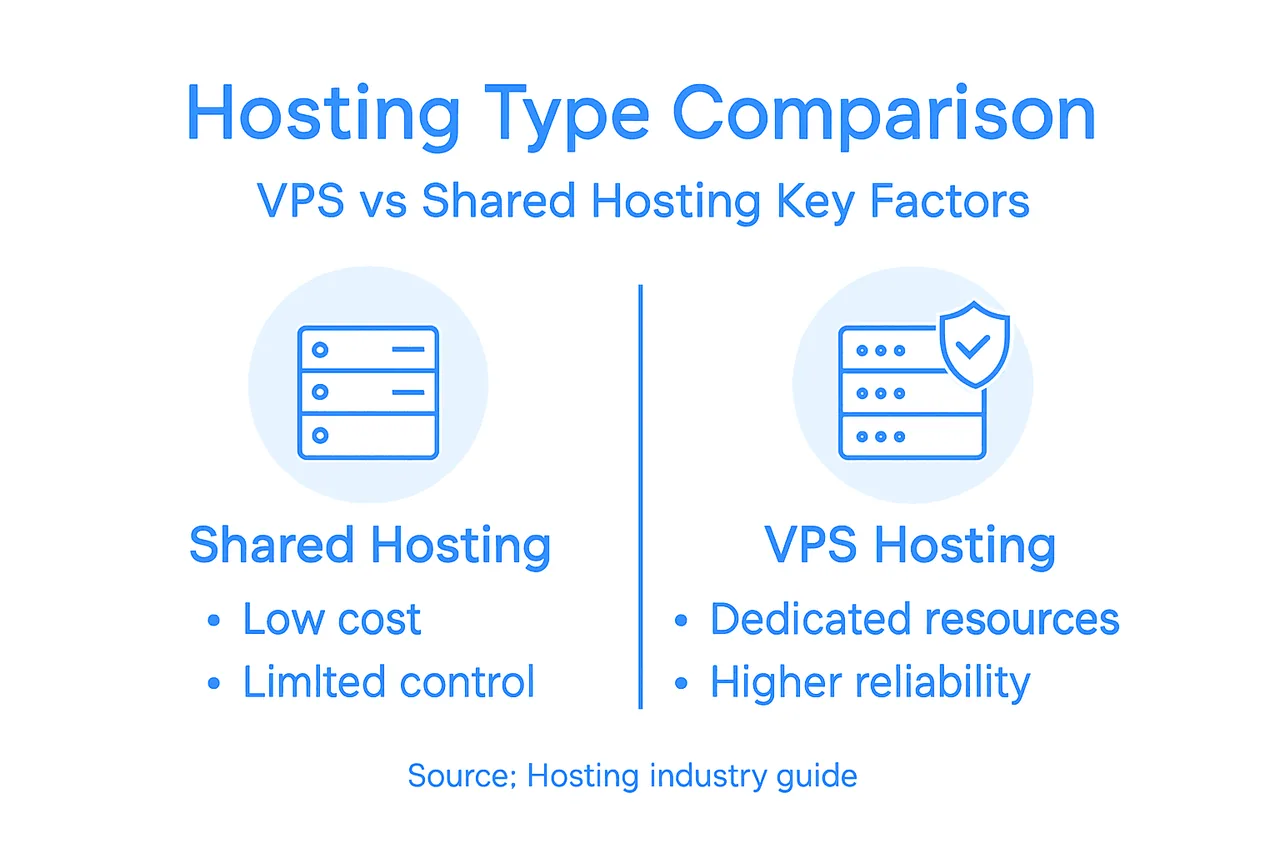
When you’re choosing where your e-commerce site lives online, you’re essentially picking between two fundamentally different approaches to hosting. Shared hosting places your website alongside dozens, sometimes hundreds, of other sites on a single physical server. You share the server’s resources—processing power, memory, bandwidth, storage—with everyone else on that machine. Think of it like a apartment building where all tenants draw from the same water supply and electrical grid. VPS hosting, on the other hand, carves out a dedicated virtual server within a physical machine, giving you allocated resources that are yours alone.
The difference between these two approaches shows up immediately in how your site behaves under pressure. With shared hosting, if another website on your server suddenly gets hammered by traffic or starts running resource-heavy tasks, your site suffers directly. Multiple websites sharing server resources can create performance problems when one site consumes excessive bandwidth or processing power, leaving less for yours. Your site slows down. Pages take longer to load. Customers abandon their shopping carts. You have no control over what’s happening, and customer support can be slow because hosting companies manage thousands of sites this way. VPS eliminates this problem entirely. Your virtual server gets fixed allocations of CPU, RAM, and storage that no other site can touch. Even if someone else’s site explodes with traffic, you’re unaffected.
Beyond performance, the technical freedom differs sharply. Shared hosting keeps you in a sandbox. You cannot install custom software, modify server settings, or install extensions you need for specific functionality. The hosting provider controls what runs on the server for security reasons—they cannot let individual users access root-level functions. This simplicity works well for straightforward websites, but it becomes a genuine obstacle for e-commerce sites needing custom integrations, payment gateway configurations, or security enhancements. VPS gives you root access, meaning you control the entire server environment. Install what you need. Configure security settings precisely. Run custom applications. Scale things up when your business grows. You get this flexibility because you own your virtual slice of the server.
Cost sits at the opposite end of this spectrum. Shared hosting typically costs between R50 and R200 per month because the provider spreads infrastructure costs across hundreds of customers. It’s genuinely affordable for small projects testing the market. VPS costs more—usually R300 to R1,500 monthly depending on resources—because you’re paying for dedicated server capacity. For mid-sized e-commerce operations handling consistent customer traffic and needing reliable performance, that cost becomes justified quickly. One poorly timed traffic spike that tanks your checkout page costs far more than the VPS premium you would have paid.
Aspect | Shared Hosting | VPS |
|---|---|---|
Resource allocation | Shared across all sites | Dedicated to your site |
Performance impact | High (neighbours affect you) | Low (isolated environment) |
Root access | None | Full access |
Customisation options | Limited | Extensive |
Typical monthly cost | R50–R200 | R300–R1,500 |
Best for | Small blogs, portfolios | Growing e-commerce sites |
Pro tip: Start with shared hosting to validate your business model and customer demand, then migrate to VPS once you have consistent daily traffic or need custom functionality that shared environments cannot support.
Architecture, Resource Allocation, And Isolation
To truly understand why VPS outperforms shared hosting for e-commerce operations, you need to grasp how these two architectures actually work at the infrastructure level. Shared hosting operates on a single physical server running Apache or Nginx, with each website assigned a user account and directory space. All sites run under the same operating system instance, share the same database server, and compete for the same pool of RAM, CPU cycles, and bandwidth. When your checkout page processes a payment whilst another site on the server runs a backup or sends bulk emails, you’re all drawing from the same finite resources. The server does its best to juggle everything, but it cannot magic up resources that do not exist. Performance degrades for everyone when demand spikes.

VPS hosting uses virtualisation technology to partition one physical server into multiple independent virtual servers. Each virtual machine operates as a completely separate environment with its own operating system, file system, and resource allocations. If you have a VPS, you might get 4 CPU cores, 8GB RAM, and 200GB storage guaranteed to your account alone. Other VPS instances on that same physical hardware have their own separate allocations that cannot be touched. This isolation layer means your neighbour’s traffic spike, security breach, or resource-hungry application stays completely contained. The hypervisor software managing this virtualisation handles resource scheduling, ensuring each virtual server gets exactly what it needs. This architecture fundamentally changes how your site behaves during high-traffic periods or when running intensive operations.
The resource allocation differences create real consequences for e-commerce businesses. With shared hosting, you cannot predict how your site will perform during peak trading periods like Black Friday or holiday sales. You might have bandwidth available, but if the server hits CPU limits due to other sites, your checkout process slows regardless. You cannot upgrade CPU without upgrading the entire hosting plan, which may include resources you do not need. With VPS, you understand exactly what resources you have available, and you can scale them independently. Need more RAM to handle a larger product catalogue? Add it without touching your storage. Running a promotional campaign that needs more bandwidth? Upgrade just that component. This granular control lets you optimise costs to match your actual requirements rather than buying oversized plans that waste money.
Security isolation adds another critical layer. Shared hosting creates vulnerability vectors because all sites share the same system permissions and database access mechanisms. If one site gets compromised by malware, the attacker gains access to the server itself, potentially affecting every site hosted there. Many hosting providers suffered breaches exposing thousands of customer sites simultaneously because of this shared vulnerability. VPS separates you completely. Your virtual server has its own firewall, separate login credentials, and isolated file systems. Even if another VPS instance on the same hardware gets compromised, yours remains untouched because the hypervisor maintains strict boundaries between virtual machines. For payment processing and customer data protection, this isolation becomes non-negotiable.
Comparing Resource Architectures
- Shared Hosting: Single OS instance, shared resource pool, noisy neighbour problems
- VPS: Multiple isolated virtual servers, dedicated resource allocations, contained environments
Shared hosting works like a shared office with one Internet connection. Everyone competes for bandwidth. If one person uploads large files, everyone slows down. VPS is like having your own dedicated office building with your own Internet line. What happens in the office next door stays next door.
Here is a quick overview of how hosting choice affects critical aspects of e-commerce operations:
Key Area | Shared Hosting Impact | VPS Impact |
|---|---|---|
Checkout speed | Often slows under heavy load | Remains fast, even at peak times |
Security breaches | Can expose all hosted websites | Contained to individual server |
Custom integration | Mostly unsupported | Full customisation possible |
Resource upgrade | Requires higher-tier plans | Fine-tune resources independently |
Pro tip: Request detailed resource specifications when evaluating VPS providers, and confirm they allocate dedicated CPU cores rather than burstable shared CPU, as this determines whether your performance remains consistent during high-traffic periods.
Performance, Security, And Scalability Compared
Performance differences between shared hosting and VPS become brutally obvious under real-world conditions. With shared hosting, your server resources including CPU, memory, disk input/output, and network bandwidth are pooled across multiple customers and allocated on a first-come, first-served basis. When traffic spikes hit your competitors’ sites on the same server, your requests get queued behind theirs. Your checkout pages slow down. Product images load sluggishly. Customers experience timeouts during critical moments. The “noisy neighbour” problem is real, and hosting providers throttle your access to prevent any single site from consuming excessive resources. VPS eliminates this entirely by allocating dedicated CPU cores and RAM directly to your virtual server. Your resource pool never shrinks because someone else’s site got popular. Virtualization provides dedicated resources with stronger isolation, meaning your performance remains consistent regardless of what other VPS instances on the same hardware are doing. For e-commerce operations, this consistency is non-negotiable. Customers expect reliable checkout experiences, and performance degradation during high-traffic periods directly impacts conversion rates and revenue.
Security represents another critical dividing line. Shared hosting creates compounded vulnerability because all websites share the same server permissions, database access mechanisms, and file system boundaries. If one site gets compromised by malware or an SQL injection attack, the attacker gains access to the underlying server environment, potentially exposing every other website hosted there. Your customer data, payment information, and business files sit in the same compromised server alongside potentially thousands of other sites. VPS isolates you completely. Your virtual server has its own operating system instance, firewall rules, and separate login credentials. Even if another VPS customer on the same physical hardware suffers a security breach, your environment remains completely sealed off. The hypervisor technology that manages the virtualisation creates hard boundaries between virtual servers that cannot be crossed. For businesses handling sensitive customer information, payment processing, or compliance requirements like POPIA or PCI DSS, this isolation transforms from “nice to have” into “absolutely required.” Shared hosting environments create security risks that no responsible e-commerce business should accept.
Scalability tells the story of what happens when your business grows. Shared hosting offers limited scaling options because you are constrained by what the hosting provider allows. Need more processing power? You cannot upgrade just your CPU. You buy the next tier hosting plan, which probably includes storage, bandwidth, and features you do not need. Your costs jump significantly for a marginal performance improvement. VPS lets you scale independently. Need more RAM to handle a larger product catalogue with advanced search functionality? Add it without touching anything else. Running a promotional campaign requiring higher bandwidth? Upgrade just that resource. Running intensive backup operations? Configure them during off-peak hours without affecting customer-facing services. This granular control means you pay for exactly what you use, and you scale in measured increments that match your actual growth.
Key Differences At A Glance
Aspect | Shared Hosting | VPS |
|---|---|---|
Resource allocation | Shared pool, variable | Dedicated per instance |
Performance consistency | Unpredictable | Predictable |
Scaling options | All-or-nothing plans | Independent resource scaling |
Security isolation | Shared environment | Complete isolation |
Suitable for | Small sites, blogs | Growing e-commerce |
Uptime reliability | Standard SLAs | Higher SLAs available |
Website performance monitoring becomes significantly easier with VPS because you control the entire environment. You can install monitoring tools, configure alerts, and troubleshoot issues directly rather than relying on support tickets that take hours to respond.
Pro tip: Test your site’s behaviour under load before committing to either platform—use load testing tools to see how your checkout and product pages perform, then choose the hosting type that maintains acceptable response times during your projected peak traffic periods.
Costs, Management, And Technical Skill Needs
Cost forms the first barrier for most businesses evaluating hosting options. Shared hosting sits at the genuinely affordable end, typically costing between R30 and R150 per month because hosting providers distribute infrastructure expenses across hundreds or thousands of customers. A small business testing an e-commerce concept can get online for minimal investment. The hosting provider handles everything—server maintenance, security patches, operating system updates, backup systems. You upload your files, configure your site, and the platform handles the rest. This hands-off approach works perfectly for small blogs, portfolios, and early-stage projects where technical expertise does not exist internally. VPS hosting costs significantly more, generally between R300 and R1,200 monthly depending on resource allocations and provider location. That price premium buys you dedicated resources, root access, and complete control over your environment. However, the cost differential matters less than understanding what you are actually paying for. Shared hosting costs range from entry-level to basic whilst VPS represents an investment in performance, security, and growth capacity. For growing e-commerce operations handling consistent customer traffic, the VPS premium often pays for itself through improved conversion rates, reduced customer frustration from slow checkout processes, and protection against security incidents.
Management responsibility shifts dramatically between these two hosting models. With shared hosting, the provider takes complete ownership of infrastructure concerns. Your server is patched automatically. Security updates deploy without your intervention. Backups run on schedule. Database optimisation happens behind the scenes. This “set and forget” approach means you can focus entirely on building your business rather than managing servers. The tradeoff is limited control—you cannot customise anything beyond what the control panel allows. VPS flips this dynamic. You own complete responsibility for server configuration, security hardening, software installation, and maintenance. You decide when updates happen and which software versions run. You configure firewalls, manage user accounts, and install security patches. This control is powerful, but it demands technical competence or requires hiring managed services to handle these tasks. VPS requires basic to advanced server management skills unless you select a managed VPS option where the provider handles technical administration for an additional fee.
Technical skill requirements create a critical decision point. Shared hosting assumes zero technical knowledge. You do not need to understand Linux commands, server configuration, or security protocols. The interface abstracts away complexity, presenting simple controls for common tasks. Developers and IT managers can manage sites without specialised system administration training. VPS assumes you have technical competence or budget for external support. Unmanaged VPS requires understanding Linux command line, package management, permission systems, and firewall configuration. You troubleshoot performance issues directly. You respond to security alerts. You install and update software. If something breaks, you fix it or pay someone to fix it. Managed VPS options bridge this gap by offering VPS resources with managed service providers handling technical work—you get VPS performance and control without needing internal expertise. These managed options cost more than unmanaged VPS but less than hiring a dedicated systems administrator.
Use this reference to understand hosting responsibilities at a glance:
Task | Shared Hosting | VPS | Managed VPS |
|---|---|---|---|
Server maintenance | Provider | Customer | Provider or shared |
Security updates | Automatic | Manual | Provider (included) |
Software installations | Limited panel | Full root | Full root (on request) |
Troubleshooting | Via support | Direct | Via managed support |
Cost And Skill Comparison
Factor | Shared Hosting | VPS | Managed VPS |
|---|---|---|---|
Monthly cost | R30–R150 | R300–R1,200 | R500–R2,000 |
Technical skill needed | None | Basic to advanced | Minimal |
Management responsibility | Provider handles all | You handle all | Shared responsibility |
Scaling flexibility | Limited | Complete | Complete |
Time investment | Very low | High | Medium |
Best for | Small sites | Growing businesses | Businesses needing control plus support |
The real decision hinges on where your business sits in its growth trajectory. Early-stage e-commerce sites benefit from shared hosting’s affordability and simplicity. As you scale and traffic increases, shifting to VPS becomes essential for reliability and customer experience. Managed VPS offers the best of both worlds if your team lacks technical depth but needs the performance and security that growing operations demand.
Pro tip: If choosing VPS without managed services, budget for 5–10 hours monthly to handle updates, monitoring, and maintenance, or allocate R2,000–R5,000 monthly for managed VPS support that eliminates these technical responsibilities from your IT manager’s plate.
Key Use Cases For E-Commerce Sites
Shared hosting and VPS serve fundamentally different e-commerce scenarios, and understanding where each belongs helps you make decisions aligned with your business stage and traffic patterns. Shared hosting suits early-stage e-commerce operations testing market viability with minimal overhead. You are launching a new product line, validating customer demand, and need to get online quickly without significant infrastructure investment. Your monthly traffic sits in the hundreds or low thousands of visitors. You do not run complex integrations with multiple payment gateways or inventory management systems. You need basic product catalogues, shopping carts, and checkout flows. Shared hosting delivers exactly this capability at minimal cost. The platform provides pre-installed e-commerce platforms like WooCommerce, Shopify, or Magento Lite. Payment processing integrates through standard gateways. You can start selling within hours. For many small retailers testing new markets or seasonal sellers running pop-up shops, shared hosting represents perfect-fit infrastructure that avoids wasteful spending on resources you do not use.
VPS becomes essential the moment your e-commerce operation exceeds shared hosting’s practical limits. You are handling consistent daily traffic of thousands of visitors, processing hundreds of orders per day, or managing inventory across multiple sales channels. Your checkout process must remain snappy even during promotional campaigns or flash sales. You need custom integrations with enterprise resource planning systems, advanced analytics platforms, or specialised fulfillment tools. You require custom SSL certificates, advanced security configurations, or compliance with specific regulatory frameworks like POPIA for South African customer data. Shared hosting cannot accommodate these requirements because it does not provide the flexibility, isolation, or performance guarantees growing operations demand. VPS handles all of this. You can install custom software, run specialised caching layers like Redis or Memcached, implement advanced security measures, and scale resources independently as traffic grows. Your checkout experience remains consistent even when promotional traffic spikes 300 percent. Your customer data sits in a completely isolated environment. Your business operations depend on infrastructure you actually control.
Real World Scenarios
Consider a clothing retailer handling seasonal traffic patterns. During off-season, shared hosting costs R80 monthly and works perfectly. Black Friday arrives. Traffic multiplies 10 times. Shared hosting buckles under the load. Customers cannot complete purchases. Revenue drops because your site cannot handle the volume. Switching to VPS months earlier costs an additional R400 monthly, but that investment captures the revenue you lose during traffic spikes. The VPS premium pays for itself with just two high-traffic days annually.
Or consider a B2B e-commerce operation selling industrial components to 50 regular clients who place bulk orders monthly. You need cloud hosting flexibility to handle bulk data transfers, custom API integrations with customer systems, and guaranteed uptime because your clients depend on your platform for their operations. Shared hosting cannot provide the customisation, performance, or reliability these clients expect. VPS delivers the professional infrastructure that builds client confidence and supports complex business relationships.
Decision Framework
- Shared Hosting Fits When: You have under 5,000 monthly visitors, simple product catalogues, standard payment processing, minimal custom integrations, and zero downtime tolerance expectations.
- VPS Makes Sense When: You exceed 10,000 monthly visitors, run promotional campaigns regularly, need custom software or advanced integrations, handle sensitive customer data, or operate mission-critical sales channels.
Pro tip: Plan your migration to VPS before traffic demands it—test your e-commerce platform on VPS during off-peak seasons so you understand performance characteristics, backup procedures, and technical workflows before peak trading periods arrive.
Choosing The Right Hosting For Your Business
Selecting the right hosting solution requires honest assessment of your current needs and realistic projections about where your business heads. Start by understanding your actual traffic patterns and growth trajectory. How many visitors does your site receive monthly today? How many orders do you process weekly? Do you experience seasonal traffic spikes, or does traffic remain relatively consistent year-round? These questions matter because they determine whether shared hosting can handle your real-world demands or whether you need VPS isolation and dedicated resources. Choosing the right hosting plan involves assessing your website’s size and traffic alongside your performance and security requirements. A site handling 2,000 monthly visitors operates in an entirely different universe from one handling 50,000. The resources needed are not linear. Performance expectations differ dramatically. Shared hosting might be adequate for the first scenario but catastrophically inadequate for the second.
Next, evaluate your technical capabilities and available support resources. Can your IT team manage VPS infrastructure, or do you need a hosting provider handling technical administration? What happens when security patches arrive? Who deploys updates? Who responds when performance issues emerge? These operational realities matter more than technology specifications because poor operations sink even well-architected infrastructure. If your team consists of non-technical staff managing your online presence, shared hosting’s managed nature becomes genuinely valuable. You gain predictability and reduced support burden. If you have capable developers or can allocate budget for managed VPS support, you unlock flexibility and control that drives business outcomes. The choice reflects your operational reality, not just technical preferences.
Consider your compliance and security obligations. Are you handling customer payment information? Do you process personal data subject to POPIA regulations? Do your clients require specific security certifications or audit trails? Shared hosting creates unnecessary risk for sensitive operations because security incidents affecting one site potentially expose yours. VPS isolates your environment completely, giving you granular control over security configurations, access logging, and compliance mechanisms. For any business handling regulated data or operating in industries with strict security frameworks, VPS becomes non-negotiable regardless of cost considerations. The regulatory risk of shared hosting outweighs the cost savings.
Decision Checklist
- Current Traffic Volume: Under 5,000 monthly visitors suggests shared hosting. Over 10,000 monthly suggests VPS.
- Traffic Predictability: Consistent traffic favours VPS planning. Highly variable traffic might justify shared hosting initially.
- Seasonal Peaks: Handle Black Friday? Seasonal promotions? Plan VPS capacity for peak periods.
- Integration Complexity: Simple checkout flows work on shared hosting. Custom ERPs or API integrations need VPS flexibility.
- Security Requirements: Sensitive data or compliance mandates point toward VPS isolation.
- Technical Capacity: No internal expertise suggests shared hosting. Available developers enable VPS management.
- Budget Reality: Startup phase favours shared hosting affordability. Growing operations justify VPS premium.
Most e-commerce businesses follow a predictable path. Start with shared hosting during market validation and early growth stages. As traffic increases and complexity grows, migrate to VPS. This approach minimises upfront investment whilst maintaining optionality to scale. The mistake most businesses make is waiting too long to migrate. Performance problems during critical trading periods cost far more than proactive infrastructure investment.
Pro tip: Request trial periods or money-back guarantees from hosting providers before committing long-term, then run your actual e-commerce platform on the hosting for 2-4 weeks under real traffic conditions to confirm performance and reliability before permanent migration.
Elevate Your E-Commerce Performance with Expert Hosting and Development Solutions
Choosing between shared hosting and VPS can define your site’s reliability, security and customer experience. The challenge lies in overcoming resource limitations, avoiding “noisy neighbour” issues and ensuring seamless scalability during peak sales periods. If your business needs dedicated environments with root access and tailored configurations to guarantee fast checkout speeds and robust security, understanding the impact of hosting choices is crucial.
Moving from shared hosting to a VPS changes who manages updates, backups and recovery. Discuss your website's hosting needs with Cloudfusion before deciding whether that extra responsibility is useful.
Don’t wait for performance bottlenecks or security risks to affect your revenue. Take proactive control with CloudFusion’s comprehensive digital and hosting solutions. See how we help businesses like yours transform online presence and achieve consistent site reliability by visiting CloudFusion now. Start your journey towards a resilient and scalable e-commerce website with expert guidance readily available.
Frequently Asked Questions
What is the main difference between VPS and shared hosting?
VPS hosting allocates dedicated resources to your site within a virtual server environment, while shared hosting places your site on a physical server shared with many other sites, leading to resource sharing.
How does shared hosting affect site reliability during traffic spikes?
With shared hosting, your site’s performance can degrade during peak traffic periods due to competing resource demands from neighboring sites, leading to slower load times and potential downtime.
Why might I choose VPS over shared hosting for an e-commerce site?
VPS is ideal for e-commerce sites as it offers dedicated resources, better control over server configurations, and improved security isolation, ensuring reliable performance and customer data protection.
Can I upgrade my resources easily with shared hosting?
Upgrading resources with shared hosting is typically limited and requires purchasing the next hosting plan tier, which may include unnecessary features. In contrast, VPS allows for independent scaling of specific resources as needed.