Surprising as it may seem, more than 80 percent of customers still prefer email for brand communication, including those in the competitive South-African e-commerce market. As global marketing managers search for proven ways to build engagement and drive sales, email marketing remains a smart choice—despite myths that it is outdated or intrusive. Discover how the right foundation dispels misconceptions, reveals effective strategies, and delivers the results today’s e-commerce startups need.
Table of Contents
- Email Marketing Fundamentals And Misconceptions
- Types Of Email Campaigns For Ecommerce
- Key Characteristics Of Effective Campaigns
- Compliance And Data Protection Considerations
- Choosing The Right Email Platform
- Common Pitfalls And Best Practices
Key Takeaways
| Point | Details |
|---|---|
| Strategic Execution is Vital | Email marketing requires strategic targeting, personalisation, and adherence to legal standards to be effective. |
| Diverse Campaign Types Enhance Engagement | Ecommerce businesses should utilise various email campaign types to engage customers and drive sales through tailored messaging. |
| Compliance is Crucial | Understanding and adhering to data protection regulations like GDPR and POPIA is essential for maintaining trust and legality in email marketing. |
| Continuous Improvement Through Testing | Regular A/B testing, list cleaning, and analytics reviews are necessary for optimizing performance and relevance in email campaigns. |
Email marketing fundamentals and misconceptions
Email marketing remains an essential digital strategy for businesses seeking direct customer communication. Despite prevalent misconceptions, this channel continues to deliver remarkable engagement and conversion potential when executed strategically. Contemporary research on email marketing approaches reveals that understanding fundamental principles is crucial for success.
Contrary to popular belief, email marketing is not merely about sending frequent messages. Effective campaigns require sophisticated targeting, personalisation, and compliance with legal standards. Modern email marketing integrates advanced segmentation techniques, allowing businesses to craft messages that resonate with specific audience segments. The key lies in delivering relevant, valuable content that addresses recipient needs and preferences.
Common misconceptions persist about email marketing’s effectiveness. Many believe these campaigns are intrusive or ineffective, yet academic research demonstrates email remains a powerful customer acquisition and retention tool. Successful strategies involve understanding recipient behaviour, optimising send times, and maintaining a clean, engaged subscriber list. Businesses must focus on building trust, providing genuine value, and respecting user preferences.
Pro tip: Regularly clean your email list by removing inactive subscribers to maintain high engagement rates and improve overall campaign performance.
Types of email campaigns for ecommerce
Ecommerce businesses can leverage multiple email campaign types to drive sales, engage customers, and build lasting relationships. Research on email marketing strategies reveals a sophisticated approach that maps specific email campaigns to different stages of the customer journey.
The primary email campaign types include welcome series, promotional, abandoned cart, transactional, post-purchase, and re-engagement emails. Welcome emails introduce new subscribers to your brand, setting the tone for future interactions. Promotional campaigns highlight special offers, discounts, and new product launches. Abandoned cart emails target potential customers who have shown interest but not completed a purchase, serving as a critical recovery mechanism for lost sales opportunities.
Comprehensive email marketing research demonstrates that effective campaigns go beyond simple messaging. Transactional emails like order confirmations and shipping notifications provide essential customer communication, while post-purchase emails can encourage repeat business through personalised recommendations. Re-engagement campaigns help reconnect with customers who haven’t made a purchase recently, offering targeted incentives to reignite their interest in your brand.
Pro tip: Develop a cohesive email marketing strategy that creates a seamless communication flow across different campaign types, ensuring each email provides value and moves customers closer to making a purchase.
Here’s a comparison of key email campaign types and how they support ecommerce goals:
| Campaign Type | Primary Goal | Typical Audience Segment | Business Impact |
|---|---|---|---|
| Welcome Series | Brand introduction | New subscribers | Boosts brand loyalty |
| Abandoned Cart | Recover lost sales | Browsers, cart-leavers | Increases conversion rate |
| Transactional | Provide order details | Recent purchasers | Enhances customer satisfaction |
| Re-engagement | Revive dormant users | Inactive customers | Reduces churn, drives repeat buys |
Key characteristics of effective campaigns
Successful email marketing campaigns are built on a foundation of strategic design and precise targeting. Comprehensive research on email marketing attributes reveals that effectiveness hinges on several critical characteristics, including relevance, personalisation, strategic timing, and measurable outcomes.

Personalisation stands at the forefront of impactful email campaigns. Scientific investigations into customer engagement demonstrate that tailored content significantly outperforms generic mass communications. This means moving beyond simple name insertion to creating truly contextual experiences that reflect individual customer preferences, purchase history, and behavioural patterns. Effective campaigns leverage sophisticated data segmentation to deliver messages that feel individually crafted and timely.
Beyond personalisation, successful email campaigns require meticulous attention to design, frequency, and strategic intent. Key characteristics include compelling subject lines, mobile-responsive layouts, clear call-to-action buttons, and content that provides genuine value. Businesses must continuously analyse campaign metrics, testing different approaches to understand what resonates with their specific audience. The goal is not just sending emails, but creating meaningful interactions that drive customer engagement and ultimately, conversions.
Pro tip: Implement a robust A/B testing strategy to systematically refine your email campaigns, experimenting with different subject lines, content structures, and sending times to optimise performance.
Compliance and data protection considerations
Navigating the complex landscape of email marketing regulations requires a comprehensive understanding of global data protection standards. Comparative research on email marketing compliance reveals critical frameworks that businesses must understand to operate legally and ethically across international markets.
Key compliance principles demand rigorous consent management and transparent data handling. This means obtaining explicit permission from subscribers, providing clear opt-out mechanisms, and maintaining detailed records of user consent. Regulations like GDPR in Europe, CAN-SPAM in the United States, and the Protection of Personal Information Act (POPIA) in South Africa each impose specific requirements on how businesses collect, store, and utilise customer data. Non-compliance can result in substantial financial penalties and significant reputational damage.
Businesses must implement a privacy-by-design approach, integrating data protection considerations into every stage of their email marketing strategy. This involves creating robust privacy policies, securing customer data through encryption and secure storage systems, and regularly auditing data collection and usage practices. Transparency is paramount – subscribers should always understand how their personal information will be used, with the ability to withdraw consent easily and quickly.
Pro tip: Develop a comprehensive consent management system that not only meets legal requirements but also builds trust by giving subscribers complete control over their personal data.
This table summarises top compliance principles for ecommerce email marketing:
| Principle | Real-World Example | Business Benefit |
|---|---|---|
| Consent Management | Double opt-in forms | Reduces complaints; ensures legality |
| Transparent Data Use | Clear privacy statements | Builds trust; avoids legal issues |
| Easy Opt-Out | Unsubscribe link in emails | Maintains reputation; prevents spam |
| Secure Data Storage | Using encrypted storage | Protects customer info; boosts trust |
Choosing the right email platform
Selecting an appropriate email marketing platform is a critical decision that can significantly impact your ecommerce business’s communication strategy. Comprehensive research on email platform selection highlights the importance of carefully evaluating multiple factors beyond surface-level features.
Key considerations include automation capabilities, deliverability rates, segmentation tools, and integration potential. Each platform offers unique strengths, so businesses must align platform features with specific marketing objectives. Smaller ecommerce operations might prioritise cost-effectiveness and ease of use, while larger enterprises require advanced analytics, sophisticated segmentation, and robust scalability. Critical evaluation points include the platform’s ability to handle complex automated workflows, provide detailed performance metrics, and seamlessly integrate with existing customer relationship management systems.
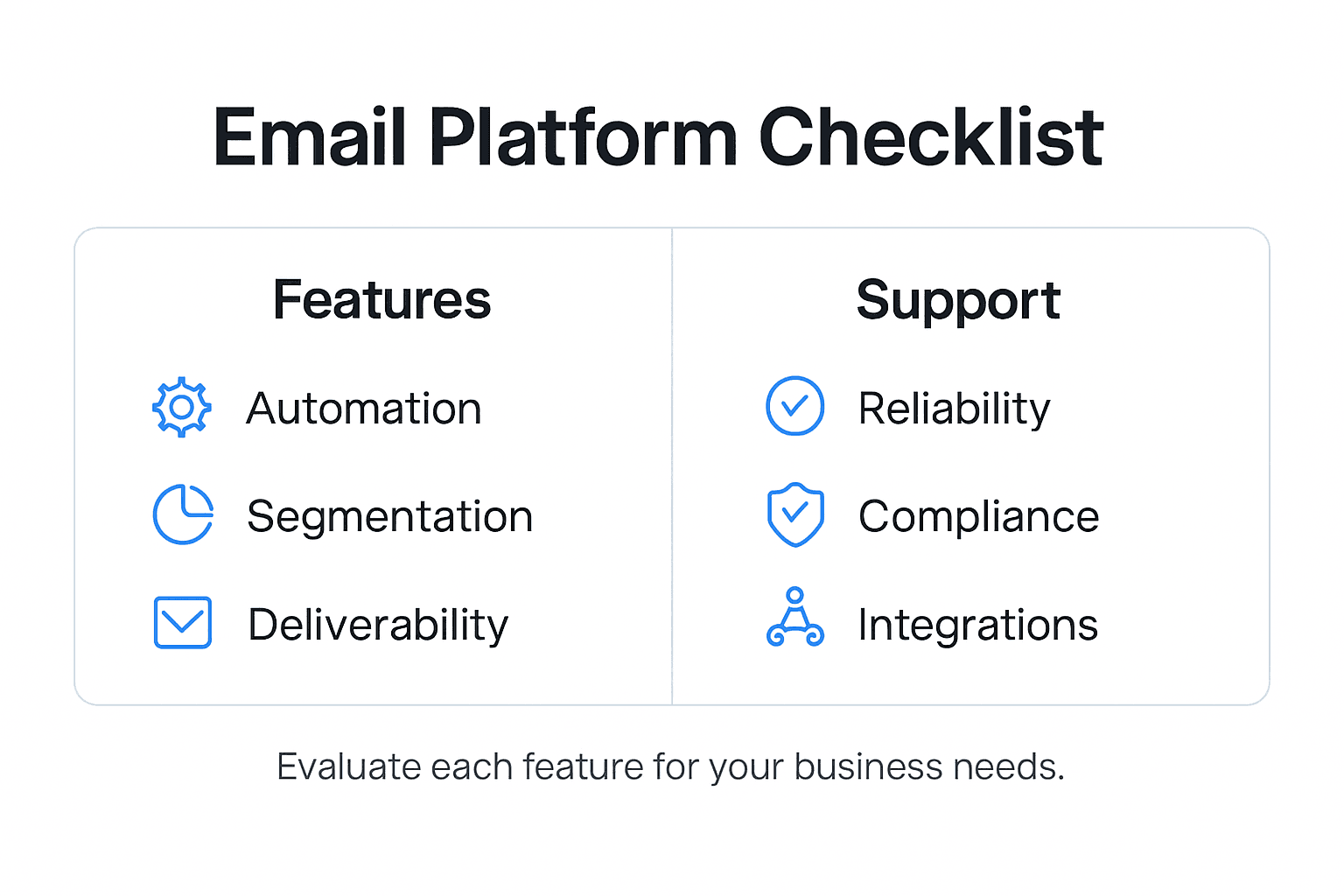
Beyond technical capabilities, businesses should assess platform reliability, customer support quality, and compliance features. This involves examining the platform’s track record for email deliverability, spam protection mechanisms, and built-in tools for maintaining regulatory compliance. Pricing structures vary widely, with options ranging from basic monthly subscriptions to enterprise-level solutions with complex pricing models. Smart selection requires a holistic approach that balances immediate needs with potential future growth and technological requirements.
Pro tip: Create a detailed feature comparison matrix before selecting an email marketing platform, weighing each option against your specific business requirements and growth projections.
Common pitfalls and best practices
Email marketing success hinges on understanding and avoiding common strategic mistakes. Academic research exploring email marketing challenges reveals a landscape riddled with potential pitfalls that can dramatically undermine campaign effectiveness.
Key challenges include list fatigue, poor segmentation, and inconsistent deliverability. Many businesses struggle with over-emailing, sending generic content that fails to resonate with specific audience segments. Effective strategies require sophisticated data management, precise targeting, and a nuanced understanding of subscriber preferences. This means developing dynamic segmentation approaches that consider customer behaviour, purchase history, engagement levels, and individual communication preferences. Successful marketers continuously refine their lists, removing inactive subscribers and ensuring content remains relevant and personalised.
Addressing technical and strategic challenges demands a comprehensive approach. Professional guides highlight critical improvement areas such as maintaining clean email lists, implementing robust spam protection mechanisms, and developing sophisticated automation workflows. Businesses must invest in regular analytics review, conduct systematic A/B testing, and maintain strict compliance with data protection regulations. The most successful email marketing strategies integrate advanced tracking, predictive analytics, and real-time performance monitoring to continuously optimise campaign performance.
Pro tip: Implement a quarterly email list hygiene protocol that removes inactive subscribers, validates email addresses, and recalibrates your segmentation strategy.
Elevate Your Ecommerce Email Marketing with Proven Digital Solutions
Struggling to overcome the common challenges of email marketing such as ineffective targeting or poor campaign design Understand that success in boosting ecommerce sales comes from strategic planning, precise personalisation, and seamless integration with your digital infrastructure. The article highlights the importance of tailored messaging, engaging automation workflows and compliance adherence — all crucial elements that demand more than just basic email tools.
At CloudFusion, we provide custom web and digital solutions designed specifically to empower your ecommerce business. From sophisticated website development to scalable cloud services, we enable your email marketing efforts to perform better by enhancing your platform’s responsiveness, automation, and customer experience. Explore our Web Design and Development Quotation to discover how we tailor solutions built on your unique business needs.
Ready to transform your email marketing into a powerful sales engine Start with a robust digital foundation that supports advanced segmentation, personalised campaigns, and compliance management. Contact us today through CloudFusion and take the first step towards maximising your ecommerce growth potential with bespoke web solutions.
Frequently Asked Questions
What are the key components of a successful email marketing campaign?
Successful email marketing campaigns hinge on strategic design, targeting, personalisation, relevant content, and measurable outcomes. Key characteristics include compelling subject lines, clear call-to-action buttons, and mobile-responsive layouts.
How can I improve my email open rates?
To improve your email open rates, focus on creating engaging subject lines, optimising send times based on audience behaviour, and personalising your content to resonate with recipients. A/B testing different subject lines can also help identify what engages your audience best.
What types of email campaigns should ecommerce businesses use?
Ecommerce businesses can leverage various email campaigns including welcome series, promotional emails, abandoned cart reminders, transactional messages, post-purchase follow-ups, and re-engagement campaigns to drive sales and enhance customer relationships.
How do I ensure compliance with email marketing regulations?
To ensure compliance, obtain explicit consent from subscribers, implement transparent data handling practices, and provide clear opt-out mechanisms. Familiarity with relevant regulations, such as GDPR and CAN-SPAM, is crucial to avoid penalties and build subscriber trust.
Recommended