
Future of Cloud Computing – Impact on SA Enterprises
Explore the future of cloud computing for South African businesses: core models, AI integration, security, costs, compliance, and practical adoption strategies.
Start reading
Few industries have witnessed transformation at the scale driven by cloud computing, with more than 90 percent of South African enterprises now investing in cloud strategies to stay competitive. As e-commerce grows globally, IT managers need actionable clarity on what sets cloud models apart and how these differences drive efficiency. This guide breaks down the core concepts, highlights critical features, and illustrates how smart adoption fuels sustainable digital growth.
Table of Contents
- Core Cloud Computing Concepts Explained
- Major Cloud Service Models And Differences
- Latest Innovations: Ai, Iot, And Automation
- Security, Privacy, And Regulatory Challenges
- Cost, Vendor Choice, And Optimisation Strategies
- Best Practices For Successful Cloud Adoption
Key Takeaways
| Point | Details |
|---|---|
| Core Service Models | Understanding IaaS, PaaS, and SaaS is crucial for selecting appropriate cloud solutions tailored to business needs. |
| Security Considerations | Comprehensive data protection and regulatory compliance are vital for mitigating risks associated with cloud adoption. |
| Cost Management | Strategic evaluation of vendors and continuous performance monitoring are essential for effective cloud expenditure optimisation. |
| Successful Adoption | A methodical approach to migration planning, governance, and employee training is key for smooth cloud integration and digital transformation. |
Core cloud computing concepts explained
Cloud computing represents a transformative technology enabling businesses to access computational resources dynamically and efficiently over the internet. Understanding cloud service models reveals how organisations can leverage flexible infrastructure without massive upfront technology investments.
The core cloud computing paradigm comprises three primary service models: Infrastructure as a Service (IaaS), Platform as a Service (PaaS), and Software as a Service (SaaS). Each model offers distinct capabilities:
- IaaS: Provides virtualised computing resources like servers, storage, and networking
- PaaS: Delivers development platforms enabling programmers to build and deploy applications
- SaaS: Offers ready-to-use software applications accessed via internet
Deployment models further differentiate cloud environments, including public clouds accessible to everyone, private clouds dedicated to single organisations, and hybrid clouds combining multiple infrastructure types. These models enable businesses to select solutions matching their specific security, performance, and scalability requirements.
This table offers a structured comparison of major cloud service and deployment models used by South African businesses.
| Model Type | Control Level | Common Use Cases | Scalability Potential |
|---|---|---|---|
| IaaS | Full technical control | Custom infrastructure setups | High, customisable |
| PaaS | Moderate, dev-centric | Rapid application development | Scales with developer needs |
| SaaS | Minimal, user-focused | Standard business processes | Vendor-managed scalability |
| Public Cloud | Shared environment | Startups, SMEs | Global, cost-effective |
| Private Cloud | Complete organisation control | Regulated industries | Tailored to enterprise scale |
| Hybrid Cloud | Balanced, flexible | Integration and innovation | Variable, adaptable |
Pro tip: When evaluating cloud services, prioritise providers offering transparent pricing, robust security protocols, and flexible scalability to match your enterprise’s evolving technological needs.
Major cloud service models and differences
Cloud service models represent distinct approaches to delivering computational resources, each offering unique advantages for South African enterprises. Cloud service architecture fundamentals reveal how businesses can strategically select models matching their specific technological requirements.
The primary cloud service models include Infrastructure as a Service (IaaS), Platform as a Service (PaaS), and Software as a Service (SaaS), each providing different levels of management complexity and operational control:
-
IaaS: Offers virtualised computing infrastructure
- Provides servers, storage, networking resources
- Highest flexibility and control for technical teams
- Ideal for enterprises requiring custom infrastructure configurations
-
PaaS: Delivers development and deployment platforms
- Handles underlying infrastructure management
- Enables developers to focus on application creation
- Reduces complexity of infrastructure maintenance
-
SaaS: Provides ready-to-use software applications
- Completely managed by service providers
- Accessible via internet browsers
- Lowest maintenance overhead for enterprises
Extended service models like Function as a Service (FaaS) and Machine Learning as a Service (MLaaS) are emerging, offering specialised computational capabilities for advanced technological requirements. These models demonstrate the evolving landscape of cloud computing, providing South African businesses increasingly sophisticated technological solutions.
Pro tip: Evaluate your enterprise’s technical expertise, budget constraints, and scalability needs when selecting cloud service models to ensure optimal technological alignment.
Latest innovations: AI, IoT, and automation
The convergence of artificial intelligence, Internet of Things (IoT), and automation technologies is revolutionising cloud computing landscapes for South African enterprises. Cloud computing integration frameworks demonstrate how these technologies are transforming traditional business operations and creating unprecedented opportunities for digital innovation.
Artificial Intelligence (AI) is dramatically reshaping cloud infrastructure by enabling intelligent data processing, predictive analytics, and automated decision-making:
- Machine Learning Models: Analyse complex datasets
- Predictive Analytics: Forecast business trends
- Intelligent Automation: Streamline operational processes
IoT technologies are expanding cloud capabilities by connecting diverse devices and generating real-time data streams:
- Sensor networks monitoring industrial equipment
- Smart city infrastructure management
- Supply chain tracking and optimisation
- Remote performance diagnostics
Automation technologies are further enhancing cloud platforms by reducing manual interventions and increasing operational efficiency. Continuous integration, automated deployment pipelines, and intelligent workflow management are enabling South African businesses to achieve unprecedented levels of technological agility and responsiveness.

Pro tip: Prioritise cloud platforms offering seamless AI, IoT, and automation integrations to future-proof your enterprise’s technological infrastructure.
Security, privacy, and regulatory challenges
Cloud computing introduces complex security and privacy landscapes that demand sophisticated risk management strategies for South African enterprises. Cloud security challenges highlight the critical need for comprehensive data protection approaches that address multi-layered technological and regulatory requirements.
Key security challenges in cloud environments include:
-
Data Confidentiality: Protecting sensitive information across distributed networks
- Encryption of data at rest and in transit
- Robust access control mechanisms
- Advanced authentication protocols
-
Identity Management: Controlling and verifying user access
- Multi-factor authentication
- Role-based access controls
- Comprehensive user activity monitoring
Regulatory compliance represents another significant challenge, with South African businesses needing to navigate complex legal frameworks:
- Protection of Personal Information Act (POPI)
- General Data Protection Regulation (GDPR) for international operations
- Industry-specific compliance requirements
- Cross-border data transfer regulations
Enterprise cloud strategies must incorporate comprehensive security frameworks that balance technological innovation with robust protection mechanisms. This involves implementing advanced encryption technologies, developing comprehensive risk management protocols, and maintaining continuous monitoring systems to detect and mitigate potential security vulnerabilities.
The following table summarises the main security and regulatory challenges facing South African cloud adopters, including practical approaches for mitigation.
| Challenge | Typical Risks | Mitigation Tactics |
|---|---|---|
| Data confidentiality | Unauthorised access, data leakage | Encryption, strict access controls |
| Identity management | Credential theft, unauthorised users | Multi-factor authentication |
| Regulatory compliance | Legal penalties, cross-border issues | Regular audits, policy updates |
Pro tip: Conduct regular security audits and invest in employee training to create a proactive cybersecurity culture within your organisation.
Cost, vendor choice, and optimisation strategies
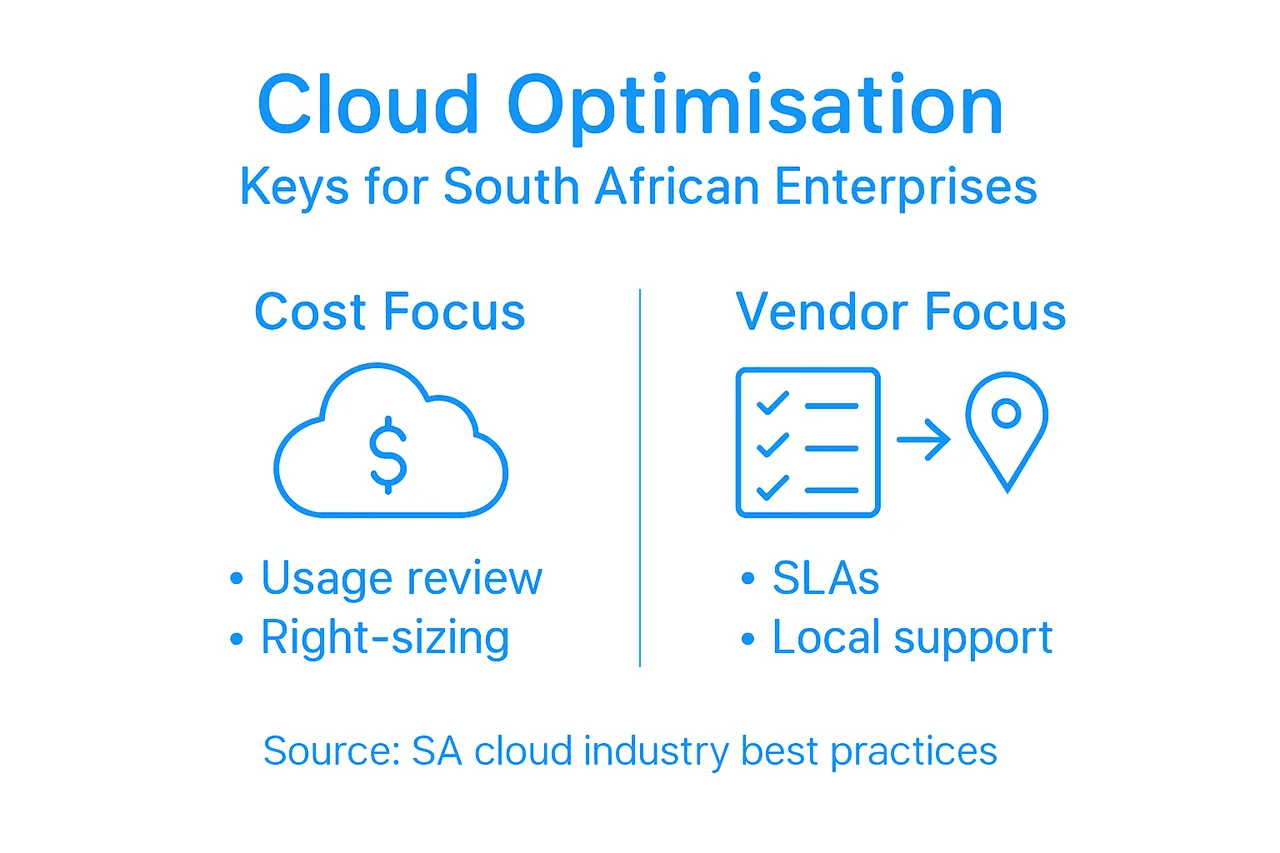
Cloud computing cost management demands strategic approaches that balance technological capabilities with financial constraints for South African enterprises. Cloud computing cost models provide critical insights into effective vendor selection and financial optimisation strategies.
Vendor selection requires comprehensive evaluation across multiple dimensions:
-
Technical Capabilities
- Infrastructure reliability
- Service level agreements
- Performance metrics
- Scalability potential
-
Financial Considerations
- Pricing structure transparency
- Flexible payment models
- Total cost of ownership
- Hidden implementation expenses
Optimisation strategies for cloud expenditure involve sophisticated approaches:
- Workload analysis and right-sizing
- Implementing reserved instance purchasing
- Continuous performance monitoring
- Automated resource allocation
- Leveraging multi-cloud strategies
South African organisations must develop nuanced financial models that account for local market conditions, technological infrastructure limitations, and long-term digital transformation objectives. This requires ongoing assessment of cloud investments, regular performance audits, and adaptive cost management techniques.
Pro tip: Develop a dedicated cloud financial management team to continuously analyse and optimise your organisation’s cloud spending and technological investments.
Best practices for successful cloud adoption
Successful cloud adoption requires a strategic and methodical approach tailored to an organisation’s unique technological ecosystem. Enterprise cloud adoption frameworks provide comprehensive guidance for South African businesses navigating digital transformation challenges.
Key strategic considerations for cloud adoption include:
-
Comprehensive Assessment
- Evaluate current technological infrastructure
- Identify organisational readiness
- Map existing technological capabilities
- Determine specific business objectives
-
Migration Planning
- Develop phased migration strategy
- Prioritise workload transferability
- Minimise operational disruption
- Establish clear migration timelines
-
Governance and Compliance
- Implement robust security protocols
- Ensure regulatory compliance
- Create clear access management policies
- Develop continuous monitoring mechanisms
Training and organisational change management represent critical components of successful cloud adoption. Enterprises must invest in upskilling employees, fostering a culture of technological adaptability, and creating clear communication channels to support seamless digital transformation.
Pro tip: Create a dedicated cloud transformation team with representation from IT, operations, and business strategy to ensure holistic and aligned cloud adoption.
Empower Your South African Enterprise With Future-Ready Cloud Solutions
The future of cloud computing holds great promise for South African enterprises yet comes with challenges like security risks, regulatory compliance, and choosing the right scalable service models. If you are navigating complex decisions around adopting IaaS, PaaS, or SaaS and want to integrate AI and automation seamlessly you need a trusted technology partner. Understanding these core concepts is vital but transforming your digital strategy requires expert guidance to tailor innovative cloud infrastructure and custom applications to your unique business needs.
At Cloud Fusion we specialise in delivering scalable web design and development solutions that align perfectly with industry-specific cloud requirements. Our expertise in cloud-based services such as hosting, domain registration, and office productivity tools empowers South African businesses to optimise costs, enhance security, and accelerate digital transformation. Don’t let the complexity of cloud adoption hold you back. Visit our custom digital solutions page now to discover how we can help you future-proof your enterprise with bespoke web and cloud innovations designed for South Africa’s evolving market. Act today to gain a competitive advantage with technology that scales with your vision.
Frequently Asked Questions
What are the main cloud service models?
The primary cloud service models are Infrastructure as a Service (IaaS), Platform as a Service (PaaS), and Software as a Service (SaaS). IaaS offers virtualised computing resources, PaaS provides development platforms, and SaaS delivers ready-to-use software applications.
How can South African enterprises benefit from cloud computing technologies?
Cloud computing enables South African enterprises to access scalable infrastructure, reduce costs, and enhance operational efficiency. Additionally, it supports digital transformation through innovations like AI, IoT, and automation.
What security challenges should businesses consider when adopting cloud computing?
Key security challenges include data confidentiality, identity management, and regulatory compliance. Businesses should implement strong encryption, robust access controls, and ensure they adhere to relevant legislation like the Protection of Personal Information Act (POPI).
How can companies optimise their cloud computing costs?
To optimise cloud costs, companies should perform workload analysis, implement reserved instance purchasing, and adopt automated resource allocation strategies. Continuous performance monitoring and leveraging multi-cloud strategies can also help control expenditure.
Recommended
- Understanding Cloud Computing for Business: A Comprehensive Guide
- SaaS vs Traditional Software – Impact on Enterprise Growth
- Enterprise Cloud Migration: Boosting Business Agility
- Understanding Cloud Services Overview for Businesses
- Complete Guide to Integrations for Dev Teams - HighFly Blog
- Benefits of Cloud Technology: Complete Guide for 2024|CS