

Effective Call To Action: Boosting Ecommerce Conversions
Effective call to action strategies for ecommerce: types, design tips, psychological triggers, and common mistakes. Maximise online conversions confidently.
Start reading
A vague button or unclear message often means a lost sale, especially for growing e-commerce sites competing on speed and trust. If customers are unsure what to do next, even the best product gets ignored and your conversion numbers stall. Research confirms that an effective call to action must specify exactly what action is expected, closing this gap and motivating real behaviour change. Get to grips with the building blocks of high-converting CTAs and see how clarity transforms page visitors into loyal customers.
Table of Contents
- Understanding An Effective Call To Action
- Types Of Calls To Action For Ecommerce
- Psychological Triggers Behind Conversion
- Design Principles That Drive Engagement
- Common Pitfalls And How To Avoid Them
Key Takeaways
Point | Details |
|---|---|
Clarity in CTAs is Crucial | Specific and clear calls to action significantly improve conversion rates by eliminating confusion. |
Psychological Triggers Enhance Effectiveness | Incorporating urgency, scarcity, and social proof can compel customers to act swiftly. |
Design and Placement Matter | A well-designed CTA that stands out visually and is strategically placed increases user engagement and likelihood to convert. |
Test and Iterate | Regularly testing different CTA elements allows for optimisation based on real customer behaviour, improving overall performance. |
Understanding An Effective Call To Action
A call to action (CTA) is the instruction that tells your visitor exactly what to do next. Without it, even the most compelling product page leaves customers uncertain and conversions stall. Your CTA bridges the gap between interest and action.
Most marketing managers underestimate how much clarity matters. Vague instructions like “Learn more” or “Explore” create confusion. Research shows that effective CTAs specify exactly what action is expected, preventing what psychologists call diffusion of responsibility—where unclear messaging causes people to delay or abandon the purchase entirely.
A strong CTA does three things:
- States the exact action – “Add to cart,” “Claim your discount,” or “Book a consultation” leaves no room for guessing
- Creates urgency or benefit – Words like “Now,” “Today,” or “Limited time” motivate immediate response
- Removes friction – One clear button beats three confusing options
Consider the difference between “Click here” and “Get your free audit in 5 minutes.” The second tells customers what they’ll receive, how long it takes, and why they should act now.
For e-commerce sites, the CTA must align with where customers are in their journey. On a product page, “Add to cart” works. On a landing page introducing a new product range, “Explore the collection” or “Shop now” fits better. Combining clear instructions with practical pathways to action drives meaningful conversions, rather than simply telling customers that action is needed.
Your CTA language should match your audience’s mindset. Someone browsing casually needs a softer invite like “Browse the range.” Someone comparing prices wants certainty: “Proceed to checkout.” Matching the message to the moment increases response rates significantly.
The position, colour, and size matter too. A CTA buried in grey text on a crowded page gets ignored. It needs visual prominence and breathing room to stand out.

Pro tip: Test your CTA text with real customers by changing one element at a time—the button colour, the wording, or the placement—and measure which version converts better before rolling it out across your entire site.
Types Of Calls To Action For Ecommerce
Not all CTAs are created equal. Different types of calls to action serve different purposes, and choosing the right one depends on where your customer sits in their buying journey. The wrong CTA at the wrong time kills conversions.
The most common ecommerce CTA types break down like this:
- Buy Now – Drives immediate purchase completion; works best for customers ready to transact
- Shop Now – Invites browsing and discovery; suits awareness and consideration stages
- Sign Up – Converts visitors into subscribers or leads for future nurturing
- Free Trial or Demo – Reduces purchase risk and builds trust before commitment
- Add to Cart – Bridges the gap between interest and checkout; keeps friction low
- Learn More – Encourages engagement with product details or educational content
Different CTA types guide users through distinct stages of the customer journey, balancing how aggressive you are with how much freedom customers feel they have.
Choosing the right type means matching urgency to customer readiness. Someone browsing your collection for the first time needs “Explore” or “Discover.” Someone with items in their cart needs “Complete purchase” or “Checkout.” A visitor comparing your product to competitors needs confidence-building language like “View full specifications” or “See why customers choose us.”
Free trials and demos deserve special attention. They work because they lower the barrier to entry and let customers experience value before spending money. This approach converts hesitant buyers into paying customers at significantly higher rates than direct “Buy Now” buttons alone.
Selecting the appropriate CTA type depends on your marketing goal, urgency level, and how ready your audience is to act. The same visitor pool may need different CTAs on different pages.
Visual design matters too. Your CTA button colour, size, and placement should match its importance. A primary action like “Buy Now” deserves a prominent, contrasting colour. Secondary actions like “Continue shopping” can be more subtle.
One final point: test your assumptions. What converts for a luxury brand won’t work for a discount retailer. Your customer base, product category, and brand positioning all influence which CTA types perform best.
Pro tip: Create a simple table tracking which CTA types perform best on each page type (product detail, category, landing page), then test variations monthly to catch trends before your competitors do.
Here’s a quick comparison of CTA types and their ideal placement in ecommerce funnels:
CTA Type | Best Page Placement | Expected Outcome |
|---|---|---|
Buy Now | Product detail page | Immediate purchase |
Shop Now | Homepage/category page | Product discovery |
Sign Up | Landing page, blog | Lead generation |
Free Trial/Demo | Homepage, pricing page | Lower risk, trust building |
Learn More | Product info section | Increased engagement |
Add to Cart | Product detail page | Cart initiation |
Psychological Triggers Behind Conversion
Your CTA doesn’t work in isolation. Behind every conversion is a psychological force—a reason why someone decides to act now instead of later, or not at all. Understanding these triggers transforms how you write, position, and design your CTAs.
The most powerful psychological triggers in ecommerce are straightforward:
- Scarcity – “Only 3 items left in stock” or “Limited-time offer” makes customers fear missing out
- Urgency – Countdown timers, deadline language, and time-sensitive deals pressure immediate action
- Social proof – Customer reviews, ratings, and “X people bought this” reassure hesitant buyers
- Authority – Trust badges, certifications, and expert endorsements build confidence
- Personalisation – Tailored recommendations and messages feel relevant and considerate
Scarcity and urgency heighten purchase intent by creating a sense of limited availability, whilst personalisation fosters trust. The challenge is balancing these triggers without overdoing it—repeated exposure causes fatigue and damages credibility.
Scarcity works because it activates loss aversion. We hate missing out more than we enjoy gaining something. A product shown as “Bestseller—only 2 left” creates urgency faster than “Available now.”
Social proof removes the risk from buying. When someone sees that 847 others purchased your product and rated it 4.8 stars, they feel safer committing. This is why customer reviews matter so much.
Leveraging cognitive biases such as scarcity, social proof, and authority alongside emotional drivers like trust creates persuasive, urgency-invoking elements. The key is matching these triggers to your customer’s current mindset.
Personalisation deserves care. “Hi Sarah, we thought you’d like this” beats generic product recommendations. But bombard customers with too many personalised offers and they feel manipulated.
Use psychological triggers ethically. Manufacture false scarcity or exaggerate social proof and customers notice, resent it, and leave.
The strongest approach combines multiple triggers naturally. A product page showing “Bestseller, 4.8 stars from 1,200 reviews, only 5 left in stock” activates scarcity, social proof, and authority without feeling heavy-handed.
Pro tip: Test one psychological trigger at a time on your CTA—add social proof to one variant, urgency language to another, and scarcity to a third—then measure which combination converts best before scaling across your entire site.
To clarify the impact of various psychological triggers, see this overview:
Trigger | Customer Effect | Example CTA Application |
|---|---|---|
Scarcity | Increases urgency | “Offer ends soon” |
Social Proof | Boosts trust | “Trusted by 5,000 shoppers” |
Authority | Builds confidence | “Certified product” |
Personalisation | Feels tailored | “Recommended for you” |
Urgency | Encourages fast action | “Order today” |
Design Principles That Drive Engagement
How your CTA looks matters as much as what it says. A poorly designed button loses conversions even if the messaging is spot-on. Design principles that drive engagement focus on clarity, visual hierarchy, and removing friction from the user experience.
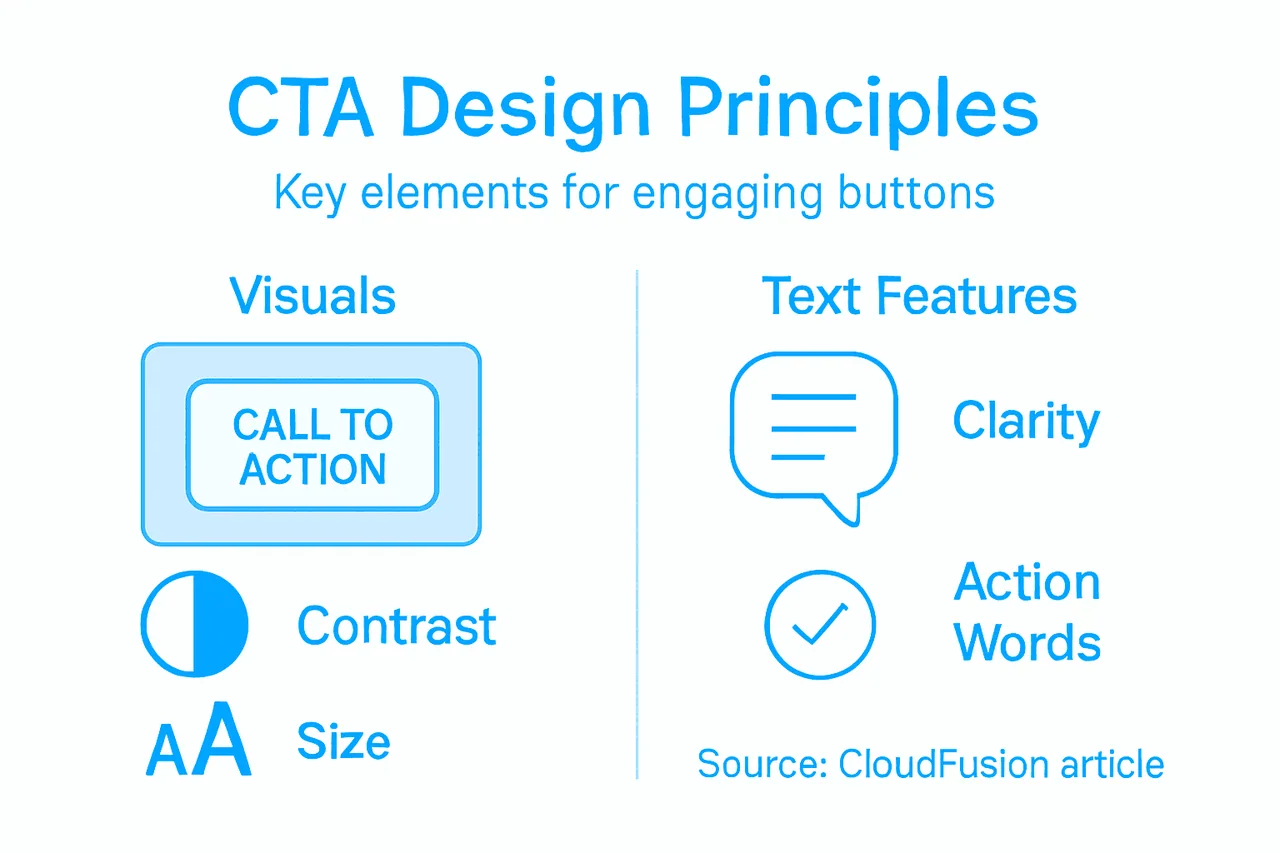
The core design elements for effective CTAs are:
- Contrast – Your button should stand out from the page background and other elements
- Size and placement – Primary CTAs need prominent positioning, typically above the fold
- Colour psychology – Orange, green, and red typically convert better than blue or grey
- White space – Breathing room around your CTA prevents it getting lost in clutter
- Mobile responsiveness – Buttons must be thumb-friendly on smartphones, not tiny or cramped
- Loading speed – Slow pages frustrate users before they even see your CTA
Intuitive navigation, appealing visuals, and responsive interactions contribute to seamless user experiences that keep customers engaged and willing to act. When a user encounters friction—slow loading, confusing layouts, or hard-to-click buttons—they leave.
Contrast is fundamental. A bright orange “Buy now” button on a white background commands attention. The same button in pale grey disappears. Test your button colours against your background to ensure they pop without feeling aggressive.
Placement follows a principle: put your primary CTA where eyes naturally go. On product pages, that’s after the key benefits and social proof. On landing pages, it’s typically after you’ve established value. Secondary actions (“Continue shopping,” “View details”) can be less prominent.
Mobile design deserves obsessive attention. A button that’s perfectly clickable on desktop might be impossible on a phone. Aim for buttons at least 44 pixels tall and wide, with adequate spacing around them so accidental clicks don’t happen.
Personalisation and responsive design foster a sense of connection and satisfaction, boosting overall engagement and conversion likelihood. Generic design looks untrusted; tailored design feels intentional.
Typography matters too. Button text should be readable at a glance, using clear, action-oriented language. “Add to cart” beats “Proceed.” The font weight should make the text bold enough to stand out without looking heavy.
One final principle: test and iterate. What works for a luxury brand may flop for a discount retailer. Your audience, product category, and brand personality all influence which design approach converts best.
Pro tip: Run A/B tests on button colour, size, and copy simultaneously—test a red button with “Buy now” against a green button with “Claim yours”—and track which combination produces the highest conversion rate before optimising other page elements.
Common Pitfalls And How To Avoid Them
Most ecommerce sites make the same CTA mistakes repeatedly. These aren’t complex errors—they’re oversights that cost real revenue. Knowing what to avoid puts you ahead of competitors who haven’t optimised their conversions yet.
The most frequent pitfalls are:
- Button blindness – CTAs so small or visually lost that visitors miss them entirely
- Too many CTAs – Multiple competing calls to action confuse customers about what matters most
- Vague language – “Click here” or “Submit” tells visitors nothing about what happens next
- Poor placement – CTAs buried below the fold or in unexpected locations get ignored
- Mobile neglect – Buttons unclickable or misaligned on phones where most traffic comes from
- Inconsistent design – CTAs that don’t match your brand or page design feel untrustworthy
Button blindness occurs when CTAs are too small or visually lost, requiring strategic placement where users remain focused and ensuring distinct button colours against backgrounds. If visitors can’t see your CTA, they can’t click it.
Multiple CTAs create decision paralysis. A product page with “Buy now,” “Add to wishlist,” “View reviews,” and “Contact sales” leaves customers uncertain. Prioritise ruthlessly—one primary action, maximum two secondary ones.
Vague language kills trust. “Submit” leaves people wondering what they’re agreeing to. “Claim your discount code” tells them exactly what happens. Specificity converts better than generic instructions.
Placement matters strategically. Best practices involve differentiating primary and secondary CTAs and testing variations to enhance conversion whilst maintaining a clean, focused user experience. Your primary CTA should appear after you’ve built value—after benefits, after social proof, never at the top of an empty page.
Mobile optimisation isn’t optional anymore. Over 60% of ecommerce traffic comes from phones. A button that’s perfectly clickable on desktop might be impossible to tap on mobile. Test your CTAs on actual devices, not just browser previews.
Inconsistent design creates doubt. If your CTA button doesn’t match your brand colours or typography, it looks like a scam or external ad. Brand consistency builds confidence.
Failing to adapt CTAs to the sales funnel stage causes missed conversions at every step. An awareness-stage visitor needs different language than a comparison-stage visitor.
Pro tip: Audit your entire site and list every CTA—button text, colour, size, placement—then identify which ones underperform and redesign systematically rather than changing everything at once.
Unlock Higher Ecommerce Conversions with Expert Web Solutions
Struggling with vague call to action buttons or low conversion rates on your ecommerce site The article reveals how precise CTAs like “Add to cart” or “Claim your discount” combined with compelling urgency and clear design drive real customer action. If your digital presence lacks this clarity and emotional trigger you risk losing valuable sales opportunities. Key challenges include button blindness confusing multiple CTAs and missing mobile optimisation.
A call to action needs clear wording, a usable position and a destination that fulfils its promise. Discuss the relevant page or checkout step with Cloudfusion before changing the design.
Don’t let poor CTA strategy hold your business back. Take the next step and partner with CloudFusion to harness cutting-edge design techniques and advanced web development. Request your personalised web design and development quotation today and start turning clicks into customers on https://cloudfusion.co.za.
Frequently Asked Questions
What makes an effective call to action (CTA) for ecommerce?
An effective CTA clearly states the action expected from the visitor, creates a sense of urgency, and minimizes friction by offering a straightforward pathway to take action.
How do psychological triggers impact conversion rates in ecommerce?
Psychological triggers like scarcity, urgency, social proof, and authority can significantly influence customers by creating a sense of importance and trust, which encourages them to complete purchases promptly.
What are the common pitfalls to avoid when designing CTAs?
Common pitfalls include button blindness (making CTAs too small), having too many CTAs that cause confusion, using vague language, poor placement, neglecting mobile optimization, and inconsistent design that can undermine trust.
How should the design of a CTA button be approached to enhance conversion?
The design should focus on contrast to stand out, appropriate size and placement to ensure visibility, colour psychology to evoke the right response, and be mobile responsive for accessibility on various devices.