

How to Improve Conversions with Tailored Digital Solutions
Discover how to improve conversions for your business with this step-by-step guide using tailored digital solutions for measurable growth and lasting results.
Start reading
Every Marketing Director knows the frustration of watching potential customers slip away at key moments. For mid-sized E-commerce companies, tracking each step of the conversion funnel uncovers where user interest fades and what causes drop off. Leveraging conversion funnel analysis and behavioural data ensures your digital strategies target friction points with precision, driving stronger conversion rates through tailored enhancements that fit your audience across both desktop and mobile experiences.
Table of Contents
- Step 1: Assess Current Conversion Funnel Data
- Step 2: Identify and Remove User Friction Points
- Step 3: Implement Tailored Web and Mobile Enhancements
- Step 4: Optimise Calls to Action for Engagement
- Step 5: Test and Analyse Conversion Improvements
Quick Summary
Key Insight | Explanation |
|---|---|
1. Assess Conversion Funnel Metrics | Analyze user data at each funnel stage to identify performance gaps and optimization opportunities. Focus on user engagement metrics and drop-off points. |
2. Eliminate User Friction Points | Identify obstacles that hinder conversions by utilizing analytical tools. Prioritize fixing significant barriers like complex navigation or slow loading times. |
3. Tailor Enhancements for Devices | Implement responsive design and device-specific features to improve user experience. Adapt navigation and content for mobile users to enhance conversions. |
4. Optimize Calls to Action | Craft clear, action-oriented calls to action that resonate with users. A/B test various designs and messages to determine the most effective strategies. |
5. Conduct Rigorous Testing | Establish a systematic approach for testing improvements. Collect data on conversions to analyze and refine strategies based on user behaviour and preferences. |
Step 1: Assess Current Conversion Funnel Data
Understanding your digital conversion funnel begins with comprehensive data analysis. By systematically reviewing your current performance metrics, you can identify precise areas for improvement and strategic optimization.
Start by collecting detailed user interaction data across each funnel stage. Conversion funnel analysis enables businesses to track user behaviour from initial engagement to final conversion. This process involves examining key metrics such as traffic volume, click through rates, sign up completions, and final purchase actions. Utilise advanced analytical tools that provide granular insights into user drop off points and potential friction areas in your digital experience.
Map out each stage of your conversion journey visually using your collected data. Break down performance by segmenting user interactions into distinct phases tracking how potential customers move through awareness, interest, desire, and action stages. Pay special attention to transition points where user numbers significantly decrease.
Here’s how each conversion funnel stage relates to key user metrics and focus areas:
Funnel Stage | Main Metric | Typical User Action | Key Optimisation Focus |
|---|---|---|---|
Awareness | Impressions | Viewing content | Improve first touchpoints |
Interest | Click rate | Browsing products | Enhance engagement cues |
Desire | Sign-up rate | Registering interest | Simplify information flow |
Action | Conversion % | Completing purchase | Streamline purchase process |
Practical Tip: Select web analytics platforms that offer comprehensive heat mapping and session recording features to understand user interactions beyond basic numerical data.
Step 2: Identify and Remove User Friction Points
Understanding and eliminating user friction points is critical to improving your digital conversion strategy. By systematically identifying where potential customers encounter obstacles, you can dramatically enhance their experience and increase overall conversion rates.

Detecting friction points involves using advanced analytical tools that map user interactions and highlight areas of potential difficulty. Conduct a comprehensive review of your website or application by examining user session recordings, heatmaps, and interaction patterns. Look for specific indicators such as unusually long page load times, complex navigation structures, unclear call to action buttons, or multi step processes that seem overly complicated.
Prioritise removing friction by addressing the most significant barriers first. This might involve simplifying form designs, reducing the number of clicks required to complete an action, improving page load speeds, or clarifying user instructions. Pay close attention to transition points where users are most likely to abandon their journey, such as checkout processes in ecommerce platforms or sign up workflows in digital services.
Practical Tip: Conduct regular user testing and gather direct feedback to continuously identify and address potential friction points before they significantly impact your conversion rates.
Step 3: Implement Tailored Web and Mobile Enhancements
Transforming your digital platform requires strategic and targeted enhancements that address specific user needs across different devices and interaction points. The goal is to create a seamless experience that adapts intuitively to user preferences and technological constraints.
Mobile user behaviour analysis reveals critical differences in how users interact with mobile versus desktop platforms. Begin by implementing responsive design principles that automatically adjust layout, content, and functionality based on screen size and device capabilities. Focus on creating simplified navigation structures, optimising image and content load times, and designing touch friendly interfaces that work seamlessly across smartphones and tablets.
Prioritise performance and user experience by conducting thorough testing on multiple devices and network conditions. This might involve developing device specific features such as location based personalisation, simplified forms for mobile users, and adaptive content that changes based on user interaction patterns. Pay special attention to reducing friction points like complex registration processes or slow loading pages that can dramatically impact conversion rates.
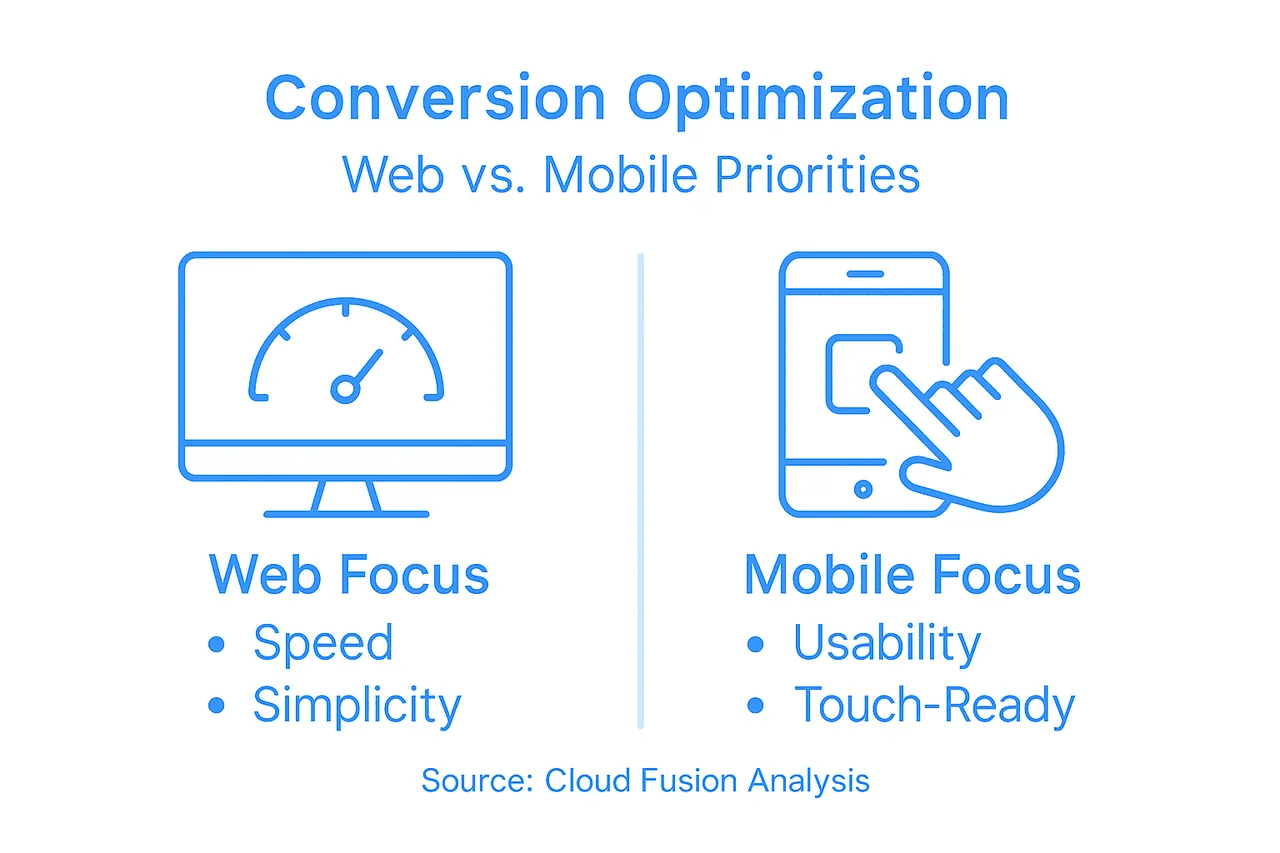
Compare web versus mobile optimisation priorities for conversion improvement:
Device Type | Top Enhancement Priority | Common Friction Point | Unique Feature Consideration |
|---|---|---|---|
Web | Navigation clarity | Overloaded menus | Detailed site search options |
Mobile | Quick load times | Clunky forms | Touch-friendly interfaces |
Practical Tip: Invest in comprehensive user testing across diverse devices and network conditions to identify and resolve potential enhancement opportunities before full implementation.
Step 4: Optimise Calls to Action for Engagement
Creating compelling calls to action is a critical strategy for guiding potential customers through your digital conversion journey. Your objective is to design clear, persuasive prompts that motivate users to take immediate and meaningful actions.
Conversion funnel CTA strategies reveal that effective calls to action must be strategically crafted to address user needs at different engagement stages. Begin by developing concise, action oriented language that speaks directly to your audience’s desires and pain points. Use powerful verbs that create a sense of urgency and value such as “Unlock,” “Discover,” or “Transform” instead of passive phrases like “Click here.”
Analyse and test multiple CTA variations to understand what resonates most with your target audience. This involves experimenting with different colours, placement, size, and wording to determine which combination generates the highest engagement rates. Consider creating device specific CTAs that adapt to mobile and desktop user experiences, ensuring that the messaging and design feel intuitive and compelling across all platforms.
Practical Tip: Implement A/B testing for your calls to action to systematically identify the most effective design and messaging that drives user conversions.
Step 5: Test and Analyse Conversion Improvements
Successfully improving digital conversions requires a systematic approach to testing and analysing your strategic interventions. This stage transforms your theoretical improvements into measurable, actionable insights that drive real business growth.
Personalized intervention testing provides a powerful framework for continuous optimization of your conversion strategies. Implement a robust testing methodology that involves creating controlled experiments where you modify specific elements of your digital platform. This might include testing different user interface designs, simplified registration processes, or personalised content recommendations. Collect comprehensive data across multiple metrics such as click through rates, time spent on page, and final conversion percentages.
Utilise statistical analysis techniques to interpret your testing results objectively. Look beyond surface level metrics to understand the deeper patterns of user behaviour. Segment your data by user demographics, device types, and interaction patterns to uncover nuanced insights that can inform targeted improvements. Pay close attention to statistically significant variations that indicate meaningful changes in user engagement and conversion potential.
Practical Tip: Maintain a structured testing log that documents each experiment, its hypothesis, implementation details, and measurable outcomes to build a systematic knowledge base for continuous digital optimization.
Unlock Your Business Potential with Tailored Digital Conversion Solutions
You know the frustration when your website or app is not converting visitors into loyal customers. This article highlights critical challenges such as user friction points, unclear calls to action, and the need for device-specific optimisation. If your goal is to enhance engagement and boost conversion rates by eliminating barriers and simplifying the user journey then your business deserves digital solutions designed specifically for your unique needs.
At Cloud Fusion we specialise in creating bespoke web and mobile experiences that address exactly these pain points. Our expert team combines advanced web design and development with strategic digital branding to deliver seamless interfaces that captivate and convert. By optimising user interaction stages and crafting clear calls to action you can transform casual visitors into committed clients.
Are you ready to eliminate conversion roadblocks and experience measurable growth right now Take the first step by exploring our comprehensive web design and development quotation and discover how expert tailored solutions can revolutionise your digital presence. Don’t wait let Cloud Fusion guide you through a transformation that puts your customers front and centre.
Frequently Asked Questions
How can I assess my current conversion funnel data?
Start by collecting detailed user interaction data across each stage of your conversion funnel. Review key performance metrics like traffic volume and click-through rates to identify specific areas for improvement within 30 days.
What tools can I use to identify user friction points in my digital platforms?
Utilise advanced analytical tools that offer features like heat mapping and session recording. These will help you pinpoint obstacles users face, allowing you to make necessary enhancements to improve conversion rates.
What enhancements should I implement for mobile users?
Prioritise responsive design principles to create a seamless experience for mobile users. Focus on simplifying navigation and optimising load times to ensure that users can easily engage with your platform from their smartphones or tablets.
How can I optimise my calls to action for better engagement?
Craft clear and compelling calls to action that resonate with your audience’s needs. Test different wording, colours, and placements, aiming for a noticeable increase in user engagement within a few weeks.
What is the best way to test the effectiveness of my conversion improvements?
Implement a controlled testing methodology where you modify specific elements of your platform. Track metrics like click-through rates and conversion percentages to identify which changes yield significant results over 60 days.