

Market Research Basics: Driving E-Commerce Growth
Market research basics for e-commerce managers: learn core concepts, research types, data collection best practices, and avoid costly mistakes.
Start reading
Finding clear answers about online customers often feels complex, especially when the digital marketplace never sits still. Understanding what drives purchase decisions and how trends shift can be the difference between steady growth and being left behind. By mastering systematic data collection and choosing the right market research methods, marketing managers gain real insights to refine strategies, optimise product offerings, and create engaging shopping experiences in competitive global markets.
Table of Contents
- Defining Market Research For E-Commerce
- Types Of Market Research Methods
- Executing Effective Data Collection
- Interpreting Results For Business Decisions
- Common Pitfalls And How To Avoid Them
Key Takeaways
Point | Details |
|---|---|
Market Research Importance | Effective market research in e-commerce identifies consumer behaviour and market trends, allowing for tailored strategies and improved shopping experiences. |
Research Methodologies | A combination of primary and secondary research methods, both qualitative and quantitative, provides comprehensive insights for decision-making. |
Data Collection Strategies | Implementing a structured data collection framework ensures relevant and actionable information is gathered for strategic insights. |
Avoiding Common Pitfalls | Recognising pitfalls like confirmation bias and excessive data collection helps maintain research objectivity and effectiveness in market analysis. |
Defining Market Research For E-Commerce
Market research for e-commerce is a systematic process of gathering, analysing, and interpreting data about online consumer behaviour, market trends, and competitive landscapes. Systematic data collection helps businesses understand user preferences, purchasing patterns, and potential opportunities within digital marketplaces.
In the context of e-commerce, market research goes beyond traditional methods by focusing specifically on online consumer interactions. It involves examining digital touchpoints, website analytics, social media engagement, and customer feedback mechanisms. E-commerce market research enables businesses to develop targeted strategies that address specific customer needs, optimise product offerings, and improve overall online shopping experiences.
Effective market research for e-commerce typically encompasses several critical components:
- Consumer behaviour analysis
- Competitive landscape assessment
- Product demand evaluation
- Pricing strategy development
- Digital marketing channel exploration
By leveraging sophisticated research techniques, e-commerce businesses can gain actionable insights that drive strategic decision-making and sustainable growth in an increasingly competitive digital marketplace.
Pro Tip: Invest in robust web analytics tools that provide real-time consumer behaviour insights to continuously refine your e-commerce strategy.
Types Of Market Research Methods
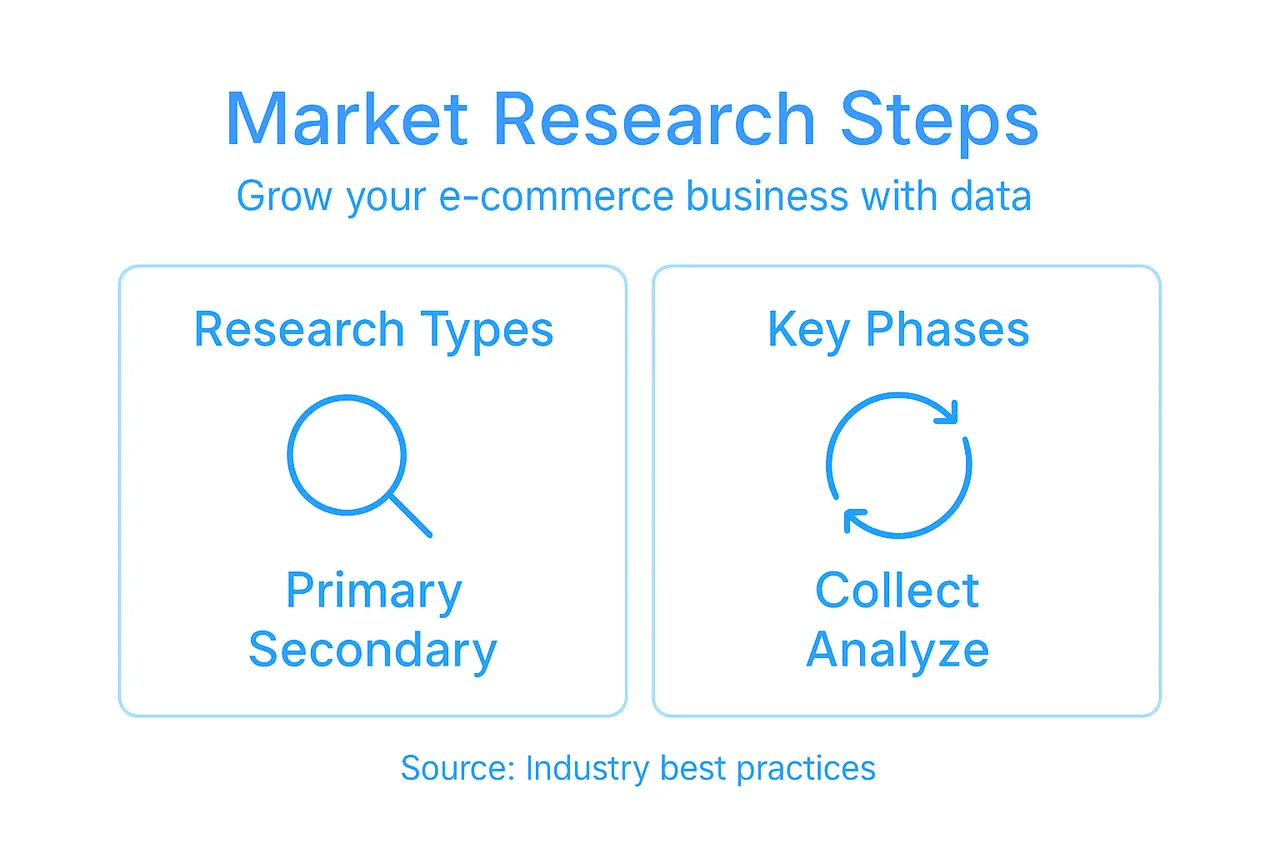
Market research comprises diverse methodologies that enable businesses to gather critical insights about consumer behaviour and market dynamics. Primary and secondary research techniques form the foundational approaches for understanding complex market landscapes. These methods provide comprehensive perspectives that help organisations make data-driven decisions.
Primary research methods involve direct data collection through hands-on techniques such as:
- Surveys
- Individual interviews
- Focus group discussions
- Field observations
- Experimental research
Secondary research encompasses analysing existing data sources including:
- Industry reports
- Academic publications
- Government statistics
- Competitor analyses
- Market trend documentation
Market research methods can be further categorised into qualitative and quantitative approaches. Qualitative research explores nuanced consumer perceptions and motivations through descriptive insights, while quantitative research provides numerical data that can be statistically analysed. Many sophisticated market research strategies now employ mixed-method approaches, combining both qualitative and quantitative techniques to generate more holistic and robust insights.
Here’s a quick comparison of qualitative, quantitative, and mixed-method market research approaches for e-commerce:
Approach | Data Type | Typical Use Cases | Business Advantage |
|---|---|---|---|
Qualitative | Non-numerical insights | Exploring consumer motivations and attitudes | Reveals hidden preferences |
Quantitative | Statistical data | Measuring purchasing trends and segments | Enables precise market forecasting |
Mixed-Method | Both types combined | Integrating depth with reliability | Balanced, actionable recommendations |
Understanding these diverse research methodologies allows e-commerce businesses to develop targeted strategies that respond precisely to customer needs and market opportunities.
Pro Tip: Combine multiple research methods to create a comprehensive understanding of your target market and reduce potential research bias.
Executing Effective Data Collection
Market research data collection represents a critical process for e-commerce businesses seeking strategic insights. This systematic approach involves gathering, recording, and analysing information that helps organisations understand their target markets, consumer behaviours, and competitive landscapes. Successful data collection requires careful planning, precise methodologies, and a strategic approach to information gathering.
Key components of effective data collection include:
- Defining clear research objectives
- Selecting appropriate data collection methods
- Designing robust research instruments
- Establishing reliable sampling techniques
- Implementing ethical data collection practices
The data collection process encompasses multiple strategic approaches:
- Quantitative methods: Surveys, online questionnaires, numerical tracking
- Qualitative methods: Interviews, focus groups, observational research
- Digital tracking: Website analytics, social media insights, customer behaviour tracking
Effective data collection techniques demand consistent protocols and rigorous preparation. E-commerce businesses must prioritise data quality, ensuring that collected information is relevant, current, and actionable. This involves developing sophisticated research tools, maintaining ethical standards, and implementing comprehensive validation processes to guarantee research reliability.
Understanding and executing robust data collection strategies enables e-commerce organisations to transform raw information into meaningful strategic insights that drive business growth and competitive advantage.
Pro Tip: Develop a structured data collection framework that integrates multiple research methods to ensure comprehensive and nuanced market understanding.
Interpreting Results For Business Decisions
Market research interpretation transforms raw data into strategic insights that drive meaningful business decisions. This critical process involves more than simply analysing numbers; it requires a nuanced understanding of contextual patterns, emerging trends, and potential implications for organisational strategy.
Key steps in effective result interpretation include:
- Aligning findings with specific business objectives
- Identifying statistically significant patterns
- Contextualising data within broader market landscapes
- Recognising potential biases in data collection
- Translating technical findings into actionable recommendations
Successful interpretation demands a multifaceted approach that combines quantitative and qualitative analysis techniques. Statistical tools help uncover numerical trends, while qualitative assessment provides deeper insights into consumer motivations, preferences, and behavioural nuances. Research results interpretation requires cross-functional collaboration, ensuring insights are comprehensively understood across marketing, product development, and strategic planning teams.
E-commerce businesses must approach result interpretation as a strategic exercise, transforming complex data into clear, compelling narratives that guide decision-making. This involves creating visual representations, developing concise executive summaries, and presenting recommendations that directly address organisational goals and challenges.

Pro Tip: Create a standardised interpretation framework that systematically translates research findings into clear, actionable strategic recommendations across different business units.
Common Pitfalls And How To Avoid Them
Market research challenges can significantly undermine the effectiveness of e-commerce strategic planning. Understanding and proactively addressing these potential obstacles is crucial for generating meaningful, actionable insights that drive business growth and competitive advantage.
Common market research pitfalls include:
- Confirmation bias in data interpretation
- Over-generalising target audience characteristics
- Collecting excessive, irrelevant data
- Failing to update research methodologies
- Neglecting competitive landscape analysis
- Inadequate market segmentation techniques
Market research mistakes often stem from a lack of systematic approach and strategic thinking. E-commerce businesses must develop robust protocols that maintain research objectivity, ensure comprehensive data collection, and implement rigorous validation processes. This involves creating clear research objectives, adopting contemporary methodological frameworks, and maintaining a critical perspective throughout the investigative process.
Mitigating research pitfalls requires a multifaceted strategy that emphasises continuous learning, methodological flexibility, and a commitment to unbiased data interpretation. Organisations should establish cross-functional review mechanisms, invest in ongoing training, and develop adaptive research frameworks that can evolve with changing market dynamics.
To help e-commerce firms avoid frequent errors, here is a summary of common market research pitfalls and effective ways to address each:
Pitfall | Impact on Business | Mitigation Strategy |
|---|---|---|
Confirmation bias | Misguided strategy decisions | Peer review and diverse perspectives |
Excessive irrelevant data | Resource waste, analysis delays | Clear objectives and focused data sets |
Poor market segmentation | Missed opportunities | Use advanced segmentation techniques |
Pro Tip: Implement a structured peer-review process for research findings to systematically challenge assumptions and identify potential interpretative biases.
Elevate Your E-Commerce Success with Tailored Digital Solutions
Understanding the critical role of market research for e-commerce means recognising the challenge of turning complex consumer data into actionable strategies. You may be facing difficulties in analysing consumer behaviour, optimising your website, or developing the perfect pricing and marketing plans. With insights into data collection, interpretation, and avoiding common pitfalls, the next step is to ensure your online presence matches those strategies with a strong, custom web solution.
At CloudFusion we specialise in delivering scalable and industry-specific digital solutions that transform your market research findings into real business growth. Whether you need a custom website design and development quotation to improve user experience and data integration or bespoke mobile apps tailored to your e-commerce needs, our expertise ensures your digital platform aligns perfectly with strategic goals. Don’t let valuable insights go unused when you can act now and convert your market research into a competitive advantage. Explore more about our services and get your personalised solution today at CloudFusion.
Ready to turn your e-commerce data into growth? Contact us for a web design and development quotation and take the first step toward digital transformation that drives sales and customer loyalty.
Frequently Asked Questions
What is market research for e-commerce?
Market research for e-commerce involves systematically gathering, analysing, and interpreting data about online consumer behaviour, market trends, and competitive landscapes to develop targeted strategies that optimise product offerings and improve shopping experiences.
What are the main types of market research methods?
The main types of market research methods include primary research techniques, such as surveys and interviews, and secondary research, which involves analysing existing data sources like industry reports and competitor analyses. These can be further categorised into qualitative and quantitative approaches.
How can e-commerce businesses effectively collect data?
E-commerce businesses can effectively collect data by clearly defining research objectives, selecting appropriate collection methods, designing robust research instruments, implementing ethical practices, and prioritising data quality to ensure that the gathered information is relevant and actionable.
What common pitfalls should be avoided in market research?
Common pitfalls include confirmation bias, over-generalising target audience characteristics, collecting excessive irrelevant data, and inadequate market segmentation. Implementing a structured approach and involving diverse perspectives can help mitigate these challenges.