

Mobile web design in South Africa: boost business in 2026
Discover proven mobile web design strategies for South African businesses in 2026. Learn responsive design, performance optimization, and localization techniques that boost engagement and conversions.
Start reading
Mobile internet now drives over 60% of web traffic in South Africa, fundamentally changing how businesses connect with customers. Yet many local companies still struggle with slow loading times, poor mobile experiences, and design approaches that ignore South African network realities. This guide walks you through proven mobile web design strategies tailored specifically for South African businesses, from choosing the right responsive framework to optimizing performance under local bandwidth constraints.
Table of Contents
- Introduction To Mobile Web Design In South Africa
- Core Principles Of Effective Mobile Web Design
- Common Misconceptions In Mobile Web Design
- Comparison Framework: Mobile Web Design Approaches For South African Businesses
- Performance Optimization Techniques For South African Mobile Websites
- Localization And User Experience Customization
- Measuring Success And Continuous Improvement
- Case Studies And Real-World Examples
- Explore Custom Web Design Solutions With Cloudfusion
- Frequently Asked Questions
Key takeaways
| Point | Details |
|---|---|
| Mobile dominance | Over 60% of South African internet traffic comes from mobile devices, making mobile optimization essential for reaching most customers. |
| Responsive design advantage | Responsive frameworks offer broad device compatibility and cost efficiency compared to separate mobile sites or apps. |
| Performance is critical | Pages loading under 3 seconds reduce bounce rates by 32% and directly improve conversion rates. |
| Localization matters | Adapting language, cultural elements, and content to South African users increases engagement and builds trust. |
Introduction to mobile web design in South Africa
South African businesses face a unique mobile landscape. Mobile devices account for over 60% of web traffic, making mobile web design the primary touchpoint for most potential customers. This shift reflects broader web design trends in South Africa and signals massive opportunities for businesses that get mobile right.
Yet local conditions create distinct challenges. Network variability remains common, with users switching between 4G, 3G, and even 2G connections throughout their browsing sessions. Device diversity spans from flagship smartphones to budget Android models with limited processing power. These constraints demand design approaches that prioritize performance and accessibility over visual complexity.
Effective mobile design must address these realities directly. Understanding future mobile commerce trends helps businesses stay ahead, while leveraging content delivery network services ensures faster load times across regions.
Key local challenges include:
- Bandwidth limitations: Many South African users face data cost concerns and slower connection speeds
- Device fragmentation: Wide range of screen sizes, resolutions, and processing capabilities across user base
- Network instability: Users frequently experience connection drops or switches between network types
- Data consciousness: South Africans actively seek fast loading, lightweight sites that respect data limits
- Cultural diversity: Eleven official languages and diverse cultural contexts require thoughtful localization
Detailed mobile traffic statistics confirm these patterns persist across industries. Businesses ignoring mobile optimization lose over half their potential audience before the first interaction.
Core principles of effective mobile web design
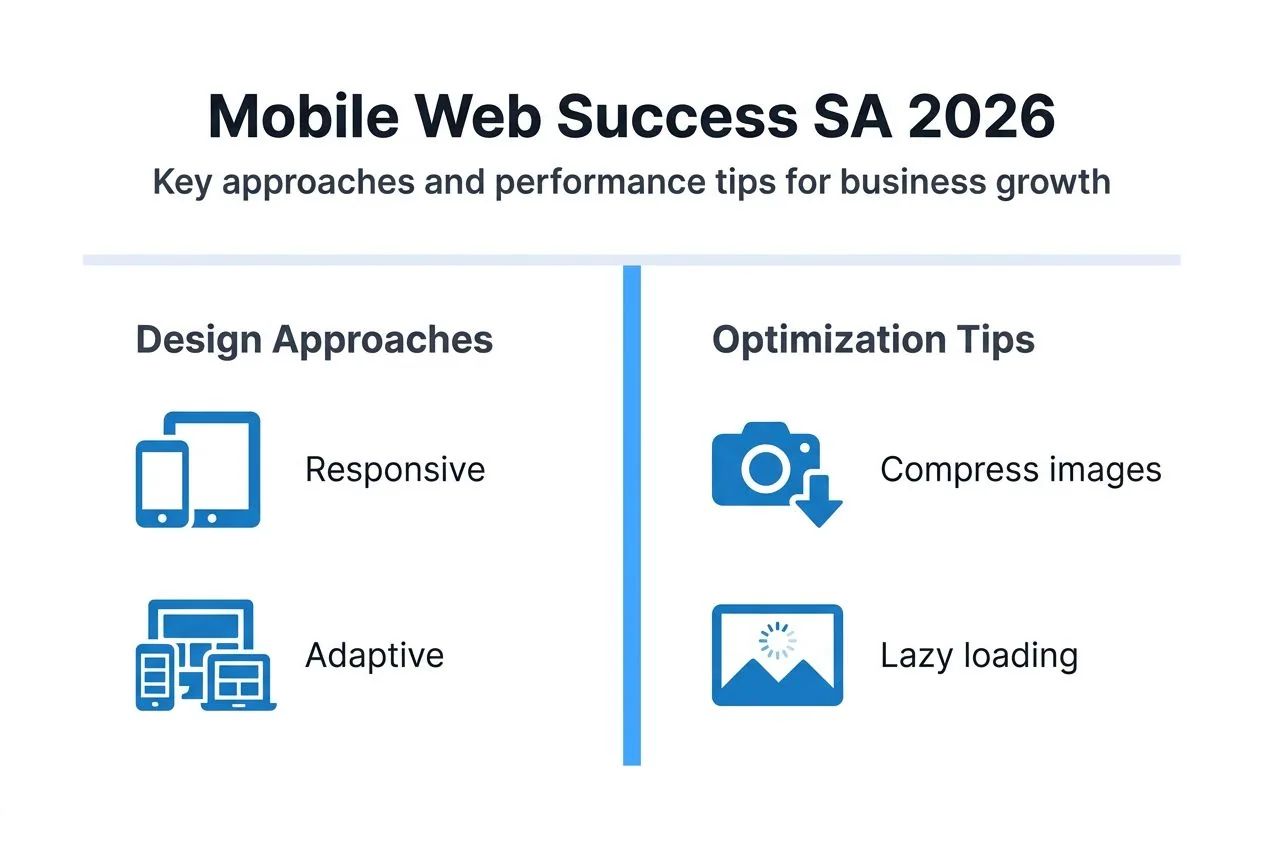
Two primary approaches dominate mobile web design: responsive and adaptive. Both address device diversity, but each suits different business contexts.
| Approach | Pros | Cons | Best For |
|---|---|---|---|
| Responsive | Single codebase, cost efficient, scales automatically across devices | Less control over specific breakpoints, can load unnecessary assets | Most South African SMEs, budget conscious businesses |
| Adaptive | Precise control per device type, optimized experiences | Higher development cost, separate layouts to maintain | Large enterprises, high traffic sites |
Responsive design typically wins for South African businesses. The responsive web design guide explains how fluid grids and flexible images adapt seamlessly to any screen size while maintaining a single codebase. This approach reduces development costs and simplifies maintenance, critical factors for growing businesses.

Performance optimization becomes non-negotiable in bandwidth limited markets. Performance optimization techniques reduce mobile page load times by up to 50% through image compression, lazy loading, and efficient code. These improvements directly impact user retention and conversion rates.
Localization extends beyond translation. Cultural visuals, locally relevant examples, and content that reflects South African contexts build deeper connections with users. Understanding responsive design importance helps businesses recognize how these elements combine to create competitive advantages.
Pro Tip: Adopt mobile first design principles from project start. Design for the smallest screen first, then scale up. This forces ruthless prioritization of essential content and features, naturally creating faster, more focused experiences that work everywhere.
Key performance optimization techniques include compressing images to WebP format, implementing lazy loading for below fold content, minimizing JavaScript execution time, and reducing server response times through caching.
Common misconceptions in mobile web design
Several myths prevent South African businesses from achieving optimal mobile performance.
Myth 1: Mobile apps always outperform websites
Reality shows mobile apps are not always better than mobile websites, especially in bandwidth limited regions. Mobile websites offer broader accessibility without download barriers, lower data usage, and immediate access through search engines. The mobile app vs website comparison reveals websites often deliver better ROI for most businesses.
Apps suit specific use cases like complex functionality, offline access, or frequent user engagement. For general business presence, customer acquisition, and content delivery, optimized mobile websites win.
Myth 2: High visual complexity increases brand trust
Simpler, faster designs consistently outperform visually complex sites in user satisfaction metrics. South African users prioritize speed and usability over elaborate animations or heavy graphics. Clean layouts with clear calls to action convert better than cluttered, slow loading pages.
Myth 3: Neglecting localization doesn’t affect engagement
Localization critically impacts relevance in South Africa’s diverse market. Users engage longer with content reflecting their language, cultural context, and local examples. Generic international content feels disconnected and reduces trust.
Common misconceptions to avoid:
- Assuming all users have latest devices and fast connections
- Prioritizing desktop design then shrinking for mobile
- Ignoring data costs in user experience decisions
- Believing mobile users want less content than desktop users
- Thinking responsive design alone solves all mobile challenges
Detailed mobile e-commerce usability reports demonstrate how these misconceptions hurt conversion rates and user satisfaction across industries.
Pro Tip: Focus resources on optimizing your mobile website before investing heavily in app development. Most South African businesses see better returns from excellent mobile sites than mediocre apps.
Comparison framework: mobile web design approaches for South African businesses
Choosing the right design approach depends on budget, technical resources, and business goals.
| Design Type | Development Cost | Performance | Device Coverage | Maintenance | Customization |
|---|---|---|---|---|---|
| Responsive | Low to Medium | Good with optimization | Excellent | Single codebase | Moderate |
| Adaptive | Medium to High | Excellent | Very Good | Multiple layouts | High |
| Custom Mobile Site | High | Excellent | Targeted devices | Separate site | Maximum |
Suitability by business profile:
- Startups and small businesses: Responsive design offers best cost to benefit ratio
- Growing SMEs: Responsive with performance optimization balances quality and budget
- Large enterprises: Adaptive or custom approaches justify investment through scale
- Ecommerce focused: Responsive with aggressive performance tuning maximizes conversion
- Content heavy sites: Responsive frameworks handle diverse content types efficiently
Scalability considerations matter long term. Responsive designs scale naturally as you add content or features. Adaptive approaches require updating multiple layouts. Custom mobile sites need parallel development alongside desktop versions.
The mobile responsiveness solutions guide shows how responsive frameworks handle most business needs while keeping costs manageable. Understanding responsive design for business success helps evaluate tradeoffs intelligently.
Decision framework:
- Assess current mobile traffic percentage and growth trends
- Define budget constraints and technical team capabilities
- Identify must have features and performance targets
- Evaluate maintenance resources available ongoing
- Choose approach matching business stage and resources
Performance optimization techniques for South African mobile websites
Speed directly determines success in mobile markets. Users expect mobile sites to load within 3 seconds, and delays beyond this threshold significantly impact engagement.
- Image optimization: Compress all images to WebP format, serve appropriately sized versions per device, implement lazy loading for below fold images
- Code efficiency: Minify CSS and JavaScript, eliminate render blocking resources, reduce third party scripts
- Server optimization: Enable compression, leverage browser caching, reduce server response times through CDN usage
- Mobile SEO: Implement structured data, optimize for local search, ensure mobile friendly indexing
- Resource prioritization: Load critical content first, defer non-essential elements, use async loading for scripts
Targeting sub-3 second load times reduces bounce rates and improves conversions measurably. Each second of delay costs engagement and revenue.
Users expect mobile sites to load within 3 seconds; delays increase bounce risk by 32%.
Addressing mobile responsiveness problems through systematic optimization creates competitive advantages. The responsive web design guide details technical implementation of these techniques.
Pro Tip: Test your site regularly on actual South African networks and devices, not just fast office WiFi. Use throttling tools to simulate 3G connections and identify real bottlenecks your users experience daily.
Studies on load time impact on bounce rates confirm performance optimization delivers measurable business results across industries and markets.
Localization and user experience customization
Adapting to South African cultural and linguistic diversity significantly improves mobile engagement.
Key localization elements:
- Language options: Offer content in primary local languages beyond English and Afrikaans where audience demands
- Cultural imagery: Use visuals reflecting South African contexts, people, and environments
- Local examples: Reference familiar brands, locations, and situations in content
- Regional relevance: Highlight solutions to specifically South African challenges
- Payment methods: Support local payment preferences and mobile money options
Localization increases time on site by making content feel personally relevant. Users engage longer, bounce less, and convert better when they see themselves reflected in your design and content.
Simple UX customizations respect cultural diversity without requiring separate sites. Thoughtful image selection, inclusive language, and locally meaningful examples create welcoming experiences for South Africa’s varied user base.
Businesses implementing thorough localization gain competitive advantages in crowded markets. The mobile responsiveness solutions framework integrates localization considerations throughout the design process.
Localization extends to practical details like displaying prices in Rands, showing local business hours, and providing South African contact options prominently.
Measuring success and continuous improvement
Data driven optimization ensures mobile investments deliver returns.
Key performance indicators to monitor:
- Bounce rate: Percentage of single page sessions, target below 50% for mobile
- Page load time: Average time to interactive, aim for under 3 seconds
- Session duration: Average time users spend per visit, higher indicates engagement
- Conversion rate: Percentage completing desired actions, track mobile separately from desktop
- Mobile traffic share: Proportion of total traffic from mobile devices, track growth trends
Google Analytics offers robust tracking suitable for most South African SMEs. Set up mobile specific segments to isolate performance metrics and identify improvement opportunities.
Continuous improvement process:
- Establish baseline metrics for current mobile performance
- Set specific, measurable improvement targets
- Implement changes systematically, testing one variable at a time
- Monitor impact over sufficient time periods for statistical significance
- Iterate based on data, not assumptions
Regular reporting keeps mobile optimization visible to stakeholders and ensures sustained attention. Monthly reviews of key metrics identify trends early and enable proactive adjustments.
Staying current with web design trends in South Africa informs strategic decisions about when to refresh designs or adopt new technologies.
Case studies and real-world examples
Real South African businesses demonstrate mobile optimization impact.
A Johannesburg based fashion retailer redesigned their mobile site with responsive frameworks and aggressive image optimization. Mobile conversion rates increased 47% within three months while bounce rates dropped from 68% to 41%. The investment paid back in increased sales within the first quarter.
An Eastern Cape ecommerce business serving township markets implemented localized content with Xhosa language options and culturally relevant imagery. Session duration increased 35% and repeat customer rates improved 28% as users felt the brand understood their context.
A Cape Town hospitality company optimized their booking flow for mobile users, reducing steps and improving load times. Mobile bookings jumped 52% while customer support queries about the booking process decreased significantly.
Key outcomes across examples:
- Average 40% improvement in mobile conversion rates
- 30% reduction in bounce rates through performance optimization
- 25% increase in session duration with localization
- Measurable ROI within 3 to 6 months of implementation
These results reflect systematic application of mobile design principles tailored to South African market conditions and user expectations.
Explore custom web design solutions with Cloudfusion
Implementing effective mobile web design requires expertise in both technical optimization and South African market dynamics. Cloudfusion specializes in custom web development tailored specifically for South African businesses and mobile users. Their services encompass responsive design, performance optimization, localization, and scalable architectures that grow with your business. Whether you need a complete mobile redesign or targeted improvements to existing sites, Cloudfusion delivers solutions backed by local market knowledge and technical excellence. Request a web design and development quotation today to start improving your mobile presence, or explore their web hosting packages to ensure your optimized site performs reliably for South African users.
Frequently asked questions
What is the difference between responsive and adaptive mobile web design?
Responsive design uses fluid grids that adjust continuously across all screen sizes, creating a seamless experience from a single codebase. Adaptive design creates distinct layouts for specific device breakpoints, offering more control but requiring separate maintenance. Most South African businesses benefit more from responsive approaches due to cost efficiency and simpler maintenance, as detailed in the responsive web design guide.
How does mobile web design affect ecommerce sales in South Africa?
Poor mobile optimization directly damages sales performance. A lack of mobile optimization was responsible for 53% of ecommerce cart abandonments in emerging markets like South Africa. Fast loading, intuitive mobile designs reduce friction in the purchase process, improving conversion rates and customer retention significantly. The mobile e-commerce usability report documents how optimization improvements translate directly to revenue gains.
Why is localization important in South African mobile web design?
Localization increases relevance and trust among South Africa’s diverse user base by reflecting their languages, cultural contexts, and local experiences. Users engage longer with content that feels personally relevant, leading to lower bounce rates, higher conversion rates, and stronger brand affinity. Localization extends beyond translation to include culturally appropriate imagery, local examples, and content addressing specifically South African challenges and opportunities.
How long should mobile pages take to load in South Africa?
Target loading times under 3 seconds to maximize user retention and conversion. South African network conditions make this challenging but achievable through systematic optimization including image compression, code minification, CDN usage, and efficient resource loading. Each additional second of load time measurably increases bounce rates and decreases engagement.
Should South African businesses prioritize mobile apps or mobile websites?
Most businesses achieve better returns from optimized mobile websites before investing in apps. Mobile websites offer immediate accessibility through search engines, no download barriers, lower development costs, and easier maintenance. Apps suit specific scenarios requiring offline access, complex functionality, or frequent user engagement, but mobile websites serve general business needs more cost effectively for most South African companies.