

Secure Data Management: Protecting E‑Commerce Trust
Secure data management for IT managers: discover controls, cloud choices, compliance, and data breach protections for global e‑commerce operations.
Start reading
Protecting customer information in e-commerce is an ongoing challenge, especially as privacy regulations tighten across the globe. For IT managers, the question is not just what defences to put in place but how to build a comprehensive framework combining legal requirements, technological controls, and organisational procedures that truly secures your data. This guide dives into the critical components that set effective secure data management apart, helping your business meet compliance standards and safeguard customer trust.
Table of Contents
- Secure Data Management Defined For E‑Commerce
- Types Of Data And Security Controls
- Data Storage Options: Cloud Versus On‑Premises
- Compliance, Privacy Laws And International Standards
- Risks, Breach Response, And Best Practices
Key Takeaways
| Point | Details |
|---|---|
| Comprehensive Data Management Framework | Secure data management in e-commerce involves legal requirements, technology controls, and organisational procedures to protect customer data effectively. |
| Understanding Data Sensitivity Levels | Different types of customer data need varying levels of protection, with payment information requiring the strictest controls. |
| Importance of Compliance | Adhering to regulations such as GDPR, CCPA, and POPI is crucial to avoid hefty fines and maintain customer trust. |
| Preparedness for Breach Response | Developing a documented breach response plan and conducting regular simulations can significantly enhance your organisation’s resilience against data breaches. |
Secure Data Management Defined For E‑Commerce
Secure data management in e-commerce represents far more than just installing encryption software. It’s a comprehensive framework combining legal requirements, technological controls, and organisational procedures that work together to protect customer information and maintain trust in digital transactions.
At its core, secure data management balances two competing demands: safeguarding personal data whilst enabling your business to operate efficiently. You need to collect customer information to process orders and improve services, but you must do so in ways that comply with regulations and respect privacy expectations.
What Makes Secure Data Management Different
Unlike general IT security, which focuses on protecting your entire network, secure data management concentrates specifically on how personal data flows through your systems—from collection to storage to deletion. This includes understanding where customer data sits, who can access it, how it moves between systems, and when it should be destroyed.
The definition spans three interconnected domains:
- Legal requirements such as GDPR, CCPA, and local regulations that define what you must do
- Technology controls like encryption and access restrictions that prevent unauthorised access
- Procedures and policies that guide how your team handles data daily
Secure data management isn’t about perfection—it’s about demonstrating that you’ve thoughtfully protected customer information using reasonable, industry-standard practices.
Why This Matters for Your E-Commerce Business
Data breaches carry real costs. Customers whose information leaks often stop buying from affected retailers. Regulatory fines can reach millions of Rand for serious violations. Beyond money, your reputation suffers damage that takes years to rebuild.
When data protection regulations create consistent frameworks across industries, they actually help you. You’re no longer guessing what’s required—the rules are clear, and customers understand that you’re following established standards.
Three Key Components
Effective secure data management rests on understanding these elements working together:
- Data inventory — You know exactly what personal information you hold, where it lives, and why you need it
- Access controls — Only authorised staff can view sensitive data, and their actions are logged
- Incident response — You have a plan for detecting breaches and notifying affected customers quickly
Your e-commerce platform likely handles payment information, addresses, email addresses, and browsing history. Each requires different protection levels. Payment data demands the strictest controls, whilst marketing preferences need simpler safeguards.
Regulations Shape the Definition
International standards like GDPR (European Union) and CCPA (California) have fundamentally changed what “secure data management” means. These aren’t optional guidelines—they’re legal requirements that apply to any business handling their citizens’ data, regardless of where your servers sit.
These frameworks require you to demonstrate that you’ve implemented reasonable protections. You must show compliance through documentation, regular audits, and clear policies.
Pro tip: Start by mapping all the places customer data lives in your business—payment processors, email systems, analytics tools, backups—then work with your team to document how each location is protected and accessed.
Types Of Data And Security Controls
Not all customer data requires the same level of protection. Payment information demands stricter safeguards than your newsletter subscription list. Understanding which data you hold and what controls protect it forms the foundation of any secure data management strategy.

Your e-commerce business collects different types of personal information throughout the customer journey. Each type carries different sensitivity levels and regulatory requirements, which means each needs tailored security controls.
Categorising Your Data
Start by grouping data based on sensitivity and what happens if it leaks. This categorisation helps you apply controls proportionally—spending security resources where they matter most.
Common data types in e-commerce include:
- Payment information — Credit card numbers, bank details, transaction histories (highest sensitivity)
- Personal identifiers — Names, addresses, email addresses, phone numbers (high sensitivity)
- Account credentials — Usernames, passwords, security questions (high sensitivity)
- Behavioural data — Browsing history, purchase preferences, search activity (medium sensitivity)
- Marketing data — Newsletter subscriptions, preference choices, communication history (lower sensitivity)
Different data types need different protection levels—payment data requires industrial-strength encryption, whilst marketing preferences need simpler safeguards.
Security Controls for Different Data Types
Data security controls vary based on the sensitivity and regulatory requirements of what you’re protecting. The tighter you make your controls, the more burden you place on your team operationally, so you need to match protection strength to actual risk.
Core controls include:
- Encryption — Convert sensitive data into unreadable code whilst stored and in transit
- Access restrictions — Only staff who need data for their jobs can view it
- Tokenisation — Replace actual payment card details with meaningless tokens for storage
- Continuous monitoring — Track who accesses what data and when, flagging unusual activity
- Data minimisation — Collect only the information you genuinely need
Payment information should use military-grade encryption and tokenisation, limiting who can see actual card numbers. Personal identifiers need encryption and strict access controls. Behavioural data might use simpler controls like basic encryption and access logs.
Matching Controls to Risk
You don’t encrypt your newsletter subscriber list the same way you encrypt payment data—that’s wasteful and impractical. Instead, assess the risk: what’s the likelihood of breach, and what would the impact be?
High-risk data (payments) gets maximum controls. Medium-risk data (addresses) gets solid controls. Lower-risk data (preferences) gets basic controls. This risk-based approach lets you protect what matters most without drowning in complexity.
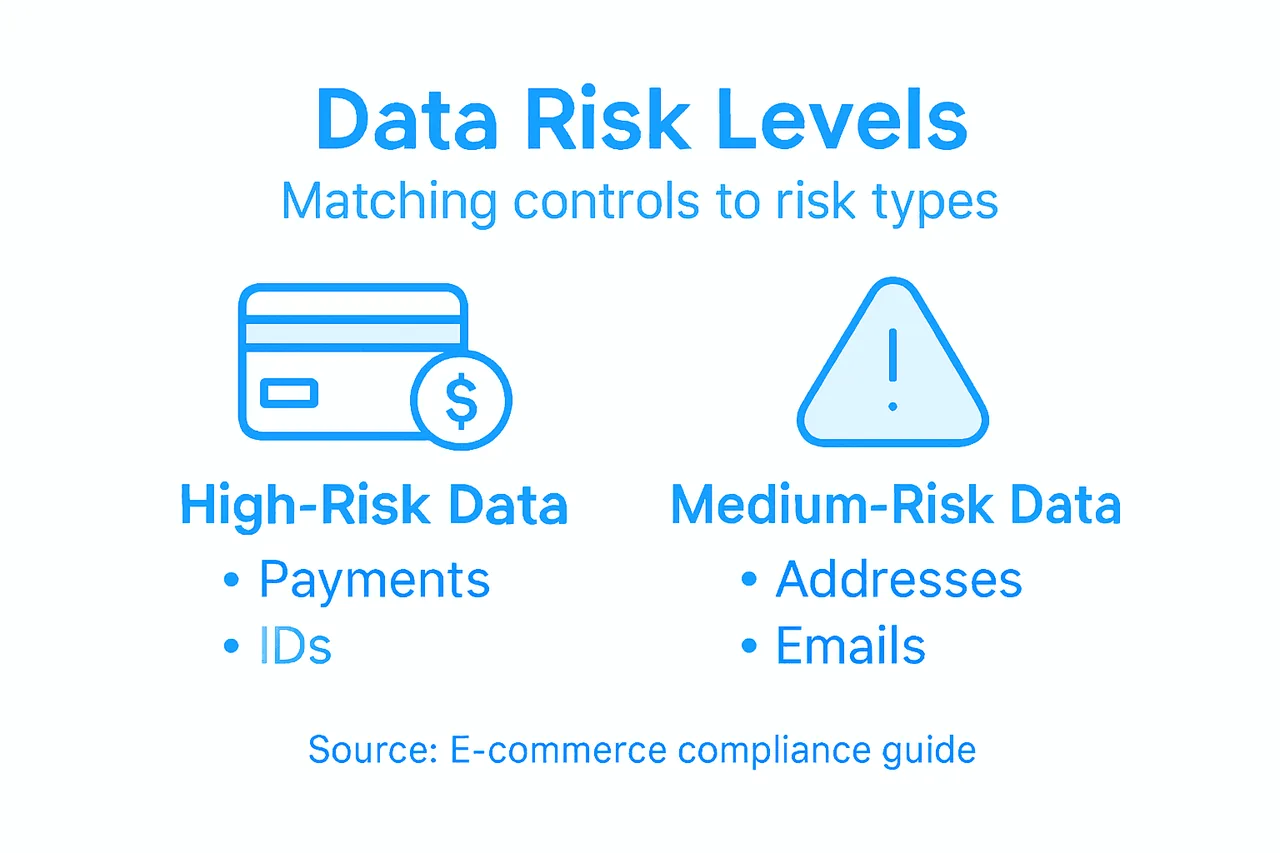
When securing customer data, document which controls protect each data type and why. This documentation proves to regulators and customers that you’ve thought carefully about protection rather than applying controls randomly.
Implementation Reality
Theory is clean. Reality is messier. Your payment processor handles card data differently than your email system handles contact information. Your analytics tool stores behavioural data in ways your backup system doesn’t. Each system needs appropriate controls for what it holds.
Start with your highest-risk data and work down. Implement controls systematically rather than trying to secure everything at once.
Pro tip: Create a simple spreadsheet listing each system you use, what data it holds, how sensitive that data is, and which controls currently protect it—this inventory becomes your roadmap for improvement.
Data Storage Options: Cloud Versus On‑Premises
Choosing where to store customer data represents one of your most significant infrastructure decisions. You’re essentially deciding between handing over physical control to a cloud provider or maintaining servers in your own facility. Both approaches work for e-commerce—neither is inherently superior. The right choice depends on your compliance requirements, budget, and appetite for managing infrastructure.
This decision affects security, cost, scalability, and regulatory compliance. Get it wrong and you’ll either overspend on unnecessary infrastructure or struggle with compliance violations.
Understanding the Two Models
Cloud storage means your data sits on servers owned and managed by providers like Amazon, Microsoft, or Google. You pay per gigabyte stored and accessed. On-premises means you own the servers, run them in your own facility or data centre, and manage everything yourself.
Cloud storage strategies work well for e-commerce because they scale automatically when you get busy—no scrambling to add servers during sales peaks. On-premises gives you direct control but requires upfront investment and ongoing maintenance.
Each model operates under a shared responsibility framework. In cloud, the provider secures the infrastructure; you secure your data and access controls. On-premises, you’re responsible for everything.
Cloud Storage: Benefits and Trade-offs
Cloud providers handle physical security, backups, disaster recovery, and infrastructure upgrades for you. You focus on protecting your data and controlling who accesses it.
Cloud advantages include:
- Automatic scaling — Storage grows with your business without purchasing new servers
- Built-in redundancy — Data copies across multiple locations automatically
- Lower upfront costs — No massive initial investment in hardware
- Professional security infrastructure — Providers employ dedicated security teams
- Simplified compliance — Providers often pre-build controls for GDPR, CCPA, and other standards
The trade-off is less direct control. Your data sits on someone else’s servers, and you trust their security practices. You’re also bound by their terms of service and data location policies.
Cloud storage works brilliantly for e-commerce when you need scalability and don’t want to manage physical infrastructure—but you must verify the provider’s encryption and access control capabilities.
On-Premises Storage: Control Versus Complexity
Running your own servers gives you complete control over physical and digital security. You know exactly where data lives and who can access it. This appeals to businesses handling extremely sensitive data or facing strict data residency requirements.
On-premises advantages include:
- Complete control — You decide every security decision and access rule
- Data residency — Data never leaves your country or facility
- No recurring fees — Initial investment, then mainly staffing costs
- Direct compliance management — You own compliance rather than trusting a provider
The drawbacks are substantial. You need skilled staff to maintain servers, handle security updates, manage backups, and respond to failures. Scaling requires purchasing new hardware. Security breaches become your entire responsibility.
Here’s a concise summary of how cloud and on-premises storage impact key factors for e-commerce businesses:
| Factor | Cloud Storage Benefit | On-Premises Storage Benefit |
|---|---|---|
| Initial Investment | Lower; pay-as-you-go | High upfront, lower ongoing |
| Scalability | Automatic; infinite scale | Manual hardware upgrades |
| Control | Less direct; third-party | Full organisational control |
| Compliance Burden | Provider shares responsibility | Sole responsibility |
| Physical Security | Handled by provider | Business directly manages |
| Speed of Deployment | Quick setup | Longer setup time |
| Flexibility | High; easily adjusted | Customisable but less flexible |
Hybrid Approaches
Many e-commerce businesses use both. Non-sensitive data like browsing history lives in the cloud for cost efficiency. Payment data and personal identifiers stay on-premises under tight control. This hybrid approach balances cost, control, and complexity.
Choosing cloud versus traditional hosting depends on your specific circumstances. Rapidly growing startups favour cloud’s scalability. Highly regulated financial services may prefer on-premises control.
Pro tip: Start by listing your data types, compliance requirements, and growth projections—then match these to what cloud providers and your internal team can actually support, rather than choosing a storage model first.
Compliance, Privacy Laws And International Standards
Regulations aren’t optional bureaucracy—they’re legal requirements that directly affect your business operations and customer relationships. If you operate an e-commerce platform, you’re likely subject to multiple overlapping privacy laws depending on where your customers live and where you store data.
Non-compliance isn’t a minor issue. Fines run into millions of Rands. Worse, customers stop trusting you after violations become public. Understanding which laws apply to your business is the foundation of secure data management.
Major Privacy Regulations You Need To Know
Three major frameworks govern most e-commerce data globally. The General Data Protection Regulation (GDPR) applies if you handle data from European Union residents. The California Consumer Privacy Act (CCPA) covers California residents. South Africa has the Protection of Personal Information Act (POPI).
Each regulation defines what personal data means, what rights customers have, and what your obligations are. They overlap considerably but differ in detail. A business serving customers across multiple continents faces compliance with all three.
Global privacy laws create significant challenges because you can’t simply pick one set of rules. You must comply with the strictest requirement applicable to your customers, then apply that standard broadly to avoid complexity.
GDPR: The European Standard
GDPR applies to any business processing data from European Union residents, regardless of where your company sits. It’s the most comprehensive regulation and sets the global standard many others follow.
Core GDPR requirements include:
- Lawful basis — You must have a valid reason to collect and process data
- Data minimisation — Collect only what you genuinely need
- Right to access — Customers can request copies of their data
- Right to deletion — Customers can demand you delete their information
- Breach notification — You must tell regulators and customers within 72 hours of discovering a breach
- Data Protection Impact Assessments — Document your data protection measures
GDPR fines reach 20 million euros or 4% of annual revenue—whichever is higher. This isn’t a fine for small violations; it’s the maximum penalty for serious breaches.
This table offers a quick reference for the main privacy regulations affecting e-commerce, highlighting their core focus and highest penalties:
| Regulation | Main Jurisdiction | Signature Requirement | Maximum Fine |
|---|---|---|---|
| GDPR | European Union | Consent, data rights, breach notice | 20 million euro or 4% revenue |
| CCPA | California, United States | Disclosure, opt-out, access right | $7,500 per intentional violation |
| POPI | South Africa | Processing limits, transparency | 10 million Rand or jail term |
CCPA and Emerging Regulations
CCPA gives California residents similar rights to access, deletion, and data portability. Other United States states have adopted similar laws. Asia is developing its own frameworks. Each adds complexity for businesses serving global customers.
Compliance isn’t about following every regulation perfectly—it’s about understanding which rules apply to your specific customers and implementing controls that satisfy the strictest requirements.
The Shared Reality Across Regulations
Despite differences, international privacy frameworks converge on core principles. All require you to safeguard personal data, limit collection to necessity, and respect customer rights. All require transparency through privacy policies and notices.
Implementing one solid compliance programme addresses most regulatory requirements simultaneously. Document your data flows, encryption methods, access controls, and incident response plan. This documentation proves compliance across multiple regulations.
Practical Compliance Steps
Start by identifying which regulations apply to your specific business. Then audit your current practices against those requirements. Close gaps systematically.
Common gaps include:
- Missing or outdated privacy policies
- No documented incident response plan
- Lack of encryption for sensitive data
- No access control documentation
- Unclear data retention policies
When implementing POPI and GDPR compliance, work with your legal team and technical staff together. Compliance requires both policy and technology—neither alone is sufficient.
Pro tip: Start with a compliance audit documenting your current data handling practices against applicable regulations, then prioritise fixing the gaps that expose you to highest fines and reputational damage.
Risks, Breach Response, And Best Practices
Data breaches aren’t a question of if but when. Every e-commerce business faces threats—from external attackers, careless employees, and system failures. What separates businesses that survive breaches from those that collapse is preparation. You need to understand the risks you face, plan your response, and implement defences before trouble strikes.
Most breaches don’t happen because a single control fails. They happen because multiple small failures compound. Address each weakness individually, and you’ll stay ahead.
Understanding Common Data Risks
Your customer data faces threats from multiple directions simultaneously. Understanding each threat type helps you build proportionate defences.
Primary risks include:
- Cyberattacks — Criminals targeting your systems directly through malware, ransomware, or hacking
- Insider threats — Employees or contractors accessing data they shouldn’t for personal gain or through carelessness
- Data leakage — Information escaping through misconfigured cloud storage, unencrypted backups, or accidental email forwards
- Third-party breaches — Your payment processor or email provider gets hacked, exposing data they hold
- Physical theft — Someone stealing a laptop or hard drive containing customer information
Data management risks require a layered response. No single defence stops all threats. Instead, multiple overlapping controls make your systems so difficult to breach that attackers move on to easier targets.
Breach Response: Having a Plan Matters
When a breach happens, your first 72 hours determine whether you contain it or watch it spiral. You need a documented plan before crisis strikes. Without one, you’ll make reactive decisions under stress that cost you more than preparation would have.
Your breach response plan should cover:
- Detection — How you’ll identify that a breach occurred
- Containment — Stopping the bleeding immediately, disconnecting affected systems
- Investigation — Understanding what was accessed and by whom
- Notification — Informing regulators and customers within required timeframes
- Recovery — Restoring systems and rebuilding customer trust
A breach response plan that sits on a shelf untested is almost worthless—you need to run simulations quarterly so your team knows their roles when real pressure hits.
Most businesses underestimate how quickly they must act. GDPR requires you to notify regulators within 72 hours of discovering a breach. You can’t take a week to investigate; you must move in parallel—containing damage whilst investigating its scope.
Best Practices That Actually Reduce Risk
Effective data protection combines technology, process, and culture. You can’t buy your way to security with tools alone, nor can you policy your way to it without technology.
Proven practices include:
- Encryption everywhere — Data encrypted at rest and in transit, so stolen data becomes useless
- Strict access controls — Only staff who need data for their jobs can access it, logged and audited
- Regular security training — Staff understand why they follow security policies, not just that they must
- Continuous monitoring — Automated systems detect unusual access patterns in real time
- Regular penetration testing — Hire security specialists to attack your systems and find weaknesses before criminals do
- Vendor management — Verify that third parties handling your data meet security standards
When implementing security best practices, start with what matters most. Encrypt payment data first. Control access to customer databases. Monitor suspicious activity. Then expand to other systems.
The Human Element
Your team is your strongest defence and your biggest vulnerability. Employees accidentally cause roughly one-third of breaches through misconfigurations, phishing susceptibility, or simple carelessness.
Invest in security culture. Make it easy for staff to follow secure practices. Reward reporting of suspicious activity rather than punishing it. When someone makes a mistake, use it as a training opportunity rather than a reason to blame.
Pro tip: Build a simple one-page breach response checklist documenting who to contact, what to do in the first hour, and escalation procedures—then test it annually with a tabletop exercise where your team walks through a simulated breach scenario.
Secure Your E-Commerce Data with Expert Digital Solutions
The article highlights the critical challenge of managing diverse customer data securely while complying with stringent privacy laws such as GDPR, POPI, and CCPA. Key pain points include protecting payment information with encryption, controlling access rigorously, and preparing effective breach response plans to safeguard customer trust and avoid costly fines. Balancing security needs with operational efficiency demands a strategic approach that combines technology and policy.
At Cloud Fusion, we understand these complexities and offer tailored solutions to help your business implement robust secure data management. Our custom web design and development services focus on building scalable and compliant e-commerce platforms that integrate strong encryption, access controls, and continuous monitoring. We also provide cloud-based hosting options that align with your compliance requirements and growth plans. Do not leave your customer data vulnerable when you can partner with experts who prioritise security and regulatory adherence.
Discover how Cloud Fusion can transform your e-commerce business by bridging technology with privacy compliance. Visit our Web Design and Development Quotation page now to explore solutions crafted for your security needs. Start protecting your digital reputation today and gain peace of mind with experienced professionals guiding your journey towards secure data management.
Frequently Asked Questions
What is secure data management in e-commerce?
Secure data management in e-commerce is a comprehensive framework that combines legal requirements, technological controls, and organisational procedures to protect customer information and maintain trust in digital transactions.
Why is secure data management important for e-commerce businesses?
Secure data management is crucial for e-commerce businesses because data breaches can lead to significant costs, including regulatory fines and loss of customer trust. Proper data management helps comply with legal requirements and establishes a framework for protecting customer data.
What are the key components of effective secure data management?
The key components include data inventory, which identifies what personal information is held; access controls that determine who can view sensitive data; and incident response plans for detecting and addressing breaches promptly.
How do privacy regulations like GDPR and CCPA impact e-commerce data management?
Privacy regulations like GDPR and CCPA set strict requirements for how businesses handle personal data. They mandate transparency, consent for data collection, and the rights of customers to access and delete their data, guiding e-commerce businesses in developing compliant data management practices.