Most e-commerce businesses barely scratch the surface of what website analytics can reveal about their customers, and even American and South-African marketers are surprised by how much opportunity goes untapped. Every click, scroll, and abandoned cart holds valuable clues for digital marketing managers focused on growing sales. By understanding the real story behind customer interactions, you can transform ordinary website visits into higher conversion rates and smarter decisions that directly impact revenue.
Table of Contents
- Website Analytics Explained For E-Commerce
- Key Metrics And Tracking Methods
- Choosing Analytics Platforms And Tools
- Turning Analytics Data Into Actions
- Privacy, Compliance And Data Risks
Key Takeaways
| Point | Details |
|---|---|
| Importance of Website Analytics | E-commerce businesses must leverage website analytics to gain insights into customer behaviour and optimise online performance, ultimately driving growth. |
| Key Performance Indicators (KPIs) | Understanding specific KPIs, such as conversion rates and average order value, is crucial for measuring e-commerce effectiveness and customer engagement. |
| Selection of Analytics Platforms | Choosing the appropriate analytics platform is vital; businesses should evaluate integration capabilities, reporting features, and cost to find a suitable solution. |
| Privacy and Compliance Management | E-commerce platforms must prioritise transparent data collection practices and regulatory compliance to build trust and safeguard user information. |
Website Analytics Explained For E-Commerce
Website analytics provides e-commerce businesses with a powerful lens into customer behaviour, enabling strategic decisions that drive growth and optimise online performance. By systematically tracking and interpreting digital interactions, companies can transform raw data into actionable insights that directly impact sales and customer experience.
The core of effective website analytics involves understanding key performance indicators (KPIs) specific to online retail. These metrics include conversion rates, average order value, cart abandonment rates, traffic sources, and user engagement patterns. Web analytics tools play a critical role in decoding complex customer journeys by revealing how visitors interact with different parts of an online store, helping businesses identify potential friction points and opportunities for improvement.
Successful e-commerce analytics goes beyond simple visitor counts. Advanced data analysis techniques allow businesses to create personalised marketing strategies by segmenting customers, predicting purchasing behaviours, and tailoring user experiences. Key analytical approaches include:
- Real-time traffic monitoring
- Conversion funnel analysis
- Customer segmentation
- Behavioural tracking
- Performance benchmarking
Pro Tip: Data Collection Strategy: Implement comprehensive tracking from the beginning and ensure you’re collecting granular data across all customer touchpoints to build a holistic understanding of your online store’s performance.
By leveraging sophisticated website analytics, e-commerce businesses can make informed decisions that translate directly into improved customer satisfaction and increased revenue.
Key Metrics And Tracking Methods
E-commerce businesses rely on comprehensive tracking methods to transform digital interactions into strategic insights. Emerging web analytics trends highlight the critical importance of understanding sophisticated tracking approaches that go beyond basic website visitor statistics.
Key metrics for e-commerce performance measurement can be categorised into several essential groups:
- Acquisition Metrics
- Traffic sources
- Campaign performance
- Visitor demographics
- Conversion Metrics
- Conversion rates
- Average order value
- Cart abandonment rate
- Engagement Metrics
- Time on site
- Pages per session
- Bounce rate
Most e-commerce websites significantly underutilise available web analytics software features, which means businesses are often missing critical opportunities to optimise their online performance. Advanced tracking methods now incorporate machine learning algorithms that can predict customer behaviour, personalise user experiences, and provide granular insights into purchasing patterns.
Modern tracking technologies enable businesses to create detailed customer journey maps, understanding precisely how users interact with different website elements. This includes tracking mouse movements, click patterns, scroll depth, and even heat maps that visualise user engagement.

Pro Tip: Comprehensive Tracking Strategy: Configure your analytics tools to capture micro-interactions and implement cross-platform tracking to ensure you’re collecting holistic data across all digital touchpoints.
By mastering these key metrics and tracking methods, e-commerce businesses can make data-driven decisions that directly enhance customer experience and drive revenue growth.
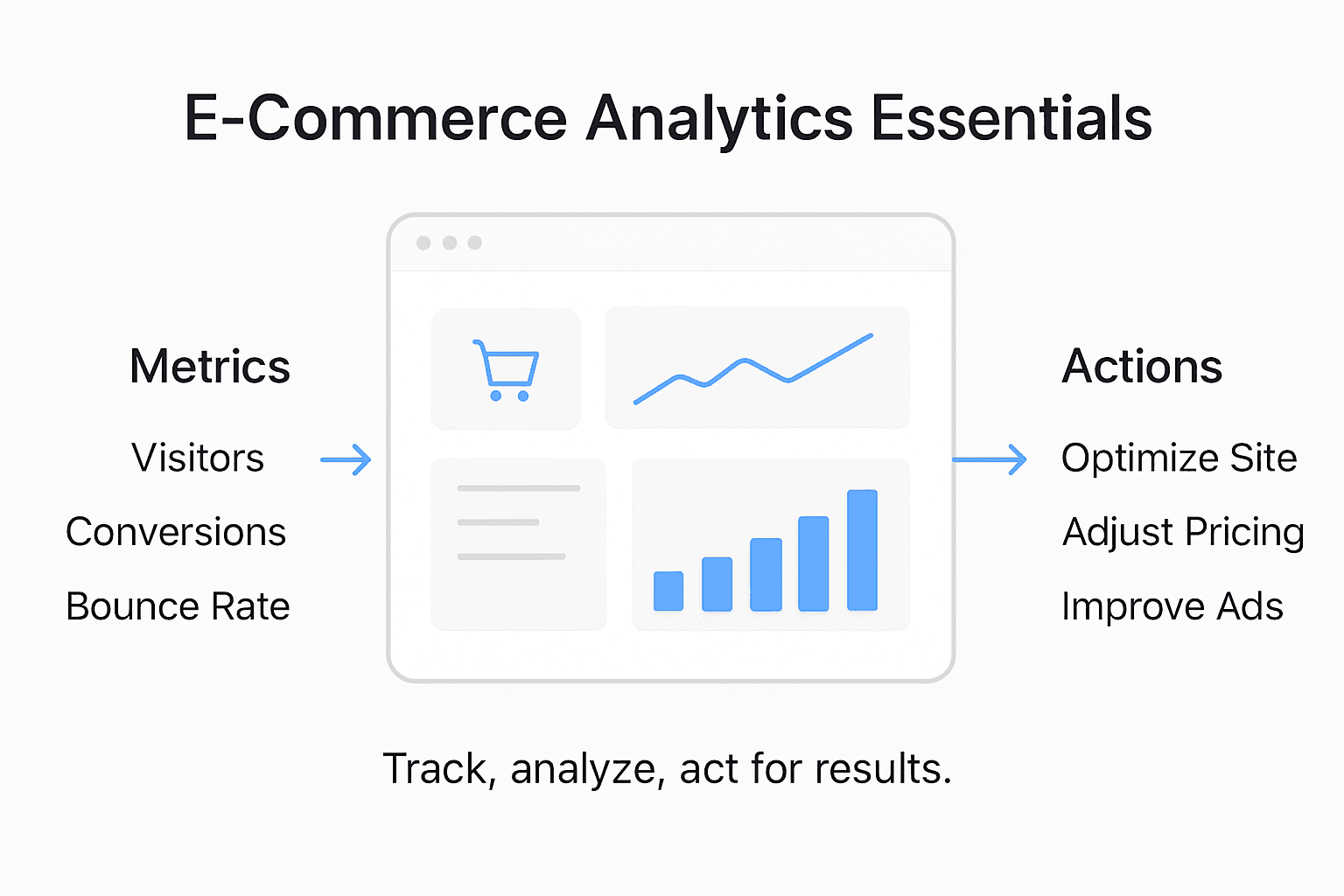
Choosing Analytics Platforms And Tools
Selecting the right analytics platform is crucial for transforming raw data into meaningful business intelligence, with each e-commerce business requiring a unique approach to digital performance measurement.
When evaluating analytics platforms, businesses should consider the following key selection criteria:
- Integration Capabilities
- Compatibility with existing technology stack
- API accessibility
- Third-party plugin support
- Reporting Features
- Customisable dashboards
- Real-time data tracking
- Advanced segmentation options
- Cost Considerations
- Pricing models
- Scalability
- Feature-to-price ratio
Advanced data science approaches demonstrate that robust analytics platforms can provide comprehensive insights through sophisticated visualization techniques, enabling businesses to understand complex user behaviour patterns and make strategic decisions.
Top analytics platforms typically offer unique strengths. Google Analytics remains popular for its comprehensive free tier, while platforms like Mixpanel and Heap provide more advanced user behaviour tracking. Enterprise-level solutions such as Adobe Analytics offer deep customisation for large-scale operations.
Here’s a comparison of leading e-commerce analytics platforms and their unique strengths:
| Platform | Key Strength | Scalability | Suitability |
|---|---|---|---|
| Google Analytics | Free, broad insights | High | Small to medium shops |
| Mixpanel | Advanced funnels | Moderate | Behavioural tracking |
| Heap | Auto-event capture | Moderate | Detailed journeys |
| Adobe Analytics | Deep customisation | Enterprise-level | Large businesses |
Pro Tip: Platform Evaluation Strategy: Create a detailed scorecard comparing potential analytics tools against your specific business requirements, prioritising platforms that offer both depth of insight and ease of implementation.
Ultimately, the most effective analytics platform is one that aligns closely with your specific e-commerce goals, provides actionable insights, and can evolve alongside your business growth.
Turning Analytics Data Into Actions
Big data analytics provides a powerful framework for transforming complex user activity into strategic business decisions, enabling e-commerce businesses to move beyond mere data collection towards meaningful performance optimization.
The process of converting analytics insights into actionable strategies involves several critical stages:
- Data Interpretation
- Identify significant patterns
- Recognize performance trends
- Understand user behaviour nuances
- Strategic Planning
- Develop targeted interventions
- Align insights with business objectives
- Create measurable improvement goals
- Continuous Optimization
- Implement changes incrementally
- Monitor impact of modifications
- Refine strategies based on ongoing feedback
Sophisticated web design research demonstrates that understanding online browsing and shopping patterns is crucial for developing effective digital strategies, allowing businesses to create more intuitive and conversion-focused user experiences.
Successful data-to-action conversion requires a systematic approach. This involves breaking down complex analytics into clear, prioritised recommendations that address specific business challenges such as reducing cart abandonment, improving user engagement, or optimising marketing spend.
Pro Tip: Insight Activation Strategy: Establish a regular review process where key stakeholders collaboratively translate analytics findings into concrete, measurable action plans, ensuring data insights directly drive business performance.
By treating analytics as a dynamic, strategic tool rather than a static reporting mechanism, e-commerce businesses can continuously adapt and improve their online performance.
Privacy, Compliance And Data Risks
Comprehensive privacy protection requires integrating both technical and policy-based frameworks that address complex data management challenges for e-commerce businesses navigating increasingly sophisticated regulatory landscapes.
Key privacy and compliance considerations for e-commerce platforms include:
- Data Collection Transparency
- Clear user consent mechanisms
- Explicit information about data usage
- Opt-out and data deletion options
- Security Protocols
- Encryption standards
- Secure data storage
- Regular security audits
- Regulatory Compliance
- POPI Act adherence
- GDPR international standards
- Local and international data protection requirements
Modern data protection strategies must balance comprehensive legal compliance with advanced privacy-preserving techniques in big data analysis, ensuring both regulatory alignment and user trust.
E-commerce businesses face significant risks from non-compliance, including potential financial penalties, reputational damage, and loss of customer confidence. Implementing robust data governance frameworks involves developing comprehensive privacy policies, conducting regular risk assessments, and maintaining transparent communication with users about data handling practices.
Below is a summary of privacy risks and recommended management strategies for e-commerce:
| Risk Area | Potential Impact | Management Strategy |
|---|---|---|
| Data Collection | Customer mistrust | Transparent consent and usage info |
| Poor Security | Data breaches, fines | Encryption, frequent audits |
| Regulatory Gaps | Legal penalties, lawsuits | Adhere to POPI Act & GDPR |
| Insufficient Policy | Damage to reputation, losses | Regular framework reviews |
Pro Tip: Privacy Risk Management: Conduct an annual comprehensive review of your data collection and storage practices, ensuring alignment with the latest regulatory requirements and emerging best practices in digital privacy.
Successful privacy management is not just about avoiding penalties, but about building trust and demonstrating genuine commitment to protecting user information.
Unlock Your E-Commerce Potential With Data-Driven Web Solutions
Struggling to translate complex website analytics into actionable strategies can hold back your online store’s growth. This article highlights challenges such as optimising conversion rates, reducing cart abandonment and personalising customer journeys. These are vital goals that require a powerful combination of smart tracking and tailored web development. Leveraging detailed customer insights demands a website designed not just for visibility but for performance and seamless user engagement.
At Cloud Fusion, we understand the crucial role of integrating advanced analytics with bespoke web design to elevate your e-commerce success. Our expert team crafts custom, scalable websites that give you full control over user behaviour tracking and conversion funnel optimisation. Explore how our Web Design and Development solutions can transform your online presence. Don’t leave valuable insights unused — take decisive action now to harness the power of data.
Ready to convert analytics into real business growth Discover the difference a tailored website can make when allied with strategic digital expertise at Cloud Fusion. Visit our Web Design and Development Quotation page and take the first step towards elevating your e-commerce platform today.
Frequently Asked Questions
What are the key metrics to track for e-commerce success?
Key metrics include acquisition metrics (traffic sources and visitor demographics), conversion metrics (conversion rates and cart abandonment rate), and engagement metrics (time on site and pages per session).
How can e-commerce businesses improve website analytics?
Businesses can improve website analytics by implementing a comprehensive data collection strategy, optimising tracking methods, and regularly analysing key performance indicators to identify areas for growth.
What factors should I consider when choosing an analytics platform?
Consider integration capabilities, reporting features, cost considerations, and scalability when evaluating analytics platforms for your e-commerce business.
How can I turn analytics data into actionable strategies?
To turn analytics data into actionable strategies, interpret the data to identify patterns, develop targeted interventions, and engage in continuous optimization based on user feedback and behavior.
Recommended