

What is an e-commerce platform: a guide for entrepreneurs
Discover what an e-commerce platform is and how it can streamline your online store. Learn key features essential for entrepreneurs.
Start reading
TL;DR:
- An e-commerce platform manages product listings, payments, and orders within a centralized system.
- Choosing the right platform improves operational efficiency and reduces manual work as a business grows.
An e-commerce platform is defined as a centralised software solution that manages every aspect of online selling within a single system, from product listings and shopping carts to payment processing and order fulfilment. This is the operational backbone of any online store, and choosing the right one shapes how efficiently your business runs day to day. For South African entrepreneurs looking to launch or grow online sales, understanding what these platforms actually do, and how they differ, is the most important technical decision you will make.
What is an e-commerce platform and what does it actually do?
An e-commerce platform is a centralised software solution that integrates product catalogue management, shopping cart functionality, payment gateway connectivity, inventory tracking, and order fulfilment into one system. It replaces the physical store digitally, giving your business global reach without a shopfront. The platform does not process payments itself. Instead, it connects to payment gateways like PayFast or Peach Payments, which handle the actual transaction security and fund movement.
Think of the platform as the engine room of your online store. It coordinates every moving part so that when a customer clicks “buy,” the system automatically updates your stock, triggers a fulfilment workflow, and records the sale in your reporting dashboard. Without this coordination, you are managing those steps manually, which introduces errors and slows your business down.
The industry standard term for this category of software is “e-commerce platform,” though you will also hear it called an “online store platform” or “digital commerce solution.” All three refer to the same thing: a unified system that makes online selling operationally manageable.
What are the essential features of an e-commerce platform?
The core features of a capable e-commerce platform cover the full sales cycle, from the moment a customer lands on your store to the moment their order arrives at their door. Here is what every platform worth considering must include:
- Product catalogue management: Add, edit, and organise products with images, descriptions, variants, and pricing.
- Shopping cart and checkout: A secure, frictionless path from product selection to purchase confirmation.
- Payment gateway integration: Connectivity to local and international payment processors, with PCI-DSS compliance handled at the gateway level.
- Inventory tracking: Real-time stock visibility that prevents overselling and triggers reorder alerts.
- Order management: A central dashboard to process, track, and fulfil customer orders.
- Third-party integrations: Connections to ERP systems, CRM tools, email marketing platforms, and shipping carriers.
- Reporting and analytics: Sales data, conversion rates, and customer behaviour metrics in one place.
Cloud-based SaaS platforms manage hosting, security, and software updates on your behalf. This removes a significant technical burden, particularly for businesses without a dedicated IT team. The benefits of cloud adoption for e-commerce include automatic scaling during traffic spikes, regular feature updates, and enterprise-grade security without enterprise-grade costs.
Pro Tip: Integration quality matters far more than design templates. A platform with 50 beautiful themes but poor shipping and accounting integrations will cost you more in manual workarounds than you save on setup.

How do different types of e-commerce platforms compare?
Not all platforms are built the same way, and the type you choose determines how much control, flexibility, and technical effort your business takes on. There are four main categories.
| Platform type | Best for | Technical skill needed | Cost model | Key trade-off |
|---|---|---|---|---|
| Hosted SaaS | Small to medium businesses | Low | Monthly subscription | Less customisation |
| Self-hosted / open source | Complex or enterprise businesses | High | Hosting + development | Full control, high maintenance |
| Marketplace | Businesses wanting built-in traffic | Low | Commission per sale | Fees and competition |
| Social commerce | Impulse-driven product categories | Low | Free to list | Limited operational control |
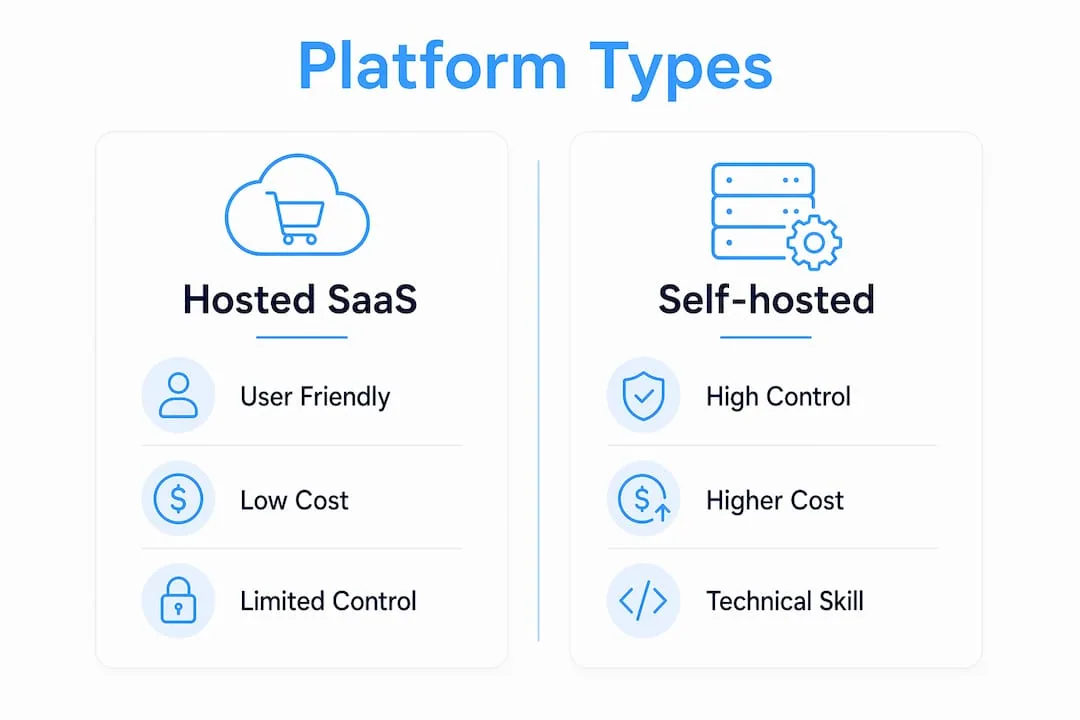
Hosted SaaS platforms are the most popular choice for growing businesses because they bundle design tools, inventory management, and payment processing into a single monthly fee. Monthly costs for well-known SaaS platforms start from around $5 and scale with features and transaction volume. That low entry point makes them accessible, but you must check what is included at each tier before committing.
Self-hosted platforms give you full control over code, design, and data. They suit businesses with complex product catalogues, custom pricing rules, or specific compliance requirements. The trade-off is real: you carry the responsibility for hosting, security patches, and ongoing development. For most South African SMEs, that overhead is not worth it unless your business genuinely needs capabilities that SaaS cannot provide.
Marketplaces like Takealot give you access to an existing customer base, but you compete directly with other sellers on price, and the platform takes a commission on every sale. Social commerce channels work well for impulse purchases but offer almost no backend management capability.
Pro Tip: Match your platform type to your current business complexity and your 24-month growth plan. A business selling 20 products today but planning 2,000 in two years needs a platform that scales, not just one that is cheap to start.
What operational advantages do e-commerce platforms offer South African businesses?
South African businesses face specific operational pressures: load shedding disrupts fulfilment, logistics networks vary by region, and customers expect local payment options like EFT, PayFast, and SnapScan. A well-chosen platform addresses all of these directly.
Automation of order processing and inventory management cuts manual errors and frees your team to focus on growth rather than admin. When a sale happens, the platform updates stock, notifies your warehouse, and sends the customer a confirmation, all without a person touching it. That speed and accuracy builds customer trust faster than any marketing campaign.
Platforms also enable unified data access across your sales, finance, and marketing teams. Instead of your finance team working from a spreadsheet and your marketing team guessing at conversion rates, everyone draws from the same live data. That alignment reduces internal friction and makes your promotional decisions more accurate.
Key operational benefits for South African businesses include:
- Local payment gateway support: Integration with PayFast, Peach Payments, and Ozow reduces transaction friction for local customers.
- R currency handling: Platforms configured for ZAR pricing and VAT compliance simplify your financial reporting.
- Logistics integration: Connections to The Courier Guy, Aramex South Africa, and similar carriers automate shipping quotes and tracking.
- Cloud resilience: SaaS platforms remain accessible during load shedding if your team has mobile data, unlike on-premise servers that go down with the power.
- Seasonal scaling: Cloud scalability means your store handles Black Friday traffic without expensive infrastructure upgrades.
Local payment gateway compatibility and R currency support are not optional extras for South African businesses. They directly affect whether customers complete their purchases or abandon their carts at checkout.
What are the common misconceptions about e-commerce platforms?
The most expensive mistake business owners make is confusing a website builder with a full e-commerce platform. Website builders focus on design, while e-commerce platforms provide backend synchronisation, inventory management, and business automation. A beautiful website that cannot track stock or automate order fulfilment is not an e-commerce platform. It is a brochure with a checkout button.
Several other misconceptions regularly cost businesses time and money:
- “The platform processes my payments.” The platform does not process payments. It integrates with a payment gateway that does. Choosing the wrong gateway affects transaction fees, security, and which payment methods your customers can use.
- “More templates mean a better platform.” Design flexibility is useful, but native integrations with shipping, tax, and marketing tools determine your long-term operational efficiency. Prioritise integrations over aesthetics.
- “Add-ons can fill any gap.” Third-party add-ons create dependency on external developers and can break during platform updates. Native integrations are more reliable.
- “The cheapest platform saves money.” A platform that forces manual workarounds costs more in staff time than a higher monthly subscription with better automation.
Pro Tip: Before signing up for any platform, map your operational workflow first. List every system your business uses, from accounting software to your courier, and verify that the platform integrates natively with each one. If it does not, factor in the cost of custom development before you commit.
Key takeaways
An e-commerce platform is the operational backbone of online retail, and choosing the right type based on your business complexity, integration needs, and growth plans determines whether your online store runs efficiently or creates constant manual work.
| Point | Details |
|---|---|
| Platform definition | A centralised system managing products, payments, inventory, and orders in one place. |
| Integration over design | Native integrations with shipping, tax, and marketing tools matter more than templates. |
| Payment gateways are separate | The platform connects to gateways like PayFast; it does not process payments itself. |
| Platform type selection | Match SaaS, self-hosted, or marketplace to your current complexity and growth plans. |
| Local context matters | South African businesses need ZAR support, local payment gateways, and logistics integrations. |
The platform decision most businesses get wrong
Here is what I have seen consistently working with South African entrepreneurs: the platform decision gets made based on price or a friend’s recommendation, not on operational fit. A business owner sees a low monthly fee, signs up, and six months later they are manually copying orders from their store into a spreadsheet because the platform does not integrate with their accounting software.
The e-commerce platform is not a website. It is your digital infrastructure. Every inefficiency baked into that infrastructure compounds as you grow. A business doing 50 orders a month can absorb manual workarounds. A business doing 500 orders a month cannot. The time to get this right is before you launch, not after you are already overwhelmed.
What I consistently recommend is this: treat your platform selection the same way you would treat choosing a business premises. You would not sign a five-year lease on a space that does not fit your operations. Do not commit to a platform that cannot support your fulfilment workflow, your payment preferences, or your reporting needs. The right CMS and platform choice is a strategic decision, not a technical afterthought.
The businesses that scale well online are the ones that invest time upfront in understanding their operational requirements and then select a platform that meets them, even if that means custom development. That investment pays back quickly in reduced admin, fewer errors, and a better customer experience.
— Anton
How Cloudfusion helps you build the right e-commerce foundation
Getting your platform choice right from the start saves you significant time and cost down the line. Cloudfusion works with South African businesses to design and build custom e-commerce solutions that fit your specific operational needs, whether that means integrating local payment gateways, connecting your store to your existing ERP, or building a fully custom online store from the ground up. The team understands the South African market context, from ZAR currency handling to local logistics integrations. If you are ready to build an online store that actually works for your business, give us a shout and let’s chat about your project.
FAQ
What is the e-commerce platform definition in simple terms?
An e-commerce platform is software that lets businesses sell products online by managing product listings, shopping carts, payments, inventory, and orders in one system.
How do e-commerce platforms work?
When a customer places an order, the platform automatically updates stock levels, triggers fulfilment workflows, and records the sale, all without manual input from your team.
What are the top features of e-commerce platforms?
The most important features are product catalogue management, secure checkout, payment gateway integration, inventory tracking, order management, and third-party integrations with shipping and accounting tools.
What is the difference between a website builder and an e-commerce platform?
A website builder focuses on design and content display, while an e-commerce platform provides backend automation, inventory synchronisation, and operational management tools for running an online store.
What are the advantages of e-commerce platforms for South African businesses?
South African businesses benefit from local payment gateway support, ZAR currency handling, logistics integrations, and cloud resilience that keeps stores accessible even during load shedding.