TL;DR:
- Digital agencies enable international growth through AI-driven marketing, cultural localisation, and adaptive systems. They focus on core channels like Meta, Google, and email while emphasizing infrastructure and localised content. Successful partnerships involve strategic collaboration and operational readiness for long-term market presence.
Digital agencies are defined as specialist partners that help businesses enter, compete in, and scale across international markets through technology, localised content, and data-driven marketing. The role of digital agencies in global growth has shifted from campaign execution to full-scale market architecture. Agencies now remove geographical and operational barriers that would otherwise take years to dismantle internally. They do this by combining AI-powered automation, cultural localisation, and adaptive marketing systems. Agencies that focused their service offerings grew at 13% versus 7.5% for generalist counterparts, with top-quartile firms retaining clients 2.3 times longer. That gap reflects the real competitive advantage a well-chosen agency delivers.
How digital agencies use AI and technology to drive global marketing
AI has moved from a nice-to-have to a core operating requirement for agencies managing international campaigns. In 2026, 34% of agencies have integrated AI across core business functions including coding, design, and marketing automation. That figure signals a market where AI competence is the baseline, not the differentiator.

The real power of AI in global marketing lies in its ability to handle complexity at a scale no manual team can match. Successful global marketing blends human strategy with machine execution, using AI guided by first-party data to capture regional search intent across dozens of markets simultaneously. A human strategist sets the direction; the machine executes, tests, and refines continuously.
Agencies that apply AI well see measurable gains in both speed and profitability. AI-powered localisation adapts imagery, cultural references, and tone at one-third the cost and half the time of traditional translation workflows. That efficiency directly improves agency margins and client outcomes. The productivity gains from AI for agencies are well-documented, with firms reporting faster delivery cycles and stronger retention rates.
Key ways agencies apply AI to global marketing include:
- First-party data activation: Feeding CRM and purchase data into AI models to improve audience targeting across markets
- Campaign architecture: Combining Demand Gen campaigns for awareness with Performance Max for conversions, guided by real-time profitability data
- Content adaptation: Generating localised ad copy, product descriptions, and emails across multiple markets from a single brief
- Predictive budgeting: Allocating spend dynamically based on market-level performance signals rather than fixed quarterly plans
Pro Tip: Get your data infrastructure right before scaling AI-driven campaigns. AI is only as good as the first-party data feeding it. Agencies that rush automation without clean data pipelines waste budget and produce off-target messaging.
Why localisation goes far beyond translation
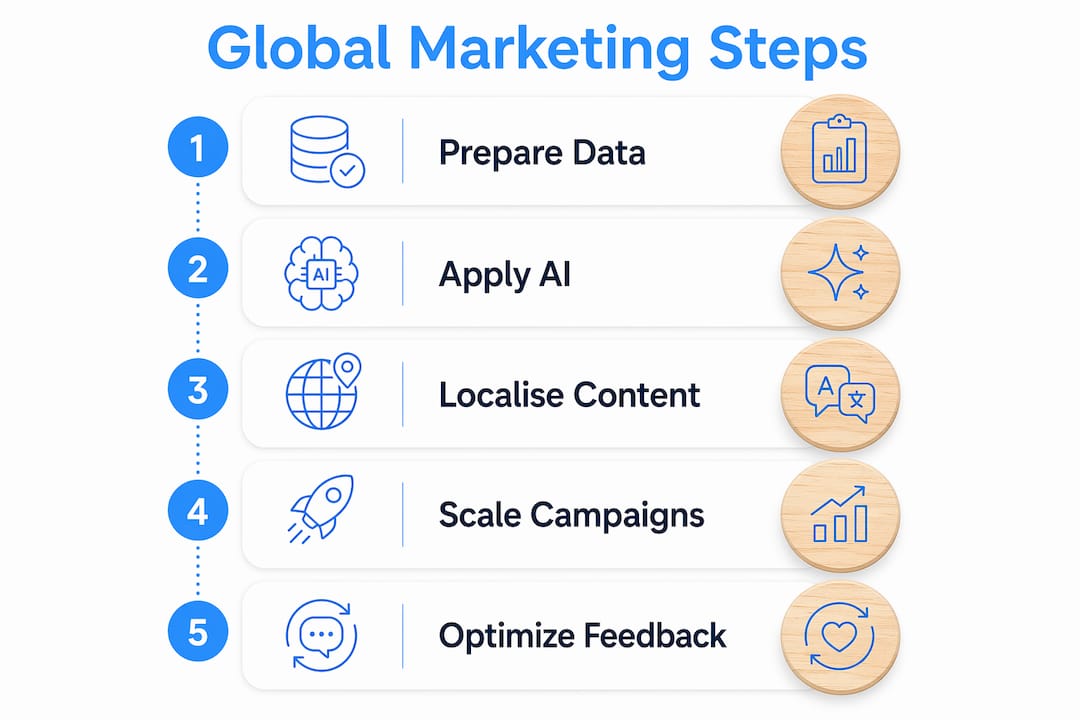
Localisation is the process of adapting your entire market presence, not just your words, to fit a specific culture, economy, and user expectation. Global expansion fails most often due to off-context messaging and a lack of cultural adaptation. Translating a campaign literally into another language is not localisation. It is a shortcut that erodes trust.
Effective localisation covers four critical dimensions:
- Cultural adaptation: Rethinking scenes, humour, colour choices, and references that carry different meanings across cultures. A campaign that works in Johannesburg may alienate audiences in Tokyo or Amsterdam without deliberate cultural review.
- Payment localisation: Offering market-specific payment methods such as iDEAL in the Netherlands or Konbini in Japan. Matching local payment habits can raise conversion rates 20–40%. That is a significant revenue impact from a single infrastructure decision.
- UX and navigation: Adapting layouts, reading direction, and information hierarchy to match local user behaviour patterns. Right-to-left languages require more than a text flip.
- Multimedia adaptation: Localising video scripts, voiceovers, and visual assets rather than adding subtitles as an afterthought. Video localisation signals genuine market commitment to local audiences.
“Mature global teams treat localisation as a continuous feedback loop, not a one-time project. They gather market-specific data, test assumptions, and refine their approach with each campaign cycle. The brands that win internationally are those that listen to local signals and adapt faster than their competitors.”
Localisation also has a direct impact on SEO performance. Search intent varies significantly by market. A keyword that drives high-volume traffic in South Africa may have a completely different meaning or search volume in Germany. Agencies that build localised content strategies around regional search data consistently outperform those that translate a single global keyword list.
Pro Tip: Build a local feedback loop into every market you enter. Appoint a regional contact or partner who can flag cultural missteps before they reach your audience. This single step prevents the most costly localisation errors.
How agencies build adaptive global marketing systems
Global expansion is not a single launch event. It is a system that must absorb market feedback, evolve with local conditions, and scale without breaking. Brands that build adaptive systems avoid costly breakdowns in the first 12–24 months of international operation. Agencies that understand this design for iteration from day one.
The distinction between a campaign and a system matters enormously here. A campaign has a start and end date. A system has feedback mechanisms, governance structures, and built-in flexibility. Agencies that treat global expansion as a system rather than a project deliver far more durable results for their clients.
Common pitfalls that adaptive systems prevent:
- Rushed market entry: Launching before localisation, logistics, and customer support are ready creates negative first impressions that are difficult to reverse
- Misaligned KPIs: Applying headquarters metrics directly to regional markets ignores local context and leads to poor decisions
- Siloed execution: Running global and regional teams without shared data creates contradictory messaging and wasted spend
- Rigid campaign structures: Building campaigns that cannot absorb creative or budget changes without a full rebuild
The AI in digital marketing space has accelerated the need for adaptive systems. AI tools surface performance signals faster than any manual reporting cycle. Agencies that build systems capable of acting on those signals in near real-time hold a clear advantage over those still running monthly review cycles.
Pro Tip: Design your global marketing architecture so that adding a new market requires configuration, not reconstruction. If entering market number five requires rebuilding your entire tech stack, the system was never designed for scale.
Which channels and infrastructure matter most internationally?
Core digital marketing channels including Meta, Google, and email remain essential internationally. New markets rarely require new platforms. They require better execution on the platforms your audience already uses. This is a point many business leaders miss when planning international expansion.
The real infrastructure investment belongs in logistics, data governance, and localisation, not in learning new advertising platforms. The table below clarifies where to focus resources:
| Area | Channel consistency | Localisation infrastructure |
|---|---|---|
| Advertising | Meta and Google work across most markets | Ad creative must be culturally adapted per market |
| Email marketing | Global platforms handle delivery | Subject lines, offers, and timing need local tuning |
| SEO | Core technical standards apply globally | Keyword research and content must be market-specific |
| Payments | Global gateways cover basic needs | Local payment methods drive conversion uplift |
| Data governance | Central analytics platform works globally | Regional data privacy laws require local compliance |
Central teams managing regional storefronts work best when they own the technology and brand standards while delegating content and offer decisions to local partners. This model keeps quality consistent without sacrificing local relevance. The digital transformation strategies that support this model prioritise modular architecture, where regional teams can customise without disrupting the global foundation.
Marketing budgets have flattened at 7.7% of company revenue, which means agencies and their clients must extract more value from existing channels rather than adding new ones. Specialisation and infrastructure investment deliver that value more reliably than platform diversification.
Key takeaways
Digital agencies drive global growth by combining AI-powered execution, deep cultural localisation, and adaptive marketing systems that evolve with each market they enter.
| Point | Details |
|---|---|
| AI is now baseline | 34% of agencies use AI across core functions; first-party data quality determines campaign effectiveness. |
| Localisation drives conversions | Market-specific payment methods alone can raise conversion rates by 20–40%. |
| Systems outperform campaigns | Adaptive marketing systems prevent costly breakdowns in the first 12–24 months of global expansion. |
| Core channels still lead | Meta, Google, and email remain the primary international channels; invest in infrastructure, not new platforms. |
| Focused agencies grow faster | Agencies with specialised offerings grow at 13% versus 7.5% for generalists, with stronger client retention. |
What South African businesses often get wrong about global agency partnerships
Here is something I see repeatedly with South African businesses pursuing international growth. They treat the digital agency relationship as a vendor arrangement rather than a strategic partnership. They brief an agency on a campaign, approve a budget, and expect results within 90 days. That mindset produces short-term activity, not long-term market presence.
The businesses that succeed internationally are the ones that give their agency access to real business data: margins, inventory levels, customer lifetime value by region, and operational constraints. When an agency understands your actual business model, it can align AI campaign decisions with profitability rather than just click-through rates. That alignment is where the real competitive advantage lives.
South African firms also tend to underestimate the time required for localisation to compound. A well-localised market presence builds trust incrementally. The SEO gains, the brand recognition, the word-of-mouth referrals: these take 12–18 months to materialise in a new market. Agencies that promise faster results are usually cutting corners on the cultural adaptation work that makes those results stick.
My honest recommendation is to prioritise agencies that ask hard questions about your operational readiness before they touch your ad account. An agency that wants to understand your logistics, your customer support capacity, and your data governance before launching campaigns is an agency that will protect your brand in markets where you have no existing reputation to fall back on.
— Anton
How Cloudfusion supports your international growth ambitions
Cloudfusion builds the digital infrastructure that global expansion actually requires. From custom web development designed for multi-market deployment to mobile applications that serve diverse regional audiences, Cloudfusion’s work is built for scale from the ground up. The team integrates AI-driven personalisation, localisation-ready architecture, and data governance considerations into every project. If you are planning international expansion or need to strengthen your digital foundation before entering new markets, give us a shout. Let’s chat about what your business needs to compete globally.
FAQ
What is the role of digital agencies in global growth?
Digital agencies help businesses enter and scale in international markets by providing AI-powered marketing, cultural localisation, and adaptive campaign systems. They remove operational and geographical barriers that internal teams typically lack the capacity to address.
How do digital agencies use AI for international marketing?
Agencies use AI to manage campaign complexity at scale, adapting content, targeting, and spend across multiple markets simultaneously. AI guided by first-party data captures regional search intent more accurately than manual campaign management.
Why does localisation matter beyond language translation?
Localisation covers cultural references, payment methods, UX design, and multimedia adaptation. Matching local payment habits alone can increase conversion rates by 20–40%, making it one of the highest-impact investments in global expansion.
How do I know if a digital agency is right for global expansion?
Choose an agency that asks about your operational readiness, data infrastructure, and logistics before discussing campaigns. Focused agencies with specialised international experience grow faster and retain clients significantly longer than generalist firms.
What digital marketing channels work best internationally?
Meta, Google, and email remain the core channels across most international markets. Infrastructure investment in localisation, payments, and data governance delivers more value than adopting new regional platforms.
Recommended