Over fifty percent of south-african e-commerce firms report that outdated software still hampers their growth. For digital transformation managers, this challenge highlights the urgent need for flexible solutions that adapt as business scales and market conditions shift. Understanding what makes SaaS unique—and recognizing common misconceptions about its security and integration—empowers you to make smarter choices that drive operational efficiency and customer engagement.
Table of Contents
- SaaS Basics And Common Misconceptions
- Major Types Of SaaS Solutions
- Key Features And How SaaS Works
- Benefits For E-Commerce Businesses
- Risks, Integration Challenges, And Security
- Choosing The Right SaaS For Your Needs
Key Takeaways
| Point | Details |
|---|---|
| Embrace SaaS for Flexibility | SaaS provides web-based applications that allow businesses to scale and adapt without significant upfront investment. |
| Prioritise Security Certifications | When evaluating SaaS solutions, choose providers with transparent security certifications to minimise risks. |
| Consider Functional Alignment | Select SaaS platforms that align with your business needs and long-term strategic goals for optimal impact. |
| Assess Integration Capabilities | Ensure chosen SaaS solutions integrate seamlessly with existing systems to maintain operational efficiency. |
SaaS basics and common misconceptions
Software as a Service (SaaS) represents a revolutionary approach to delivering software applications over the internet, transforming how businesses access and utilise technological solutions. Unlike traditional software models that require complex installations and maintenance, SaaS provides web-based applications accessible through standard internet browsers. This model enables companies to leverage sophisticated software tools without significant upfront infrastructure investments.
Many organisations harbour misconceptions about SaaS that can hinder their digital transformation efforts. Common myths about cloud services include pervasive concerns about security, scalability, and reliability. Businesses often assume SaaS solutions are less secure than on-premises systems, yet modern SaaS platforms typically implement robust security protocols that frequently surpass traditional IT infrastructure capabilities. These cloud-based services offer several key advantages:
- Automatic software updates
- Reduced IT maintenance costs
- Seamless scalability
- Enhanced accessibility from multiple devices
- Predictable monthly subscription pricing
Understanding SaaS requires recognising its fundamental shift from product-based to service-oriented software delivery. Traditional software models required businesses to purchase expensive licenses, install complex systems, and manage ongoing technical maintenance. SaaS eliminates these barriers by providing application access through cloud infrastructure, allowing companies to focus on core business objectives rather than technical complexities.
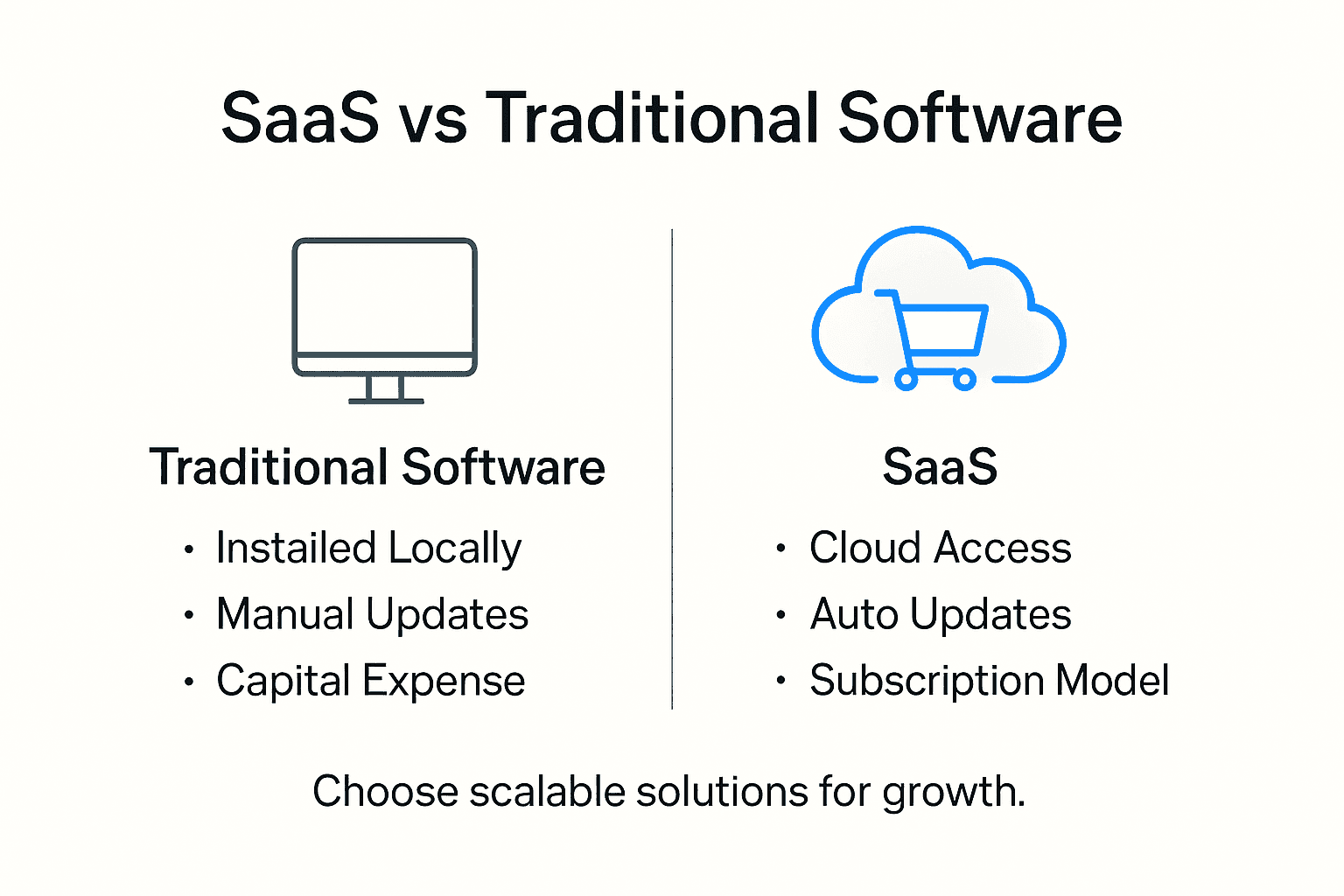
Here’s a comparison summarising traditional software and SaaS delivery models:
| Aspect | Traditional Software | SaaS (Software as a Service) |
|---|---|---|
| Deployment | Installed on local hardware | Accessed via the cloud |
| Upfront Investment | High hardware and licence costs | Subscription-based pricing |
| Maintenance | Managed by internal IT staff | Managed by the provider |
| Updates | Manual, infrequent | Automatic and regular |
| Accessibility | Limited to office devices | Accessible from any browser |
Pro tip: When evaluating SaaS solutions, prioritise providers offering transparent security certifications and comprehensive data protection frameworks to mitigate potential integration risks.
Major types of SaaS solutions
SaaS solutions have evolved into a sophisticated ecosystem that caters to diverse business needs, spanning both horizontal and vertical market segments. Classification of SaaS applications reveals a complex landscape of software offerings designed to streamline organisational processes and enhance operational efficiency across multiple industries.
Horizontal SaaS solutions represent broad-based tools applicable across different sectors, addressing universal business functions. These typically include:
- Customer Relationship Management (CRM)
- Enterprise Resource Planning (ERP)
- Human Resources Management Systems
- Project Management Tools
- Accounting and Financial Software
- Communication and Collaboration Platforms
Vertical SaaS solutions, by contrast, are industry-specific applications tailored to unique requirements of particular sectors such as healthcare, education, retail, and manufacturing. These specialised tools offer deep functionality that generic platforms cannot provide, integrating complex workflows and regulatory compliance requirements specific to each industry.
Beyond categorisation by market approach, SaaS solutions can also be differentiated by deployment model, pricing structure, and complexity. Small businesses might prefer lightweight, cost-effective solutions with straightforward interfaces, while enterprise-level organisations require robust, customisable platforms with advanced integration capabilities and comprehensive security frameworks.
This table outlines typical horizontal vs vertical SaaS solution traits for business selection:
| Solution Type | Typical Users | Key Advantage |
|---|---|---|
| Horizontal | Multiple industries | Broad, general functionalities |
| Vertical | Specific sectors (e.g., healthcare) | Highly tailored, industry compliance |
Pro tip: When selecting a SaaS solution, prioritise platforms offering seamless scalability and robust API integrations to ensure long-term technological adaptability.
Key features and how SaaS works
At its core, Software as a Service (SaaS) represents a transformative approach to software delivery, fundamentally changing how businesses access and utilise technological resources. Technical architectures of SaaS platforms reveal a sophisticated model that enables remote software access through web-based interfaces, eliminating traditional infrastructure constraints.
The key operational features of SaaS distinguish it from conventional software deployment models:
- Multi-tenancy architecture: Allows multiple users to share a single software instance
- Web-based accessibility: Enables access from any internet-connected device
- Automatic updates: Ensures all users have the latest software version
- Subscription-based pricing: Provides flexible, scalable cost structures
- Centralised data management: Simplifies maintenance and reduces technical overhead
Under the hood, SaaS platforms leverage cloud computing infrastructure to deliver seamless, scalable software experiences. Unlike traditional software models that require complex local installations, SaaS solutions host applications on remote servers, managing all backend processes, security protocols, and system maintenance. This approach dramatically reduces technological barriers for businesses, allowing them to focus on core operational objectives rather than intricate technical management.

The subscription model represents a fundamental shift in software consumption, transforming technology from a capital expense to an operational expense. Small and medium enterprises particularly benefit from this approach, gaining access to enterprise-grade tools without significant upfront investments in hardware, software licenses, or specialised IT infrastructure.
Pro tip: When evaluating SaaS solutions, carefully assess the vendor’s service level agreements to understand performance guarantees, data security provisions, and potential scalability limitations.
Benefits for e-commerce businesses
SaaS solutions have transformed the e-commerce landscape, offering unprecedented opportunities for businesses to streamline operations and enhance competitive capabilities. Impact of cloud-based technologies on e-commerce performance reveals a remarkable shift in how online businesses can scale, adapt, and respond to market dynamics with unprecedented agility.
The core benefits of SaaS for e-commerce enterprises include:
- Rapid scalability: Instantly adjust computational resources to match customer demand
- Reduced infrastructure costs: Eliminate expensive hardware and maintenance investments
- Global accessibility: Enable seamless operations across multiple geographical locations
- Real-time data analytics: Provide instant insights into customer behaviour and sales trends
- Automatic software updates: Ensure continuous technological enhancement without manual interventions
E-commerce businesses gain significant strategic advantages through SaaS platforms. These cloud-based solutions eliminate traditional technological barriers, allowing entrepreneurs to focus on core business strategies rather than complex technical infrastructure. Small and medium-sized online retailers can now access enterprise-grade tools and technologies that were previously available only to large corporations, effectively democratising digital commerce capabilities.
Modern SaaS platforms offer integrated solutions that connect multiple business functions seamlessly. Payment processing, inventory management, customer relationship systems, and marketing tools can now communicate and synchronise in real-time, creating a holistic ecosystem that dramatically improves operational efficiency and customer experience.
Pro tip: Select SaaS solutions that offer robust API integrations and comprehensive analytics dashboards to maximise your e-commerce platform’s strategic potential.
Risks, integration challenges, and security
SaaS adoption introduces complex security considerations that organisations must carefully navigate to protect their digital assets. Comprehensive security challenges in cloud-based services reveal multiple potential risks that demand strategic mitigation approaches, ranging from data privacy concerns to intricate integration vulnerabilities.
The primary security risks associated with SaaS platforms include:
- Data breaches: Potential unauthorized access to sensitive information
- Compliance complications: Navigating international data protection regulations
- Identity management: Ensuring robust user authentication protocols
- Multi-tenancy vulnerabilities: Potential cross-tenant data exposure
- Integration complexity: Maintaining secure connections between different systems
Modern enterprises must implement comprehensive risk management strategies to address these challenges. This involves conducting thorough vendor assessments, establishing clear security protocols, and maintaining ongoing monitoring of cloud infrastructure. Small and medium businesses are particularly vulnerable, often lacking dedicated cybersecurity resources to manage sophisticated cloud integration challenges.
Integration remains a critical consideration for SaaS adoption. Organisations must carefully evaluate how new cloud-based solutions will interact with existing technological ecosystems, ensuring seamless data flow while maintaining robust security standards. Technical teams need to develop sophisticated API management strategies, implement strong encryption protocols, and create comprehensive incident response plans to mitigate potential security risks.
Pro tip: Conduct regular security audits and maintain updated incident response protocols to proactively identify and mitigate potential SaaS platform vulnerabilities.
Choosing the right SaaS for your needs
Selecting the appropriate SaaS solution requires a strategic, methodical approach that aligns technological capabilities with specific business objectives. Comprehensive methodology for SaaS solution selection provides a structured framework for evaluating potential platforms across multiple critical dimensions.
Key evaluation criteria for selecting the ideal SaaS solution include:
- Functional alignment: Matching software capabilities with specific business requirements
- Scalability potential: Assessing the platform’s ability to grow with your organisation
- Integration capabilities: Ensuring seamless connectivity with existing technological ecosystems
- Security standards: Verifying robust data protection and compliance mechanisms
- Cost efficiency: Analysing total cost of ownership beyond initial subscription prices
- Vendor reputation: Evaluating track record, customer support, and long-term stability
Beyond technical specifications, organisations must consider their unique operational context. Small businesses might prioritise simplicity and affordability, while enterprise-level companies require sophisticated, customisable solutions with advanced reporting capabilities. The selection process demands a holistic view that transcends immediate functional requirements and considers long-term strategic alignment.
Successful SaaS adoption hinges on understanding your organisation’s specific digital transformation objectives. This involves conducting thorough internal assessments, engaging stakeholders across different departments, and developing a clear vision of how technological solutions will support broader business strategies. Organisations should approach SaaS selection as a strategic investment rather than a mere technological procurement exercise.
Pro tip: Create a detailed requirements matrix that objectively scores potential SaaS solutions against your specific operational needs and long-term strategic goals.
Unlock Your E-Commerce Potential with Custom SaaS Solutions
The article highlights common struggles e-commerce businesses face like managing scalability, integrating complex SaaS platforms, and securing sensitive customer data. These challenges can slow growth and increase operational headaches as your online store expands. If you need scalable, secure, and tailored software that simplifies these technical hurdles while boosting efficiency, it is time to explore expert digital development services designed specifically for your business needs.
At Cloud Fusion, we specialise in delivering custom web and mobile applications that integrate seamlessly with your existing systems. Our solutions focus on enhancing your e-commerce platform through:
- Scalable architecture built for growth
- Robust security features aligned with industry standards
- Smooth API integrations for effortless system connectivity
Start transforming your online business today by requesting a custom web design and development quotation to get a tailored strategy that matches your unique objectives. Discover how our comprehensive digital solutions can empower your venture at Cloud Fusion and unlock new efficiencies with bespoke SaaS platforms crafted just for you.
Frequently Asked Questions
What is SaaS and how does it work?
SaaS, or Software as a Service, is a software delivery model that provides applications over the internet, allowing users to access software through web browsers without the need for local installations. It operates on a subscription basis, where businesses can utilize sophisticated software tools without significant upfront costs.
What are the main advantages of using SaaS for e-commerce businesses?
SaaS offers numerous benefits for e-commerce, including rapid scalability, reduced infrastructure costs, global accessibility, real-time data analytics, and automatic software updates. This enables e-commerce businesses to adapt quickly to market changes and enhance operational efficiency.
How does SaaS ensure data security for e-commerce businesses?
SaaS providers implement robust security protocols, including strong encryption, data access controls, and regular security audits to protect sensitive information. However, businesses must also adopt their own risk management strategies to address vulnerabilities associated with data breaches and integration complexities.
What should I consider when choosing a SaaS solution for my online store?
When selecting a SaaS solution, consider factors such as functional alignment with your business needs, scalability potential, integration capabilities with existing systems, security standards, cost efficiency, and the vendor’s reputation for customer support and reliability.
Recommended