

AI website development: 85% faster growth in 2026
Discover how AI website development drives 85% faster prototyping, stronger ROI, and measurable business growth. A strategic guide for enterprise leaders in 2026.
Start reading
TL;DR:
- AI-driven web development focuses on strategic transformation, including personalisation and continuous optimisation.
- Success depends on outcome metrics like Core Web Vitals and conversion rates, not just speed.
- Enterprises must address governance, integration, and cultural change to effectively adopt AI web tools.
Most leaders assume AI website development is primarily about shipping code faster. That assumption misses the point entirely. The real business case for AI-driven web development lies in measurable strategic transformation, from accelerating prototyping cycles to personalising user experiences at scale and optimising digital assets continuously in production. Forrester confirms that AI’s impact extends well beyond deployment speed into performance gains and organisational transformation. This guide maps the core technologies, practical frameworks, and governance strategies that enterprise leaders and IT decision-makers need to harness AI website development as a genuine competitive advantage, not just a faster way to build pages.
Table of Contents
- What is AI website development?
- AI tools and frameworks: From prototyping to agentic engineering
- Measuring success: Performance, ROI, and real-world benchmarks
- Navigating challenges: Integration, governance, and enterprise-scale concerns
- A fresh perspective: What most leaders overlook about AI website development
- Take the next step with advanced web development
- Frequently asked questions
Key Takeaways
| Point | Details |
|---|---|
| AI transforms development | AI-driven approaches deliver faster prototyping, superior user experiences, and ongoing optimization for businesses. |
| Measure business impact | Successful AI website development is judged by Core Web Vitals and conversions, not just speed. |
| Enterprise integration matters | Strong IT governance and phased, pilot-based adoption are key for scaling AI in complex organizations. |
| Strategic alignment first | The biggest gains come from aligning AI web projects directly with business objectives and governance. |
What is AI website development?
AI website development refers to the integration of machine learning, generative AI, and intelligent automation into the full lifecycle of creating, managing, and optimising web properties. It is not simply using a chatbot to write copy or auto-generating a landing page template. At its core, it represents a fundamental shift in how software development lifecycles (SDLCs) operate, where AI participates as an active contributor rather than a passive tool.
The key technologies driving this shift include:
- AI code generation tools: Platforms that produce functional code from natural language prompts, dramatically reducing manual development time.
- Agentic tools (TuringBots): Advanced AI systems capable of autonomously managing tasks across the entire SDLC, from requirements gathering to testing and deployment.
- Personalised content engines: AI systems that dynamically adapt website content, layout, and calls-to-action based on user behaviour, segment, and intent signals.
- Generative design tools: Platforms that produce UI/UX variations, test them against performance benchmarks, and iterate automatically.
The practical use cases are broad. Rapid prototyping allows product teams to validate concepts in hours rather than weeks. Enhanced UX/UI design leverages AI to identify friction points and surface optimisations. Ongoing website optimisation uses machine learning to continuously refine content, navigation, and conversion pathways based on live data.
“AI-driven development tools can accelerate website prototyping by up to 85% for SMBs, fundamentally changing how quickly businesses can validate and launch digital products.”
For enterprise leaders, the SDLC shift is particularly significant. Traditional development follows a linear sequence: plan, design, build, test, deploy. AI-driven development introduces feedback loops at every stage, enabling iterative refinement that mirrors how high-performing businesses already operate strategically. Understanding AI in web development as a systemic capability, rather than a feature set, is the starting point for building a credible adoption roadmap. Organisations that approach custom website development through this lens are better positioned to extract durable value from their technology investments.
AI tools and frameworks: From prototyping to agentic engineering
With a clear definition in mind, it is time to explore which AI tools and frameworks are propelling enterprise-grade web development forward. The landscape ranges from basic code assistants to fully agentic engineering stacks, and understanding where each sits on that spectrum is critical for making sound technology decisions.
| Tool category | Capability level | Primary use case | Business impact |
|---|---|---|---|
| AI code assistants (e.g., GitHub Copilot) | Basic | Autocomplete, snippet generation | Reduces developer time per feature |
| Generative design platforms | Intermediate | UI/UX prototyping, A/B variant creation | Faster design iteration cycles |
| Agentic stacks (TuringBots) | Advanced | Full SDLC automation, autonomous testing | Systemic productivity and quality gains |
| Personalisation engines | Intermediate to advanced | Dynamic content, behavioural targeting | Conversion rate and engagement uplift |
Agentic AI tools like TuringBots support the entire development lifecycle, not just isolated tasks. This is a meaningful distinction. A code assistant helps a developer write a function faster. An agentic system can autonomously plan a feature, write the code, run tests, identify failures, and propose fixes, all with minimal human intervention. The governance implications of that distinction are substantial.
On the performance side, technologies like Incremental Static Regeneration (ISR) allow web applications to update static content without full rebuilds, delivering faster page loads while keeping content current. WebMCP (Model Context Protocol for the web) enables AI agents to interact with live web interfaces programmatically, opening new possibilities for automated quality assurance and real-time optimisation.

Keeping pace with the latest web development trends is not optional for enterprises that want to stay competitive. The gap between organisations using agentic tools and those relying on basic assistants is widening rapidly. Evaluating web development technologies through a business outcomes lens, rather than purely a technical one, will determine which investments generate real returns.
Pro Tip: When evaluating AI development tools, do not rely solely on benchmark scores or feature lists. Prioritise tools that demonstrably improve Core Web Vitals (CWVs), conversion rates, and long-term maintainability for your specific use cases.
Measuring success: Performance, ROI, and real-world benchmarks
Understanding the tools is important, but how do you evaluate whether your AI-driven approach is truly delivering for your business? The answer lies in shifting your measurement framework away from output metrics toward outcome metrics.
Forrester recommends measuring benefit by Core Web Vitals and conversions instead of raw speed alone. This is a critical reframe. A site built in record time that fails to convert visitors or loads slowly on mobile has not delivered business value, regardless of how impressive the development velocity appeared.
The KPIs that matter most for AI-driven web projects include:
- Core Web Vitals (CWVs): Largest Contentful Paint (LCP), Interaction to Next Paint (INP), and Cumulative Layout Shift (CLS) directly correlate with user experience and search ranking.
- Conversion rates: The percentage of visitors completing target actions, whether purchases, sign-ups, or enquiries.
- Bounce rates: High bounce rates signal misalignment between user expectations and what your site delivers.
- Long-term maintainability: How easily can your team update, scale, and optimise the site over 12 to 36 months?
| Metric | Legacy web project | AI-driven web project |
|---|---|---|
| Prototyping time | 4 to 8 weeks | 3 to 7 days |
| Post-launch optimisation cycles | Quarterly | Continuous |
| Personalisation capability | Static segments | Dynamic, real-time |
| CWV compliance rate | Variable | Systematically optimised |
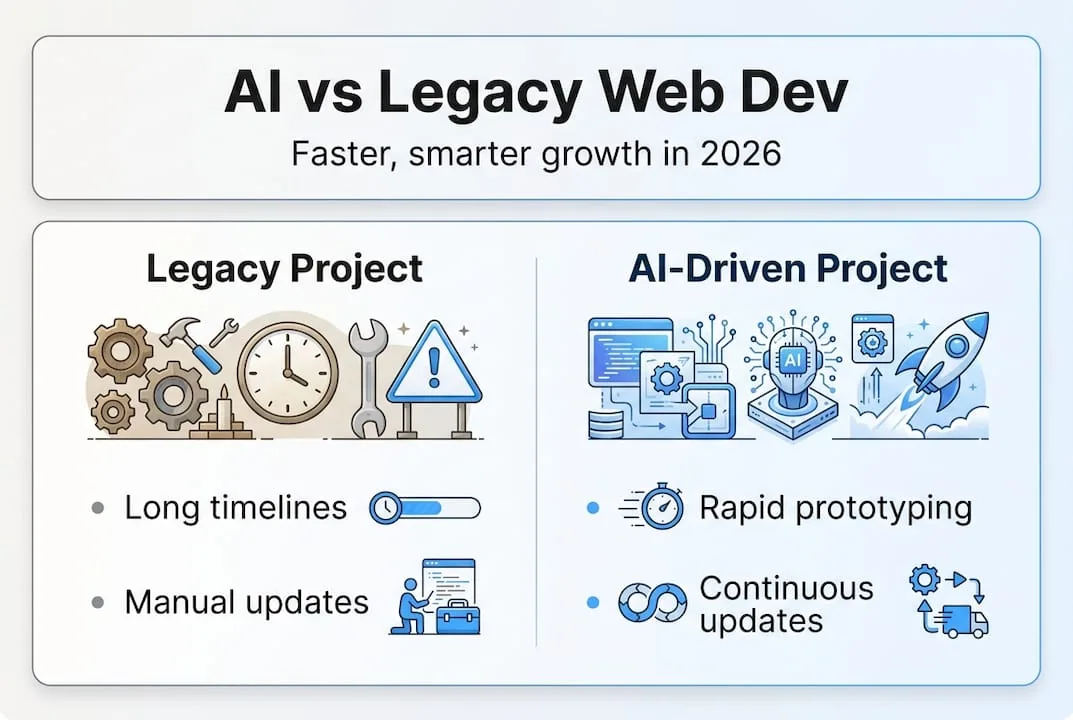
AI supports iterating and optimising web assets in production, meaning the value compounds over time rather than peaking at launch. Organisations that adopt modern web development practices recognise that a website is a living business asset. Pairing that mindset with AI for business growth strategies ensures your digital investments remain aligned with evolving commercial objectives. Define what success looks like before you build, then instrument your site to measure it continuously.
Navigating challenges: Integration, governance, and enterprise-scale concerns
Equally critical is knowing where things can go wrong and setting up for enterprise-scale success. AI website adoption is not a plug-and-play exercise, particularly for organisations with established technology estates and complex stakeholder environments.
The main challenges enterprises encounter include legacy system integration, data security and compliance requirements, talent upskilling, and securing organisational buy-in across IT, marketing, and executive leadership. SMBs often see faster gains because their technology environments are simpler and decision-making is more agile. Larger enterprises, by contrast, must navigate integration complexity and alignment across multiple business units before meaningful progress is possible.
Agentic tools require mature IT governance to succeed, especially in large enterprises where autonomous AI actions can have significant downstream consequences across interconnected systems.
A structured adoption approach significantly reduces risk. Consider the following steps:
- Audit your current technology estate: Identify integration points, data flows, and legacy dependencies before introducing AI tooling.
- Define governance frameworks: Establish clear policies for AI-generated code review, data usage, and security compliance.
- Pilot with contained projects: Select a discrete web property or feature set to test AI tooling against both technical and business KPIs.
- Build cross-functional alignment: Involve IT, marketing, legal, and executive stakeholders early to prevent adoption friction later.
- Upskill your teams: Invest in training that bridges the gap between traditional development skills and AI-augmented workflows.
- Scale based on evidence: Use pilot outcomes to build the internal business case for broader rollout.
Understanding how AI in digital marketing intersects with web development governance helps organisations see the full picture of where AI creates value and where it introduces risk.
Pro Tip: Start your AI adoption journey with a pilot project that has clearly defined success criteria spanning both technical performance and business outcomes. This builds internal credibility and surfaces integration challenges before they affect mission-critical systems.
A fresh perspective: What most leaders overlook about AI website development
Now that the core challenges and paths to success are mapped out, here is a candid perspective most articles will not tell you. Conventional wisdom in this space prioritises speed and automation as the headline benefits of AI website development. Both matter, but neither is the real differentiator.
The organisations that extract the most sustained value from AI-driven web development are those that treat it as a strategic discipline, not a technology procurement decision. Too many enterprises judge AI success on impressive demos, feature counts, or deployment timelines. The harder and more valuable question is whether your AI initiatives are genuinely aligned to business objectives and governed with the rigor those objectives demand.
Forward-thinking enterprise leaders should prioritise:
- Cross-disciplinary integration: Ensure AI web initiatives are co-owned by IT, marketing, and business strategy teams, not siloed within development.
- Continuous metrics refinement: Revisit your KPI framework quarterly as your AI capabilities and business context evolve.
- Cultural adaptation: Invest in change management alongside technology adoption. Tools without culture change deliver marginal returns.
- Strategic partnership framing: Treat AI as a long-term partner in your digital strategy, not a one-time efficiency gain.
When choosing a web development partner, look for one that asks hard questions about your business objectives before recommending technology solutions. That orientation signals a partner capable of delivering strategic value, not just technical output.
Take the next step with advanced web development
If you are ready to apply these strategies in your organisation, Cloudfusion is positioned to help you move forward with confidence. Our expertise spans custom web development projects that integrate AI-driven capabilities with your specific business objectives, from rapid prototyping through to production optimisation and ongoing performance management. We work with enterprises across industries to design scalable, governed, and outcome-focused digital solutions. Whether you need a strategic consultation, a proof-of-concept prototype, or a full project engagement, our team brings the technical depth and business acumen to make AI website development work for your organisation. Request a project quote today and take the first step toward a measurable digital transformation.
Frequently asked questions
What are the main benefits of AI website development for businesses?
AI website development accelerates prototyping, enables advanced personalisation, and drives measurable outcomes like conversion rate improvements and deeper user engagement. Prototyping acceleration of up to 85% means businesses can validate digital concepts and reach market significantly faster than with traditional approaches.
Is AI website development suitable for large enterprises with complex needs?
Yes, but sustained success at enterprise scale depends on mature IT governance, robust integration planning, and clear alignment between AI initiatives and business KPIs. Agentic tools demand governance maturity that many organisations need to build deliberately before scaling adoption.
How should ROI be measured for AI website projects?
ROI measurement should centre on Core Web Vitals, conversion rates, and business-specific outcomes rather than development speed or feature volume. Real-world performance and conversion data provide a far more reliable signal of genuine business value than internal velocity metrics.
What challenges should I expect when adopting AI in web development?
Common challenges include legacy system integration complexity, data security and compliance requirements, and securing cross-functional stakeholder buy-in. Large organisations face integration hurdles that require deliberate governance frameworks and phased adoption strategies to manage effectively.
Recommended
- AI in Web Development: Powering Smarter Digital Solutions 2025
- Best Web Development Practices for Business Growth 2025
- Why upgrade your business website: unlock growth in 2026
- What Makes a Good Website in 2025: Key Factors for Success
- 5 Ways AI is Transforming Health & Safety Management in 2025 | LifeSafety.ai