

App Design & Development 2026: Boost SME Efficiency 25%
Discover how custom app design and development can boost your South African SME's efficiency by 25%. Expert guide covering user-centric design, technology choices, cloud integration, and vendor selection for successful digital transformation in 2026.
Start reading
Over 70% of app projects fail because businesses skip proper planning and user research. South African SMEs cannot afford these mistakes. This guide reveals how custom app design and development, rooted in user-centric principles and smart technology choices, can transform your operations, cut costs by 30%, and deliver measurable efficiency gains up to 25%.
Table of Contents
- Introduction To Custom App Design And Development For SMEs
- Key Principles Of User-Centric App Design For SMEs
- Technology Stack Choices: Native Vs. Cross-Platform Development
- Common Misconceptions And Pitfalls In App Development Projects
- Integrating With Cloud And Third-Party Services For Operational Efficiency
- Selecting The Right App Development Partner In South Africa
- Case Studies: Successful App Implementations Driving SME Growth
- Conclusion And Next Steps For SMEs
- Get Expert Custom App Design And Development In South Africa
- Frequently Asked Questions
Key Takeaways
| Point | Details |
|---|---|
| Custom apps boost SME efficiency | Tailored workflows can increase operational efficiency by 25% through automation and integration. |
| User-centric design reduces risk | MVP phased rollouts with iterative testing improve adoption and cut project failure rates significantly. |
| Cross-platform saves costs | Choosing cross-platform over native development reduces build costs by approximately 30% for most SME use cases. |
| Local expertise matters | South African vendors with SME experience deliver 35% higher project success through understanding regional constraints. |
| Cloud integration amplifies value | Connecting apps to Office 365 and cloud tools automates workflows and scales seamlessly as your business grows. |
Introduction to Custom App Design and Development for SMEs
Custom app design and development means building software specifically for your business processes, unlike generic off-the-shelf products. For South African SMEs, this approach solves unique challenges like load shedding resilience, multilingual user bases, and tight budgets. Digital transformation goals for businesses often hinge on apps that fit your exact needs rather than forcing workflows into rigid templates.
South African SMEs face distinct operational constraints. Many operate with lean teams, limited IT budgets, and varying levels of digital readiness across staff. Off-the-shelf solutions often introduce unnecessary complexity or miss critical local requirements like tax compliance, language support, or offline functionality during power outages.
Digital transformation is no longer optional for SME survival. Competitors adopting custom apps gain speed, accuracy, and customer satisfaction advantages that erode your market position. Tailored apps address your specific pain points, whether inventory management, customer engagement, or field service coordination, creating competitive differentiation that generic software cannot deliver.
Key reasons SMEs invest in custom apps:
- Automate repetitive manual tasks that drain staff productivity
- Integrate disconnected systems into unified workflows
- Provide mobile access for remote teams and field workers
- Scale features incrementally as business needs evolve
Key Principles of User-Centric App Design for SMEs
User-centred app design starts with understanding who will use your app daily and what problems they need solved. South African SMEs serve diverse user groups, from technologically savvy millennials to older staff comfortable with paper processes. Your app must bridge these gaps through intuitive interfaces that require minimal training.
Usability means users accomplish tasks quickly without frustration. Simplicity removes unnecessary features that clutter screens and confuse workflows. Accessibility ensures all users, including those with visual or motor impairments, can navigate effectively. These principles directly impact adoption rates, the metric that determines whether your app investment succeeds or collects digital dust.
Localization goes beyond translation. South Africa’s multilingual environment requires tips for user-friendly apps that consider language preferences, cultural norms, and local business practices. An app targeting Johannesburg office workers needs different design decisions than one serving rural field technicians in KwaZulu-Natal.
Design features that drive engagement and efficiency:
- Clear visual hierarchy guiding users to primary actions
- Minimal text input through dropdowns, scanning, or voice
- Offline functionality preserving work during connectivity gaps
- Real-time notifications for time-sensitive updates
Pro Tip: Conduct user testing and feedback sessions with actual staff before full development. Five users testing a prototype reveal 85% of usability issues, letting you fix problems when changes cost hundreds instead of thousands.
Iterative testing means releasing features incrementally, gathering user feedback, and refining based on real usage patterns rather than assumptions. This approach reduces the risk of building an app nobody wants to use and ensures your investment aligns with actual workflow needs.
Technology Stack Choices: Native vs. Cross-Platform Development
Native development builds separate apps for iOS and Android using platform-specific languages like Swift or Kotlin. Cross-platform development uses frameworks like React Native or Flutter to write code once and deploy to both platforms. Each approach offers trade-offs that matter differently depending on your SME’s specific requirements and constraints.

Cost and time considerations heavily favor cross-platform for most SMEs. Building two native apps typically doubles development time and cost compared to one cross-platform app. For businesses without complex performance demands, mobile app development options in the cross-platform category deliver 70% to 90% of native performance at roughly 30% lower total cost.
Performance differences matter primarily for graphics-intensive apps like games or augmented reality experiences. For business apps handling forms, data display, and basic workflows, cross-platform frameworks perform indistinguishably from native to end users. Battery consumption and load times show negligible differences in real-world SME application scenarios.
| Factor | Native Development | Cross-Platform Development |
|---|---|---|
| Development Cost | Higher (separate codebases) | 30% lower (shared codebase) |
| Time to Market | Longer (dual builds) | Faster (single build) |
| Performance | Maximum optimization | 90% of native speed |
| Maintenance | Update both platforms | Update once |
| Best For | Graphics-intensive apps | Business workflow apps |
Scenarios favoring native development include apps requiring advanced camera features, complex animations, or hardware sensor integration that cross-platform frameworks handle poorly. SMEs in industries like construction surveying or medical diagnostics might justify native costs for these specialized needs.
Maintenance implications often get overlooked during initial decisions. Native apps require fixing bugs and adding features twice, once per platform. Cross-platform apps update universally, reducing ongoing costs by 40% to 50% over the app’s lifetime. For resource-constrained SMEs, this long-term savings often outweighs any initial performance advantages of native development.
Pro Tip: Start with cross-platform unless you identify specific technical requirements that absolutely demand native capabilities. You can always rebuild performance-critical modules natively later if usage data justifies the investment.
Common Misconceptions and Pitfalls in App Development Projects
Myth one: More features at launch guarantee success. SMEs often request every conceivable feature upfront, believing comprehensive functionality drives adoption. Reality shows the opposite. Overloaded apps confuse users and delay launches. Minimum viable product approaches cut development risks by 60% by validating core assumptions before investing in advanced features.
Myth two: App maintenance costs always become prohibitive. Many SMEs fear ongoing expenses spiraling out of control after launch. Truth is maintenance typically runs 15% to 20% of initial development cost annually when properly planned. This covers security updates, OS compatibility, and minor feature adjustments. Predictable maintenance budgets let you plan accordingly rather than face surprise expenses.
Myth three: Native development always delivers better performance. This belief stems from outdated information about early cross-platform frameworks. Modern tools like Flutter and React Native close performance gaps to imperceptible levels for business applications. SMEs waste budget chasing theoretical performance gains users never notice in practice.
Common development pitfalls to avoid:
- Skipping discovery phase to save time, then rebuilding when requirements prove wrong
- Ignoring user feedback during beta testing because developers prefer their original vision
- Underestimating data migration complexity when replacing legacy systems
- Launching without analytics to measure actual usage patterns and feature adoption
- Failing to plan for app store approval processes and related delays
SMEs succeed by starting small with core features that solve one critical problem extremely well. Measure adoption and satisfaction, then expand based on what users actually request rather than what stakeholders assume they need. This iterative approach matches budget constraints while maximizing return on investment through validated learning.
Integrating with Cloud and Third-Party Services for Operational Efficiency
Integrating apps with cloud services like Office 365 boosts operational efficiency by connecting previously isolated tools into unified workflows. When your custom app pulls customer data from your CRM, updates inventory in real time, and syncs documents to SharePoint automatically, manual data entry disappears. Staff focus on value-added tasks instead of copying information between systems.
Workflow automation through integration delivers measurable time savings. Consider a field service SME where technicians complete job reports in a mobile app that automatically generates invoices, updates inventory, schedules follow-ups, and emails customers. Tasks requiring 45 minutes of office work now happen instantly without human intervention. Multiply these savings across daily operations and efficiency gains of 20% to 25% become realistic targets.
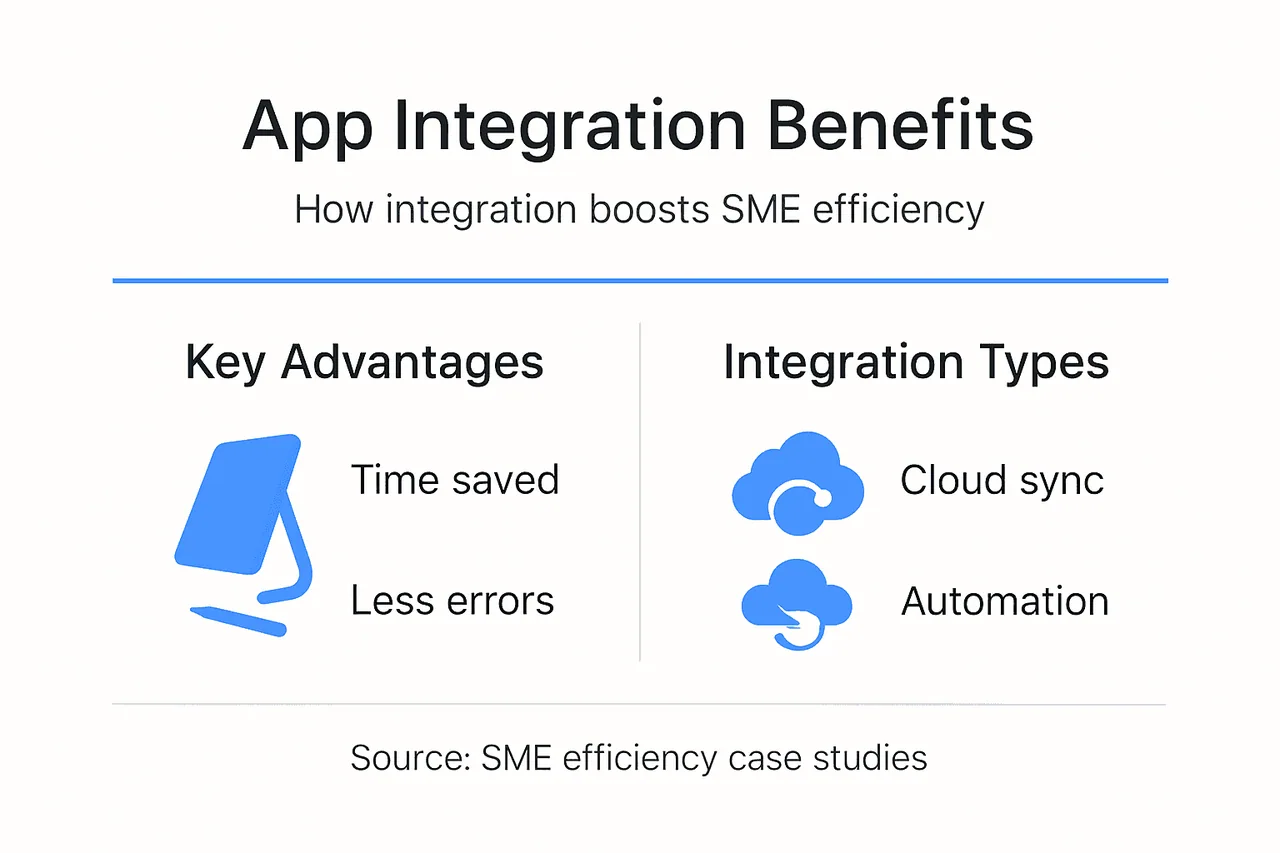
Document collaboration improves dramatically when apps integrate cloud storage. Multiple team members edit quotes, proposals, or reports simultaneously through Office 365 connections, eliminating version control nightmares and email attachment chains. Changes sync instantly across devices, letting remote teams coordinate as effectively as office-based staff.
Security and data protection require careful planning when connecting apps to cloud services. South African SMEs must consider POPIA compliance, ensuring customer data moves securely between systems with proper encryption and access controls. Enterprise app integration strategies address these concerns through authentication protocols, encrypted connections, and audit logging.
Integration planning tips:
- Map data flows between systems during design phase to identify bottlenecks
- Use established APIs rather than custom connections for reliability and support
- Implement error handling for connectivity issues without losing user work
- Test integrations with production data volumes to ensure performance scales
Pro Tip: Prioritize integrations that eliminate the most time-consuming manual tasks first. Track time savings quantitatively to justify further integration investments and demonstrate ROI to stakeholders.
Cloud integration also future-proofs your app investment. As your SME adopts new tools like advanced analytics or AI services, integrated apps connect these capabilities without complete rebuilds. Your technology stack evolves incrementally rather than requiring disruptive replacements every few years.
Selecting the Right App Development Partner in South Africa
Choosing your development partner determines project success as much as any technical decision. Local South African vendors understand unique SME challenges like operating during load shedding, navigating BBBEE requirements, and designing for diverse user literacy levels. This contextual knowledge prevents expensive mistakes that offshore teams commonly make despite lower hourly rates.
Technical expertise evaluation goes beyond reviewing portfolios. Ask candidates about their development methodology, how they handle changing requirements, and their approach to user testing. Agile practices with two-week sprints and regular demos let you course-correct before problems compound. Vendors who propose rigid waterfall schedules often deliver apps that miss your actual needs.
Post-launch support capabilities separate quality vendors from those who disappear after deployment. Your app will need bug fixes, OS updates, and feature enhancements as your business evolves. Confirm your vendor offers maintenance agreements with defined response times for critical issues. SMEs cannot afford apps that break during busy periods without immediate support.
Selection criteria checklist:
- Demonstrated experience with SME projects similar to your industry and scale
- Clear communication in plain language without excessive technical jargon
- Transparent pricing showing task-level cost breakdowns
- References from past clients willing to discuss their experience honestly
- Local presence for face-to-face meetings during critical project phases
Contract terms deserve careful attention. Ensure you own the source code and all intellectual property upon project completion. Some vendors retain code ownership, forcing you to pay perpetually for any changes. Verify that contracts specify deliverables, timelines, payment milestones, and what happens if either party needs to exit the relationship.
Pro Tip: Request a paid discovery phase before committing to full development. This two-to-four-week engagement produces detailed specifications, wireframes, and cost estimates, letting both parties validate fit before major investment. The discovery cost typically applies toward development if you proceed.
Case Studies: Successful App Implementations Driving SME Growth
A Durban logistics SME deployed a custom dispatch app connecting drivers, warehouse staff, and customers in real time. Manual phone coordination took 30 minutes per delivery change. The app reduced this to instant updates, improving delivery accuracy by 40% while cutting fuel costs 15% through optimized routing. Staff adopted the app within one week due to its simple interface matching existing workflows.
Challenges included integrating legacy fleet management software that lacked modern APIs. The development team built a middleware layer syncing data hourly rather than in real time initially, then upgraded to live sync once integration proved stable. This phased approach kept the project moving without waiting for perfect integration.
A Cape Town retail SME launched an inventory app for field sales reps, replacing paper order forms. Reps previously returned to the office daily to submit orders, delaying fulfillment 24 hours. The app synced orders instantly, improving inventory turnover 25% and increasing sales 18% through same-day delivery capability. User adoption hit 95% within two weeks.
An East London manufacturing SME implemented a quality control app on tablets for production line inspections. Paper checklists often went missing and data entry happened days later. The app captured photos, measurements, and notes in real time, reducing defect rates 22% through immediate issue identification. Management gained daily quality dashboards instead of weekly paper reports.
Key success factors across these examples:
- Focused on one critical workflow problem rather than trying to digitize everything
- Involved actual users in design and testing to ensure practical usability
- Launched with core features, then added enhancements based on usage feedback
- Measured specific metrics like time saved, error reduction, or revenue impact
These SMEs achieved returns on investment within 6 to 12 months through quantifiable efficiency gains and cost reductions. Custom apps delivered competitive advantages their industries’ off-the-shelf software could not match.
Conclusion and Next Steps for SMEs
Custom app design and development tailored to South African SME needs delivers measurable efficiency gains, cost reductions, and competitive advantages that generic software cannot match. User-centric design ensures adoption, smart technology choices control costs, and cloud integration amplifies operational benefits across your entire business.
Starting your app project follows a clear path:
- Identify your single biggest operational bottleneck costing time or money daily
- Map the current workflow step by step, noting pain points and workarounds
- Define success metrics like time saved, errors reduced, or revenue increased
- Research development partners with relevant SME experience and request discovery proposals
- Build a minimum viable product focused on core workflow, not wish-list features
- Test with actual users, gather feedback, and refine before full deployment
- Measure adoption rates and efficiency metrics against your baseline
- Plan feature enhancements based on user requests and usage analytics
Continuous improvement separates successful app projects from those that stagnate. Review usage analytics quarterly to identify underutilized features and pain points users encounter. Survey users about desired enhancements rather than guessing what they need. Technology and business needs evolve, and your app should adapt accordingly.
Pro Tip: Start small but think big. Your initial app might address one department’s workflow, but design the architecture to expand across other areas as you prove value and build internal support for broader digital transformation.
Resources supporting your journey include vendor portfolios showing relevant industry experience, case studies demonstrating measurable SME outcomes, and discovery workshops clarifying requirements before major commitments. The investment in proper planning and user-centric design pays dividends through higher adoption, faster ROI, and sustainable competitive advantage.
Get Expert Custom App Design and Development in South Africa
Cloudfusion specializes in mobile app development services tailored specifically for South African SMEs facing unique operational challenges and budget constraints. Our team understands local market dynamics, from load shedding resilience to multilingual user requirements, ensuring your app solves real problems effectively.
We combine user-centric design principles with agile development practices, delivering custom app solutions that integrate seamlessly with your existing systems and cloud tools. Our phased approach starts with discovery and MVP development, minimizing risk while proving value before major investment. Ongoing support ensures your app evolves as your business grows.
Ready to transform your operations with a custom app designed for your specific workflows? Contact Cloudfusion for app design consultation and receive a detailed proposal outlining how we will deliver measurable efficiency gains aligned with your business goals.
Frequently Asked Questions
What is the typical cost range for custom app development for SMEs?
Costs vary significantly based on app complexity, feature count, and technology choices. Simple workflow apps with basic data entry and cloud sync typically start around R80,000 to R150,000. Cross-platform development reduces costs by approximately 30% compared to building separate native iOS and Android apps. Most SME projects fall between R150,000 and R400,000 for full-featured business applications with integrations.
How can SMEs ensure their app achieves good user adoption?
Focus on solving one critical workflow problem exceptionally well rather than building comprehensive features users find overwhelming. User-centred design principles like simple interfaces, minimal training requirements, and offline functionality drive adoption among diverse user groups. Launch with a minimum viable product, gather feedback from actual users, and refine based on real usage patterns rather than assumptions.
Why is choosing a local South African app vendor important?
Local vendors understand unique SME operational challenges like load shedding, POPIA compliance, multilingual requirements, and BBBEE considerations that offshore teams commonly miss. Projects with South African-experienced vendors show 35% higher success rates through contextual knowledge that prevents expensive rebuilds. Face-to-face meetings during critical project phases also improve communication and alignment on business goals.
How long does typical SME app development take from start to launch?
Discovery and planning phases require two to four weeks to define requirements, create wireframes, and establish project scope. Development of a minimum viable product with core features typically spans 12 to 16 weeks using agile methodology with regular demos. Testing and refinement add another four weeks before deployment. Total timeline ranges from four to six months for most SME business applications, though simpler apps may launch faster.