

Custom business software: a 2026 guide for decision-makers
Discover how custom business software can transform your operations in 2026. Unlock tailored solutions that fit your unique needs.
Start reading
TL;DR:
- Custom business software is tailored to an organization’s unique workflows, data structures, and integration needs, avoiding the limitations of generic solutions. It offers better operational control, scalability, and security aligned with local regulatory requirements, especially in South Africa’s complex market. Developing such software involves a structured process, embedding security throughout, with the goal of creating a strategic long-term asset rather than a temporary tool.
Custom business software is software specifically designed and developed to meet an individual organisation’s unique operational workflows, data structures, and integration requirements, rather than forcing your business to adapt to a generic off-the-shelf product. In the South African market, where businesses face a distinct combination of regulatory demands, infrastructure constraints, and competitive pressures, tailored software solutions offer a level of operational control that packaged products simply cannot match. Whether you need a custom CRM, a bespoke ERP, or a mobile application built around your field teams’ daily processes, the core principle is the same: the software fits your business, not the other way around.
What are the common types of custom business software?
Custom business software spans a wide range of application types, each addressing a different layer of how an organisation operates. Understanding the categories helps decision-makers identify where a tailored solution will deliver the most measurable impact.

Custom CRM systems are among the most frequently requested bespoke applications. Custom CRM software is built around actual workflows, data structures, and integration requirements, offering real-time management visibility that generic platforms like Salesforce or HubSpot cannot replicate without significant workarounds. For a South African financial services firm or a logistics company with a non-standard sales cycle, this distinction is material.
Beyond CRM, the most common types include:
- Custom ERP and process automation platforms that unify finance, procurement, inventory, and HR into a single system aligned with your specific approval hierarchies and reporting structures.
- Mobile applications designed for field teams, technicians, or client-facing staff, where the workflows are too specialised for generic apps.
- SaaS and cloud-based bespoke solutions that allow multiple users or even external clients to access a platform built entirely around your service model.
- Industry-specific applications in sectors like healthcare, mining, agriculture, and retail, where compliance requirements or operational complexity make off-the-shelf products inadequate.
The table below summarises the primary types and their typical business benefits:
| Software type | Typical use case | Key benefit |
|---|---|---|
| Custom CRM | Sales, client management, support | Tailored workflows and real-time visibility |
| Custom ERP | Finance, inventory, HR, procurement | Unified data and process automation |
| Mobile application | Field operations, client engagement | Purpose-built for specific team workflows |
| SaaS platform | Multi-user or client-facing services | Scalable, accessible, and fully owned |
| Industry-specific app | Healthcare, mining, agriculture, retail | Compliance alignment and operational fit |
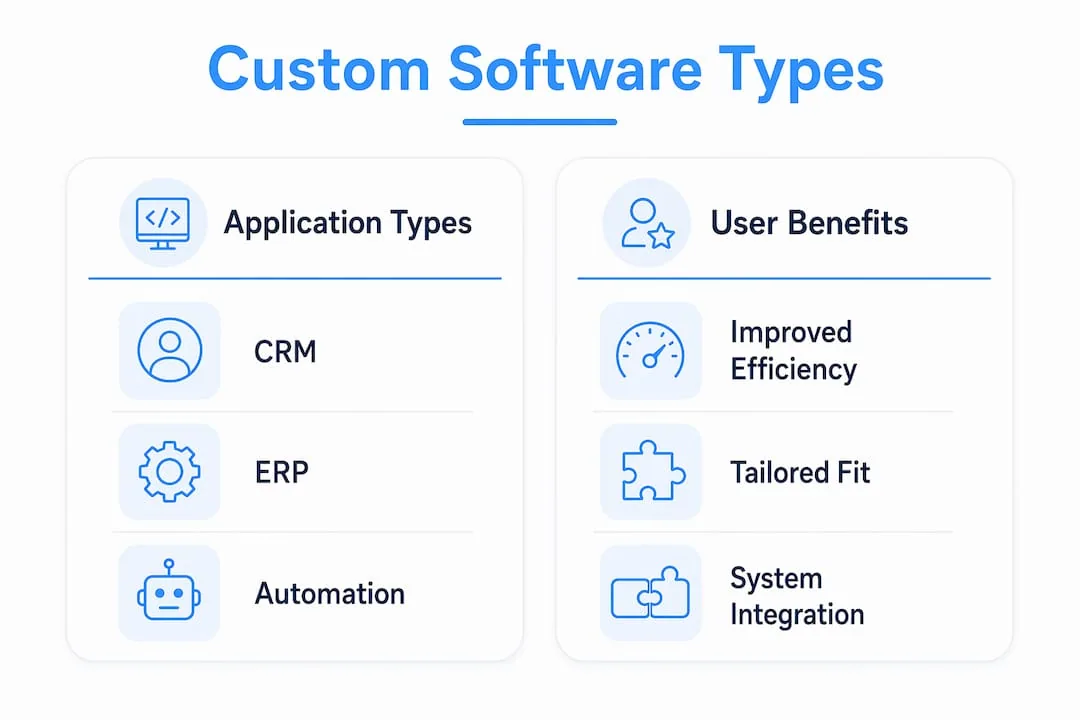
Custom solutions integrate deeply with internal systems such as telephony, payment gateways, and ERP platforms, enabling workflows that off-the-shelf tools cannot replicate. This integration depth is what transforms software from a tool into a genuine operational asset.
Why invest in custom software instead of off-the-shelf solutions?
The most direct answer is fit. Off-the-shelf solutions fail when they cannot support growth, operational complexity, or integration needs specific to your organisation. Businesses that persist with generic software often accumulate costly workarounds, manual data transfers between disconnected systems, and staff who spend more time managing the software than doing their actual work.
The advantages of investing in a tailored software solution include:
- Workflow alignment: The software is built around how your teams actually work, not how a vendor assumes they work.
- Automation of manual processes: Repetitive tasks like report generation, approval routing, and data synchronisation are automated at the source.
- Scalability: As your business grows, the software grows with it. You add features and capacity on your terms, not a vendor’s upgrade schedule.
- System ownership: Owning the software outright eliminates recurring per-user licensing fees, which become significant as headcount scales. For a South African business with 50 or more users, this alone can justify the development investment within two to three years.
- Competitive differentiation: Your processes, your data models, and your client experience become proprietary advantages rather than shared features available to every competitor using the same platform.
You can explore how custom web apps improve workflows in practice, including specific examples of automation and process integration that translate directly to time and cost savings.
Pro Tip: Before approaching a development partner, document the three to five processes in your business that consume the most manual effort or cause the most errors. These are your highest-value targets for automation and the clearest brief you can give a developer.
Custom CRM and ERP systems become a system of record that operational teams and management rely on daily for real-time insights and decision-making. That level of organisational dependency is only sustainable when the software is built to match your exact requirements.
How secure is custom business software?
Security in custom business software is not a feature you add at the end of a project. It is a discipline embedded throughout the entire development process. The NIST Secure Software Development Framework (SSDF) Version 1.2 provides a core set of secure development practices designed to reduce vulnerabilities by integrating security into every phase of the Software Development Life Cycle (SDLC). This is the international benchmark against which credible development teams measure their practices.
The practical implication for your business is straightforward: a development partner who treats security as a final checklist item is a liability. Security integrated within DevSecOps pipelines automates and standardises security controls throughout the build process, catching vulnerabilities early rather than discovering them after deployment. Early detection is significantly less expensive to remediate and far less damaging to your operations and reputation.
Security must be viewed as integral to software development rather than a separate compliance task. This requires cultural and process changes within the development team, not just the addition of a scanning tool. When evaluating a development partner, ask specifically how they embed security into their sprint cycles and what automated testing they run before each release.
Pro Tip: Ask any prospective development partner to walk you through their DevSecOps pipeline. If they cannot explain how security is tested at each build stage, that is a clear signal to look elsewhere. A developer environment setup checklist is a useful reference for understanding what a security-conscious development environment should include.
For South African businesses operating under POPIA (Protection of Personal Information Act), secure software development is also a compliance requirement. Custom software built with SSDF-aligned practices gives you a defensible position when demonstrating data protection to regulators or clients.
What does the custom software development process look like?
Understanding the development process helps you plan realistically, budget accurately, and hold your development partner accountable. A structured development process aligns software features and integrations with business goals while supporting scalability and adaptability over time.
The typical phases for bespoke business application development are:
- Business needs assessment: Map your existing technology infrastructure, identify the processes causing the most friction, and define the outcomes the software must achieve. This phase determines whether a full custom build, a partial customisation, or an integration solution is the right approach.
- Specification and design: Define functional requirements, data models, user roles, and integration points. UI/UX design at this stage ensures the interface reflects how your teams actually work, reducing adoption resistance later.
- Agile development with sprint reviews: Development proceeds in iterative cycles, with working software demonstrated at the end of each sprint. This gives you visibility and control throughout the build, not just at the end.
- MVP deployment: A Minimum Viable Product approach validates core features with real users before full-scale deployment, reducing the risk of building functionality that does not serve the actual need.
- Testing and phased rollout: Functional, integration, and security testing precede deployment. A phased rollout limits operational disruption and allows issues to be resolved before the full user base is affected.
- Post-launch maintenance and evolution: Custom software requires ongoing maintenance and incremental updating post-launch to adapt to evolving business requirements and security threats. The vendor relationship you establish at the start is therefore a long-term partnership, not a once-off transaction.
On cost: custom software development typically ranges from tens of thousands to several hundred thousand Rands depending on scope, technology stack, integrations, and ongoing maintenance requirements. This range is wide because scope varies enormously. A focused internal workflow tool is a very different investment from a multi-tenant SaaS platform. The MVP approach is particularly valuable for South African businesses managing budget constraints, as it allows you to validate the concept and demonstrate ROI before committing to the full build.
You can read more about solving business problems with custom software to understand how specific development decisions translate into measurable operational improvements.
Key takeaways
Custom business software delivers its greatest value when it is built to fit your specific workflows, integrated with your existing systems, and maintained as a long-term strategic asset rather than a once-off project.
| Point | Details |
|---|---|
| Fit over features | Custom software built around your workflows outperforms generic tools regardless of feature count. |
| Ownership reduces long-term cost | Eliminating per-user licensing fees makes custom software financially competitive within two to three years. |
| Security must be embedded | NIST SSDF-aligned development integrates security throughout the SDLC, not as a final audit. |
| MVP reduces investment risk | Deploying a Minimum Viable Product first validates core features before full-scale commitment. |
| Maintenance is non-negotiable | Post-launch updates and security patches are essential to keep custom software aligned with business and compliance needs. |
Why I think most businesses underestimate what custom software actually is
From working with South African businesses across multiple sectors, the most common misconception I encounter is that custom software is simply an expensive version of something you could buy off the shelf. That framing misses the point entirely.
The businesses that get the most from a tailored software solution are the ones that treat it as a process redesign exercise, not a technology purchase. The software is the output. The real work is understanding your workflows deeply enough to specify what the software must do. When that groundwork is done properly, the resulting system becomes a genuine competitive asset, one that a competitor cannot simply replicate by buying the same subscription.
I have also seen too many projects where security was treated as something to sort out after launch. Retrofitting security into a deployed system is expensive, disruptive, and often incomplete. The NIST SSDF framework exists precisely because this pattern is so common and so costly. Choosing a development partner who builds with security from day one is not a premium option. It is the baseline.
For South African businesses specifically, the combination of POPIA compliance requirements and the practical realities of local infrastructure makes the choice of development partner more consequential than it might appear in a global context. A partner who understands the local environment, from payment gateway integrations to data residency considerations, will save you significant rework down the line. That local knowledge is worth prioritising when you evaluate your options.
— Anton
Build software that fits your business with Cloudfusion
Cloudfusion builds custom web and mobile applications for South African businesses that need software aligned with their specific workflows, integration requirements, and growth plans. From initial scoping through to post-launch maintenance, the team brings local market knowledge and security-conscious development practices to every project. Whether you are replacing a manual process, integrating disconnected systems, or building a client-facing platform from the ground up, Cloudfusion approaches each brief as a long-term partnership. If you are evaluating a mobile application for your field teams or a bespoke web platform for your operations, give us a shout and let’s talk through what the right solution looks like for your business.
FAQ
What is custom business software?
Custom business software is software designed and developed specifically for a single organisation’s workflows, data requirements, and integration needs. Unlike off-the-shelf products, it is built to fit the business rather than requiring the business to adapt to the software.
How much does custom software development cost in South Africa?
Costs typically range from tens of thousands to several hundred thousand Rands, depending on scope, technology stack, integrations, and ongoing maintenance. An MVP approach allows businesses to validate core functionality before committing to the full investment.
Is custom software more secure than off-the-shelf products?
Custom software built using NIST SSDF-aligned practices and DevSecOps pipelines can be significantly more secure, because security is embedded throughout the development lifecycle rather than applied as a final review. The security outcome depends entirely on the development practices of the team you choose.
How long does it take to develop bespoke business applications?
Timelines vary based on complexity, but a focused MVP can typically be delivered within two to four months, with the full system following in subsequent phases. Agile development with regular sprint reviews gives you visibility and control throughout the process.
When should a business choose custom software over off-the-shelf?
Custom software is the right choice when off-the-shelf solutions cannot support your growth, require excessive workarounds, or cannot integrate with your existing systems. Businesses with specialised workflows, compliance requirements, or a need to own their technology infrastructure benefit most from a tailored approach.