

What is a digital ecosystem: a guide for businesses
Discover what is a digital ecosystem and how it can transform your business strategies. Learn to harness interconnected networks for success.
Start reading
TL;DR:
- A digital ecosystem is an interconnected network of organizations, technologies, and data sharing that creates shared value. Building such ecosystems involves open APIs, partnerships, and governance, leading to agility, cost savings, and innovation. Success depends on transitioning from control to self-organization and emphasizing data ownership and trust.
A digital ecosystem is defined as an interconnected network of technologies, organisations, users, and data flows that collaborate to create shared value beyond what any single component achieves alone. The concept draws from biological ecosystems, where interdependence drives resilience and growth. For business professionals and entrepreneurs, understanding the digital ecosystem definition is no longer optional. It shapes how you build products, serve customers, and compete. The core components include technological infrastructure, participant networks, and value exchange mechanisms, each working together through APIs, cloud services, and open data principles to deliver integrated experiences at scale.
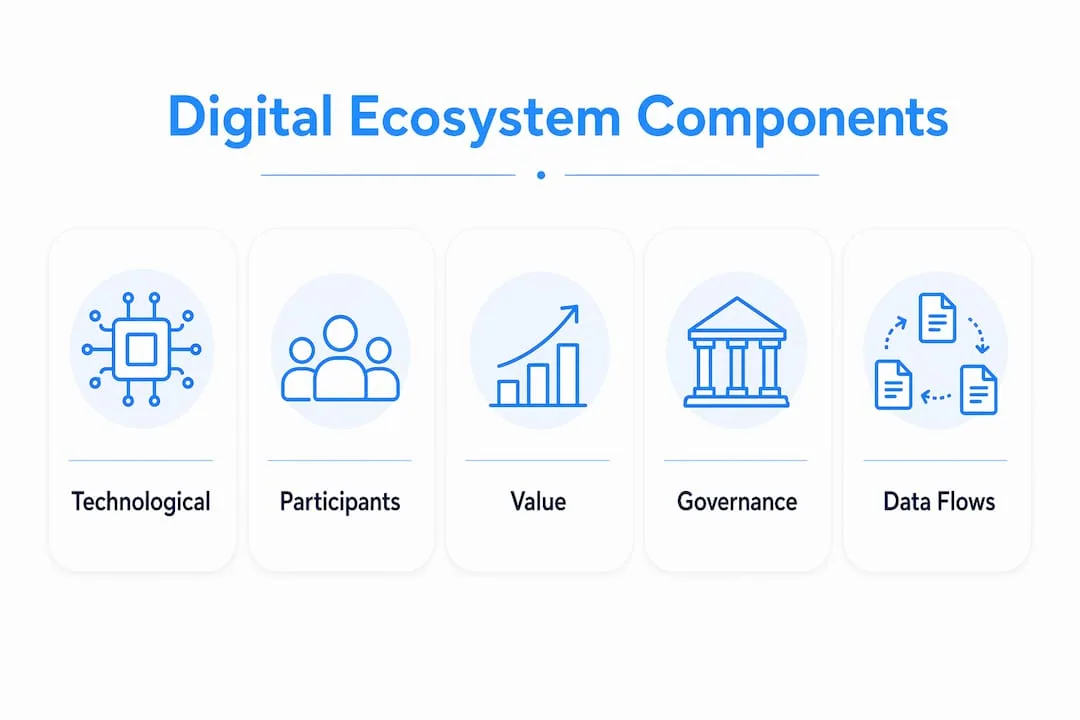
What is a digital ecosystem and what makes it different?
A digital ecosystem differs fundamentally from a traditional IT setup. Where conventional infrastructure centres on a single organisation’s internal systems, a digital ecosystem spans multiple organisations with flexible, API-driven collaboration rather than centralised control. This distinction matters because it changes how value is created, shared, and scaled.

Traditional IT systems are closed. They serve one business, follow one governance model, and rarely exchange data with external partners without significant custom integration work. A digital ecosystem, by contrast, is open by design. Participants, whether suppliers, customers, developers, or regulators, connect through shared standards and APIs to co-create value continuously.
The three defining characteristics of a mature ecosystem are open innovation, self-organisation, and interdependence. Open innovation means participants contribute ideas and capabilities beyond their own boundaries. Self-organisation means the ecosystem adapts without a central authority dictating every change. Interdependence means each participant’s success is tied to the health of the whole network.
| Feature | Traditional IT system | Digital ecosystem |
|---|---|---|
| Scope | Single organisation | Multiple organisations and users |
| Integration | Closed, custom-built | Open APIs and shared standards |
| Governance | Centralised control | Distributed, self-organising |
| Value creation | Internal efficiency | Co-created across participants |
| Adaptability | Slow, planned changes | Continuous, emergent adaptation |
Pro Tip: Map your current technology stack against this table before planning any ecosystem initiative. If your integrations are all custom-built and inward-facing, you are still operating in traditional IT mode, regardless of how many cloud tools you use.
How do digital ecosystems create value and transform business models?
Digital ecosystems create value through data sharing, integrated services, and co-innovation. Businesses that participate in well-structured ecosystems achieve improved customer journeys and measurable gains in operational efficiency. The mechanism is not simply digitising existing workflows. It is reimagining entire value chains through connected platforms and services.
Consider a South African retailer that connects its e-commerce platform to a logistics partner’s API, a payment gateway, a loyalty programme, and a supplier inventory system. Each connection adds a layer of value the retailer could not build alone. The customer experiences a single, coherent journey. The retailer gains real-time visibility across its supply chain. That is a digital ecosystem in practice.
The key benefits businesses gain from participating in or building digital ecosystems include:
- Customer centricity: Integrated data from multiple touchpoints gives a complete picture of customer behaviour, enabling personalised experiences.
- Agility: Shared infrastructure and partner capabilities mean you can launch new services faster than building everything in-house.
- Cost reduction: Eliminating manual handoffs and redundant systems reduces operational overhead significantly.
- Network effects: Each new participant adds value for all existing participants, compounding the ecosystem’s worth over time.
- Access to innovation: Partners and developers contribute capabilities you would never prioritise internally.
Digital ecosystems transform industries by enabling cross-sectoral integration and entirely new business models. A financial services firm that opens its data through open banking APIs does not just improve its own product. It becomes the foundation for a fintech ecosystem where third-party developers build services its own team never imagined.
What are practical ways to build and optimise a digital ecosystem?
Building a digital ecosystem requires a structured approach. Organisations that treat it as a technology project alone consistently underperform those that treat it as a business and governance challenge. The stepwise approach below leads to resilient, scalable outcomes.
- Assess your current technology landscape. Audit existing systems, data flows, and integration points. Identify where manual handoffs slow down value delivery and where data sits in silos.
- Define your ecosystem role. Decide whether you will be an orchestrator (the platform owner who sets the rules) or a participant (a contributor who adds value within someone else’s ecosystem). Both are valid, but they require different investments.
- Adopt open APIs and cloud services. APIs are the connective tissue of any digital ecosystem. Cloud adoption gives you the elastic infrastructure needed to support growing participant networks.
- Cultivate partnerships deliberately. Identify organisations whose capabilities complement yours. Formalise data sharing agreements and integration standards before building technical connections.
- Implement governance and data privacy standards. Define who owns what data, how it is used, and how disputes are resolved. South African businesses must align with the Protection of Personal Information Act (POPIA) at this stage.
- Build for self-organisation. A mature digital ecosystem fosters self-organisation with properties like fairness, risk control, and graceful failure instead of centralised control. Design your governance model to allow participants to adapt and contribute without requiring your approval at every step.
Pro Tip: The biggest mistake organisations make is over-engineering the governance model at launch. Start with clear data ownership rules and a simple API contract. Complexity can be added as the ecosystem matures. Premature control structures kill participation.
Cloudfusion’s experience with digital transformation strategies consistently shows that businesses which invest in API architecture early recover that investment through faster partner onboarding and reduced integration costs within 12 to 18 months.
What are common types and examples of digital ecosystems?
Digital ecosystems appear across every industry, though they take different structural forms depending on the participants and value propositions involved. Understanding the type most relevant to your sector helps you identify where to focus your development efforts.
Examples of digital ecosystems include marketplaces, platform ecosystems with partner apps, and integrated company technology stacks. Each shows a network of interdependent participants and technologies delivering superior combined value.
| Ecosystem type | Typical participants | Core value proposition |
|---|---|---|
| Marketplace | Buyers, sellers, payment providers | Centralised discovery and transaction |
| Platform ecosystem | Core platform, third-party developers, end users | Extensible functionality through partner apps |
| Super-app | Users, service providers, financial institutions | Single interface for multiple life needs |
| Internal company ecosystem | Departments, tools, data systems | Unified data and workflow across the organisation |
| Industry consortium | Competing firms, regulators, standards bodies | Shared infrastructure and interoperability |
South African examples are growing rapidly. The financial sector has seen open banking initiatives connect banks, fintechs, and retailers into participant networks that serve customers more completely than any single institution could. In logistics, platforms connecting fleet operators, shippers, and customs authorities are reducing clearance times and improving visibility across the supply chain.
The open innovation principles underpinning these ecosystems move businesses beyond closed proprietary silos. That shift is what separates organisations building lasting competitive advantage from those simply digitising old processes.
For businesses exploring e-commerce growth, marketplace and platform ecosystems offer the most direct path to network effects and expanded customer reach.
Key takeaways
A digital ecosystem creates value that no single organisation can generate alone, making ecosystem participation a core requirement for competitive digital transformation.
| Point | Details |
|---|---|
| Definition clarity | A digital ecosystem is an interconnected network of technologies, participants, and data flows that co-create value. |
| Three core components | Technological infrastructure, participant networks, and value exchange mechanisms form every digital ecosystem. |
| Value creation mechanism | Data sharing, API integration, and co-innovation drive customer centricity, agility, and cost reduction. |
| Build in sequence | Assess, define your role, adopt open APIs, cultivate partnerships, then implement governance and self-organisation. |
| South African relevance | POPIA compliance and open banking initiatives make ecosystem governance a legal and commercial priority locally. |
The part most businesses get wrong about digital ecosystems
Most organisations I work with understand the concept of a digital ecosystem intellectually. Where they consistently struggle is in the transition from understanding to execution. The instinct is to control everything. Build the platform, set all the rules, own all the data. That instinct kills ecosystems before they start.
The research is clear: self-organisation over centralised control is what makes ecosystems scalable and resilient. The businesses that thrive are those willing to share governance, publish open APIs, and let partners build things they never anticipated. That requires a mindset shift that is genuinely difficult for organisations used to operating as closed systems.
The second thing I have observed is that technology is rarely the bottleneck. The real friction is in data ownership agreements, partner trust, and governance design. I have seen technically excellent platforms fail because no one resolved who owned the customer data when a partner left the ecosystem. Get the governance right first. The technology follows.
For South African businesses specifically, the impact of digital transformation on industries like retail, logistics, and financial services is accelerating. Organisations that wait for a perfect ecosystem strategy will find the window for orchestrator roles closing. Participant roles will still be available, but the value distribution favours those who set the rules early.
AI and machine learning are adding a new layer to ecosystem intelligence. Ecosystems that share data across participants can train models no single organisation could build alone. That is a compounding advantage that grows with every new participant. The time to build the data infrastructure that supports this is now, not after the ecosystem matures.
— Anton
How Cloudfusion supports your digital ecosystem development
Cloudfusion builds the technical foundations that South African businesses need to participate in and orchestrate digital ecosystems. From custom web development that integrates with partner APIs to mobile application development that extends your ecosystem to end users, the team brings both technical depth and local market understanding to every project. Cloudfusion’s approach starts with your existing systems and builds outward, connecting your technology to the partners, platforms, and data flows that create real business value. Give us a shout if you want to talk through where your ecosystem strategy stands and what the right next step looks like for your business.
FAQ
What is the simplest digital ecosystem definition?
A digital ecosystem is an interconnected network of technologies, organisations, and users that share data and services to create value no single participant could deliver alone.
What are the main components of a digital ecosystem?
The primary components are technological infrastructure, a participant network, and value exchange mechanisms. These enable functions like customer self-service, supplier data exchange, and integrated service delivery.
How does a digital ecosystem differ from a traditional IT system?
A digital ecosystem spans multiple organisations and uses open APIs and shared governance to co-create value, while a traditional IT system operates within a single organisation under centralised control.
Why are digital ecosystems important for South African businesses?
Digital ecosystems give South African businesses access to partner capabilities, network effects, and integrated customer experiences that would be too costly to build independently. POPIA compliance adds a governance dimension that makes structured ecosystem design a legal requirement, not just a best practice.
How long does it take to build a digital ecosystem?
There is no fixed timeline, but organisations that follow a structured approach, assessing systems, adopting open APIs, and building governance before scaling, typically see measurable ecosystem value within 12 to 24 months of their first partner integrations.