

The role of UX in online shopping: a 2026 guide
Discover the role of UX in online shopping and how it drives sales, reduces cart abandonment, and boosts customer loyalty in 2026.
Start reading
TL;DR:
- Poor user experience in online shopping leads to high cart abandonment and lost revenue. Improving navigation, site speed, trust signals, and personalized control increases conversions and customer loyalty. Continuous measurement and iteration are essential for sustainable ecommerce UX success.
User experience (UX) in online shopping is the design practice dedicated to making ecommerce websites intuitive, trustworthy, and efficient for customers. It directly determines whether a visitor buys or leaves. Poor UX costs South African online retailers real revenue every day. Research from the Baymard Institute shows average cart abandonment sits above 70%, with hidden costs, forced account creation, and long checkout flows as the primary causes. The role of UX in online shopping is not a design preference. It is a measurable business driver that affects conversion rates, customer loyalty, and long-term brand equity.
How does site navigation shape the online shopping experience?
Navigation is the single biggest driver of abandonment in ecommerce. 80% of online shoppers abandon a website due to navigation or product discovery difficulties. That figure means four out of every five potential customers leave before they buy, simply because they could not find what they needed.

Shoppers who do engage with a site’s search function convert at 2–3 times the rate of those who browse manually. This tells you that your internal search engine is not a secondary feature. It is one of your highest-value conversion tools.
Effective navigation in ecommerce relies on a few proven techniques:
- Faceted filtering: lets shoppers narrow results by size, colour, price, or category without reloading the page.
- Typo tolerance in search: returns relevant results even when a customer misspells a product name.
- Relevance ranking: surfaces the most popular or contextually appropriate products first.
- “No results” recovery: suggests alternatives or related categories instead of showing a dead end.
- Clear category labels: uses language your customers actually use, not internal product codes or jargon.
A UI redesign focused on usability metrics produces statistically significant gains in task completion, error reduction, and customer satisfaction. Cart modification workflows, in particular, show the largest improvement when feedback and error prevention are built in.
Pro Tip: Audit your site search monthly. Check the top “no results” queries and map them to existing products. This single fix often lifts product discovery without any development work.
For a deeper look at navigation best practices in ecommerce, the principles apply directly to South African retail contexts where mobile browsing dominates.
What does site speed do to your conversion rate?
Site speed is a direct revenue lever, not a technical nicety. Every 100ms improvement in Largest Contentful Paint (LCP) raises conversion by 1–2%. That is a measurable sales lift from a single performance metric.
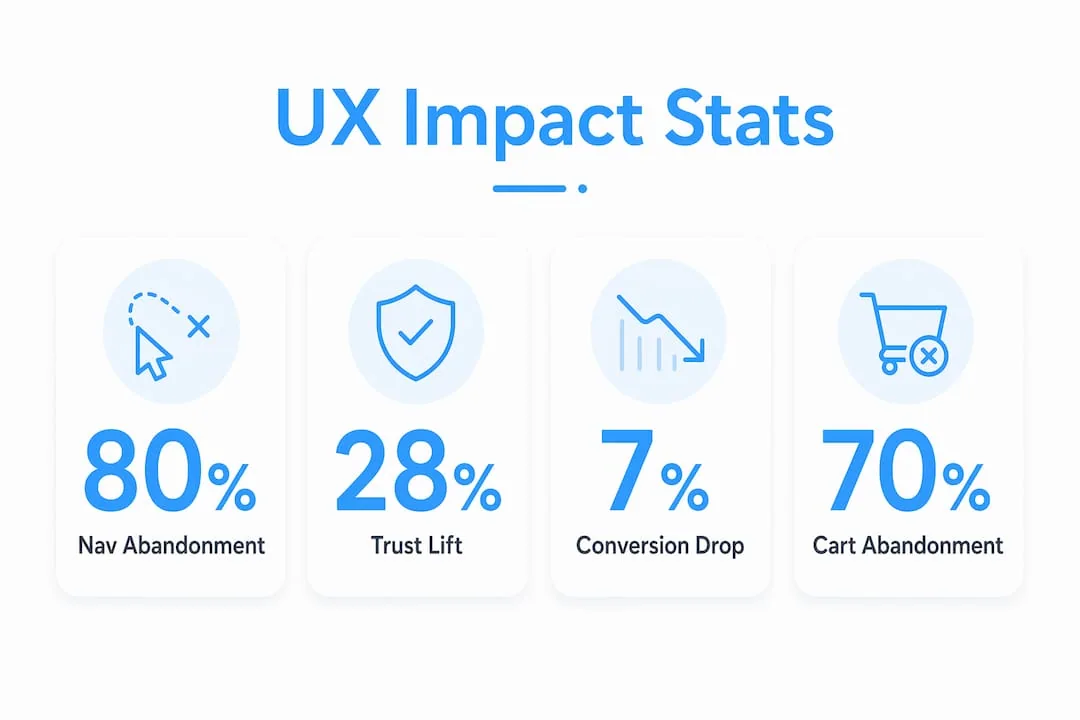
The inverse is equally true. Every additional second of load time reduces conversion by approximately 7%. For a South African online store turning over R500,000 a month, a two-second delay could cost R70,000 in lost sales every month.
Mobile performance deserves particular attention. Mobile cart abandonment rates range from 76% to 80%, compared to around 66% on desktop. South African shoppers increasingly browse and buy on mobile networks, where latency is higher and patience is lower.
Key techniques to improve ecommerce site speed include:
- Image compression: use modern formats like WebP to reduce file sizes without losing visual quality.
- Simplified code: remove unused JavaScript and CSS that bloat page weight.
- Content delivery networks (CDNs): serve assets from servers closer to your customers.
- Quality hosting: shared hosting on an overloaded server undermines every other performance fix.
Pro Tip: Monitor your Core Web Vitals in Google Search Console weekly, not just at launch. Performance degrades as you add plugins, images, and third-party scripts over time.
Speed optimisation also carries an SEO benefit. Google uses Core Web Vitals as a ranking signal, so faster pages earn better organic visibility. Cloudfusion’s guide on website performance optimisation covers the technical steps in detail.
How do trust signals affect shopper confidence and conversions?
Shoppers often describe a poor experience as “the site felt weird” before they can articulate why. That instinct is trust. When trust is absent, shoppers abandon for familiar marketplaces, regardless of your price or product quality.
Nielsen Norman Group research shows authentic product photography increases perceived trust by 28%. Real-life images of products in context outperform stock photography because they signal that a real business stands behind the listing.
The following trust elements have a direct impact on conversion rates:
| Trust element | Conversion impact |
|---|---|
| Authentic product photography | 28% lift in perceived trust |
| Prominently displayed customer reviews | Reduces purchase hesitation |
| Visible security badges near checkout | Lowers payment anxiety |
| Clear return and refund policies | Removes post-purchase risk perception |
| Easy customer service access | Signals accountability and reliability |
Visible reviews, return policies, and security badges placed near the checkout materially improve conversion. The placement matters as much as the presence. A return policy buried in the footer does far less work than one displayed on the product page and again at checkout.
Slow, cluttered checkout processes are a major friction point that drives near 70% cart abandonment globally. Transparent pricing, with no surprise shipping costs revealed at the final step, is the single most effective checkout fix available.
Pro Tip: Place your trust signals where anxiety peaks: on the product page, in the cart, and on the payment screen. Do not make customers hunt for reassurance.
How does personalisation improve the online shopping experience?
Personalisation is the practice of tailoring content, product recommendations, and messaging to individual shoppers based on their behaviour and preferences. Done well, it lifts conversions and builds loyalty. Done poorly, it feels intrusive and erodes trust.
Academic research on AI-driven ecommerce identifies the TAPE model as a framework for sustainable personalisation. TAPE stands for Trust, Autonomy, Personalisation, and Engagement. Each driver positively influences customer experience, with personalisation and engagement producing the strongest effects on satisfaction and brand equity.
Autonomy is the element most often overlooked. Shoppers want to feel in control of their experience. Personalisation that feels forced or opaque, such as recommendations with no clear logic, or emails triggered by a single accidental click, damages the relationship. Personalisation must respect privacy boundaries and provide genuine control, or it risks alienating customers despite the technology behind it.
Practical personalisation features that build rather than break trust:
- “Recently viewed” product carousels: transparent, useful, and expected by shoppers.
- Wishlist and save-for-later functionality: gives shoppers control over their own discovery.
- Preference centres: let customers choose email frequency and product categories.
- Contextual recommendations: based on current session behaviour, not just historical data.
- Post-purchase follow-up: personalised care instructions or complementary product suggestions add genuine value after the sale.
Pro Tip: Always show shoppers why they are seeing a recommendation. “Because you viewed X” is more trusted than an unexplained list. Transparency in personalisation is a conversion tool, not just a compliance requirement.
For a broader view of how ecommerce conversion optimisation connects to UX strategy, the distinction between UX and conversion rate optimisation (CRO) is worth understanding. UX provides the foundation. CRO is the iterative testing you run on top of that foundation.
Key takeaways
UX in online shopping directly determines conversion rates, cart abandonment, and customer loyalty through navigation clarity, site speed, trust signals, and ethical personalisation.
| Point | Details |
|---|---|
| Navigation drives abandonment | 80% of shoppers leave due to poor navigation; fix search and filtering first. |
| Speed is a revenue metric | Every extra second of load time cuts conversion by 7%; mobile is the highest-risk channel. |
| Trust signals must be visible | Place reviews, return policies, and security badges at the exact points where anxiety peaks. |
| Personalisation requires autonomy | The TAPE model shows that trust and customer control are prerequisites for effective personalisation. |
| UX and CRO are distinct | UX builds the foundation; CRO tests and refines conversion on top of that foundation. |
Where most ecommerce businesses get UX wrong
Having worked on ecommerce projects across South Africa, I have seen the same pattern repeat. Businesses invest in a new design, launch it, and then measure nothing. Six months later, conversion rates are flat and no one knows why.
The highest-ROI UX fixes are rarely the most glamorous. Fixing a broken search function, removing a forced account creation step, or displaying shipping costs upfront will outperform a full visual redesign almost every time. These are not exciting changes. They are the ones that move revenue.
The second mistake I see constantly is over-engineering personalisation before the basics are solid. A site with slow load times and confusing navigation will not benefit from AI-driven product recommendations. Shoppers will not stay long enough to see them.
South African ecommerce has a specific challenge that many international UX guides ignore: mobile network variability. A page that loads in two seconds on fibre feels completely different on a 4G connection in a township or rural area. Your performance targets need to account for your actual audience, not a global average.
The most sustainable UX gains come from continuous measurement and iteration, not one-off redesigns. Tools like heatmaps, session recordings, and usability testing with real South African shoppers will tell you more than any benchmark study. Cloudfusion builds ecommerce sites with this measurement-first mindset, which is why the results hold up over time.
— Anton
How Cloudfusion supports ecommerce UX performance
Cloudfusion builds custom ecommerce websites with UX performance built into the architecture from day one, not bolted on afterwards. That means fast load times, intuitive navigation structures, and trust-focused checkout flows designed for South African shoppers. If your current store is losing customers to poor navigation, slow pages, or a checkout that leaks conversions, give us a shout. We will audit your existing experience, identify the highest-impact fixes, and build a solution that performs. Let’s chat about your project at cloudfusion.co.za.
FAQ
What is the role of UX in online shopping?
UX in online shopping is the design practice that makes ecommerce websites easy to use, trustworthy, and efficient. It directly affects conversion rates, cart abandonment, and customer loyalty.
How does UX affect online shopping conversion rates?
Poor navigation causes 80% of shoppers to abandon a site, while every additional second of load time reduces conversion by 7%. Fixing these two factors alone produces measurable revenue gains.
What are the most important UX elements for ecommerce?
The four highest-impact elements are intuitive navigation and search, fast page load times, visible trust signals, and transparent pricing with no hidden costs revealed at checkout.
How does mobile UX differ from desktop UX in ecommerce?
Mobile cart abandonment rates range from 76% to 80%, compared to around 66% on desktop. Mobile shoppers are more sensitive to slow load times and complex checkout flows, making performance optimisation critical.
What is the difference between UX and CRO in ecommerce?
UX provides the structural foundation of a usable, trustworthy site. Conversion rate optimisation (CRO) is the iterative testing process you run on top of that foundation to improve specific outcomes like checkout completion or add-to-cart rates.