

What is a remote software development team?
Discover what a remote software development team is and how it provides access to global talent, faster delivery, and cost advantages.
Start reading
TL;DR:
- Remote software development teams are dedicated groups that embed into workflows and focus on long-term product outcomes. They offer access to broader talent pools, faster delivery, and cost savings while emphasizing outcome-based management and async communication. Success relies on clear processes, documentation, and structured onboarding to build trust across distributed locations.
A remote software development team is a dedicated group of software professionals, including developers, designers, QA engineers, and project managers, who work from distributed locations to deliver your project as a fully integrated unit. Unlike freelancers hired for one-off tasks, these teams embed themselves in your workflows, adopt your goals, and operate under structured communication rhythms. Dedicated remote teams act as long-term extensions of your engineering function, focused on product health rather than task completion. For business leaders and startup founders, this model offers access to global talent, faster delivery, and meaningful cost advantages over traditional co-located hiring.
What is a remote software development team made of?

The industry term for this model is a distributed development team, though “remote software development team” is the phrase most founders use when they start researching the concept. Both terms describe the same structure: a cross-functional group working outside a shared physical office.
A typical distributed team includes the following roles:
- Software developers (front-end, back-end, or full-stack) who write and maintain the codebase
- QA engineers who test features, catch regressions, and maintain release quality
- UI/UX designers who translate business requirements into user interfaces
- Project managers or Scrum masters who coordinate sprints, remove blockers, and report progress
- Business analysts who clarify requirements and bridge product vision with technical execution
Engagement models compared
How you structure the relationship matters as much as who you hire. Three models dominate the market:
| Engagement model | Focus | Ownership | Best use case |
|---|---|---|---|
| Dedicated team | Long-term product development | High: team owns outcomes | Startups and scale-ups building core products |
| Staff augmentation | Filling specific skill gaps | Shared: client directs work | Existing teams needing extra capacity |
| Freelance / project-based | Short, defined deliverables | Low: task completion only | One-off features or prototypes |
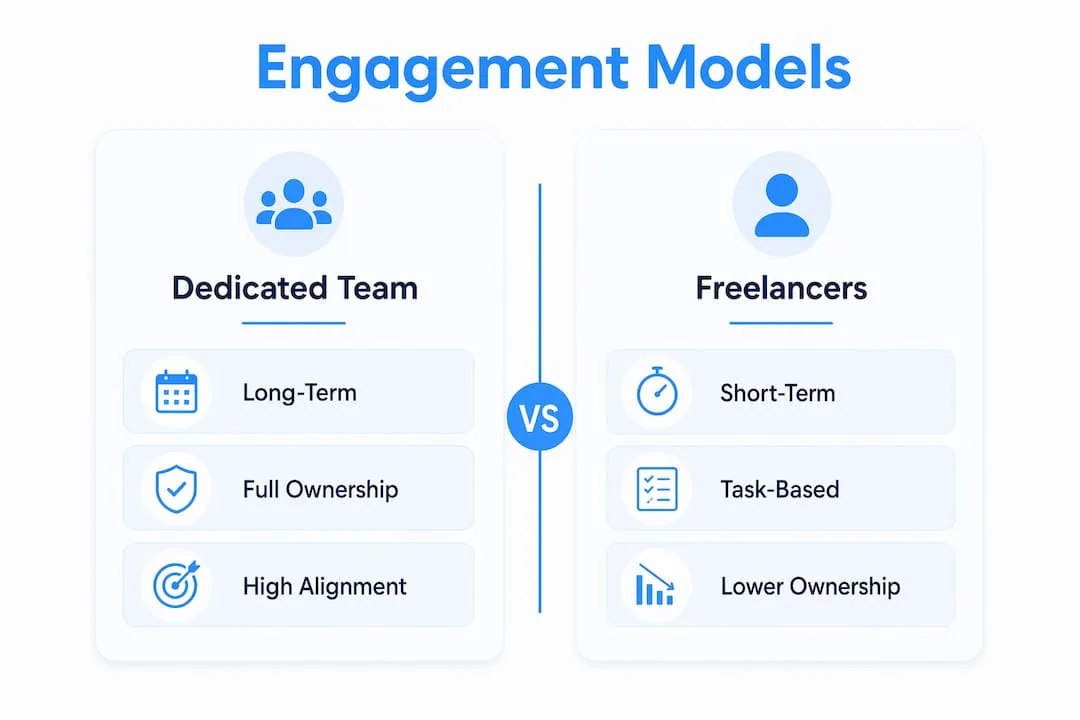
Dedicated remote teams consistently show the highest alignment and ownership compared to freelancers and traditional outsourcing. That alignment is what makes them the preferred model for founders who need a team that cares about the product, not just the invoice.
What are the real benefits of remote development teams?
The advantages of hiring remote developers go well beyond saving on office rent. The structural benefits reshape how fast and how well you can build.
- Talent pool depth. Async-first remote hiring accesses a talent pool 10 times larger than local hiring and reduces cost-per-hire by 20–35%. That means you are not limited to whoever happens to live within commuting distance of your office.
- Productivity gains. Developers on structured remote teams show 13–20% higher individual productivity due to fewer office distractions and better focus time. Open-plan offices are productivity killers; remote removes that friction entirely.
- Faster delivery. Teams with structured remote management cadences deliver projects 25% faster than traditionally managed teams. The discipline required to manage remotely forces clarity that in-office teams often skip.
- Cost efficiency. Savings come from reduced office infrastructure, lower recruitment overhead, and access to competitive global salary markets.
- Hiring speed. Distributed teams can scale up or down within weeks. Hiring in-house at the same pace is rarely possible, particularly in South Africa’s constrained developer market.
For a startup founder trying to ship a product before a competitor, these advantages are not abstract. They are the difference between launching in six months and launching in twelve.
How do you manage remote software development teams effectively?
Managing a distributed team well is the single biggest determinant of whether the model works for your business. The challenges are real: communication gaps, time zone friction, and the difficulty of building trust without physical presence. The solutions are equally concrete.
Build an async-first communication culture
High-performing remote teams operate on async-first communication for 90% of tasks, reserving synchronous meetings for complex decisions and relationship-building. This protects developer focus time and reduces burnout caused by back-to-back video calls.
The operating rhythm that works looks like this:
- Daily async standup posted in a shared channel: what was done, what is next, and any blockers
- Weekly synchronous sync for sprint reviews, planning, and team alignment
- Monthly retrospective to address process issues, celebrate wins, and recalibrate goals
Pro Tip: A short end-of-day report from each team member, taking under two minutes to write and read, reduces meeting overhead and keeps every stakeholder informed without a single calendar invite.
Shift from hours to outcomes
The most common mistake founders make is managing remote teams the same way they manage in-office staff. Tracking hours does not work across time zones and it destroys trust. Outcome-based management paired with a shared handbook system is the approach that scales. Define deliverables clearly, agree on acceptance criteria upfront, and measure completion rather than activity.
Document everything
A handbook-first culture means your processes, decisions, and standards live in writing, not in someone’s head. New team members onboard faster. Decisions are traceable. Misunderstandings drop sharply. Tools like Notion or Confluence work well for this. The best practices for remote software teams consistently point to documentation as the foundation of everything else.
How do you hire and onboard a remote development team?
Remote hiring differs from in-office hiring in ways that catch most founders off guard. The process must screen for skills that only matter at a distance.
- Async assessment first. Use written take-home tasks or proctored technical assessments before any video call. This screens for the ability to work independently, which is non-negotiable in a remote context.
- Written communication screening. Evaluate how candidates write. Clear, concise written communication predicts remote performance better than interview charisma. Async coding assessments and written screening remove geographic bias and surface genuine skill.
- Time zone alignment. Hire for at least four hours of daily overlap with your core working hours. Full async across 12-hour time zone gaps works for some tasks but creates friction on anything requiring real-time input.
- Culture fit for remote work. Ask candidates how they handle ambiguity, how they communicate blockers, and what their home working setup looks like. These answers reveal whether someone will thrive or struggle without an office structure.
Pro Tip: When working with a vendor or provider to build your team, confirm upfront who handles contracts, payroll, and compliance. A good vendor manages all of this, leaving you free to focus on product direction rather than HR administration.
Onboarding a remote team requires more structure than onboarding an in-office hire. Provide written role descriptions, tool access checklists, and a documented first-week plan before day one. Assign a buddy or point of contact for the first month. The goal is to eliminate confusion before it becomes friction. For more on remote team collaboration, a structured onboarding process is the single highest-return investment you can make in the first 30 days.
What tools do remote software development teams need?
The remote work software market reached $58.5 billion in 2025, a figure that reflects how central tooling has become to distributed team performance. The right stack removes friction; the wrong stack creates it.
Four categories of tools are non-negotiable:
- Communication: Slack or Microsoft Teams for async messaging, threaded discussions, and channel-based organisation
- Project management: Asana, ClickUp, or Jira for sprint tracking, task ownership, and progress visibility
- Documentation: Notion or Confluence for handbooks, decision logs, and onboarding materials
- Video conferencing: Zoom or Google Meet for weekly syncs and relationship-building sessions
Two additional categories matter for security and file management:
- Security: VPN access and Single Sign-On (SSO) for all shared systems
- File sharing: Cloud storage platforms that give the whole team access to assets without email attachments
The discipline here is restraint. Limit your core stack to six tools maximum. Tool sprawl fragments attention and creates the same noise that async communication is designed to eliminate. For a detailed breakdown of web development tools that support remote teams in 2026, the principles of integration and simplicity apply across every category.
Key takeaways
A remote software development team succeeds when it combines the right structure, clear outcome-based management, and an async-first communication culture built on documented processes.
| Point | Details |
|---|---|
| Dedicated teams outperform freelancers | Dedicated remote teams show higher ownership and alignment, making them the best fit for product-focused startups. |
| Talent pool and cost advantages are significant | Remote hiring accesses a 10x larger talent pool and cuts cost-per-hire by 20–35%. |
| Async-first culture drives productivity | Reserving 90% of communication for async channels protects developer focus and speeds delivery. |
| Outcomes replace hours as the management metric | Measuring deliverables rather than time worked builds trust and scales across time zones. |
| Documentation is the foundation | A handbook-first approach reduces onboarding friction and keeps distributed teams aligned without constant meetings. |
What I have learned about making remote teams actually work
Most founders approach remote teams as a cost-saving measure and then wonder why the results disappoint. The model is not primarily about cost. It is about access and discipline.
The teams I have seen perform best share one characteristic: they treat remote as a permanent operating model, not a temporary workaround. That means investing in documentation before it feels necessary, establishing communication rhythms before problems arise, and measuring outcomes from week one rather than retrofitting accountability after trust breaks down.
The shift from attendance-based to outcome-based management is uncomfortable for leaders who are used to seeing their teams. But physical presence was never a reliable proxy for performance. A developer sitting at a desk in your office for eight hours produces no more than one working from home with clear goals and no interruptions. Often less.
The remote company culture question is where most distributed teams either solidify or fracture. Culture does not happen by accident in a remote context. It requires deliberate effort: shared rituals, visible recognition, and leaders who model the communication behaviours they expect from the team. Get that right, and distance becomes a genuine advantage rather than a liability.
— Anton
How Cloudfusion supports your remote development goals
Cloudfusion works with business leaders and startup founders who need more than a list of developers. We build and manage dedicated remote teams aligned to your product goals, handling the technical complexity so you can focus on growth. Our work spans custom web development, mobile application development, cloud file storage, and digital business solutions tailored to your requirements. Whether you are starting from scratch or scaling an existing product, we bring the structure, the talent, and the process discipline that distributed teams need to deliver. Give us a shout and let’s chat about what your project needs.
FAQ
What is a remote software development team?
A remote software development team is a dedicated group of developers, designers, QA engineers, and project managers who work from distributed locations as a fully integrated unit on your project. Unlike freelancers, they embed in your workflows and focus on long-term product outcomes.
How does a distributed team differ from staff augmentation?
A distributed or dedicated team owns the full product outcome and operates as a long-term extension of your engineering function. Staff augmentation fills specific skill gaps within an existing team under the client’s direct management.
What are the biggest challenges of remote software development?
The main challenges are communication breakdowns across time zones, building trust without physical presence, and maintaining project visibility. These are addressed through async-first communication, outcome-based management, and structured daily reporting.
How do you manage remote teams without micromanaging?
Define clear deliverables and acceptance criteria upfront, use daily async standups for visibility, and measure outcomes rather than hours. Short end-of-day reports from each team member maintain transparency without requiring constant check-in meetings.
What tools do remote development teams use?
The core stack covers four categories: communication tools like Slack or Microsoft Teams, project management tools like ClickUp or Jira, documentation platforms like Notion or Confluence, and video conferencing via Zoom or Google Meet. Security tools including VPN and SSO complete the setup.