

Why offshore software development works in 2026
Discover why offshore software development works in 2026. Access skilled engineers and overcome local hiring challenges with effective solutions.
Start reading
TL;DR:
- Offshore software development addresses talent shortages and reduces costs while accelerating product delivery. Skilled global teams can onboard in weeks, providing flexible staffing that adapts to project needs. Proper security measures and structured processes ensure high-quality results and IP protection.
Offshore software development is defined as the practice of contracting engineering teams in foreign countries to build, maintain, or extend software products for your business. The model works because it solves three problems that domestic hiring cannot: a structural shortage of available engineers, the high cost of local talent, and the fixed productive hours of a single-timezone team. The Stack Overflow 2025 survey shows 62% of engineering managers cite talent availability, not budget, as their primary constraint on product roadmaps. That finding reframes the entire offshore conversation. Cost savings matter, but access to skilled engineers is the real driver of offshore development success.
Why offshore software development works for talent-constrained businesses
The global tech industry faces a structural talent crisis that domestic hiring alone cannot resolve. The US is projected to face a shortfall of over 1.2 million software developers by 2026. That gap does not close by paying higher salaries locally. It closes by expanding where you hire.
Countries like Vietnam, India, and those across Eastern Europe have built deep engineering workforces over the past two decades. Vietnam produces approximately 50,000 IT graduates annually, with 15% year-over-year growth sustained for five years. India holds the largest engineering workforce globally, with particular depth in cloud infrastructure and enterprise systems. Eastern European markets contribute strong expertise in backend architecture, cybersecurity, and AI development.
Offshore teams can be tailored to your specific tech stack. Whether you need React developers, cloud engineers, or machine learning specialists, global talent pools give you access to engineers who have already worked in your domain. This specificity is something that generic local recruitment rarely delivers at speed.
The hiring timeline difference is significant. Average time-to-hire for senior engineers in US tech hubs now runs 90–120 days. Offshore teams can be onboarded in 2–3 weeks. For a product team under delivery pressure, that difference is not marginal. It is the difference between shipping on schedule and missing a market window.
- Access to engineers specialised in AI, cloud, cybersecurity, and backend systems
- Talent pools in Vietnam, India, and Eastern Europe with proven track records
- Onboarding timelines of 2–3 weeks versus domestic cycles of 90–120 days
- Ability to match offshore engineers to your exact technology stack
Pro Tip: Ask any offshore partner to walk you through their vetting and technical assessment process before signing. A partner with a documented hiring protocol produces far more consistent results than one that simply promises “senior engineers.”
What are the real cost advantages of offshore development?
Cost reduction is the most cited benefit of offshore software development, but the numbers deserve closer examination. Senior engineers offshore typically earn between $40,000 and $90,000 per year depending on location and specialisation. That represents a 50–70% saving compared to equivalent US salaries. For South African businesses, the rand-to-dollar dynamic adds another layer of complexity, but the principle holds: offshore markets offer qualified engineers at a fraction of the local cost for comparable roles.
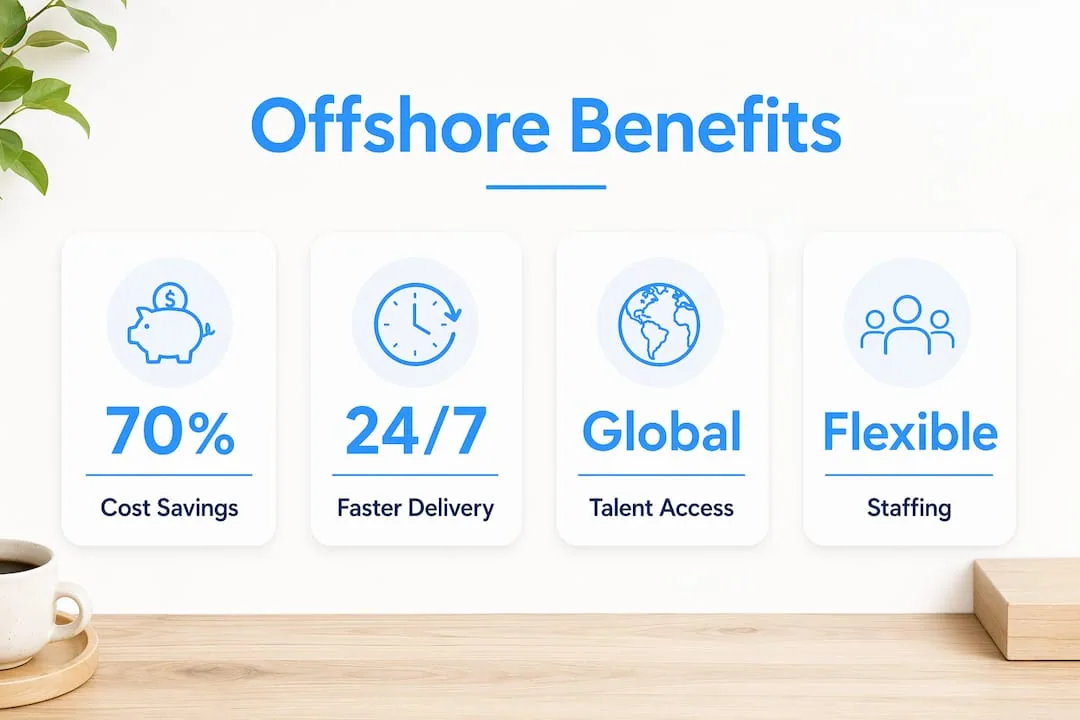
The savings compound at scale. A team of five offshore engineers at the midpoint of that salary range saves your business well over R5 million annually compared to building the same team domestically. That capital does not have to sit idle. Cost savings from offshore development allow reinvestment in marketing, customer support, and funding runway extension. For startups, this reallocation often determines whether a product launches before capital runs out.
The important nuance here is that cost should not be your only selection criterion. A cheap offshore team that delivers poor code quality, misses deadlines, or creates security vulnerabilities will cost you far more in rework and lost time than a slightly more expensive partner with strong processes. The offshore software advantages are real, but they require quality-first partner selection to materialise.
- 50–70% salary savings compared to equivalent domestic engineers
- Savings compound significantly across larger team sizes
- Freed capital can fund marketing, support, or product development
- Cost is a benefit, not a selection criterion on its own
Pro Tip: Evaluate offshore partners on code quality, communication standards, and delivery track record. Price is the last filter, not the first.
How does offshore development accelerate product delivery?
A domestic engineering team working in a single time zone has a fixed productive window of roughly 8–9 hours per day. An offshore team in a complementary time zone extends that window without requiring anyone to work unsociable hours. Teams in UTC+7 time zones, such as Vietnam, align well with US morning handoffs and European afternoon reviews. The result is a development cycle that does not stop when your local team logs off.

The data supports this. Distributed engineering teams with structured async workflows complete feature sets 28% faster than comparable co-located teams constrained by a single time zone. That figure comes from GitHub’s 2025 research into distributed team performance. A 28% velocity gain on a six-month product build is roughly seven additional weeks of effective output.
Realising that velocity gain requires deliberate process design. The time zone advantage does not appear automatically. It requires:
- Clear sprint definitions with acceptance criteria written before work begins
- Documented handoff protocols so the incoming team knows exactly where to pick up
- Asynchronous code review cycles that do not block progress waiting for a response
- Shared project management tooling with real-time visibility for all stakeholders
- Regular synchronous check-ins to resolve ambiguity and maintain alignment
Overnight QA cycles are one of the most practical expressions of this model. Your offshore QA team runs test suites while your product team sleeps. Bug reports land in your inbox by morning. You review, prioritise, and the offshore team fixes during their next session. The cycle compresses what would normally take three days into one.
For more on building effective distributed workflows, Cloudfusion’s guide on remote team collaboration covers the practical tools and protocols that make this work.
Pro Tip: Invest in process maturity before you invest in headcount. A well-documented async workflow with two offshore engineers outperforms a chaotic setup with ten.
How does offshore development give you staffing flexibility?
Offshore development gives businesses a staffing model that matches the actual rhythm of software projects. Product development does not require a constant team size. Launch phases demand more engineers. Maintenance phases demand fewer. Domestic hiring cannot accommodate that rhythm without costly consequences.
Adding two to three engineers offshore takes 2–3 weeks. Scaling down carries none of the legal, financial, or reputational costs associated with domestic redundancies. This flexibility is particularly valuable for growth-stage companies whose engineering needs shift rapidly as products evolve.
- Scale up in 2–3 weeks to meet launch deadlines or new feature sprints
- Scale down after launch without the cost and complexity of domestic layoffs
- Use contract-based offshore arrangements to avoid long-term employment obligations
- Adjust team composition by specialisation as project phases change
For startups and scale-ups, this model reduces the risk of over-hiring during uncertain growth phases. You build the team you need now, not the team you hope to need in twelve months. That discipline preserves capital and keeps your engineering spend aligned with actual delivery requirements. The benefits of investing in custom software are amplified when your team structure can adapt as quickly as your product strategy.
How do you protect IP and data security in offshore engagements?
Security and intellectual property protection are legitimate concerns in any offshore engagement. They are also well-understood risks with established mitigation frameworks. The key is selecting partners who have already built those frameworks into their operations.
Established offshore partners maintain baseline contractual protections including NDAs, client IP assignment clauses, and prohibitions on code reuse across clients. These are non-negotiable starting points, not optional extras. For fintech or healthcare projects, SOC 2 Type II and ISO 27001 certifications demonstrate that a partner has mature, audited security controls in place.
Practical steps to protect your business in an offshore engagement:
- Require signed NDAs and IP assignment agreements before any code is written
- Verify SOC 2 Type II or ISO 27001 certification for sensitive projects
- Enforce data residency requirements where your industry mandates them
- Use private code repositories with role-based access controls
- Conduct periodic security audits of the offshore team’s infrastructure
South African businesses operating under POPIA have additional data governance obligations that offshore partners must accommodate. Cloudfusion’s resource on cybersecurity best practices for SA businesses covers the specific compliance considerations relevant to local operations. For startups building on distributed infrastructure, the DevOps practices guide for founders provides a practical framework for securing offshore development pipelines from day one.
Key takeaways
Offshore software development works because it solves talent shortages, reduces costs by 50–70%, accelerates delivery through time zone advantages, and provides flexible staffing that domestic hiring cannot match.
| Point | Details |
|---|---|
| Talent access drives the model | Offshore teams solve structural engineer shortages that higher local salaries cannot fix. |
| Cost savings enable reinvestment | A 50–70% salary reduction frees capital for marketing, support, and product growth. |
| Async workflows increase velocity | Structured distributed teams complete features 28% faster than single-timezone teams. |
| Flexibility reduces business risk | Offshore teams scale up or down in 2–3 weeks, avoiding costly domestic hiring cycles. |
| Security requires deliberate structure | NDAs, IP assignment, and SOC 2 Type II certification are baseline requirements, not optional. |
What I have learned from watching offshore development succeed and fail
After working with businesses across multiple industries on their software delivery strategies, the pattern is consistent. The companies that get offshore development right treat it as a capability, not a transaction. They invest in onboarding their offshore team into the product vision, not just the technical backlog. They write documentation. They run structured handoffs. They treat their offshore engineers as colleagues, not contractors.
The companies that struggle do the opposite. They select partners based on the lowest hourly rate, provide minimal context, and then express surprise when the output does not match their expectations. Offshore development does not fail because of geography. It fails because of process gaps and misaligned expectations.
The talent shortage argument is the one that resonates most with me. A 62% majority of engineering managers naming talent availability as their primary constraint is not a temporary market condition. It is a structural reality that will persist for years. Offshore development is the most direct response to that reality available to most businesses right now.
IP protection concerns are real but manageable. I have seen businesses walk away from offshore partnerships because of vague fears about code theft, only to spend twice as much hiring locally and missing their launch window. The legal frameworks exist. Use them. Verify certifications. Audit regularly. The risk is controllable.
The businesses that will build the best products over the next five years are those that treat global engineering talent as a core part of their capability, not a fallback option. Offshore development is not staffing arbitrage. It is a deliberate expansion of what your business can build and how fast it can build it.
— Anton
How Cloudfusion can support your offshore development goals
Cloudfusion works with South African businesses that need high-quality custom software delivered on time and within budget. Our team brings together vetted technical talent, structured delivery processes, and a clear focus on IP protection and client control. Whether you need a full product build or additional engineering capacity for an existing project, we can scale a team around your requirements within weeks, not months. Give us a shout to discuss your project and get a tailored quote. Explore our custom web development portfolio to see the kind of work we deliver, or let’s chat about how we can build the right team for your next product.
FAQ
Why does offshore software development work for businesses?
Offshore software development works because it expands access to engineering talent that domestic markets cannot supply at the required speed or cost. It also extends productive development hours through time zone coverage, which accelerates delivery.
How quickly can an offshore team be assembled?
Offshore teams can typically be onboarded within 2–3 weeks, compared to domestic hiring cycles that average 90–120 days for senior engineers.
What are the main cost benefits of offshore development?
Senior offshore engineers typically earn $40,000 to $90,000 per year, representing a 50–70% saving compared to equivalent US salaries. Those savings compound significantly across larger teams.
How do you protect intellectual property with an offshore team?
Require NDAs, IP assignment clauses, and prohibitions on code reuse before any work begins. For sensitive projects, verify that your partner holds SOC 2 Type II or ISO 27001 certification.
Does offshore development actually deliver faster results?
Distributed teams using structured async workflows complete feature sets 28% faster than co-located teams in a single time zone, according to GitHub’s 2025 research. The velocity gain requires deliberate process design to realise.