

What is enterprise application development: a 2026 guide
Discover what enterprise application development is and how it can transform your organization. 2026 is your year for digital growth.
Start reading
TL;DR:
- Enterprise application development involves creating complex, custom software systems that support large organizations and require extensive integration.
- These applications are built on multi-layer architectures, emphasizing security, scalability, and governance, and follow structured development processes to ensure compliance and longevity.
Enterprise application development is defined as the process of designing, building, and maintaining custom software systems that support the complex operational needs of large organisations. Unlike consumer apps or small business tools, these systems must handle user bases exceeding 1,000 seats and integrate with ten or more external platforms simultaneously. That scale demands a fundamentally different approach to architecture, governance, and delivery. For South African business decision-makers and IT managers, understanding this process is the first step toward making technology investments that genuinely move the needle on efficiency and digital transformation.
What is enterprise application development and why does it matter?
Enterprise application development is the discipline of building software that automates, integrates, and supports the core functions of a large organisation. The industry standard term for the output is “enterprise software,” and it covers systems like ERP platforms, CRM tools, supply chain management applications, and custom workflow engines built specifically for a business’s needs.
The critical distinction from off-the-shelf software is fit. Customised enterprise applications fill the gap when packaged tools cannot meet growing operational demands or integration requirements. A retailer managing 50 branches across South Africa, for example, cannot rely on a generic inventory system. They need software that connects their point-of-sale terminals, warehouse management, supplier portals, and financial reporting in one coherent system.

Governance frameworks like NIST SP 800-160 formalise the security and engineering standards that enterprise software must meet. These standards exist because the stakes are high. A failure in an enterprise system does not affect one user. It affects an entire organisation, its customers, and potentially its regulatory standing.
What are the key architectural features of enterprise applications?
Enterprise applications are built on a three-tier architecture comprising a presentation layer, a logic layer, and a data layer. Each tier operates independently, which means you can scale your database infrastructure without touching the user interface, or update business logic without disrupting data storage. That independence is what makes large systems maintainable over years, not just months.
Core architectural principles
- Presentation layer: The interface that users interact with, whether a web browser, mobile app, or desktop client.
- Logic layer: The application server that processes business rules, workflows, and data transformations.
- Data layer: The databases and storage systems that persist and retrieve information at scale.
- Integration layer: APIs and middleware that connect the application to external systems like payment gateways, HR platforms, or government data services.
Security architecture is not an afterthought in enterprise development. Security frameworks like NIST SP 800-160 define how protection must be built into every layer, which is especially critical in regulated sectors like financial services and healthcare. South African businesses operating under POPIA have an additional compliance layer to consider alongside international standards.
| Architecture concern | Consumer app approach | Enterprise app approach |
|---|---|---|
| Scalability | Single server, vertical scaling | Multi-tier, horizontal scaling |
| Security | Basic authentication | Framework-aligned, multi-layer controls |
| Integration | Standalone or minimal APIs | 10+ system integrations via middleware |
| Governance | Minimal | Requirements management, change control |
| Deployment | Cloud or app store | Cloud, on-premise, or hybrid |
Cloud deployment has shifted how organisations think about these layers. Many South African enterprises now adopt cloud-native or hybrid architectures, which reduces infrastructure overhead while maintaining the control that regulated industries require. You can read more about enterprise cloud architecture and how it applies to local business contexts.
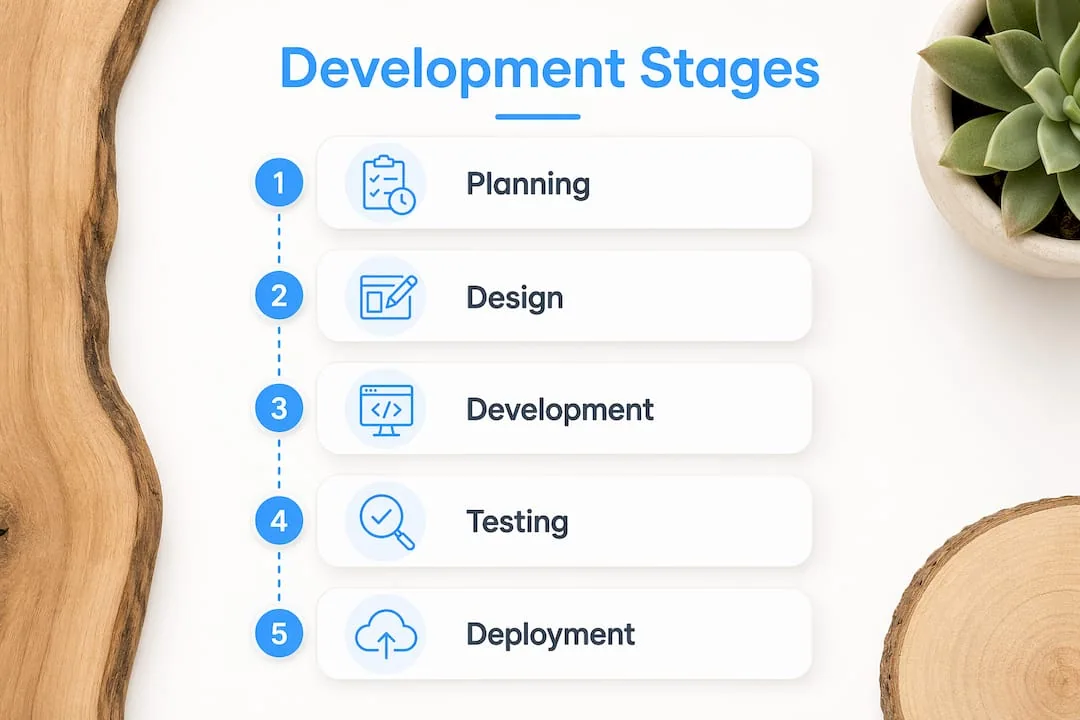
What are the main stages of the enterprise app development process?
The enterprise app development process is more structured and governance-heavy than typical software projects. That structure is not bureaucracy for its own sake. It exists because governance processes like requirements management, change control, and stakeholder approvals are what prevent costly rework and compliance failures in complex environments.
A well-run enterprise project follows these stages:
- Strategic alignment: Define the business problem, success metrics, and organisational objectives before writing a single line of code. IT and business teams must agree on scope at this stage.
- Requirements management: Document functional and non-functional requirements in detail. Include security, performance, and integration specifications. Change control processes begin here.
- Architecture and design: Select the technology stack, define the data model, and map integration points. Security architecture is designed at this stage, not retrofitted later.
- Agile development sprints: Build in iterative cycles with regular stakeholder reviews. Agile and DevOps methodologies reduce release cycle times and improve deployment reliability in complex environments.
- Testing and quality assurance: Conduct unit, integration, performance, and security testing. Enterprise systems require load testing at realistic user volumes.
- Deployment and CI/CD: Use continuous integration and continuous delivery pipelines to automate testing and deployment. This keeps release cycles predictable and reduces human error.
- Governance sign-off: Obtain formal stakeholder and compliance approvals before go-live. This step is non-negotiable in regulated industries.
- Maintenance and iteration: Enterprise software is never truly “finished.” Plan for ongoing updates, security patches, and feature evolution from day one.
Pro Tip: Involve your end users in requirements workshops from the start. The most common cause of enterprise project failure is not technical. It is a gap between what IT built and what the business actually needed.
What business benefits do enterprise applications deliver?
The core benefit of enterprise software is that it automates and orchestrates complex workflows across departments, eliminating the data silos that slow organisations down. When your finance team, operations team, and customer service team all work from the same data in real time, decision-making accelerates and errors decrease.
The tangible benefits for South African organisations include:
- Workflow automation: Repetitive manual processes, from invoice approvals to compliance reporting, are automated, freeing staff for higher-value work.
- Real-time data access: Managers get live dashboards instead of waiting for end-of-month reports. That visibility changes how quickly you can respond to market shifts.
- Regulatory compliance: Built-in controls and audit trails make POPIA compliance, tax reporting, and industry-specific regulations easier to manage consistently.
- System integration: A single enterprise platform replaces the patchwork of disconnected tools that most growing organisations accumulate over time.
- Consistent customer experience: When all customer-facing teams access the same data, service quality becomes consistent regardless of which team member handles an interaction.
Enterprise applications do not just improve efficiency. They change the quality of decisions an organisation can make, because those decisions are grounded in accurate, real-time information rather than outdated reports or gut feel.
Understanding scalable software solutions is central to realising these benefits. A system that cannot grow with your business will create new bottlenecks as quickly as it solves old ones.
How do modern trends shape enterprise app development?
The enterprise application space is shifting faster than at any point in the past decade. Cloud platforms and low-code development tools now accelerate delivery by abstracting infrastructure concerns and enabling rapid iteration. That means the gap between a business requirement and a working prototype has narrowed significantly.
Key trends influencing enterprise development in 2026
- Cloud-native architectures: Organisations are moving away from on-premise data centres toward cloud platforms that offer pay-as-you-use pricing and built-in redundancy.
- Low-code and no-code platforms: Business analysts can now build workflow automations and simple applications without deep coding skills, freeing developers for complex integrations.
- AI and automation agents: AI is being embedded directly into enterprise workflows, from intelligent document processing to predictive maintenance alerts.
- Interoperability standards: The push for open APIs and standardised data formats means enterprise systems can connect more easily across vendor ecosystems.
- Data readiness: Organisations are investing in clean, well-governed data before building AI features, because AI outputs are only as reliable as the data feeding them.
Pro Tip: Before adopting a low-code platform for enterprise use, verify that it supports your security and compliance requirements. Many entry-level tools lack the governance controls that regulated industries demand.
Keeping up with current web development trends helps IT managers anticipate which technologies will mature into enterprise-grade options and which are still too early for production use. The pace of change also has implications for digital marketing, where scalable SEO strategies are increasingly tied to the performance and architecture of the underlying enterprise platform.
Key takeaways
Enterprise application development succeeds when architecture, governance, and business alignment are treated as equally important from the first day of the project.
| Point | Details |
|---|---|
| Definition is foundational | Enterprise apps are custom systems built for large organisations with complex integration and governance needs. |
| Architecture drives longevity | Three-tier architecture with independent layers allows systems to scale and be maintained over years. |
| Governance prevents failure | Requirements management, change control, and stakeholder sign-off are what separate successful projects from costly ones. |
| Benefits are operational and strategic | Workflow automation and real-time data access change both efficiency and decision quality. |
| Modern trends accelerate delivery | Cloud platforms, low-code tools, and AI integration reduce time-to-value without sacrificing governance. |
Why I think most enterprise projects fail before development even starts
After working on enterprise software projects across multiple industries, the pattern I see most often is this: organisations invest heavily in the technical build and almost nothing in the alignment work that should precede it. They arrive at a development partner with a vague brief, a tight deadline, and the assumption that the technology will figure out the rest.
The projects that succeed are the ones where business leaders and IT managers sit in the same room and agree, in writing, on what success looks like before architecture decisions are made. Modular design matters. Security-first thinking matters. Agile delivery matters. But none of those practices save a project that started with the wrong problem statement.
My honest advice: treat the discovery and requirements phase as the most valuable investment in your enterprise project. It costs a fraction of a full build and prevents the kind of rework that doubles budgets and delays go-live dates by months. South African organisations, in particular, benefit from working with development partners who understand local compliance requirements, local infrastructure realities, and the specific integration challenges of operating in this market. Generic offshore solutions rarely account for those nuances.
— Anton
How Cloudfusion supports enterprise application development
Cloudfusion builds custom web and mobile applications for South African businesses that need software tailored to their specific operational context. Whether you are replacing a legacy system, integrating disconnected platforms, or building a new enterprise tool from the ground up, Cloudfusion brings the technical depth and local market knowledge to deliver it properly. The team works closely with your business and IT stakeholders through every stage of the enterprise app development process, from requirements through to deployment and ongoing support. If you are ready to talk through your project requirements, give us a shout and let’s chat about what the right solution looks like for your organisation.
FAQ
What is enterprise application development in simple terms?
Enterprise application development is the process of building custom software for large organisations that need to automate complex processes, integrate multiple systems, and support large numbers of users simultaneously.
How does enterprise software differ from standard business software?
Enterprise software is designed for organisations with user bases exceeding 1,000 seats and integration requirements spanning ten or more external systems, with formal governance, security frameworks, and compliance controls built in from the start.
What methodologies are used in enterprise app development?
Agile, DevOps, and CI/CD practices are the standard approach in enterprise projects. These methodologies reduce release cycle times and improve deployment reliability across complex, multi-team environments.
How long does it take to develop an enterprise application?
Timelines vary significantly based on complexity, integration scope, and governance requirements. Simple enterprise tools may take three to six months, while large-scale systems with extensive integrations typically require twelve months or more.
Why do South African businesses need custom enterprise applications?
Off-the-shelf tools rarely address local compliance requirements like POPIA, local infrastructure constraints, or the specific integration needs of South African market operations. Custom enterprise applications are built to fit those realities precisely.