

Bespoke software development for business efficiency 2026
Learn how bespoke software development drives business efficiency in 2026, from process and design to market trends and strategic insights for every business size.
Start reading
TL;DR:
- The bespoke software market is rapidly growing, reaching an estimated $43-$59 billion in 2025.
- Custom software offers flexibility, scalability, and integration benefits tailored to specific business needs.
- Successful projects prioritize clear requirements, user experience, and iterative development to maximize value.
Bespoke software is no longer the exclusive domain of large enterprises with deep technology budgets. The custom software market is valued between $43 billion and $59 billion in 2025, projected to reach $65 to $73 billion in 2026, and growing at a compound annual growth rate of 22 to 23 percent toward $474 billion by 2035. This rapid expansion signals a fundamental shift: businesses of every size are recognising that generic software simply cannot keep pace with evolving operational demands. This article clarifies what bespoke software development actually means, how the process works, what the design phase involves, and why the market data points to a compelling case for investing in tailored digital solutions.
Table of Contents
- Understanding bespoke software development
- The bespoke software development process explained
- Design and prototyping: Turning ideas into user-friendly solutions
- Market trends and business impact: Bespoke software in 2026 and beyond
- A strategic perspective: What most businesses overlook in bespoke software projects
- Next steps: Connect with leading bespoke software development experts
- Frequently asked questions
Key Takeaways
| Point | Details |
|---|---|
| Structured development process | Bespoke software follows clear steps, from requirement analysis to ongoing support. |
| Market growth opportunities | The custom software sector is expanding rapidly, offering significant value for businesses. |
| Agile vs Waterfall methods | Agile is ideal for iterative, changing projects, while Waterfall fits well-defined needs. |
| UI/UX design matters | Early-stage design and prototyping ensure software is user-friendly and drives real adoption. |
| Strategic alignment | Success depends on aligning bespoke solutions with real business goals—not just technical features. |
Understanding bespoke software development
Bespoke software, at its core, is software built specifically for your business rather than purchased off a shelf and adapted to fit. Unlike commercial off-the-shelf (COTS) solutions such as generic CRM platforms or standard accounting tools, bespoke software is engineered around your exact workflows, user requirements, and strategic objectives. The distinction matters enormously in practice.
Off-the-shelf software offers speed and lower initial cost, but it forces your processes to conform to the software’s logic. Bespoke solutions invert this relationship entirely. Your business requirements drive every design and development decision, which means you gain a bespoke user experience that directly supports how your teams actually work.
Businesses typically invest in bespoke development for several well-defined reasons:
- Flexibility: Custom software adapts as your business evolves, without waiting for a vendor’s product roadmap.
- Scalability: Architecture is designed from the outset to handle growth in users, data volumes, and feature complexity.
- Competitive differentiation: Proprietary software becomes a strategic asset that competitors cannot simply replicate by purchasing the same licence.
- Integration capability: Bespoke systems connect seamlessly with your existing infrastructure, eliminating data silos.
- Long-term cost efficiency: While upfront investment is higher, ongoing licence fees and costly workarounds are eliminated.
Real-world use cases span industries. A logistics company might require a custom route optimisation engine. A financial services firm may need a regulatory compliance tracking system built to local legislative requirements. A healthcare provider might commission a patient management platform that integrates with existing diagnostic equipment. In each case, no off-the-shelf product adequately addresses the specific operational context.
“Bespoke software development follows a structured process that prioritises alignment between business requirements and technical execution at every stage.”
Understanding embracing UX design as a foundational element of bespoke projects separates successful implementations from costly failures. When user experience is treated as an afterthought rather than a design principle, even technically sound software suffers poor adoption rates.
The bespoke software development process explained
Knowing what bespoke software is only takes you so far. Understanding how it gets built is where strategic decisions become critical. The development process follows a structured sequence of phases, each building on the previous one.
- Requirements gathering: Stakeholders define business objectives, user needs, technical constraints, and success metrics. This phase determines the entire project trajectory.
- Design: Architects and UX specialists translate requirements into system architecture, interface wireframes, and data models.
- Development: Engineers write, review, and integrate code according to the agreed specifications and chosen methodology.
- Testing: Quality assurance teams validate functionality, performance, security, and usability against defined acceptance criteria.
- Deployment: The solution is released to production environments, often in staged rollouts to manage risk.
- Maintenance: Ongoing support, performance monitoring, and iterative enhancements keep the system aligned with evolving business needs.
Two primary methodologies govern how these phases are sequenced. Staying current with technology trends helps you choose the right approach for your project context.
| Methodology | Approach | Best suited for | Key advantage |
|---|---|---|---|
| Agile | Iterative, incremental sprints | Dynamic, evolving requirements | Flexibility and faster feedback loops |
| Waterfall | Sequential, phase-by-phase | Fixed, well-defined requirements | Predictable timelines and budgets |
Most modern bespoke projects favour Agile because requirements rarely remain static. Maximizing custom web design outcomes depends on iterative refinement informed by real user feedback, not assumptions made at project inception.
Common pitfalls include scope creep, insufficient stakeholder engagement during requirements gathering, and neglecting web usability standards during development. Each of these risks is manageable with disciplined project governance.
Pro Tip: Establish a formal change control process before development begins. Every scope change should be evaluated for its impact on timeline, budget, and architecture before approval. This single practice prevents the majority of bespoke project overruns.
Design and prototyping: Turning ideas into user-friendly solutions
The design phase is where abstract business requirements become tangible, testable solutions. It is also where the most consequential decisions about user adoption are made, often before a single line of production code is written.

Wireframes, UI/UX, and prototyping are the core instruments of this phase. Wireframes are low-fidelity skeletal layouts that map information architecture and user flows without visual styling. Prototypes are interactive, higher-fidelity representations that simulate actual software behaviour, enabling stakeholders to test and validate concepts before development investment is committed.
Key design activities that directly affect business outcomes include:
- User journey mapping: Identifying every interaction point between users and the system to eliminate friction.
- Interface consistency: Applying design systems that ensure visual and functional coherence across all screens.
- Accessibility compliance: Building to WCAG standards ensures the software serves all users, including those with disabilities.
- Responsive design: Ensuring the solution performs across devices, particularly for mobile-first workforces.
- Feedback integration: Structured user testing sessions during prototyping surface usability issues before they become expensive fixes.
Our UI/UX guide provides detailed frameworks for evaluating design decisions against business objectives. Applying UX principles rigorously during this phase directly reduces post-launch change requests and support costs.
Understanding the distinction between UX and UI is also critical. The UX vs UI guide clarifies how user experience strategy and interface design serve different but complementary functions within a bespoke project. Looking ahead, user experience in 2026 is increasingly shaped by AI-assisted personalisation and voice interaction, both of which must be considered during the design phase of any forward-looking bespoke solution.
Pro Tip: Involve end users, not just project sponsors, in prototype review sessions. Sponsors understand business goals; end users understand operational reality. Both perspectives are essential for a solution that works in practice.
Market trends and business impact: Bespoke software in 2026 and beyond
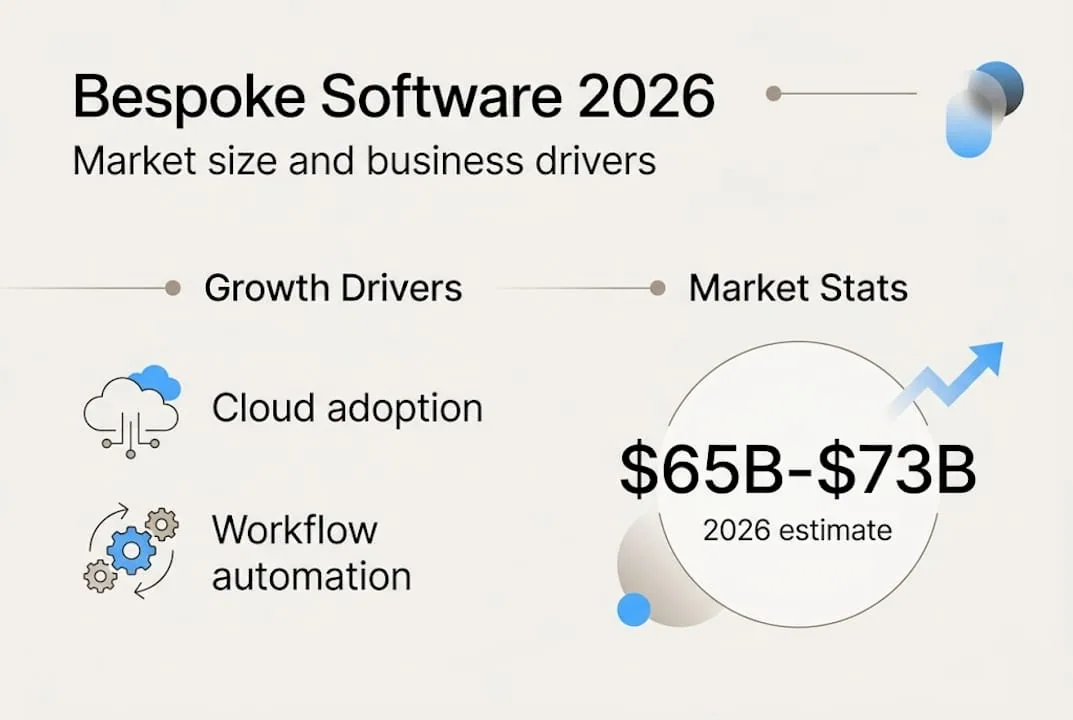
The numbers tell a compelling story. The custom software market is projected to reach between $65 billion and $73 billion in 2026, with long-range forecasts placing it at $474 billion by 2035. This trajectory reflects a structural shift in how businesses approach software industry trends and digital investment.
| Year | Market size estimate | Growth driver |
|---|---|---|
| 2025 | $43B to $59B | Cloud adoption, digital transformation |
| 2026 | $65B to $73B | AI integration, operational efficiency demand |
| 2030 | $141B+ | Enterprise automation, industry-specific solutions |
| 2035 | $474B | Global digital infrastructure maturity |
Several forces are accelerating this growth. Cloud-native architecture has dramatically reduced the infrastructure cost of deploying custom solutions. AI and machine learning capabilities are now accessible to mid-market businesses through APIs and pre-trained models, enabling sophisticated automation without prohibitive development costs. Regulatory complexity across industries is also driving demand for compliance-specific software that generic products cannot adequately address.
The operational efficiency gains from well-executed bespoke solutions are measurable and significant:
- Elimination of manual data transfer between incompatible systems reduces error rates and processing time.
- Automated workflows replace repetitive administrative tasks, freeing skilled staff for higher-value activities.
- Real-time reporting dashboards built around your specific KPIs accelerate decision-making cycles.
- Role-based access controls and audit trails improve governance and reduce security exposure.
However, bespoke software is not without risk. Higher upfront investment, longer time-to-deployment compared to off-the-shelf alternatives, and dependency on skilled development partners are genuine considerations. Businesses must evaluate total cost of ownership over a three to five year horizon, not just initial project cost, to make an accurate comparison.
A strategic perspective: What most businesses overlook in bespoke software projects
Here is what experience consistently reveals: most bespoke software projects that underperform do not fail because of technical execution. They fail because the business never clearly defined what success actually looks like in operational terms.
Companies invest in custom development with enthusiasm, then over-engineer features that users do not need, while neglecting the workflows that cause daily friction. The trap is building what stakeholders think the business needs rather than what improving user experience data and operational analysis actually reveal.
Scalability is another overlooked dimension. Businesses design for current headcount and current data volumes, then find themselves with a system that cannot accommodate growth eighteen months after launch. Designing for scale from the outset costs a fraction of retrofitting it later.
The most successful bespoke projects we have observed share one characteristic: ruthless prioritisation during requirements gathering. They build the minimum viable product that solves the core problem, validate it with real users, and then extend it iteratively. This discipline, more than any technical choice, determines whether a bespoke investment delivers genuine business value or becomes an expensive lesson in scope management.
Next steps: Connect with leading bespoke software development experts
Bespoke software development is a strategic investment that demands the right partner, not just the right technology. At Cloudfusion, we specialise in delivering custom web development solutions and mobile app development services engineered around your specific business requirements, operational workflows, and growth objectives. Our approach combines rigorous requirements analysis with iterative design and development practices that keep your project on scope, on budget, and aligned with measurable outcomes. Whether you are evaluating your first bespoke solution or scaling an existing digital ecosystem, we bring the technical depth and strategic perspective your project requires. Request a quote today and take the first step toward software that works the way your business does.
Frequently asked questions
What is bespoke software development?
Bespoke software development means creating custom software tailored to a business’s unique requirements, rather than using generic off-the-shelf solutions. Every feature, workflow, and integration is designed specifically for your operational context.
How much does bespoke software development cost?
Costs vary based on project complexity, feature scope, and delivery timeline, but bespoke solutions generally require a higher initial investment than ready-made software. The relevant comparison is total cost of ownership over three to five years, where bespoke often proves more cost-effective.
How long does bespoke software development take?
Timelines vary by project scope and methodology, typically ranging from a few months for focused applications to a year or more for complex, enterprise-level systems. Agile delivery allows usable functionality to be released incrementally rather than waiting for full completion.
Is bespoke software scalable for growing businesses?
Yes. Bespoke software offers the distinct advantage of being architected for scalability from the outset, allowing the system to grow alongside your business without requiring costly structural overhauls.
What are the advantages of Agile over Waterfall for bespoke projects?
Agile enables faster, iterative progress and adaptability to changing requirements, while Waterfall is structured but less flexible. 64% of organisations that outsource bespoke development prefer Agile because dynamic business environments rarely support fixed, sequential delivery models.
Recommended
- Custom software guide for business efficiency in 2026
- Exploring the Advantages of Custom Software Development in 2024
- Top Benefits of Investing in Custom Software Development
- How Custom Software Can Address Your Business Needs
- Studio201 - Tworzymy aplikacje, systemy i programy
- Benefits of Online Scheduling: Boosting Business Efficiency | Ibrandmedia