

Choosing the right software development company for growth
Learn how to choose a software development company that handles complexity, edge cases, and methodology fit to drive real business growth in 2026.
Start reading
TL;DR:
- Most software failures are caused by overlooked edge cases during development.
- Choosing a partner with process maturity and edge case handling skills is crucial.
- Hybrid methodologies are preferred for complex enterprise projects requiring balance of speed and governance.
Software failures rarely happen because a team missed a headline feature. 70-75% of failures trace back to overlooked edge cases, those boundary conditions that seem unlikely until they bring down a production system at the worst possible moment. For business decision-makers and IT managers, this reframes the entire question of how to choose a software development company. It is not simply about who has the most impressive portfolio or the lowest day rate. It is about finding a partner whose process is built to handle complexity, ambiguity, and the unexpected with the same rigour as the obvious requirements.
Table of Contents
- Understanding the software development company landscape
- Comparing popular development methodologies
- Evaluating a software development company’s technical and business expertise
- Best practices for engaging a software development partner
- What most companies get wrong when choosing a software development company
- How Cloudfusion partners with you for lasting software success
- Frequently asked questions
Key Takeaways
| Point | Details |
|---|---|
| Hybrid model advantage | Hybrid methodologies offer the best balance for complex business needs, combining agility with governance. |
| Edge-case focus | The best companies prioritize edge-case analysis to prevent software failures early. |
| Choose by fit, not trend | Select a software development company based on process maturity and resilience, not just latest industry trends. |
| Engagement matters | Success depends on clear contracts and communication, not just on technical capability. |
Understanding the software development company landscape
With the risks in mind, it is important to know the current landscape of providers and methods before you begin evaluating candidates. Software development companies today range considerably in structure, focus, and capability, and understanding these archetypes helps you match your needs to the right kind of partner.
The main company types you will encounter include:
- Boutique studios: Small, specialist teams that excel in specific domains such as fintech, healthtech, or e-commerce. They offer focused expertise but may lack capacity for large-scale enterprise rollouts.
- Enterprise-focused firms: Larger organisations with formal project governance, dedicated account management, and the bench strength to scale teams rapidly.
- Offshore and nearshore providers: Cost-competitive options that require careful vetting of communication practices, time zone alignment, and quality assurance maturity.
- Specialised providers: Companies built around specific delivery types, whether custom web development, mobile applications, or cloud-native architecture.
Agile methodologies dominate software development with 58% adoption, and Scrum is the most applied framework at 37%. Waterfall survives primarily in highly regulated sectors such as defence, medical devices, and financial compliance, where requirements are locked and audit trails are mandatory. Most modern providers operate somewhere in between, using hybrid models that blend iterative delivery with structured governance. This is particularly relevant for enterprise digital transformation, where speed and control must coexist.
Key differentiators to look for are process maturity, compliance readiness, and a demonstrated ability to handle complex edge cases across the full development lifecycle. Understanding Agile tech team efficiency and how it applies to your business context is a strong starting point for evaluating any provider.
Pro Tip: Ask every candidate to walk you through how they handle a requirement change mid-sprint. Their answer reveals more about their process maturity than any case study will.
Comparing popular development methodologies
Once you are familiar with company types, the next consideration is process fit. The methodology a company uses is not just an internal workflow preference. It directly shapes how your project is managed, how risks surface, and how quickly you can course-correct.
Here is a direct comparison of the four dominant methodologies:
| Methodology | Best use case | Strengths | Weaknesses |
|---|---|---|---|
| Agile/Scrum | Evolving requirements, product development | Fast iteration, stakeholder feedback loops | Can lack governance, scope creep risk |
| Waterfall | Regulated, stable-requirement projects | Clear milestones, audit-friendly | Slow feedback, costly late changes |
| Hybrid | Complex enterprise projects | Balances speed with control and compliance | Requires skilled facilitation |
| DevOps | Continuous delivery environments | Speeds CI/CD pipelines, reduces release risk | Needs cultural alignment across teams |
Hybrid methodologies outperform pure Agile or Waterfall in enterprise settings, with 42% of organisations using hybrid models, rising to 49% in larger firms. This is not a coincidence. Enterprise projects carry dependencies, compliance obligations, and stakeholder complexity that pure Agile struggles to govern and that Waterfall cannot adapt to quickly enough.
“The most successful enterprise software projects we observe are not purely Agile or purely Waterfall. They are deliberately designed hybrid approaches that match governance intensity to project risk.”
When evaluating providers, consider reading a practical hybrid app development guide to understand how these models translate into real delivery structures. You should also look at how enterprise cloud agility is achieved through methodology choices, not just technology selections. For additional context on outsourcing developers, understanding methodology fit is equally critical when working with external teams.
Your business context, not the trendiness of a methodology, should drive the selection. A regulated financial platform needs different governance than a consumer mobile app.
Evaluating a software development company’s technical and business expertise
Beyond models and buzzwords, evaluating a company’s technical and consultative depth is critical. This is where most procurement processes fall short. They assess what a company has built, but not how they think about failure.
Here is a five-step checklist for evaluating any software development provider:
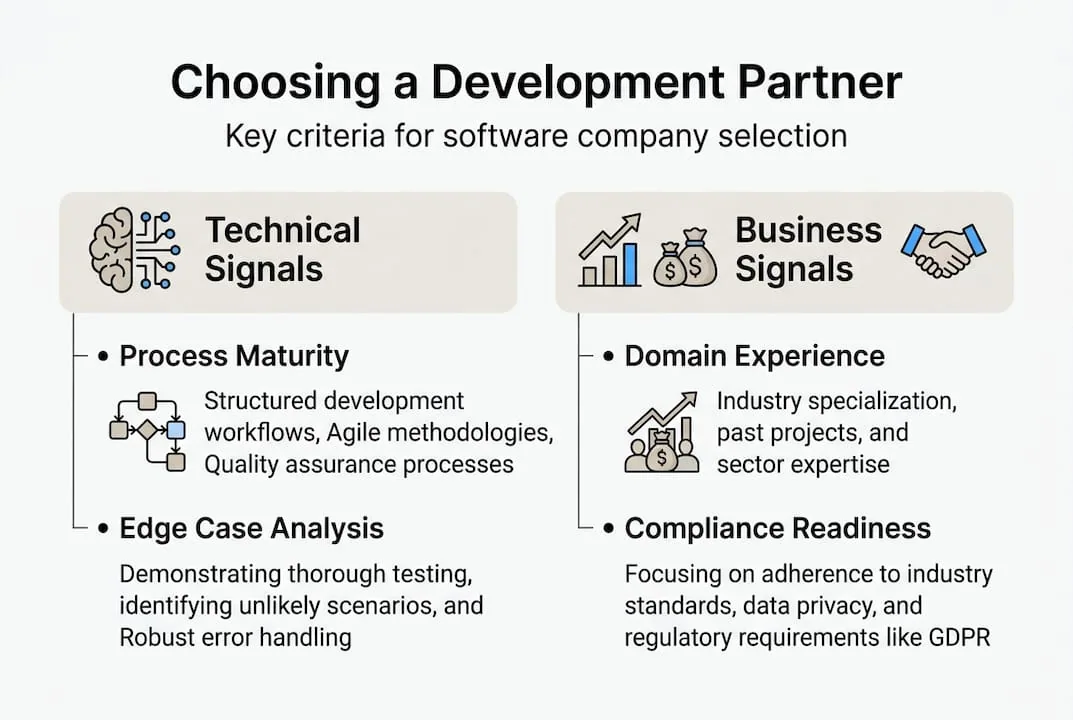
- Process maturity: Can they demonstrate a structured requirements process that includes edge case identification from the design phase?
- Team skills and composition: Do they have architects, QA engineers, and security specialists, or just developers?
- Technology stack alignment: Does their preferred stack match your scalability and integration requirements?
- Scalability planning: How do they design systems to handle load spikes, data growth, and feature expansion?
- Post-launch support: What does their support model look like after go-live, including SLAs and incident response?
Edge cases cause 70-75% of failures, and systematic discovery through FMEA-inspired analysis tables and property-based testing is what separates resilient software from fragile systems. Ask candidates directly: do they integrate edge case analysis into the design phase, or treat it as a late-stage QA activity?
| Evaluation criterion | Strong signal | Weak signal |
|---|---|---|
| Edge case handling | FMEA tables, property-based testing in design | “We test thoroughly before release” |
| Domain expertise | Industry-specific case studies with measurable outcomes | Generic portfolio with no vertical focus |
| Communication | Named stakeholder contacts, structured reporting | Single point of contact, ad hoc updates |
Domain expertise also matters more than most buyers realise. A company that has built software for your industry understands the regulatory landscape, the data sensitivities, and the user behaviour patterns that shape good software design patterns. This translates directly into fewer surprises and faster delivery.

Pro Tip: Request a technical discovery session before signing any contract. A company that asks sharp questions about your failure modes and integration constraints is demonstrating exactly the kind of thinking you need.
Best practices for engaging a software development partner
Having chosen a provider, how you structure the engagement determines whether the partnership delivers its potential. Even the best development company will underperform if the commercial and communication framework is poorly designed.
Start with contract fundamentals:
- Scope clarity: Define what is in scope and, critically, what is explicitly out of scope. Ambiguity here is the primary driver of cost overruns.
- Staged deliverables: Break the project into phases with defined acceptance criteria. This creates natural review points and reduces the risk of a large late-stage failure.
- Built-in review loops: Contractually require retrospectives and change management processes, not just delivery milestones.
Communication cadence is equally important. Weekly progress updates, direct stakeholder access to technical leads, and regular demo sessions keep alignment tight and surface risks early. Avoid arrangements where you only hear from a project manager and never interact with the team building your product.
For ongoing improvement, measure ROI at each phase gate, not just at project completion. Use retrospectives to adjust scope, reprioritise features, and recalibrate timelines based on actual velocity. This is where hybrid methodologies outperform rigid alternatives: they create the structural flexibility to adapt without losing governance discipline.
For practical guidance on improving business software once a system is live, the principles are the same: structured feedback, clear ownership, and measurable improvement cycles. Explore custom software insights to see how leading organisations approach ongoing digital evolution rather than treating software as a one-time project.
What most companies get wrong when choosing a software development company
Most guides stop at practical steps, but the real-world decision often fails for reasons that are harder to see in a proposal document. We have observed a consistent pattern: businesses gravitate toward companies with polished portfolios and recognisable client logos, then discover too late that the team cannot handle the specific complexity their project demands.
The most common pitfall is mistaking trend alignment for fitness to your business complexity. A company that talks fluently about microservices and AI integration is not necessarily equipped to manage the edge cases your industry generates. Technical vocabulary is easy to acquire. Systematic resilience thinking is not.
Businesses also consistently underweight cross-team communication ability. A development company that cannot translate technical risk into business language will leave your stakeholders uninformed until a problem becomes a crisis.
Our strongest advice: prioritise demonstrated edge case analysis and hybrid methodology experience over portfolio polish. Ask for a live walkthrough of how they handled a project that went wrong and what they changed as a result. Pure Agile risks governance gaps, Waterfall delays feedback, and hybrid approaches bring the real-world balance that complex enterprise projects require. The companies that understand this distinction, and can prove it, are the ones worth engaging.
How Cloudfusion partners with you for lasting software success
If the principles in this article resonate with how you think about software risk and digital transformation, Cloudfusion is built to be that kind of partner. Our approach to custom web development is grounded in process rigour, edge case awareness, and methodology alignment to your specific business context. We do not apply a single template to every project. We evaluate your requirements, your industry constraints, and your scalability goals before recommending a delivery model.
Whether you need a scalable mobile app development solution, a robust cloud-hosted platform, or reliable web hosting packages to underpin your digital presence, we offer tailored proposals and a free initial consultation. Reach out to discuss your next project and experience the difference that structured, resilience-focused development makes.
Frequently asked questions
What is the main advantage of using a hybrid Agile methodology?
Hybrid Agile combines iterative flexibility with structured governance, making it particularly effective for complex enterprise projects that carry compliance requirements or cross-functional dependencies. Hybrid models outperform pure approaches in most large-firm environments.
How can we evaluate a software development company’s ability to handle edge cases?
Ask specifically about their use of FMEA-inspired analysis tables and property-based testing, and confirm whether edge case discovery is integrated into the design phase rather than left to late-stage QA.
Why is Waterfall still relevant in some industries?
Waterfall suits projects with locked, stable requirements and mandatory audit trails, which is why it persists in regulated sectors such as healthcare, defence, and financial compliance. Waterfall suits regulated projects but struggles when requirements evolve mid-delivery.
What common mistake do businesses make when choosing a software development company?
The most frequent error is prioritising price or technology trend alignment over assessing a company’s actual problem-solving depth and resilience capability. Prioritise edge case proficiency and hybrid methodology experience above portfolio aesthetics.
Recommended
- The Benefits of Building Custom Software for Your Company
- Understanding Custom Development Company Solutions
- Top Benefits of Investing in Custom Software Development
- How Custom Software Can Address Your Business Needs
- How To Pick the Right Software for Your Business? | Capital for Business Blog | Capital for Business