

Cloud Hosting Pros and Cons – Business Impact Unpacked
Cloud hosting pros and cons explained for IT managers. Learn about scalability, costs, performance, risks, compliance, and alternatives for enterprises.
Start reading
Most IT managers know that choosing the right hosting solution can determine future growth or unexpected pitfalls. As global enterprise spending on cloud technology heads toward a staggering R1.3 trillion, south-african businesses are part of a worldwide shift away from traditional infrastructure. This introduction explores how cloud hosting changes the game for medium and large organisations, highlighting what sets virtual servers apart and flagging essential factors for informed decision-making.
Table of Contents
- Cloud Hosting Defined For Enterprise IT
- Key Types Of Cloud Hosting Models
- Scalability, Reliability And Performance Benefits
- Security, Compliance And Cost Considerations
- Vendor Lock-In, Control, And Risk Factors
- Comparing Cloud Hosting To Other Solutions
Key Takeaways
| Point | Details |
|---|---|
| Adoption of Cloud Hosting | Cloud hosting is increasingly favoured by enterprises for its scalability, flexibility, and cost-effectiveness compared to traditional hosting solutions. |
| Deployment Models | Businesses can choose from various cloud hosting models, including Public, Private, Hybrid, and Multi-Cloud, based on their specific needs. |
| Operational Benefits | Key advantages of cloud hosting include elastic resource scaling, high availability, and performance optimisation, leading to improved operational efficiency. |
| Vendor Lock-In Risks | Enterprises must be vigilant about potential vendor lock-in, employing strategies like Multi-Cloud architecture and open standards to maintain control and flexibility. |
Cloud Hosting Defined For Enterprise IT
Cloud hosting represents a transformative technological infrastructure where computing resources are delivered remotely through internet-connected servers, enabling businesses to access powerful computational capabilities without maintaining physical hardware. Worldwide enterprise cloud spending is projected to reach R1.3 trillion by 2024, signalling a fundamental shift in how organisations manage technological infrastructure.
At its core, cloud hosting provides businesses with scalable, flexible computing environments where virtual servers replace traditional on-premises hardware. These virtualized platforms allow enterprises to dynamically allocate computational resources, scaling infrastructure up or down based on immediate business requirements. Unlike traditional hosting models, cloud solutions offer granular control, with organisations paying precisely for the computing power and storage they consume.
The architectural design of cloud hosting encompasses several critical deployment models tailored to enterprise needs:
- Public Cloud: Shared infrastructure managed by third-party providers
- Private Cloud: Dedicated infrastructure exclusively for a single organisation
- Hybrid Cloud: Integrated environment combining public and private cloud resources
- Multi-Cloud: Utilising multiple cloud providers to diversify technological capabilities
Modern enterprises are increasingly adopting cloud hosting to drive digital transformation, with public cloud services supporting diverse enterprise workloads that demand high performance, security, and reliability. The technology enables rapid deployment of applications, enhances operational flexibility, and provides robust disaster recovery mechanisms.
Pro tip: Before migrating to cloud hosting, conduct a comprehensive audit of your current IT infrastructure to identify precise resource requirements and potential integration challenges.
Key Types Of Cloud Hosting Models
Cloud hosting models represent sophisticated technological frameworks that enable businesses to leverage remote computing resources with varying levels of control, flexibility, and management. Cloud hosting deployment strategies encompass multiple architectural approaches designed to meet diverse enterprise technological requirements.
Four primary cloud hosting models dominate the enterprise landscape:
-
Public Cloud: Shared infrastructure managed by third-party providers, offering scalable and cost-effective solutions for businesses seeking flexible computational resources. These platforms allow organisations to access powerful computing capabilities without significant upfront infrastructure investments.
-
Private Cloud: Dedicated infrastructure exclusively controlled by a single organisation, providing enhanced security, compliance, and customisation opportunities. Private clouds enable businesses to maintain rigorous data governance standards while enjoying cloud technology’s inherent flexibility.
-
Hybrid Cloud: An integrated environment combining public and private cloud resources, allowing enterprises to optimise workload placement and balance performance with security requirements. Hybrid models enable organisations to distribute computational tasks strategically across different infrastructure types.
-
Multi-Cloud: A sophisticated approach involving multiple cloud providers to diversify technological capabilities, improve resilience, and mitigate vendor lock-in risks. Cloud service models further categorise these deployments into Infrastructure as a Service (IaaS), Platform as a Service (PaaS), and Software as a Service (SaaS), each offering distinct management and control levels.
The selection of an appropriate cloud hosting model depends on an organisation’s specific technological needs, regulatory environment, budget constraints, and strategic objectives. Enterprises must carefully evaluate their computational requirements, security protocols, and scalability expectations when choosing between these diverse hosting approaches.

To clarify the differences among cloud hosting models, here’s a side-by-side comparison of their unique characteristics and benefits:
| Hosting Model | Control & Customisation | Typical Use Cases | Security & Compliance Focus |
|---|---|---|---|
| Public Cloud | Limited control, standard setup | Rapid growth startups, cost-sensitive | Industry-standard protections |
| Private Cloud | Full control, highly customisable | Financial institutions, healthcare | Tight governance, strict compliance |
| Hybrid Cloud | Balanced control, selective tuning | Large enterprises with variable needs | Mix of security, easy expansion |
| Multi-Cloud | Strategic diversity, integration | Businesses seeking resilience | Multi-layered, avoids vendor risks |
Pro tip: Conduct a comprehensive workload assessment and performance analysis before selecting a cloud hosting model to ensure optimal alignment with your organisation’s technological infrastructure and business goals.
Scalability, Reliability And Performance Benefits
Cloud hosting transforms enterprise computational capabilities through dynamic resource allocation and robust performance optimisation. Cloud computing scalability enables organisations to adapt computational infrastructure instantaneously, responding to fluctuating business demands with unprecedented flexibility.
The core performance benefits of cloud hosting emerge through three critical dimensions:
-
Elastic Resource Scaling: Automatic adjustment of computational resources allows businesses to handle sudden traffic surges without infrastructure limitations. Organisations can seamlessly expand or contract computing power, storage, and network capabilities based on real-time requirements.
-
High Availability: Cloud platforms provide redundant infrastructure across multiple geographic locations, ensuring continuous operational reliability. This distributed architecture minimises downtime risks and supports business continuity even during localised technical disruptions.
-
Performance Optimisation: Advanced cloud scalability strategies enable precise resource allocation, allowing enterprises to maintain optimal performance levels while managing computational expenses efficiently. Intelligent load balancing and automated resource provisioning ensure consistent application responsiveness.
Enterprise performance metrics demonstrate significant improvements through cloud hosting adoption. Organisations typically experience 30-50% enhanced computational efficiency, reduced infrastructure maintenance costs, and improved response times compared to traditional on-premises solutions.
The following table summarises key operational benefits cloud hosting delivers to South African enterprises:
| Benefit | Business Impact | Typical Result |
|---|---|---|
| Elastic Resource Scaling | Handles traffic spikes efficiently | Fewer outages, improved experience |
| High Availability | Minimises downtime risks | Reliable service, enhanced continuity |
| Performance Optimisation | Matches resources to workload automatically | Cost reduction, quicker response times |
The strategic implementation of cloud hosting enables businesses to transform technological infrastructure from a cost centre to a dynamic, responsive operational asset. By leveraging intelligent scaling mechanisms, enterprises can achieve unprecedented levels of technological agility and performance optimization.
Pro tip: Regularly monitor and analyse your cloud resource utilisation patterns to identify opportunities for right-sizing your infrastructure and optimising computational expenses.
Security, Compliance And Cost Considerations
Cloud hosting introduces complex security and compliance challenges that demand strategic management across technological and regulatory domains. Cloud security strategies require comprehensive approaches to protect enterprise digital assets and maintain regulatory conformity.
Key security considerations for cloud hosting encompass three primary dimensions:
-
Data Protection: Implementing robust encryption protocols, access controls, and continuous monitoring to prevent unauthorised data breaches and maintain information integrity.
-
Regulatory Compliance: Adhering to global standards such as GDPR, POPIA, and industry-specific regulations that govern data privacy, storage, and cross-border information transfers.
-
Risk Management: Cloud computing security frameworks necessitate proactive identification, assessment, and mitigation of potential technological vulnerabilities and operational risks.
Cost considerations in cloud hosting extend beyond simple infrastructure expenses. Enterprises must evaluate total cost of ownership, including:
- Initial migration expenses
- Ongoing operational costs
- Potential savings from reduced hardware maintenance
- Scalability-related financial flexibility
South African businesses increasingly recognise that cloud hosting represents a strategic investment rather than merely a technological expense. By carefully balancing security protocols, compliance requirements, and cost optimisation, organisations can transform cloud infrastructure into a competitive advantage.
Pro tip: Conduct quarterly comprehensive security audits and cost assessments to ensure your cloud hosting strategy remains aligned with evolving business needs and technological landscapes.
Vendor Lock-In, Control, And Risk Factors
Vendor lock-in represents a critical strategic challenge for enterprises adopting cloud hosting solutions. Vendor lock-in risks emerge when organisations become excessively dependent on a single cloud provider’s proprietary technologies, limiting technological flexibility and increasing operational complexities.
Key risk factors in cloud vendor relationships include:
- Technological Dependencies: Proprietary platforms and unique service architectures that make migrations challenging
- Contractual Constraints: Long-term agreements with restrictive terms that impede technological adaptability
- Integration Complexity: Significant technical obstacles preventing seamless transitions between cloud environments
Mitigation strategies for managing vendor lock-in involve multiple sophisticated approaches:
- Multi-Cloud Architecture: Distributing computational workloads across multiple cloud providers
- Open Standards Adoption: Implementing platform-agnostic technologies and containerisation
- Comprehensive Exit Planning: Developing robust migration strategies before initial cloud deployment
Cloud vendor dependency strategies require proactive management, focusing on maintaining technological sovereignty and operational flexibility. South African enterprises must carefully evaluate potential vendor relationships, understanding that cloud hosting represents a strategic partnership rather than a simple transactional service.
Successful cloud hosting strategies demand continuous assessment of vendor relationships, technological capabilities, and potential migration pathways. Organisations must balance immediate operational needs with long-term technological independence and strategic adaptability.
Pro tip: Develop a comprehensive vendor evaluation framework that includes exit strategies, interoperability assessments, and periodic technological audits to maintain organisational control.
Comparing Cloud Hosting To Other Solutions
Cloud hosting represents a transformative technological approach that fundamentally differs from traditional infrastructure models. Cloud versus on-premises solutions demonstrate significant variations in technological capability, financial investment, and operational flexibility.
Key comparative dimensions between cloud hosting and alternative solutions include:
- Infrastructure Investment:
- Cloud Hosting: Minimal upfront capital expenditure
- Traditional Hosting: Substantial hardware purchase and maintenance costs
- On-Premises: Significant capital investment in physical infrastructure
- Scalability Capabilities:
- Cloud Hosting: Instant, dynamic resource allocation
- Traditional Hosting: Limited, incremental scaling
- On-Premises: Slow, expensive infrastructure modifications
- Operational Flexibility:
- Cloud Hosting: Rapid deployment and configuration
- Traditional Hosting: Rigid, time-consuming setup
- On-Premises: Complex change management processes
Managed Hosting Solutions occupy an interesting middle ground, offering some cloud-like benefits while providing more direct infrastructure control. These hybrid models appeal to organisations seeking balanced technological approaches.
South African enterprises increasingly recognise cloud hosting’s strategic advantages, particularly for businesses requiring agile, cost-effective technological infrastructure. The ability to rapidly scale resources, reduce maintenance overhead, and access advanced technological capabilities makes cloud solutions increasingly compelling.
Pro tip: Conduct a comprehensive total cost of ownership analysis comparing cloud, traditional, and on-premises solutions to identify the most strategic technological investment for your specific organisational requirements.
Maximise Your Cloud Hosting Potential With Custom Digital Solutions
Understanding the pros and cons of cloud hosting helps you navigate challenges like vendor lock-in, security compliance, and scalability. If your business seeks flexible, scalable web infrastructure that aligns perfectly with these needs, tailored digital solutions are essential. At Cloudfusion, we address critical pain points by delivering custom web development and cloud-based services designed to enhance performance, reliability, and control for South African enterprises.
Seize the advantage of cloud hosting without compromise by partnering with experts who understand your unique requirements. Explore how our web design and development quotation services provide bespoke, industry-specific digital platforms that integrate seamlessly with cloud hosting capabilities. Ready to overcome your cloud challenges and accelerate your digital transformation? Contact us today at Cloudfusion to start building resilient, efficient, and future-proof solutions that grow with your business.
Frequently Asked Questions
What are the main pros of cloud hosting for businesses?
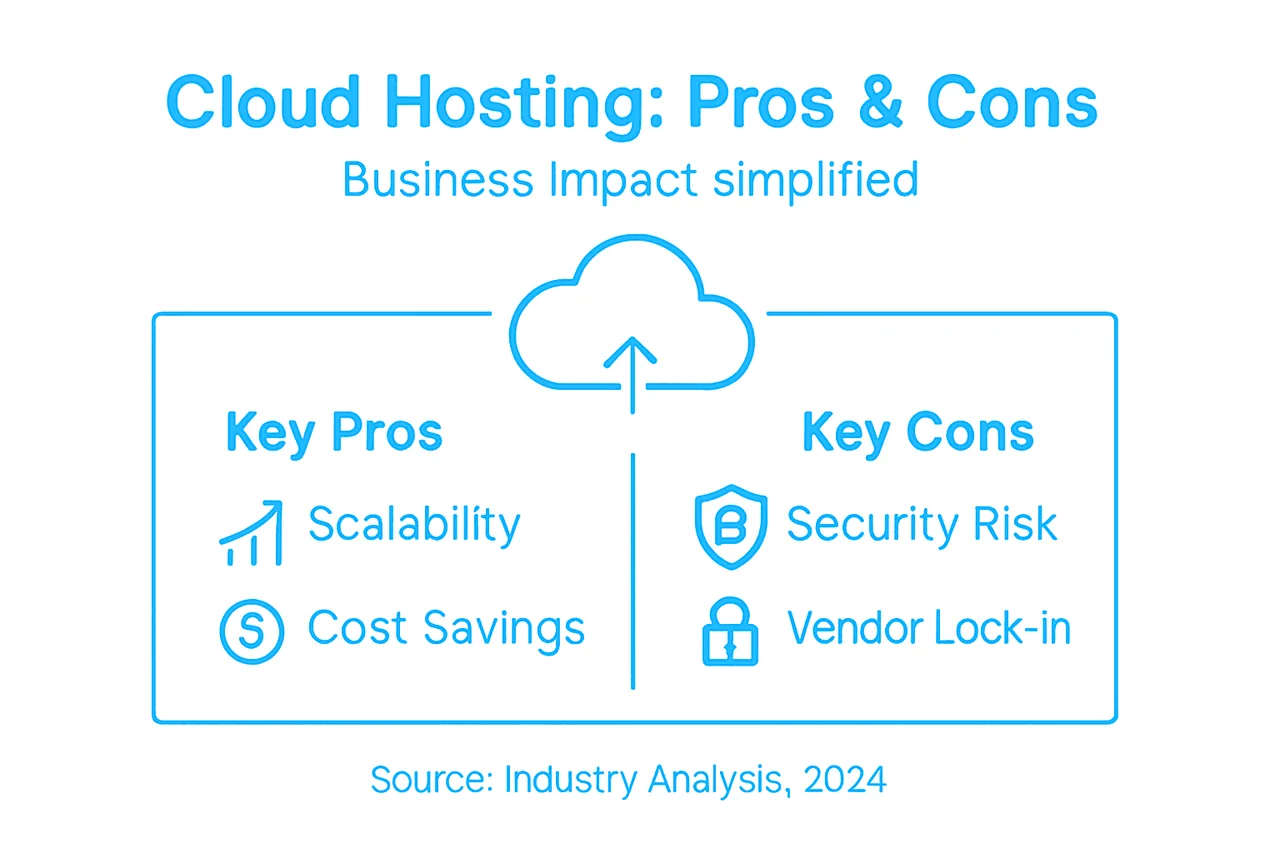
Cloud hosting offers several advantages, including scalability, cost-effectiveness, enhanced performance, and high availability. Businesses can easily scale their resources up or down based on demand, reducing operational costs and improving overall efficiency.
What cons should businesses consider when using cloud hosting?
Some potential downsides of cloud hosting include security concerns, vendor lock-in risks, and potential compliance issues. Businesses must ensure that their data is secure and compliant with industry regulations, and be cautious of becoming too dependent on a single cloud provider.
How does cloud hosting compare to traditional hosting solutions?
Cloud hosting provides greater scalability and flexibility compared to traditional hosting solutions. While traditional hosting requires significant upfront capital expenditure and is often less agile, cloud hosting allows for dynamic resource allocation with minimal upfront costs.
What should businesses do to mitigate vendor lock-in risks with cloud hosting?
To manage vendor lock-in risks, businesses can adopt a multi-cloud strategy, utilize open standards, and develop comprehensive exit plans. This approach helps maintain flexibility and control over their computing environment, reducing dependency on a single provider.