

Disaster Recovery Planning: Protecting Your E-commerce
Disaster recovery planning helps IT managers at e-commerce firms safeguard data, minimise downtime, and meet compliance. Learn types, strategies, and risks.
Start reading
A single untimely outage can turn a thriving online business into a scramble for survival. For IT managers in mid-sized e-commerce firms, the difference between a brief disruption and lasting damage often comes down to how well your disaster recovery plan holds up under pressure. Mastering the fundamentals of disaster recovery means you protect not just your data, but your reputation and revenue when trouble hits. This guide unpacks how purposeful planning and resilient systems build true business continuity.
Table of Contents
- Disaster Recovery Planning Fundamentals Explained
- Variations And Methods For E-Commerce Resilience
- Key Steps In Crafting A Recovery Strategy
- Roles, Compliance, And Legal Obligations
- Common Pitfalls And Risk Mitigation Techniques
Key Takeaways
| Point | Details |
|---|---|
| Comprehensive Disaster Recovery Planning is Essential | A solid disaster recovery plan ensures that businesses can restore systems and data efficiently after major incidents. |
| Clear Roles and Responsibilities Must be Defined | Assign specific roles during recovery to ensure effective response and coordination among various teams. |
| Regular Testing is Crucial | Conduct routine drills to validate the recovery plan and identify potential weaknesses before a real disaster occurs. |
| Understand Your Recovery Metrics | Clearly define Recovery Time Objectives (RTO) and Recovery Point Objectives (RPO) to gauge and tailor your recovery strategy effectively. |
Disaster recovery planning fundamentals explained
Disaster recovery planning is your safety net when things go catastrophically wrong. Whether it’s a cyberattack, hardware failure, natural disaster, or human error, having a solid plan separates businesses that bounce back quickly from those that disappear entirely.
At its core, disaster recovery means having documented procedures to restore your systems and data after an incident. This is different from backup—backups are just copies of your data sitting somewhere safe. Recovery planning is the actual roadmap for how you’ll use those backups to get back online.
Here’s what you need to understand about the fundamentals:
The core components:
- Recovery Time Objective (RTO): How fast you need to be back up and running (measured in hours or minutes)
- Recovery Point Objective (RPO): How much data loss you can tolerate (measured in hours of lost transactions)
- Backup infrastructure: Where your copies live and how often they’re updated
- Documentation: Step-by-step instructions for restoring each system
- Testing: Regular drills to prove your plan actually works
For e-commerce specifically, business continuity planning directly impacts your recovery strategy because your systems, inventory, and customer data all feed into one another.

Here’s a quick comparison of disaster recovery and business continuity planning for e-commerce operations:
| Aspect | Disaster Recovery Planning | Business Continuity Planning |
|---|---|---|
| Primary Focus | Restoring IT systems and data | Maintaining overall business functions |
| Typical Scope | Technical infrastructure and software | Supply chain, finances, operations |
| Key Metrics | RTO and RPO | Uptime, customer satisfaction |
| Business Impact | Rapid IT restoration after disruptions | Sustained revenue and reputation |
| Responsibility | IT and technical teams | Multidepartmental leadership |
Most e-commerce managers assume their hosting provider handles everything. That’s a dangerous myth. Your provider may recover their infrastructure, but they won’t restore your custom database configurations, your product catalogue settings, or your payment gateway integrations.
Your disaster recovery plan must cover not just data, but the entire application stack—databases, code repositories, configurations, and customer records.
You need to know your actual numbers before you start planning. What’s your average hourly revenue? How many customers can you afford to disappoint? How long can your warehouse operations stall? These figures determine whether you need recovery in 1 hour or 24 hours.
The second critical step is cataloguing what actually needs to be protected. Not everything is equally critical. Your payment processing system is critical. Your blog is not. Your customer database is critical. Your email archive is not.
Then comes the infrastructure decision—where do backups actually live? Cloud storage, redundant servers at different locations, or a combination? For most mid-sized e-commerce businesses, cloud-based solutions offer the best balance of cost and reliability.
Pro tip: Start by identifying your top three most critical systems, define their RTO and RPO values, then test recovery on just those systems. You can expand the plan once you’ve proven the process actually works.
Variations and methods for e-commerce resilience
E-commerce resilience isn’t one-size-fits-all. Different businesses face different risks, so the strategies you adopt need to match your specific vulnerabilities and operational structure.
The foundation starts with understanding your actual risk profile. Are you vulnerable to supplier disruptions? Data centre failures? Payment gateway outages? Demand spikes? Each scenario demands a slightly different recovery approach.
Key resilience strategies include:
- Supplier diversification: Multiple vendors for critical goods reduces dependency on any single source
- Inventory optimisation: Balancing stock levels to handle unexpected demand without over-committing capital
- Technological redundancy: Backup systems, failover servers, and distributed databases across multiple locations
- Data flow integration: Real-time visibility across your supply chain and operations
- Local rapid response: Ability to quickly shift to alternative sourcing or fulfillment methods
Research on supply chain resilience strategies shows that combining traditional risk management with advanced technologies like artificial intelligence and IoT sensors creates more adaptive systems.
For platform-based e-commerce operations, bidirectional data flows between you, suppliers, and fulfillment partners enable faster detection of problems and quicker pivots when disruptions occur.
The most resilient e-commerce businesses don’t just prepare for one type of failure—they build flexibility across multiple systems so they can adapt quickly to whatever emerges.
Cloud-based infrastructure offers particular advantages here. Instead of betting everything on one physical location, cloud scalability benefits allow you to shift computing resources, spin up additional capacity, or reroute traffic within minutes.
Product customisation and local waste valorisation strategies also matter. Businesses that can quickly adjust product offerings or pivot to alternative revenue streams recover faster than those locked into rigid supply models.
Your method should combine automated responses with human decision-making. Automated failovers handle immediate system restoration. Human teams handle the strategic decisions about supplier pivots or customer communication during extended outages.
Pro tip: Map out your three most likely failure scenarios, then design one unique recovery method for each. This targeted approach beats generic disaster recovery plans that don’t actually address your real risks.
Key steps in crafting a recovery strategy
Crafting a recovery strategy isn’t something you do once and forget. It’s a structured process that follows logical stages, each building on the previous one. Get this right and you’ll actually be able to restore operations when disaster strikes.
Start with a comprehensive risk assessment. You need to identify what could go wrong specific to your business—not generic catastrophes, but real threats you actually face. Examine your infrastructure, dependencies, and operational vulnerabilities.
Next comes the critical step of integrating IT disaster recovery with business continuity. Your recovery plan isn’t just technical—it must connect to your business objectives and revenue protection.
The core procedural steps are:
- Assess your current infrastructure in detail—systems, data locations, dependencies, and interdependencies
- Document every critical application, database, and service that supports revenue
- Define realistic RTO and RPO targets based on actual business impact
- Design recovery procedures for each critical component
- Create step-by-step runbooks that anyone on your team can follow during stress
- Test your plan regularly—at least quarterly for mid-sized e-commerce operations
- Update documentation whenever your systems change
Often the biggest gap is between what you think your infrastructure looks like and what it actually is. Map it thoroughly. Who owns each system? Where are the single points of failure? What would break if one supplier went offline?
Your recovery strategy must account for the fact that during an actual disaster, your best people will be stressed, distracted, and possibly unavailable—so procedures must be clear enough for anyone to execute.
Documentation matters more than you’d expect. When your payment system is down and you’re losing R50,000 per hour, you won’t have time to figure things out. Your runbooks need to be step-by-step, specific to your environment, and regularly tested.
Coordination across teams is essential. Recovery isn’t just IT’s job—your finance team, customer service, operations, and management all play roles. Securing customer data throughout recovery is also critical for maintaining trust and compliance.
The final piece is treating recovery as cyclical, not static. Technology changes, threats evolve, and your business grows. Review and update your strategy annually at minimum.
Pro tip: Start with your three most critical systems, complete the full recovery process for those, then expand. A partially tested plan that actually works beats an untested comprehensive plan that might not.
Roles, compliance, and legal obligations
Disaster recovery isn’t just a technical problem—it’s a legal and operational responsibility that touches every part of your organisation. Who’s accountable? What regulations apply? What happens if you fail? These aren’t afterthoughts; they shape your entire recovery strategy.
Start by understanding that compliance obligations span multiple areas. Data protection laws, industry regulations, environmental reporting, stakeholder notifications, and employee-related requirements all come into play during and after a disaster.
Your IT team owns technical recovery, but that’s only part of the picture. Different roles carry different responsibilities during a disaster response.
Key roles and responsibilities:
- IT leadership: System restoration, data integrity, infrastructure recovery
- Legal and compliance: Regulatory reporting, breach notifications, contractual obligations
- Finance: Impact assessment, insurance claims, budget reallocation
- Customer service: Communication, status updates, complaint handling
- Operations: Logistics, supplier coordination, fulfillment adjustments
- Executive leadership: Strategic decisions, stakeholder communication, recovery prioritisation
Data protection is critical here. Many regions now require notification of data breaches within specific timeframes. POPI and GDPR compliance requirements mean that if customer data was compromised, you must notify affected individuals and regulators—sometimes within 72 hours.
For reference, here are common disaster recovery roles and their key responsibilities:
| Role | Main Responsibility | Example Task |
|---|---|---|
| IT Leadership | System and data recovery | Restoring servers and databases |
| Legal/Compliance | Regulatory reporting | Filing breach notifications |
| Finance | Immediate impact assessment | Estimating revenue loss |
| Customer Service | Stakeholder communication | Updating clients on service status |
| Operations | Logistics and supply chain | Adjusting fulfilment processes |
| Executive Leadership | Strategic decision-making | Authorising recovery priorities |
Legal frameworks provide essential structure. Strengthening disaster risk governance through legal frameworks ensures coordinated management and proper enforcement of recovery obligations.
Proactive compliance planning during recovery prevents legal liability, regulatory fines, and reputational damage that can destroy a business faster than the original disaster.
Your recovery plan must document who makes decisions when. During a crisis, communication breaks down without clear authority. Who can authorise extended downtime? Who communicates with customers? Who contacts regulators? Define these before disaster strikes.
External obligations matter just as much as internal ones. Customer contracts may specify uptime guarantees. Payment processors have their own incident reporting requirements. Suppliers need notification timelines. Insurance policies have documentation requirements.
Proactive compliance management across all recovery phases—planning, response, and restoration—mitigates legal risk and keeps your business functioning ethically during crisis.
Pro tip: Assign a compliance owner to your recovery planning committee. This person ensures every procedure includes notification timelines, regulatory requirements, and documentation standards specific to your industry and jurisdiction.
Common pitfalls and risk mitigation techniques
Most e-commerce businesses make the same mistakes when planning for disaster recovery. They build plans based on assumptions rather than actual infrastructure, they skip testing, or they create procedures so complicated that nobody can follow them under pressure.
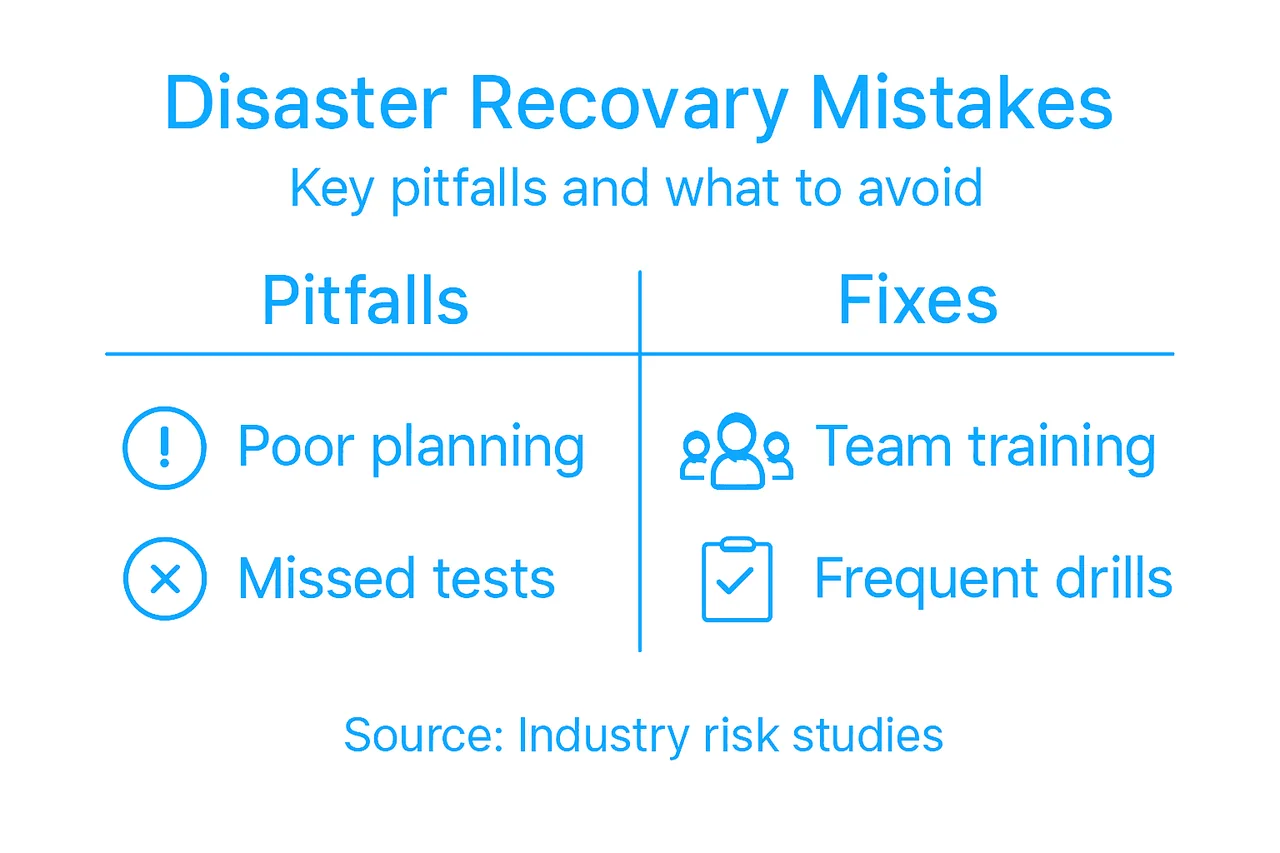
The first major pitfall is insufficient planning and inadequate communication. Teams don’t understand the plan, executives aren’t aligned on priorities, and suppliers aren’t informed of their role in recovery. When disaster strikes, everybody’s working from different assumptions.
Another critical mistake: ignoring local context and systemic risks. You plan for a server failure but ignore that your primary backup facility is in the same geographic region. You protect against data loss but don’t account for your payment processor going offline. Common pitfalls in post-disaster recovery include coordination failures, resource mismanagement, and lack of stakeholder engagement across all recovery phases.
The biggest pitfalls in practice:
- No testing: Plans that look good on paper fail spectacularly in reality
- Single points of failure: Backup systems in the same location as primary systems
- Unclear objectives: Nobody knows what “recovery” actually means for your business
- Poor documentation: Procedures written in jargon only one person understands
- Lack of stakeholder involvement: Teams weren’t part of planning so they don’t support it
- No regular updates: Plans become outdated as systems change
Risk mitigation starts with comprehensive risk assessment and scenario planning. Map your actual infrastructure, identify realistic threats specific to your business, then design recovery for those specific scenarios.
Clear accountability structures matter enormously. Who decides to activate the recovery plan? Who communicates with customers? Who authorises spending? Define this before crisis hits, not during it.
The difference between plans that work and plans that fail usually isn’t technology—it’s clarity about who does what, when, and why.
Inclusive planning prevents blind spots. Involve IT, finance, customer service, operations, and legal from the start. Each team sees risks the others miss. This also builds buy-in—people support plans they helped create.
Regular testing reveals what actually breaks. Most organisations discover critical flaws only when they run their first full recovery test. Test quarterly at minimum. Start small, expand over time.
Cloud security challenges during recovery require proactive mitigation—ensure your backup infrastructure itself has proper security so restoration doesn’t introduce new vulnerabilities.
Transparent communication throughout recovery builds stakeholder trust. Keep customers, employees, and regulators informed. Most people understand disasters; they lose trust when communication disappears.
Pro tip: Run a “chaos test” quarterly where you randomly fail one critical system without warning and see how your team responds. This reveals whether your documented procedures actually work in real conditions.
Strengthen Your E-commerce Disaster Recovery with Custom Digital Solutions
Disaster recovery planning demands more than just backups. Your e-commerce business needs a tailored approach that safeguards critical systems, meets Recovery Time Objectives, and ensures fast restoration of your entire application stack. At Cloud Fusion, we understand the urgency to protect your customer data, payment gateways, and operational workflows when every minute offline means lost revenue and trust.
Our expert team delivers custom web design and development solutions built to align with your specific disaster recovery goals and business continuity plans. By integrating scalable cloud infrastructure with your unique operational needs, we help eliminate single points of failure and support rapid recovery through tested, clear procedures. Discover how our custom services can help you define and meet your Recovery Point Objectives and secure your e-commerce platform against unexpected disruptions.
Don’t wait for disaster to reveal your weaknesses. Take control today by requesting a personalised web design and development quotation or explore our comprehensive digital offerings at Cloud Fusion. Ensure your business is ready to bounce back quickly by partnering with a provider experienced in delivering reliable, scalable, and resilient e-commerce solutions.
Frequently Asked Questions
What is disaster recovery planning for e-commerce?
Disaster recovery planning for e-commerce involves creating documented procedures to restore IT systems and data after a catastrophic event, thereby ensuring continuous business operations and minimising data loss.
What are RTO and RPO in disaster recovery planning?
Recovery Time Objective (RTO) refers to the maximum acceptable length of time for a system to be restored after a disruption, while Recovery Point Objective (RPO) indicates the maximum data loss measured in time that a business can tolerate during a disaster recovery process.
How often should I test my disaster recovery plan?
It is recommended to test your disaster recovery plan at least quarterly. Regular testing helps identify gaps and ensures that all team members are familiar with the procedures during an actual crisis.
What role does documentation play in disaster recovery planning?
Documentation is crucial in disaster recovery planning as it provides clear, step-by-step instructions that anyone on the team can follow to restore systems and data when disaster strikes, ensuring a swift and organised response.