

Cloud Security Challenges – How They Affect Business Continuity
Cloud security challenges impact risk management, compliance, and resilience. Learn about top threats, regulatory obligations, and vital solution strategies.
Start reading
Every south-african enterprise knows the pressure of securing business in the cloud, yet more than 85 percent of organisations worldwide experience preventable security missteps after migrating. With regulatory demands rising and cyber threats growing more complex, IT leaders cannot afford old myths or misplaced trust in cloud providers. This article unpacks the real risks, clarifies responsibilities, and debunks common misconceptions holding companies back from strong, compliant cloud protection.
Table of Contents
- Defining Cloud Security And Common Myths
- Key Types Of Cloud Security Threats
- How Cloud Security Works In Practice
- 2026 Regulatory Demands And Compliance Issues
- Responsibilities In Shared Cloud Environments
- Major Risks, Costs, And Business Implications
Key Takeaways
Point | Details |
|---|---|
Understanding Cloud Security | Cloud security is a shared responsibility, requiring collaboration between providers and customers for effective protection. |
Recognising Threats | The landscape includes risks from credential compromise, misconfigurations, insider threats, and more, necessitating continuous vigilance. |
Implementing Compliance | Organisations must adapt to evolving regulatory demands by enhancing data governance and privacy measures ahead of 2026 requirements. |
Identifying Financial Risks | Cloud security breaches can lead to severe financial implications, necessitating robust risk assessment frameworks to mitigate potential losses. |
Defining Cloud Security and Common Myths
Cloud security represents a comprehensive approach to protecting digital infrastructure, applications, and data within cloud computing environments. At its core, cloud computing security involves a complex network of policies, technologies, and controls designed to safeguard virtualized intellectual property and critical business assets.
Businesses often misunderstand cloud security, believing that cloud providers automatically handle all security responsibilities. However, the reality is far more nuanced. Security operates under a shared responsibility model, where providers and customers must collaborate to maintain robust protection. Common misconceptions include assuming cloud platforms are inherently secure and that minimal configuration is required to protect sensitive information.
The landscape of cloud security encompasses multiple critical domains:
- Data protection and encryption
- Access management and identity verification
- Network and infrastructure security
- Compliance with regulatory standards
- Incident response and threat management
Most cloud security breaches stem not from sophisticated attacks, but from misconfigurations and inadequate security protocols. Organisations must recognise that security is an ongoing process requiring continuous monitoring, updates, and strategic implementation.
Pro tip: Conduct a comprehensive security audit of your cloud infrastructure at least quarterly to identify and address potential vulnerabilities before they become critical risks.
Key Types of Cloud Security Threats
Cloud environments face a diverse array of sophisticated security challenges that can compromise organisational digital infrastructure. Top cloud security threats range from sophisticated cyber attacks to seemingly innocuous misconfigurations that can create significant vulnerabilities.
The primary categories of cloud security threats include:
- Credential Compromise: Attackers exploiting weak authentication mechanisms
- Misconfiguration Risks: Improperly configured cloud services leaving data exposed
- Insider Threats: Malicious actions from internal personnel with system access
- Third-Party Provider Vulnerabilities: Security weaknesses introduced through external service integrations
- Advanced Persistent Threats (APTs): Sophisticated, long-term cyber attacks targeting specific organisations
Specifically, ransomware, phishing attempts, and denial-of-service attacks represent significant risks in cloud environments. These threats can emerge across different service models - Infrastructure as a Service (IaaS), Platform as a Service (PaaS), and Software as a Service (SaaS) - each presenting unique security challenges that require targeted mitigation strategies.

Understanding the complex landscape of cloud security threats requires continuous monitoring, robust access controls, and proactive risk management. Organisations must develop comprehensive security frameworks that anticipate and neutralise potential vulnerabilities before they can be exploited.
Pro tip: Implement multi-factor authentication and regular security training to create a human firewall against potential cloud security breaches.
How Cloud Security Works in Practice
Implementing cloud security is a complex, multi-layered process that requires strategic coordination between cloud providers and organisational teams. Cloud security implementation involves a comprehensive approach that addresses multiple critical technological and procedural domains.
The practical implementation of cloud security typically encompasses several key strategic components:
- Infrastructure Protection: Securing underlying hardware, networks, and data centres
- Access Management: Implementing robust identity verification and permission controls
- Data Encryption: Protecting sensitive information during transmission and storage
- Continuous Monitoring: Real-time threat detection and response mechanisms
- Compliance Frameworks: Ensuring adherence to industry-specific regulatory standards
Organisations must develop a nuanced understanding of the shared responsibility model, where cloud providers secure the fundamental infrastructure while businesses remain responsible for configuring access controls, managing user permissions, and protecting their specific data assets. This dynamic requires sophisticated security protocols that integrate automated monitoring tools, advanced authentication mechanisms, and proactive threat intelligence systems.
Effective cloud security demands a holistic approach that combines technological solutions with human expertise. This means not only implementing cutting-edge security technologies but also cultivating a security-aware organisational culture that understands and mitigates potential risks across all operational levels.
Pro tip: Conduct regular security assessments and penetration testing to identify and address potential vulnerabilities before they can be exploited by malicious actors.
2026 Regulatory Demands and Compliance Issues
The regulatory landscape for cloud security and data privacy is undergoing significant transformations, with new legal requirements emerging that demand unprecedented levels of organisational adaptability and technological sophistication.
Key regulatory developments in 2026 will focus on several critical compliance domains:
- Data Transparency: Mandatory disclosure of automated decision-making processes
- Privacy Risk Assessment: Comprehensive cybersecurity audits and documentation
- Consumer Protection: Enhanced consent mechanisms and data broker regulations
- Automated Processing: Stringent requirements for algorithmic accountability
- Cross-Border Data Management: Stricter international data transfer protocols
Organisations must proactively redesign their cloud security strategies to accommodate these evolving regulatory frameworks. This involves implementing robust privacy-by-design principles, developing granular data governance models, and creating sophisticated compliance monitoring systems that can adapt to rapidly changing legal landscapes.
The complexity of 2026’s regulatory environment requires a holistic approach that integrates legal expertise, technological capabilities, and strategic risk management. Businesses will need to invest in advanced compliance technologies, train their teams comprehensively, and develop agile governance structures that can respond quickly to emerging regulatory challenges.
Pro tip: Develop a dedicated compliance task force with cross-functional expertise to continuously monitor and implement regulatory changes in real-time.
Responsibilities in Shared Cloud Environments
Cloud security demands a nuanced understanding of the shared responsibility model, where security obligations are strategically divided between cloud service providers and organisational customers across different service models.
The responsibilities typically break down as follows:
- Cloud Provider Responsibilities:
- Securing physical data centre infrastructure
- Maintaining underlying hardware and network security
- Implementing core platform security updates
- Managing hypervisor and virtualisation layers
- Customer Responsibilities:
- Configuring application-level security
- Managing user access and identity controls
- Protecting sensitive organisational data
- Implementing proper configuration settings
- Maintaining compliance with industry regulations
Different cloud service models (Infrastructure as a Service, Platform as a Service, and Software as a Service) introduce varying degrees of shared responsibility. This means organisations must carefully understand their specific security obligations, which can range from comprehensive infrastructure management in IaaS environments to more limited configurations in fully managed SaaS platforms.
To help differentiate cloud service models, consider the following comparison of shared security responsibilities:
Service Model | Provider’s Security Focus | Customer’s Security Focus | Example Areas Managed by Customer |
|---|---|---|---|
Infrastructure (IaaS) | Hardware, core network | OS, apps, data, configuration | User permissions, firewall rules |
Platform (PaaS) | OS, runtime, basic network | App code, data, access | API keys, app-level authorisation |
Software (SaaS) | Full stack, application | User settings, data | Password policies, information access |
Successful shared cloud security requires transparent communication, continuous collaboration, and a proactive approach to risk management. Organisations must develop robust internal processes that complement their cloud provider’s security framework, ensuring no critical security domains are overlooked or assumed to be someone else’s responsibility.
Pro tip: Conduct quarterly joint security reviews with your cloud service provider to ensure complete alignment and identify potential security gaps.
Major Risks, Costs, and Business Implications
Cloud migration introduces complex cybersecurity risks and financial challenges that extend far beyond traditional technology considerations. These multifaceted challenges demand comprehensive strategic assessment and proactive management to protect organisational interests.
The primary risk domains encompass:
- Data Breach Potential:
- Exposure of sensitive corporate information
- Potential intellectual property compromise
- Regulatory compliance violations
- Financial Implications:
- Direct remediation costs
- Potential regulatory fines
- Reputation damage and lost business opportunities
- Increased insurance and security investment requirements
Organisations must recognise that cloud security is not merely a technological challenge but a holistic business risk management strategy. This involves developing sophisticated risk assessment frameworks, implementing robust monitoring systems, and creating adaptive security protocols that can evolve with emerging technological landscapes.
The financial implications of cloud security breaches can be devastating, potentially threatening entire business operations. Small misconfigurations can lead to catastrophic data exposures, resulting in substantial economic losses, legal complications, and long-term reputational damage that extends well beyond immediate financial impact.
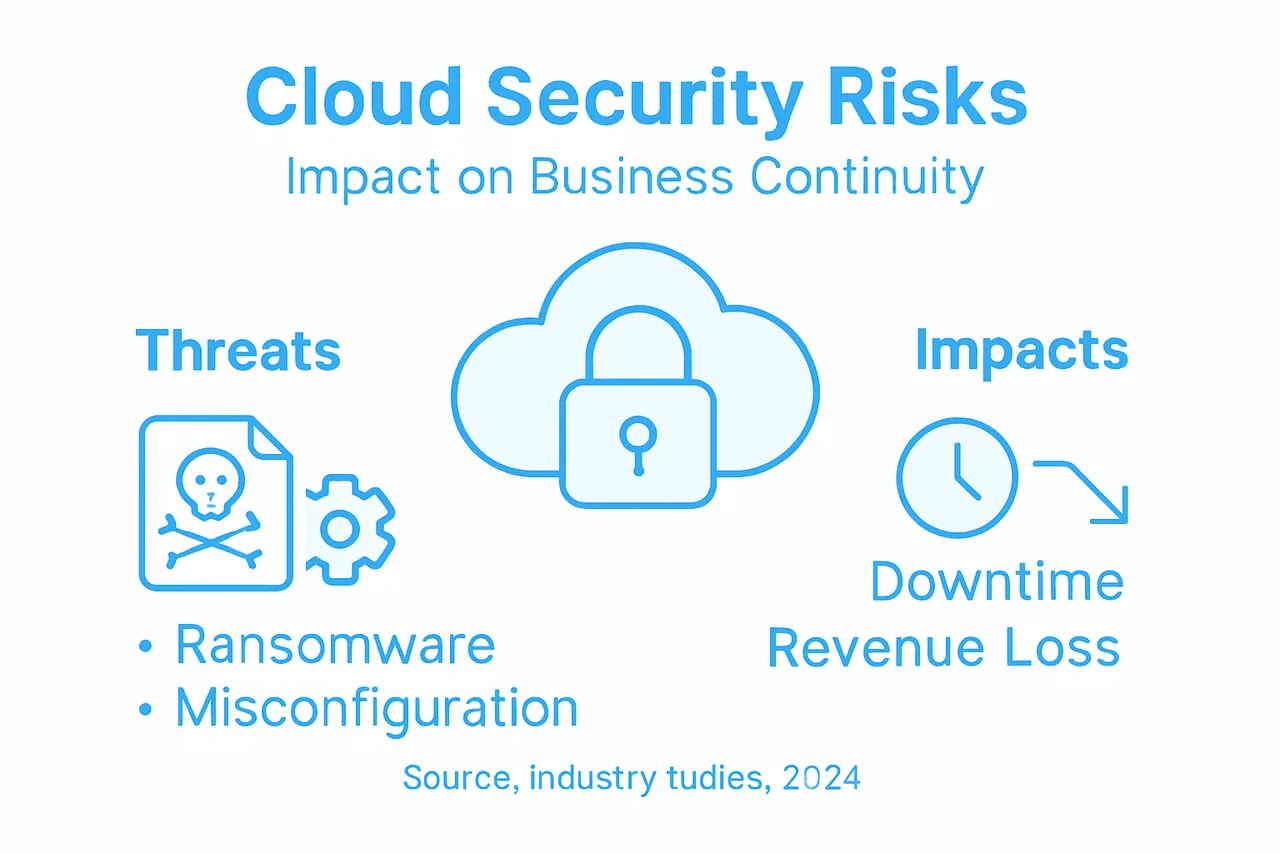
Here’s a summary of major cloud security risks and their potential business impacts:
Risk Category | Potential Consequence | Business Impact Example |
|---|---|---|
Data Breach | Sensitive info leaked | Regulatory fines, loss of trust |
Ransomware Attack | System access ransom | Business disruption, revenue loss |
Misconfiguration | Unintentional data exposure | Intellectual property compromise |
Insider Threat | Internal sabotage or theft | Legal action, brand reputation harm |
Third-Party Weaknesses | Exposure via vendor vulnerabilities | Supply chain disruption, compliance fines |
Pro tip: Develop a comprehensive cloud security risk quantification model that translates potential vulnerabilities into measurable financial and operational impacts.
Strengthen Your Business Continuity with Expert Cloud Security Solutions
Cloud security challenges such as misconfigurations and insider threats can put your business continuity at serious risk. The shared responsibility model means your organisation must stay vigilant in managing access controls, data protection and compliance. Without expert support, these complexities may lead to costly breaches and regulatory issues. Understanding risks like ransomware attacks and implementing strong identity verification are critical steps towards securing your cloud environment.
At Cloudfusion, we specialise in delivering custom digital solutions including web design and development tailored to your unique business needs. Our services integrate robust cloud security practices and scalable architectures that help prevent vulnerabilities before they impact your operations. Don’t wait for a breach to expose weaknesses. Contact us today to explore how our expertise can safeguard your digital presence and ensure ongoing compliance in an evolving regulatory landscape. Visit Cloudfusion to request a personalised quotation and take the next step towards uninterrupted business continuity.
Frequently Asked Questions
What are the main challenges of cloud security that affect business continuity?
Cloud security challenges include credential compromise, misconfiguration risks, insider threats, third-party provider vulnerabilities, and advanced persistent threats (APTs). These can lead to data breaches and disruptions in business operations.
How can organizations mitigate the risks associated with cloud security?
Organizations can mitigate risks by implementing multi-factor authentication, conducting regular security audits, ensuring proper configuration settings, and developing robust access management protocols.
What is the shared responsibility model in cloud security?
The shared responsibility model means that cloud service providers are responsible for securing the core infrastructure, while customers must manage application-level security, user access, and compliance with regulations to protect their specific data assets.
How do cloud security breaches impact an organization’s finances?
Cloud security breaches can lead to significant financial implications such as direct remediation costs, regulatory fines, damage to reputation, and increased security investments, potentially harming overall business operations.