TL;DR:
- Most businesses fail to convert website traffic because they lack a structured funnel guiding visitors through stages of decision-making. Building effective digital marketing funnels requires clear goals, targeted content, automation, and ongoing measurement, especially tailored to South African audiences. Regular review, alignment between marketing and sales, and automation flows significantly improve revenue and customer retention.
Most businesses drive traffic to their website and then wonder why the sales never follow. The problem is rarely the traffic itself. It is the absence of a structured process that guides visitors from first contact to purchase and beyond. Creating digital marketing funnels solves exactly this problem by aligning your messaging, content, and automation with the natural stages of your customer’s decision-making process. This guide walks you through everything you need to build funnels that drive real engagement and sales, with practical context for South African business conditions.
Table of Contents
- Key takeaways
- Before you build: goals, audience, and tools
- Step-by-step guide to building your funnel
- Common funnel-building pitfalls
- Measuring and optimising funnel performance
- My take on funnels for South African businesses
- How Cloudfusion can help you build better funnels
- FAQ
Key takeaways
| Point | Details |
|---|---|
| Prepare before you build | Define clear goals, profile your ideal customers, and select the right tools before designing any funnel stage. |
| Map every customer stage | Build targeted content and automation flows for awareness, consideration, conversion, and loyalty separately. |
| Automate your nurture flows | Automated email sequences generate far higher revenue per recipient than manual broadcast campaigns. |
| Align marketing and sales | Use lead scoring and formal SLAs to define qualified leads and reduce pipeline friction between teams. |
| Measure and recalibrate | Track conversion rates at each funnel stage and use path analysis to find and fix drop-off points. |
Before you build: goals, audience, and tools
The single biggest reason funnels fail before they are even launched is that businesses skip the preparation phase entirely. They jump straight into designing landing pages or writing email sequences without first defining what the funnel is supposed to achieve, who it is targeting, or what tools will power it.
Start with your goals. A lead generation funnel for a B2B software company in Cape Town looks nothing like a product funnel for an e-commerce retailer in Johannesburg. Your funnel goal determines the metrics you will track, the content you will create, and the automation flows you will build. Be specific: “increase qualified sales leads by 30% in Q3” is a funnel goal. “Get more customers” is not.
Next, profile your ideal customer. In the South African context, this means accounting for factors like digital literacy levels, preferred communication channels (WhatsApp remains dominant here), income segmentation, and the reality that mobile browsing far outpaces desktop for most consumer-facing businesses. Your buyer personas must reflect actual local behaviour, not generic international templates.
Once goals and audience are clear, choose your tools. Here is a practical comparison of what South African marketers typically use:
| Tool category | Popular options | Primary use in funnel |
|---|---|---|
| CRM | HubSpot, Pipedrive, Zoho | Lead tracking and pipeline management |
| Email automation | Klaviyo, Mailchimp, ActiveCampaign | Nurture flows, welcome series, abandoned cart |
| Analytics | Google Analytics 4, Hotjar | Path analysis, heatmaps, drop-off diagnosis |
| Landing page builders | Unbounce, Webflow, WordPress | Top-of-funnel and conversion page creation |
| WhatsApp automation | WhatsAble | Conversational nurturing and re-engagement |
The tools you select must integrate with each other. A CRM that cannot talk to your email automation platform creates data silos that will cripple your ability to manage customer journeys at scale. Prioritise integration capability above feature count when evaluating options.
Key preparation checklist before building:
- Document your funnel goal with a measurable outcome and timeline
- Create at least two buyer personas with channel preferences and pain points
- Map your existing customer touchpoints and identify gaps
- Select and integrate your core tools: CRM, email automation, and analytics as a minimum
- Set baseline metrics so you have something to improve against
Step-by-step guide to building your funnel
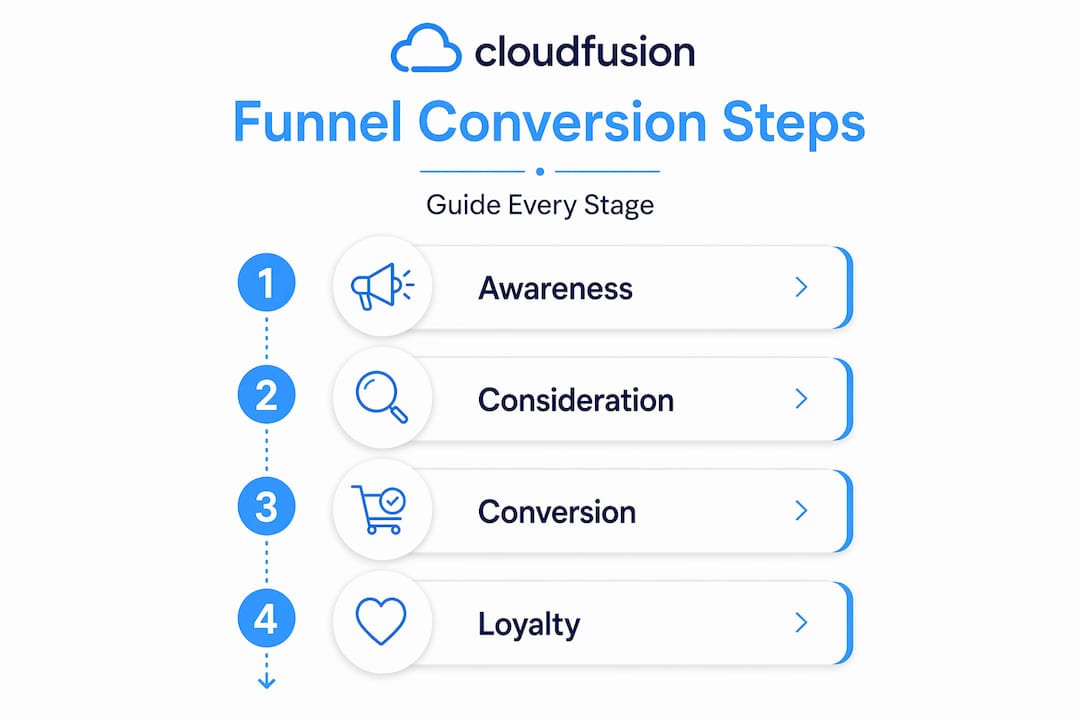
With preparation in place, you can build your funnel systematically across four core stages: awareness, consideration, conversion, and loyalty. Each stage requires different content, different messaging, and different automation logic.
Step 1: Awareness stage
Your goal here is to attract the right people, not just any people. Use SEO-driven blog content, social media advertising, Google Ads, and referral traffic to bring qualified prospects into the funnel. The content at this stage must address a real problem your audience has, not promote your product. A useful article, a comparison guide, or a short explainer video builds trust before your brand ever asks for anything in return.
Step 2: Consideration stage
Once someone is aware of you, they need a reason to engage more deeply. This is where lead magnets work well: free downloadable guides, webinars, free trials, or consultation offers. Gate these behind a simple form to capture contact details and trigger your first automation flow. For South African audiences, keep forms short. Friction kills conversion, and mobile users in particular will abandon long forms without hesitation.
Step 3: Conversion stage
This is where your lead becomes a customer. Your conversion stage must include a compelling offer, a clear call to action, and a frictionless checkout or booking process. Ecommerce benchmarks show average cart abandonment sits around 76%, which means your abandoned cart automation flow is not optional. Build it. Set it to trigger within one hour of abandonment and include a time-sensitive incentive in the second message.
Step 4: Loyalty and retention
Most funnels stop at conversion. That is a costly mistake. Reducing customer churn by 5% can increase profits by between 25% and 95%. Post-purchase email sequences, loyalty programme integrations, and re-engagement campaigns all belong in your funnel design. Treat existing customers as a separate audience with their own journey and content stream.
Automating your key flows
Automated email flows generate 17.6 times more revenue per recipient than manual broadcast campaigns, producing 37 to 41% of total email revenue from just 2% of send volume. The three flows every funnel needs from day one are: a welcome series (triggered at opt-in), an abandoned cart sequence (triggered at checkout drop-off), and a post-purchase nurture sequence (triggered after payment). Build these before you build anything else.

Lead scoring and qualification
Not every lead who enters your funnel is ready to buy, and not every lead that downloads your guide should be handed to your sales team. Lead scoring that combines demographic fit with behavioural engagement, and includes a decay mechanism for leads that go cold, improves Marketing Qualified Lead to Sales Qualified Lead conversion by 20 to 30%. Set up a simple scoring system in your CRM. Assign points for actions like email opens, page visits, and content downloads. Set a threshold for when a lead becomes sales-ready.
Pro Tip: Set up a formal Service Level Agreement between your marketing and sales teams. Define exactly what a qualified lead looks like, how quickly sales must follow up, and what happens to leads that are not ready. This single document reduces pipeline friction more than any technology upgrade.
For South African audiences specifically, consider the timing of your automation flows. Mid-morning on weekdays tends to outperform weekend sends for B2B funnels. For B2C, test WhatsApp-based re-engagement as a complement to email, particularly for audiences in the 25 to 45 age bracket where WhatsApp read receipts and automation can signal intent far faster than email open rates alone.
Common funnel-building pitfalls
Building a funnel is only half the work. Knowing what breaks funnels is equally important, and most problems are predictable.
- Marketing and sales misalignment: Most funnel failures trace back to poor alignment between marketing and sales rather than poor content. When marketing defines a qualified lead differently to sales, leads get passed prematurely, salespeople disengage, and marketing blames sales for not closing. Document your definitions formally and revisit them quarterly.
- Over-investing in campaigns, under-investing in flows: Many South African businesses spend heavily on paid social or Google Ads campaigns but have no automation flows to nurture the leads those campaigns generate. Campaigns require constant creative input and budget. Flows, once built, work continuously.
- Ignoring behavioural data: GA4 path exploration reveals the actual routes users take through your website, which often differ significantly from the paths you designed. If you are not reading this data, you are optimising a version of your funnel that your customers are not actually using.
- One-size-fits-all messaging: Sending the same email to every subscriber regardless of their behaviour or segment is one of the fastest ways to accumulate unsubscribes. Segment by behaviour, purchase history, and stage in the funnel. AI-driven personalisation increases email revenue by 41% and improves open rates by 15 to 23%. That is not a marginal gain.
- Building and forgetting: A funnel is not a once-off project. Formalising customer journey management produces 10 to 15% revenue increases, but only when the journey map has an owner who reviews and updates it regularly. Assign ownership.
“A funnel without a review cycle is just a leaky pipe. The data will always tell you where the water is escaping. The question is whether you are checking.”
Measuring and optimising funnel performance
You cannot improve what you do not measure. Once your funnel is live, your focus shifts to identifying friction points and incrementally improving conversion rates at every stage.
The core metrics to track across your funnel are:
| Metric | What it tells you | Benchmark reference |
|---|---|---|
| Add-to-cart rate | Top-of-conversion intent | ~6.8% average |
| Cart abandonment rate | Drop-off before checkout | ~76% average |
| Email conversion rate | Flow vs campaign effectiveness | Flows: ~2.11%, Campaigns: ~0.16% |
| Lead qualification rate | MQL to SQL progression | Improves 20-30% with scoring |
| Mobile conversion rate | Device-specific friction | ~2.8% average |
Start with Google Analytics 4. The Path Exploration report shows you where users actually go after landing on your site, not where you assumed they would go. Pair this with a heatmap tool like Hotjar to understand where users click, scroll, and drop off on key pages.
When you identify a drop-off point, do not immediately redesign the entire page. Test one change at a time: headline copy, button placement, form length, or offer positioning. Running multiple simultaneous changes makes it impossible to attribute performance shifts accurately.
Pro Tip: Segment your funnel analytics by traffic source. Email traffic converts at 4 to 5% on average, while social media traffic typically converts at 1 to 2%. If you are treating all traffic the same in your funnel, you are almost certainly under-serving your highest-intent visitors.
For conversion rate optimisation to be meaningful, you need sufficient traffic volume. South African businesses with lower traffic volumes should focus on qualitative data first: session recordings, user interviews, and sales team feedback. Quantitative A/B testing needs statistical significance to be trustworthy, and that takes time when volumes are modest.
My take on funnels for South African businesses
I have seen businesses pour significant budget into digital advertising and then express surprise when the sales do not follow. The problem, almost without exception, is not the ad. It is the absence of a structured process after the click.
What I have learned from working in this space is that formalising your customer journey management is not a nice-to-have. It is the mechanism that transforms marketing spend into measurable revenue. Businesses that treat their funnel as a living document, with a named owner and a quarterly review cycle, consistently outperform those that treat it as a once-off build.
On automation: the gap between what automated flows deliver versus manual campaigns is not incremental. It is structural. Flows run while you sleep. They follow up on behaviour in real time. A welcome series sent within the first hour of sign-up converts at a completely different rate to one sent the next morning. In the South African context, where WhatsApp is the dominant communication channel for many demographics, blending email automation with messaging tools opens up funnel touchpoints that most competitors are still ignoring.
The marketing and sales alignment issue is the one I see most often underestimated. A formal SLA and a shared definition of what constitutes a qualified lead, documented and agreed upon by both teams, will do more for your pipeline than any new platform. Start simple, measure consistently, and treat your funnel as an evolving asset rather than a completed project.
— Anton
How Cloudfusion can help you build better funnels
If you are ready to move from theory to execution, Cloudfusion has the expertise to support every technical layer of your funnel infrastructure. From custom web development built to integrate with your CRM and automation platforms, to mobile app development that extends your funnel reach across South Africa’s mobile-first audience, Cloudfusion delivers solutions tailored to your specific business model and market. With fast, secure web hosting ensuring your funnel pages load quickly and stay online, your campaigns and flows have the infrastructure they need to perform. You can also explore digital sales funnel strategies through Cloudfusion’s insights library. Give us a shout to discuss how we can support your funnel build from the ground up.
FAQ
What is a digital marketing funnel?
A digital marketing funnel is a structured process that guides potential customers from first awareness of your brand through to purchase and retention, using targeted content and automation at each stage.
How long does it take to build an effective funnel?
A basic funnel with a welcome series and a conversion page can be built in two to four weeks. A fully optimised funnel with lead scoring, segmentation, and multi-stage automation typically takes two to three months of build and testing.
Why do most digital marketing funnels fail?
Most funnel failures come from poor alignment between marketing and sales teams on what constitutes a qualified lead, combined with a lack of automation flows to nurture leads after they enter the funnel.
What metrics should I track in my funnel?
Track conversion rate at each stage, email flow revenue versus campaign revenue, lead qualification rate, cart abandonment rate, and mobile conversion rate as your core performance indicators.
How do automated flows differ from email campaigns?
Automated flows are triggered by user behaviour and run continuously, generating up to 17.6 times more revenue per recipient than manual broadcast campaigns, which require ongoing creative effort and send budget.
Recommended