

Custom application development tailored to your business in 2026
Discover how custom application development drives efficiency, scalability, and ROI. Learn key stages, challenges, edge case strategies, and how to choose the right development partner.
Start reading
TL;DR:
- Custom application development creates tailored software that aligns precisely with business workflows.
- Effective projects follow structured stages, from discovery to ongoing maintenance, with risk management strategies.
- Addressing edge cases and maintaining continuous user feedback are crucial for reliable, scalable, and secure software.
Off-the-shelf software rarely fits the way your business actually operates. Most platforms are built for the broadest possible audience, which means they carry features you will never use and lack capabilities you genuinely need. Business leaders who invest in custom application development gain software that mirrors their exact workflows, scales with their growth, and integrates with their existing systems without compromise. This guide walks you through what custom development involves, how projects unfold, what risks to anticipate, and how to build applications that perform reliably under every condition, giving you the clarity to make confident, strategic technology decisions.
Table of Contents
- What is custom application development and why does it matter?
- Core stages of custom application development
- Critical challenges and how to address them
- Edge cases and technical strategies for robust software
- What most business leaders miss about custom application development
- Take your business further with expert custom application development
- Frequently asked questions
Key Takeaways
Point | Details |
|---|---|
Tailored solutions drive results | Custom application development aligns software perfectly with your business needs. |
Plan for challenges | Careful project planning and a contingency budget help avoid delays and overruns. |
Edge cases impact reliability | Handling rare scenarios is essential for robust, secure business applications. |
Choose the right partner | Selecting an experienced development team maximises ROI and competitive advantage. |
What is custom application development and why does it matter?
Custom application development is the process of designing, building, and maintaining software that is purpose-built for a specific organisation’s needs. Unlike off-the-shelf solutions, which require your business to adapt to the software’s logic, custom applications are engineered around your processes, your users, and your goals. The distinction is significant. A standard accounting tool may handle invoicing and payroll, but it cannot automate the unique approval chain your company uses, or connect seamlessly to a legacy system your operations depend on.
The benefits of custom software extend well beyond convenience. Custom solutions deliver measurable gains in operational efficiency because they eliminate the workarounds employees rely on when generic software falls short. They are inherently more scalable, growing with your business rather than capping your capacity. Security posture improves because your application is not a widely distributed target for generic exploits, and it can be built to satisfy specific compliance obligations relevant to your industry.
Custom development is also strategically important for modern businesses navigating rapid change. Organisations that rely entirely on third-party platforms surrender a degree of digital agility, remaining dependent on vendor roadmaps and pricing decisions. The importance for modern businesses of owning your software ecosystem cannot be understated, particularly when market conditions demand fast adaptation.
Here are the core business pain points that custom applications consistently resolve:
- Process inefficiency: Automating manual workflows that generic tools cannot accommodate
- Integration gaps: Connecting disparate systems that do not communicate with standard software
- Scalability ceilings: Removing user or data limits imposed by off-the-shelf licensing
- Compliance requirements: Meeting industry-specific regulations that packaged software ignores
- Competitive differentiation: Building features your competitors cannot access from the same vendor
It is worth noting that custom development carries inherent complexity. Key challenges include vague or shifting requirements, budget overruns, poor code quality, talent shortages, security concerns, integration complexities, and edge cases such as maximum input lengths, zero or negative values, and network failures. Recognising these risks upfront is the first step toward managing them effectively.

Pro Tip: Before approaching a development partner, document your current workflows in detail. The more precisely you can describe what your business does, the more accurately a custom solution can be scoped and priced.
Core stages of custom application development
Having established what custom application development is and why it is critical, let us explore how such projects typically unfold. Most successful projects follow a structured lifecycle that creates accountability, reduces ambiguity, and improves the likelihood of delivering on time and within budget.
- Discovery and requirements gathering: This is where business goals are translated into technical specifications. Stakeholders, end-users, and developers align on scope, constraints, and success criteria. Poorly defined requirements are the single most common cause of project failure.
- System design and architecture: The technical team designs the data models, user interfaces, integrations, and infrastructure. Decisions made here shape the application’s long-term scalability and maintainability.
- Development and iteration: Code is written in sprints or milestones, with working features delivered incrementally. Regular reviews allow stakeholders to provide feedback before too much effort is invested in the wrong direction.
- Quality assurance and testing: Functional, performance, security, and integration testing verify that the application behaves correctly across all expected scenarios, including edge cases.
- Deployment and go-live: The application is released to its production environment. A phased rollout reduces risk, particularly for business-critical systems.
- Maintenance and ongoing support: Software requires continuous attention, including bug fixes, security patches, performance optimisation, and feature enhancements as business needs evolve.
Understanding the web app development process in detail helps you ask sharper questions when evaluating development partners. For those newer to this space, a beginner’s custom web guide provides further foundational context.
Challenges such as vague requirements, budget overruns, technical debt, and integration complexities appear repeatedly across projects of all sizes. The most effective mitigation is rigorous planning at the discovery stage, paired with a budget contingency of 10 to 20 percent to absorb unforeseen complexity.
Pro Tip: Treat your requirements document as a living contract. Update it formally when scope changes, and ensure both your team and your development partner sign off on every significant revision.
Critical challenges and how to address them
With an understanding of project stages, it is vital to recognise and overcome key hurdles that disrupt success. Scope creep, budget overruns, technical debt, talent shortages, security and compliance concerns, and integration complexities are persistent obstacles in custom development projects.
The following approaches address each challenge directly:
- Scope management: Define a minimum viable product and use change control processes for any additions beyond the original specification
- Budget discipline: Apply a 10 to 20 percent contingency from the outset and review burn rates at each milestone
- Code quality: Mandate code reviews, automated testing pipelines, and clear coding standards to prevent technical debt from accumulating
- Talent strategy: Engage a development partner with demonstrated expertise rather than assembling an ad hoc team with gaps in capability
- Security by design: Integrate security reviews at every stage rather than treating them as a final-phase checkbox
- Integration planning: Map all third-party systems and APIs early, and account for their rate limits, authentication requirements, and potential downtime
Choosing the right partner is itself a major risk decision. A company comparison framework helps you evaluate providers against consistent criteria. Managing integration challenges across desktop and mobile environments requires particular attention when your application must serve users across multiple device types.
Challenge | Traditional approach | Modern mitigation |
|---|---|---|
Scope creep | Fixed-scope contracts | Agile sprints with change control |
Budget overruns | Contingency ignored | 10-20% built-in reserve |
Technical debt | Deferred refactoring | Continuous code review and automated testing |
Talent gaps | In-house only | Specialised development partner |
Security risks | End-stage audit | Security integrated throughout lifecycle |
Integration failure | Assumed compatibility | Early API mapping and sandbox testing |
“The businesses that successfully navigate custom development are those that treat risk identification as a strategic discipline, not a technical afterthought.”
Edge cases and technical strategies for robust software
Beyond broad project risks, technical pitfalls such as edge cases can make or break your application’s reliability. An edge case is a scenario that occurs at the boundary of expected input or system behaviour. Maximum character input in a form field, a user submitting a negative quantity in an order, a network request timing out mid-transaction, these are the conditions that expose fragile code.
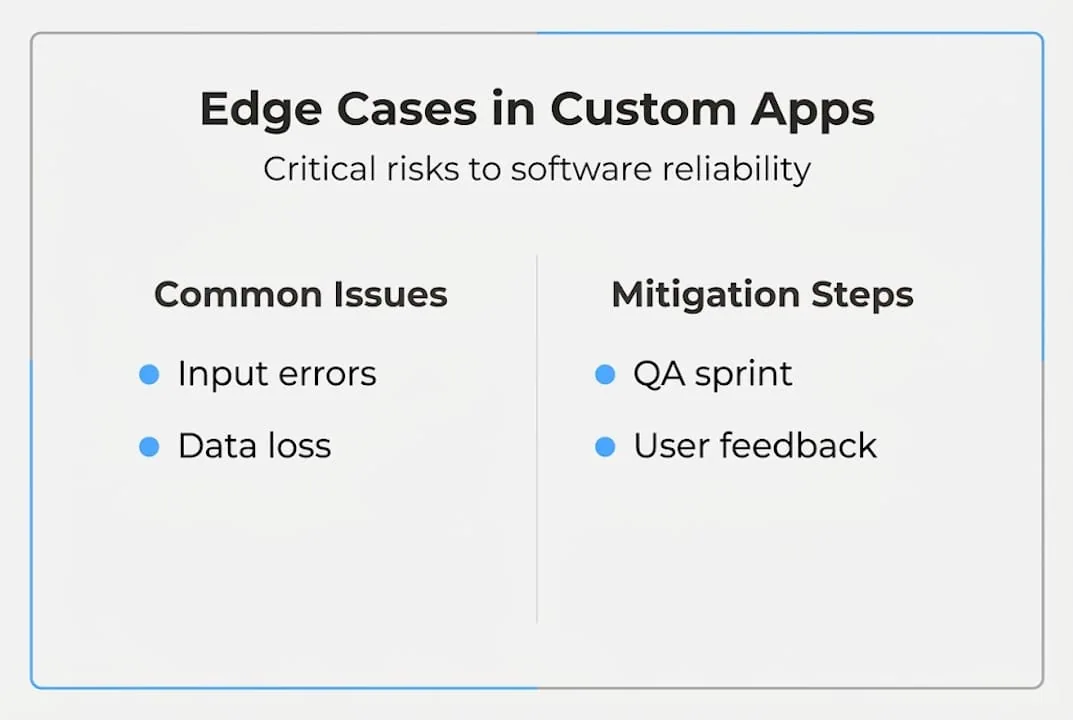
Edge cases account for 80% of bugs despite representing only 20% of actual usage. Boundary value analysis, the CRUD+E framework, graceful degradation, and fuzz testing are the principal strategies for identifying and resolving them before they reach production.
Here is how to approach edge case management systematically:
- Boundary value analysis: Test inputs at their minimum, maximum, and just-beyond-maximum values to expose failures at the extremes of accepted ranges
- CRUD+E framework: Beyond standard create, read, update, and delete operations, explicitly test the error scenarios that arise when any operation fails partially or completely
- Fuzz testing: Inject random, malformed, or unexpected inputs to discover how the system handles data it was never designed to process
- Graceful degradation: Design the application to continue operating in a reduced capacity when a component fails, rather than crashing entirely
- Prioritisation by impact: Focus QA effort on edge cases that could cause data loss, security breaches, or regulatory violations first, since not all edge cases carry equal risk
The advantages of custom web apps become most visible when applications handle these scenarios without user-facing failures, building trust and reliability. This directly supports business workflow improvement by removing the friction caused by unpredictable software behaviour.
Testing technique | What it targets | Business impact |
|---|---|---|
Boundary value analysis | Input range limits | Prevents data corruption |
CRUD+E testing | Operation failure states | Ensures transaction integrity |
Fuzz testing | Unexpected inputs | Hardens security posture |
Graceful degradation | Component failure | Maintains uptime and user trust |
Impact-based prioritisation | High-risk edge cases | Reduces critical bug exposure |
Pro Tip: Allocate a dedicated QA sprint specifically to rare and unusual scenarios. The edge case strategies that seem unlikely in planning are precisely the ones that surface in production at the worst possible moment.
What most business leaders miss about custom application development
Technical strategy matters enormously, but the businesses that extract the most value from custom development share a quality that has nothing to do with code. They treat the software as a business asset that requires ongoing attention to user feedback, not a project to be completed and handed off.
The most common misstep we observe is organisations that invest heavily in the build phase and then disengage from the feedback loop. Users adapt their behaviour around broken workflows, workarounds multiply, and the application gradually loses alignment with actual business needs. The value erodes quietly.
Custom web apps for customer engagement consistently outperform generic alternatives because they are refined continuously based on real usage, not assumptions. The right development partner accelerates this cycle, translating user feedback into tangible improvements quickly. Trust and open communication with your software team is as commercially critical as the quality of the code itself. Choose a partner who treats your business context as essential knowledge, not background noise.
Take your business further with expert custom application development
Having learned what it takes to build robust, business-focused software, you may be ready to take the next step. At CloudFusion, we design and deliver custom web development services that are aligned precisely to your operational goals, whether you need a client portal, an internal workflow tool, or a complex integration platform. Our team also specialises in mobile application development, ensuring your solution reaches users on every device they rely on. We bring strategic expertise, technical rigour, and ongoing support to every engagement. Reach out to our team to discuss your requirements and receive a structured consultation that turns your business challenges into scalable, production-ready software.
Frequently asked questions
How does custom application development differ from standard software?
Custom applications are tailored to your unique business processes, while standard software offers a one-size-fits-all solution that often requires your team to work around its limitations rather than with them.
What are the top challenges to watch out for?
Scope creep, budget overruns, integration complexities, and security issues are the most common risks, and each requires a deliberate mitigation strategy from the earliest stages of planning.
Why are edge cases so important in custom software?
Edge cases account for 80% of bugs despite low usage frequency, meaning they can cause data loss or security breaches that undermine user trust and business continuity if left unaddressed.
How much extra budget should I allow for unforeseen issues?
Add a 10 to 20 percent contingency to your initial budget estimate, as budget overruns are a documented and consistent pattern in custom application development projects of all scales.