

Multilingual website development: a practical guide
Discover what multilingual website development is and how it enhances business reach. Learn key strategies and tools for effective global engagement.
Start reading
TL;DR:
- Multilingual website development involves internationalisation as a technical foundation and localisation as a cultural adaptation, ensuring support for diverse languages and regions. Proper planning and architecture from the start simplify adding new languages, improve SEO, and enhance user experience across markets, especially in complex contexts like South Africa. Continuous workflows and localized content build trust, boost conversions, and make multilingual sites valuable growth assets for global businesses.
Multilingual website development is the process of designing and building websites that deliver content in more than one language, enabling businesses to connect authentically with audiences across different regions and cultures. The industry term for the foundational technical work is internationalisation (i18n), which prepares a codebase to support multiple locales before any translation begins. 76% of online consumers prefer purchasing in their native language, and 40% will not buy from a foreign-language site even if they partially understand it. That single statistic reframes multilingual web design from a “nice to have” into a direct revenue decision. Tools like Weglot, DeepL, and Phrase have made the process more accessible, but the strategic and technical decisions behind a well-built multilingual site still require careful planning.
What does multilingual website development involve?
Multilingual website development covers two distinct but interdependent layers: internationalisation and localisation. Internationalisation is the engineering groundwork. It means extracting all user-facing strings into resource files, configuring locale-aware databases, and confirming UTF-8 character encoding throughout the codebase so that scripts like Arabic, Chinese, or Cyrillic render correctly. Without this foundation, adding a second language later creates significant technical debt.

Localisation goes further than translation. Successful localisation adapts currencies, payment methods, date formats, shipping rules, imagery, and legal content to fit the cultural context of each target market. A South African e-commerce site entering France, for example, needs to display prices in Euros, use DD/MM/YYYY date formatting, and comply with GDPR. These are not translation tasks. They are product decisions.
URL structure options for multilingual sites
The URL structure you choose affects both SEO performance and maintenance complexity. The three main approaches each carry trade-offs:
| Structure | Example | Pros | Cons |
|---|---|---|---|
| Country-code top-level domain (ccTLD) | example.fr | Strongest geo-targeting signal | Highest cost and maintenance overhead |
| Subdomain | fr.example.com | Easy to host separately | Weaker domain authority inheritance |
| Subdirectory | example.com/fr/ | Shares root domain authority | Requires careful server configuration |
For most growing businesses, subdirectories offer the best balance of SEO authority and operational simplicity.
RTL languages and text expansion
RTL languages like Arabic and Hebrew require fundamental visual and UX adjustments from the start, not as an afterthought. Icon direction, text alignment, navigation order, and even page weight all change. Treating RTL support as a bolt-on after launch is one of the most common and costly mistakes in multilingual projects.
Text expansion is a related challenge that catches many developers off guard. Translated text often requires 20 to 30% more space than its English equivalent, which means fixed-width UI components will break. Flexible, fluid layouts are not optional when you are building for multiple languages.
Pro Tip: Label your language switcher using native language names, not flags. Flags represent countries, not languages, and using them causes confusion. Write “Français” instead of “French” and “Afrikaans” instead of a South African flag icon.
How do multilingual sites improve UX and business performance?
The business case for multilingual websites is well-documented and direct. 90% of EU internet users prefer browsing in their own language, and localised content significantly reduces bounce rates by removing the immediate friction of a language barrier. Lower bounce rates feed directly into better SEO rankings and longer session times, both of which improve conversion probability.
The advantages extend well beyond engagement metrics:
- Higher conversion rates. Non-English markets average 1.5x higher conversion rates when localised sites are used compared to English-only versions, according to web localisation research.
- Reduced paid advertising dependency. Localised content marketing generates approximately 3x more leads than non-localised content, and after roughly six months, a multilingual site becomes a compounding asset that drives traffic without recurring international ad spend.
- Stronger cultural trust. Localisation signals to users that your business understands their context, not just their language. Adapting imagery, tone, and payment options builds the kind of trust that generic translation cannot replicate.
- Improved search visibility. Per-locale keyword research and correct hreflang implementation allow your site to rank in local search engines, not just Google.com. Every localised page must reference all other locale versions including itself in hreflang tags, or you risk SEO penalties.
“Localisation should be seen as a growth multiplier, building market-specific customer loyalty that English-only competitors cannot replicate easily.” — Web Localisation Research
The compounding nature of multilingual SEO is worth emphasising. Unlike paid campaigns that stop delivering the moment you stop spending, well-structured localised content continues to attract organic traffic from each target market over time. For businesses with limited international marketing budgets, this is a significant strategic advantage.
What are the steps to create a multilingual website?
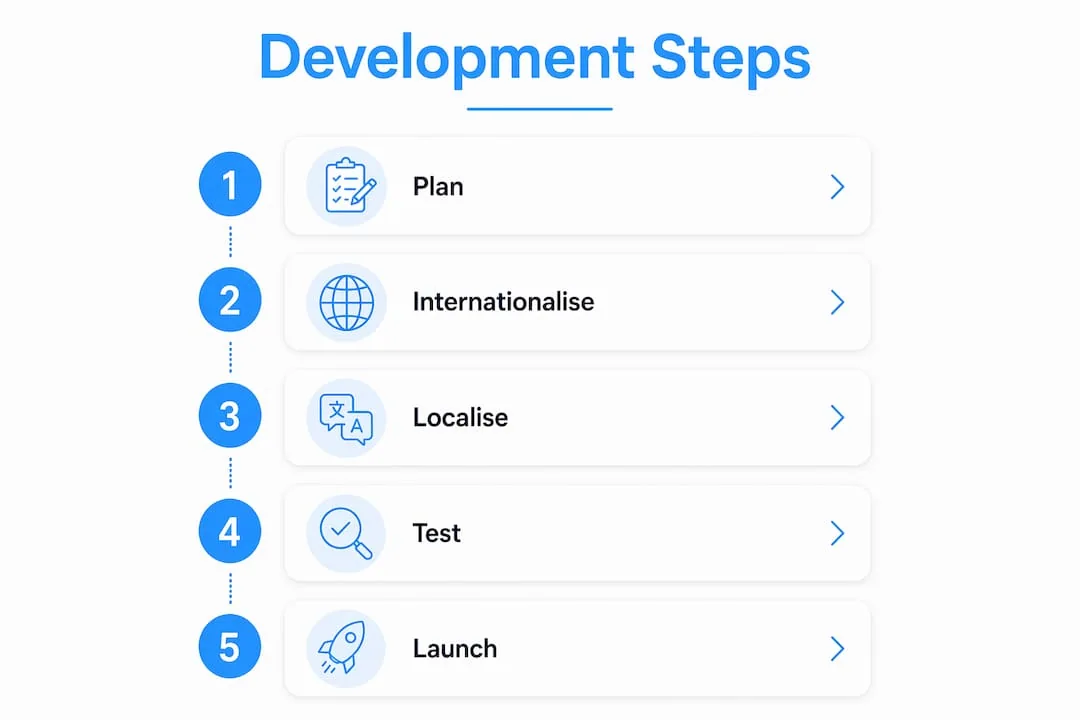
Building a multilingual site effectively requires a structured workflow. Skipping steps, particularly in the planning and internationalisation phases, creates problems that are expensive to fix later. Here is a practical sequence that Cloudfusion follows on multilingual projects:
-
Define target locales based on market research. Identify which languages and regions represent genuine business opportunity. Note that French for France and French for Canada require separate localisation due to spelling, legal, and cultural differences. Locale specificity matters.
-
Choose your URL structure. Select ccTLD, subdomain, or subdirectory based on your SEO goals, budget, and technical capacity. Document this decision before any development begins.
-
Implement internationalisation. Extract all user-facing strings into locale resource files. Configure locale switching in your framework, whether that is Next.js i18n routing, WordPress WPML, or a custom solution. Add RTL stylesheet support if required.
-
Set up translation management. Use a translation management system (TMS) like Phrase or Lokalise to manage string files, track translation status, and coordinate between developers and translators. Machine translation combined with human post-editing achieves faster, cost-effective results. AI translation delivers 85 to 95% quality for many language pairs, but human review is non-negotiable for brand tone and accuracy.
-
Configure multilingual SEO. Implement hreflang tags on every localised page, create locale-specific metadata, and conduct keyword research per language and region. Do not assume that translated keywords perform the same as their English equivalents.
-
Build and test the language switcher. Place it in a consistent, visible location. Auto-redirection based on IP frustrates users and creates accessibility issues. Detect browser language as a default suggestion, but always allow manual override with a persistent preference stored in a cookie or user profile.
-
Establish a continuous localisation workflow. Connect your CMS to your TMS so that new content automatically enters the translation pipeline. This prevents localisation debt, where your English site grows while translated versions fall behind.
Pro Tip: Treat your web development process as multilingual from day one. Retrofitting i18n onto a monolingual codebase costs significantly more in developer time than building it in from the start.
How does multilingual development differ for South African markets?
South Africa presents a genuinely unique multilingual context. The country has 11 official languages, with Zulu, Xhosa, Afrikaans, and English being the most widely spoken online. Businesses targeting local consumers have a real opportunity to differentiate by offering content in languages beyond English, particularly for sectors like retail, financial services, and healthcare where trust and comprehension directly affect decisions.
Several considerations are specific to the South African and broader African market context:
- Mobile-first localisation. The majority of South African internet users access the web via mobile devices, often on lower-bandwidth connections. Multilingual sites must be optimised for performance across all locales, with lightweight assets and efficient font loading for non-Latin scripts.
- Local payment methods and currency. Localisation for South African users means displaying prices in Rand ®, integrating payment gateways like PayFast or Peach Payments, and reflecting local VAT rules. These are not translation tasks. They require deliberate development decisions.
- Legal and compliance considerations. South Africa’s Protection of Personal Information Act (POPIA) applies regardless of which language your site operates in. Localised privacy policies and consent flows must comply with POPIA for South African users and GDPR for European visitors.
- Competitive advantage in diverse markets. Most South African business websites operate in English only. Offering content in Afrikaans or Zulu, even partially, signals cultural respect and can meaningfully differentiate your brand in competitive sectors.
- International expansion readiness. South African businesses expanding into other African markets, Europe, or the Middle East need localisation strategies that account for French-speaking West Africa, Arabic-speaking North Africa, and Portuguese-speaking Mozambique and Angola.
The practical implication is that custom website development for South African businesses should account for multilingual requirements at the architecture stage, not as a feature added after launch.
Key takeaways
Multilingual website development requires internationalisation as a technical foundation, localisation as a cultural and business discipline, and continuous workflows to sustain quality across all language versions.
| Point | Details |
|---|---|
| i18n before translation | Build internationalisation into the codebase from the start to avoid costly retrofitting later. |
| Localisation beyond text | Adapt currencies, payment methods, legal content, and imagery, not just language strings. |
| URL structure affects SEO | Subdirectories offer the best balance of domain authority and operational simplicity for most businesses. |
| Continuous localisation | Connect your CMS to a TMS to keep all language versions current and prevent content drift. |
| South African opportunity | Offering content in Afrikaans, Zulu, or Xhosa creates genuine competitive differentiation in local markets. |
Why I think most businesses get multilingual development backwards
Most businesses I have worked with approach multilingual as a translation project. They build the site in English, launch it, gain traction, and then ask: “Can we add French and Portuguese?” At that point, the codebase is not structured for it. The database does not support locale-aware queries. The UI components have fixed widths that will break under German or Arabic text. What should have been a straightforward configuration becomes a significant rebuild.
The more productive framing is to treat multilingual capability as a core architectural decision, like choosing your database or your hosting infrastructure. It does not mean you launch in five languages on day one. It means you build the foundation so that adding a language later costs weeks, not months.
I have also seen businesses underestimate the difference between translation and localisation. A client once translated their South African e-commerce site into French for a West African market and left the pricing in Rand, the payment gateway as PayFast, and the imagery unchanged. The French text was accurate. The site was still unusable for its intended audience. Localisation is the work that makes translation commercially effective.
The businesses that get this right treat localisation as an ongoing investment, not a once-off project. They budget for human review of machine-translated content, they monitor per-locale analytics, and they update translated content when the source changes. That discipline is what separates a multilingual site that generates leads from one that simply exists in multiple languages.
— Anton
How Cloudfusion builds multilingual websites that perform
Cloudfusion builds custom multilingual websites that integrate internationalisation, localisation, and SEO from the ground up. Our approach combines technical architecture with cultural sensitivity, so your site does not just display in multiple languages. It performs in them. Whether you are targeting Afrikaans-speaking South Africans, French-speaking West African markets, or European audiences, we handle the full stack: i18n implementation, translation management integration, hreflang configuration, and locale-specific UX design. Give us a shout to discuss your multilingual requirements, and we will put together a solution that fits your market and your budget.
FAQ
What is the difference between i18n and localisation?
Internationalisation (i18n) is the technical process of preparing a codebase to support multiple languages and locales. Localisation is the subsequent process of adapting content, currency, imagery, and legal information for each specific market.
How many languages should my website support?
Start with the languages that represent your highest-priority markets based on traffic data and revenue potential. A focused two or three language rollout executed well outperforms a broad ten-language rollout done poorly.
Do I need separate SEO for each language version?
Yes. Each language version requires its own keyword research, localised metadata, and correctly implemented hreflang tags. Translated keywords do not automatically rank for the same search volumes as their English equivalents.
What is a translation management system?
A translation management system (TMS) is a platform, such as Phrase or Lokalise, that manages translation workflows, tracks string status, and integrates with your CMS to automate content handoff between developers and translators.
Can I use machine translation for my multilingual site?
Machine translation tools like DeepL provide 85 to 95% quality for many language pairs and are a practical starting point. Human post-editing remains necessary to confirm accuracy, maintain brand tone, and catch cultural errors that automated tools miss.