

Custom Software Solutions South Africa 2026: Boost Efficiency 40%
Discover how custom software solutions boost efficiency by 40% for South African businesses. Complete 2026 guide covering costs, timelines, ROI, and decision frameworks.
Start reading
Custom software can increase your operational efficiency by 40% compared to off-the-shelf alternatives, making it a strategic investment for South African businesses navigating digital transformation. While generic solutions force you to adapt your workflows, custom software adapts to you. This guide explores what custom software solutions are, their benefits, costs, development timelines, and how to decide if they’re right for your business in 2026.
Table of Contents
- Understanding Custom Software Solutions
- Key Benefits And Operational Impact
- Custom Software Development Process And Timelines
- Cost Factors, Roi, And Common Misconceptions
- Decision Framework: Custom Vs Off-The-Shelf Software
- Local Market Considerations For South African Businesses
- Integration And Scalability Strategies
- Explore Custom Software Solutions With Cloudfusion
- Frequently Asked Questions About Custom Software Solutions
Key Takeaways
| Point | Details |
|---|---|
| Efficiency Gains | Custom software increases operational efficiency by 20-40% through workflow automation. |
| Development Timeline | Typical projects take 12 to 24 weeks depending on complexity and scope. |
| Long-Term Savings | Total ownership costs can be 15-30% lower than off-the-shelf over five years. |
| Risk Reduction | Structured decision frameworks reduce implementation risks by 25%. |
| African Adoption | 75% of digitally mature businesses in Africa use custom or hybrid solutions. |
Understanding Custom Software Solutions
Custom software is developed specifically to meet your unique workflows, business rules, and operational requirements. Unlike off-the-shelf products designed for broad markets, custom solutions fit your processes exactly as they exist today and evolve with you tomorrow.
The fundamental difference lies in adaptability. Generic software forces you to change how you work to match its features. Custom software changes to match how you work. This matters enormously for businesses with unique compliance requirements or complex operational workflows that don’t fit standard templates.
South African industries relying heavily on custom solutions include:
- Financial services requiring POPIA compliance and secure transaction processing
- Retail businesses needing integrated inventory, point-of-sale, and customer relationship systems
- Manufacturing operations tracking custom production workflows and supply chains
- Logistics companies managing unique routing, tracking, and delivery requirements
The benefits of investing in custom software development extend beyond functionality. Custom solutions integrate seamlessly with your existing systems, scale precisely as your business grows, and eliminate ongoing licensing fees for features you never use. For South African businesses, custom development ensures compliance with local regulations like the Protection of Personal Information Act without costly workarounds.
Key Benefits and Operational Impact
Custom software delivers measurable productivity gains by automating workflows that off-the-shelf products simply cannot support. When software matches your exact processes, employees spend less time on manual workarounds and data transfers between incompatible systems.

Security tailored to your specific operations reduces risk substantially. Generic software applies broad security models that may leave gaps in your particular use case. Custom solutions implement security measures designed around your actual data flows, access patterns, and compliance requirements under South African law.
Integration capabilities represent another critical advantage. Custom software connects your systems through APIs and data structures designed specifically for your technology stack. This eliminates the data silos that plague businesses using multiple off-the-shelf products that don’t communicate effectively.
Scalability becomes strategic rather than reactive. As your business grows, you add features and capacity exactly where needed, when needed. You’re not paying for enterprise-level capabilities while still a small operation, nor are you forced into expensive platform migrations when you outgrow starter plans.
Key operational benefits include:
- Automation of unique business processes that generic software cannot handle
- Real-time data visibility across all business functions without manual consolidation
- Reduced training time because interfaces match familiar internal workflows
- Elimination of manual data entry between disconnected systems
- Faster decision-making through customized reporting and analytics
Pro Tip: Document your current manual workarounds and data transfer processes. These pain points often justify custom development costs through time savings alone.
Businesses using custom-built software report 30-50% reduction in time spent on routine administrative tasks, freeing staff for higher-value work.
Custom Software Development Process and Timelines
Custom software development follows an iterative approach that involves your team at every stage. This collaborative process reduces the risk of building something that doesn’t meet actual needs, a problem that affects 40% of software projects with insufficient stakeholder involvement.
The typical development lifecycle includes:
- Requirements gathering through stakeholder interviews and workflow analysis
- Design and prototyping to visualize solutions before full development
- Iterative development in sprints with regular feedback and adjustments
- Comprehensive testing including user acceptance testing with your team
- Deployment and training tailored to your staff’s technical proficiency
- Ongoing support and incremental improvements based on real-world use
Timelines typically range from 12 to 24 weeks for most business applications. Simple workflow automation tools may take 8-12 weeks, while complex enterprise systems with multiple integrations can extend to 6-9 months. Scope, not technical difficulty, usually drives duration.
Successful projects maintain continuous communication between developers and end users. Weekly demos and feedback sessions catch issues early when they’re inexpensive to fix. This iterative approach also helps you solve specific business problems more effectively than waterfall methods that deliver everything at once.
Pro Tip: Engage developers with experience in South African business contexts and regulatory requirements. Local expertise accelerates development by reducing learning curves around compliance, payment systems, and market-specific needs. Following a structured development guide ensures systematic progress through each phase.
Cost Factors, ROI, and Common Misconceptions
Custom software requires higher upfront investment than off-the-shelf licenses, but total ownership costs over five years often favor custom solutions by 15-30%. Initial development costs vary widely based on complexity, from R150,000 for simple business tools to R1.5 million or more for enterprise systems.
Ongoing costs include hosting, maintenance, and periodic feature additions. However, you avoid the perpetual licensing fees, per-user costs, and forced upgrades common with commercial software. Many businesses find their custom software investment pays for itself within 18-24 months through efficiency gains alone.
| Factor | Custom Software | Off-the-Shelf Software |
|---|---|---|
| Initial Cost | Higher (development investment) | Lower (licensing fees) |
| Ongoing Costs | Lower (maintenance only) | Higher (recurring licenses, per-user fees) |
| Flexibility | Complete control over features | Limited to vendor roadmap |
| Scalability | Scales precisely with needs | Tiered pricing, paying for unused capacity |
| Compliance | Built for your exact requirements | Generic, may need workarounds |
| Integration | Designed for your systems | May require middleware or APIs |
Common misconceptions about custom software include:
- Myth: Custom software always costs more. Reality: Total five-year ownership costs are often lower, especially for businesses with unique needs.
- Myth: Development takes too long. Reality: Most projects deliver core functionality in 12-16 weeks, faster than implementing and customizing complex off-the-shelf systems.
- Myth: Only large enterprises can afford custom solutions. Reality: Small businesses with specific workflows often see the fastest ROI from targeted custom tools.
- Myth: Maintenance becomes impossible if developers leave. Reality: Proper documentation and modern development practices make handoffs straightforward.
Pro Tip: Evaluate total cost of ownership over five years, not just initial investment. Include license fees, per-user costs, integration expenses, and the value of time saved through automation when comparing options.
Decision Framework: Custom vs Off-the-Shelf Software
Deciding between custom and off-the-shelf software requires systematic evaluation of your business complexity, budget constraints, and strategic goals. Use this framework to assess which approach best serves your needs.
Follow these steps to make an informed decision:
- Map your critical business processes and identify unique workflows that generic software cannot support
- Assess whether off-the-shelf solutions require expensive customization or force inefficient workarounds
- Calculate total five-year costs including licenses, per-user fees, integration, and productivity impacts
- Evaluate your timeline flexibility and whether you need immediate deployment or can invest in proper development
- Consider scalability requirements and whether tiered pricing models or feature limitations will constrain growth
- Analyze integration needs with existing systems and data sources
Key trade-offs to consider:
- Speed to deployment versus long-term fit and efficiency
- Lower initial cost versus total ownership economics
- Vendor support and updates versus complete control over features and roadmap
- Standardized best practices versus optimization for your specific operations
Small businesses with highly unique workflows, specific compliance requirements, or integration needs often benefit most from custom solutions. Startups with standard processes and limited budgets may prefer off-the-shelf initially, then transition to custom tools as they scale and differentiate.
Businesses in regulated industries, those with complex approval workflows, or companies where software provides competitive advantage typically find custom development worthwhile. Solving unique business problems often requires purpose-built tools.
Local Market Considerations for South African Businesses
South African businesses face specific factors that influence custom software decisions. Regulatory compliance, infrastructure variability, and digital transformation maturity all affect whether custom solutions deliver optimal value in the local market.
Compliance with POPIA and other South African regulations often requires tailored security features, data handling procedures, and audit trails that generic software cannot provide without extensive customization. Financial services, healthcare, and any business handling personal information must ensure software meets specific legal requirements.
Cloud and mobile-first strategies are growing rapidly across South African enterprises. Custom software designed for cloud deployment and mobile access from the start positions businesses to serve distributed teams and customers effectively. This matters especially for retail, field services, and logistics operations.
Digitally mature South African businesses increasingly adopt custom or hybrid approaches. Research shows 75% of advanced organizations use custom-built or heavily customized software to maintain competitive advantages in their markets.
Key local considerations include:
- Multi-language support for diverse customer and employee bases
- Offline capability for areas with unreliable connectivity
- Integration with South African payment gateways and banking systems
- Load shedding resilience through proper architecture and data synchronization
- Local data residency requirements for certain industries
- Currency handling and multi-tax zone support for regional operations
The benefits of investing in custom software development compound in the South African context, where unique market conditions and regulatory requirements make one-size-fits-all solutions less effective.
Integration and Scalability Strategies
Modular architecture ensures custom software remains adaptable as your business evolves. Building applications as independent, loosely coupled components allows you to update, replace, or expand specific features without disrupting entire systems.
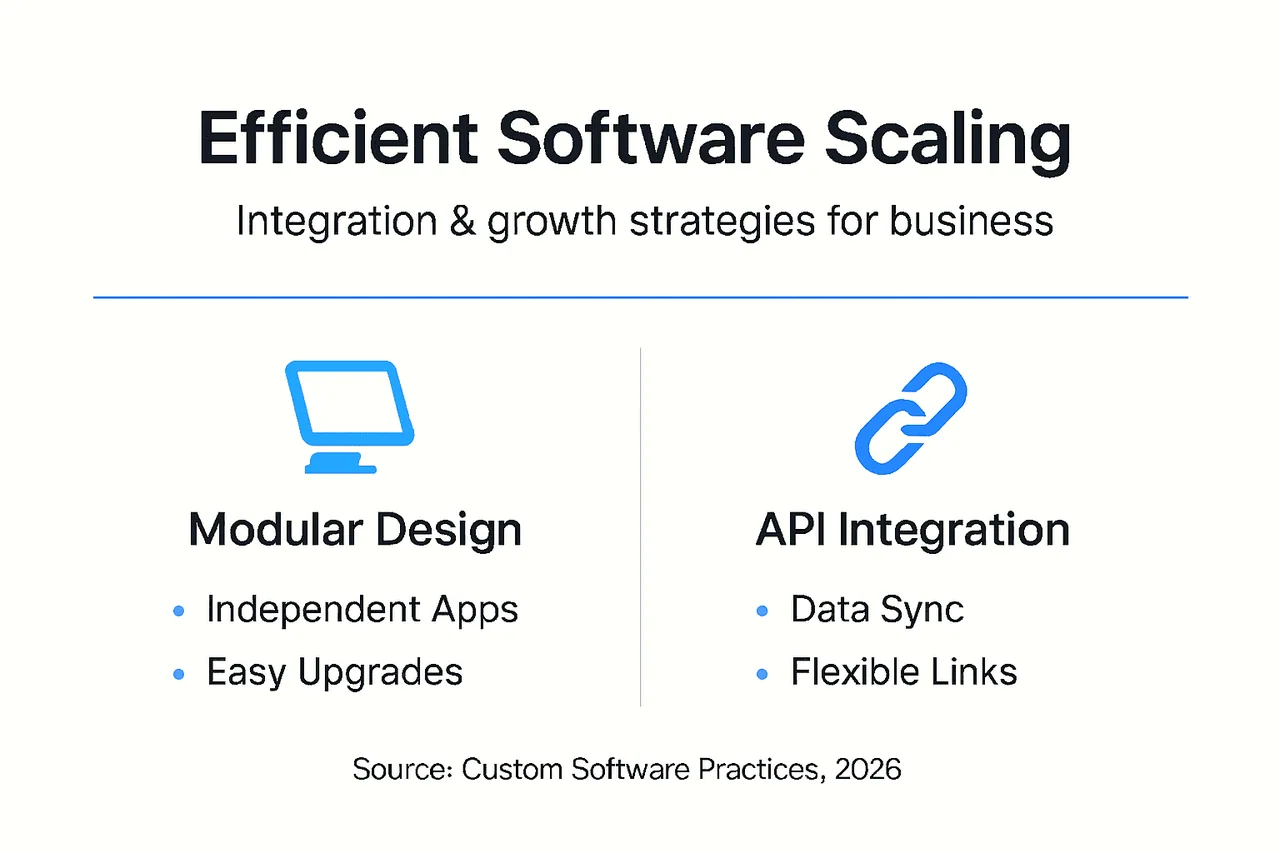
Planning integration from the project start prevents costly retrofits later. Modern custom software uses APIs to connect with existing systems, cloud services, mobile applications, and future tools you haven’t deployed yet. This interoperability protects your investment as your technology ecosystem grows.
Best practices for scalable custom software include:
- Version control and documented code standards for maintainability
- Decoupled modules that can be updated independently
- API-first design enabling future integrations you haven’t planned yet
- Cloud-native architecture supporting elastic scaling as demand grows
- Automated testing ensuring changes don’t break existing functionality
- Performance monitoring identifying bottlenecks before they impact users
Pro Tip: Prioritize scalable architecture from day one, even if you’re starting small. Rebuilding software to handle growth costs far more than designing it properly initially. Good developers build for tomorrow’s needs, not just today’s.
Integration capabilities extend beyond technical connections. Custom software can address your specific business needs by unifying workflows across departments, automating handoffs between teams, and providing single sources of truth for critical business data.
Explore Custom Software Solutions with Cloudfusion
Transforming your operations through custom software requires experienced partners who understand both technology and South African business contexts. Cloudfusion delivers tailored custom software development designed specifically for your workflows, compliance requirements, and integration needs.
Our local expertise ensures your solution meets POPIA regulations, integrates with South African payment and banking systems, and addresses the unique challenges of operating in this market. We’ve helped businesses across industries improve efficiency and scalability through purpose-built applications.
Discover how our proven development approach helps you automate unique workflows, eliminate data silos, and build competitive advantages through technology. Explore the benefits of investing in custom software for your business, or review our web design and development solutions to see how we can support your digital transformation.
Frequently Asked Questions about Custom Software Solutions
What is the typical timeline for custom software development projects?
Most custom software projects take 12 to 24 weeks from requirements gathering to deployment. Simple workflow automation tools may complete in 8-12 weeks, while complex enterprise systems with multiple integrations can take 6-9 months depending on scope and complexity.
How does custom software improve compliance with South African data laws?
Custom software builds POPIA compliance directly into your data handling, security measures, and audit trails. You implement exactly the controls required for your specific data types and business processes, rather than adapting generic tools that may leave compliance gaps.
Is custom software cost-effective for small businesses in South Africa?
Small businesses with unique workflows or specific compliance needs often see the fastest ROI from custom solutions. While upfront costs are higher, total five-year ownership costs typically run 15-30% lower than off-the-shelf alternatives when you account for licensing fees, unused features, and efficiency gains.
Can custom software integrate with my existing business systems?
Yes, integration with existing systems is a primary advantage of custom development. Modern custom software uses APIs to connect with your current tools, cloud services, databases, and future applications, creating unified workflows across your entire technology stack.
What steps should I take to start a custom software project?
Begin by documenting your current workflows and identifying pain points where manual processes or system limitations hurt efficiency. Engage experienced developers for requirements analysis, then collaborate on solution design before committing to full development. Involving end users throughout the process ensures the final product meets actual needs.