

Headless Commerce – Transforming Retail Innovation
Headless commerce explained for retail: learn core concepts, architecture variations, integration strategies, and practical risks for modern e-commerce.
Start reading
More than 60 percent of global retailers are now considering headless commerce to deliver personalised shopping experiences that set them apart. For e-commerce managers, the shift goes beyond buzzwords—staying competitive means adapting quickly to consumer trends, such as those driving rapid innovation in the South-African retail sector. This overview unpacks the fundamentals of headless commerce technology and offers practical insights so you can evaluate whether this approach aligns with your strategy for future growth.
Table of Contents
- Defining Headless Commerce Technology
- Architecture Models And Key Variations
- How Headless Commerce Platforms Function
- Integration Options For Business Systems
- Benefits And Risks For Retailers
- Comparing Headless And Traditional Commerce
Key Takeaways
| Point | Details |
|---|---|
| Decoupled Architecture | Headless commerce separates the front-end and back-end systems, allowing for customisable and flexible online shopping experiences. |
| Integration Capabilities | The technology relies on APIs to seamlessly integrate with various business systems, enhancing operational efficiency. |
| Scalability and Adaptability | Businesses can scale and adapt quickly to market changes without disrupting core operations, making it ideal for omnichannel strategies. |
| Technical Expertise Required | Implementing headless commerce requires advanced technical skills, making it necessary for businesses to assess their technical capabilities before adoption. |
Defining headless commerce technology
Headless commerce represents a revolutionary approach to digital retail architecture where the front-end presentation layer is completely decoupled from the back-end commerce functionality. This innovative technology enables businesses to create highly customisable, flexible online shopping experiences by separating user interface from core commerce systems.
At its core, headless commerce works through application programming interfaces (APIs) that allow independent development and modification of the front-end and back-end systems. Unlike traditional monolithic e-commerce platforms, this approach means businesses can update their customer-facing design without disrupting critical backend operations like inventory management, payment processing, or product catalogues. The architecture provides unprecedented flexibility for brands wanting to create unique digital experiences across multiple channels and devices.
Key characteristics of headless commerce include its ability to support omnichannel retail strategies, enable faster time-to-market for new features, and provide seamless integration with various third-party applications. This emerging platform architecture allows businesses to design custom user experiences independently of back-end operations, ultimately delivering more personalised and responsive digital commerce solutions.
Pro tip: When implementing headless commerce, prioritise selecting robust API frameworks that offer comprehensive documentation and strong developer support to ensure smooth integration and scalability.
Architecture models and key variations
Headless commerce architecture represents a sophisticated approach to digital retail infrastructure with multiple distinct models designed to address diverse business requirements. Multi-cloud architectural patterns have emerged as a critical strategy for retailers seeking enhanced scalability and operational flexibility, enabling organisations to distribute their commerce systems across different cloud environments while maintaining a unified customer experience.
The primary architecture models can be categorised into three fundamental approaches: fully decoupled frontends, microservices-based backends, and hybrid integration models. Fully decoupled architectures provide complete separation between front-end and back-end systems, allowing independent development and deployment cycles. Microservices-based models break down commerce functionality into discrete, independently manageable services that can be updated or scaled without disrupting the entire system. Hybrid models combine headless features with existing legacy systems, offering a transitional pathway for organisations incrementally modernising their digital commerce infrastructure.
Each architectural variation presents unique advantages and challenges. Fully decoupled models offer maximum flexibility but require significant technical expertise. Microservices architectures enable granular scalability and faster innovation cycles. Hybrid approaches provide a pragmatic solution for businesses with complex existing technology ecosystems, allowing gradual transformation without complete system replacement. The selection of an appropriate architecture depends on factors including organisational technical capabilities, existing infrastructure, scalability requirements, and long-term digital transformation strategies.
Here’s a concise comparison of three common headless commerce architecture models and their business relevance:
| Architecture Model | Scalability Potential | Technical Expertise Required | Ideal Use Case |
|---|---|---|---|
| Fully Decoupled | Very high | Advanced | Rapid innovation and extensive customisation |
| Microservices-Based | Excellent for modular growth | Intermediate to advanced | Scaling specific functions independently |
| Hybrid Integration | Moderate to high | Moderate | Gradual transition from legacy systems |
Pro tip: When evaluating headless commerce architecture models, conduct a comprehensive assessment of your current technology landscape and future scalability needs to select the most appropriate architectural approach.
How headless commerce platforms function
Headless commerce platforms operate through a sophisticated system of application programming interfaces (APIs) that enable seamless communication between front-end and back-end systems. Scalable e-commerce solutions fundamentally rely on these API connections to create flexible, modular digital commerce experiences that can adapt rapidly to changing business requirements.
The functional architecture of headless commerce platforms typically involves multiple critical components working in synchronised harmony. These include API gateways that manage data transmission, microservices responsible for specific commerce functions like inventory management or pricing, and decoupled front-end presentation layers that can be independently developed and deployed. Each component communicates through standardised API protocols, allowing businesses to create custom user interfaces, integrate multiple sales channels, and modify individual system elements without disrupting the entire commerce ecosystem.

Practically, this means organisations can develop unique customer experiences across various platforms – mobile applications, web interfaces, smart device interfaces, or emerging digital touchpoints – while maintaining a consistent and robust back-end infrastructure. The platform’s modular design enables rapid iteration, supports omnichannel strategies, and provides unprecedented flexibility in how businesses design, implement, and evolve their digital commerce capabilities. Technical teams can update front-end experiences, implement new features, or integrate third-party services without extensive backend reconfiguration, dramatically reducing development time and complexity.
Pro tip: When implementing a headless commerce platform, prioritise selecting an API framework with comprehensive documentation, robust developer support, and proven scalability to ensure smooth integration and future-proofing.
Integration options for business systems
Headless commerce platforms offer multiple sophisticated integration options for businesses seeking comprehensive digital ecosystem connectivity. Enterprise app integration strategies have evolved to support complex interconnections between disparate business systems through robust API frameworks that enable seamless data exchange and functionality synchronisation.
Core integration capabilities for headless commerce platforms typically include synchronisation with critical enterprise systems, such as customer relationship management (CRM) platforms, enterprise resource planning (ERP) solutions, inventory management systems, payment gateways, and analytics platforms. These integrations utilise standardised API protocols that allow businesses to connect multiple software applications without extensive custom development, creating a unified technological ecosystem that supports comprehensive operational efficiency.
The integration landscape encompasses several primary approaches: point-to-point integrations for direct system connections, middleware platforms that facilitate complex multi-system interactions, and microservices architectures that enable granular, modular system communications. Each approach offers unique advantages, with businesses selecting integration strategies based on their specific technological requirements, scalability needs, and existing system infrastructure. The flexibility of headless commerce platforms allows organisations to implement hybrid integration models that combine different approaches, ensuring maximum adaptability and future-proofing of their digital infrastructure.
Pro tip: When planning system integrations, conduct a comprehensive audit of your existing technological ecosystem and prioritise API-first solutions that offer robust documentation and flexible configuration options.
Benefits and risks for retailers
Headless commerce presents a transformative opportunity for retailers seeking to enhance their digital capabilities and customer experiences. Benefits of this innovative approach include unprecedented flexibility in customising front-end interfaces and creating seamless omnichannel strategies, enabling businesses to rapidly adapt to changing market demands and customer expectations.
The technological landscape reveals a nuanced profile of advantages and potential challenges. Key benefits encompass dramatically improved website performance, faster page load times, and the ability to update customer-facing experiences without disrupting core backend operations. Retailers gain the capability to create unique, tailored digital experiences across multiple platforms and devices, from mobile applications to smart device interfaces. However, these advantages are counterbalanced by significant implementation considerations, including higher initial investment requirements, increased technical complexity, and the necessity for specialised development expertise.
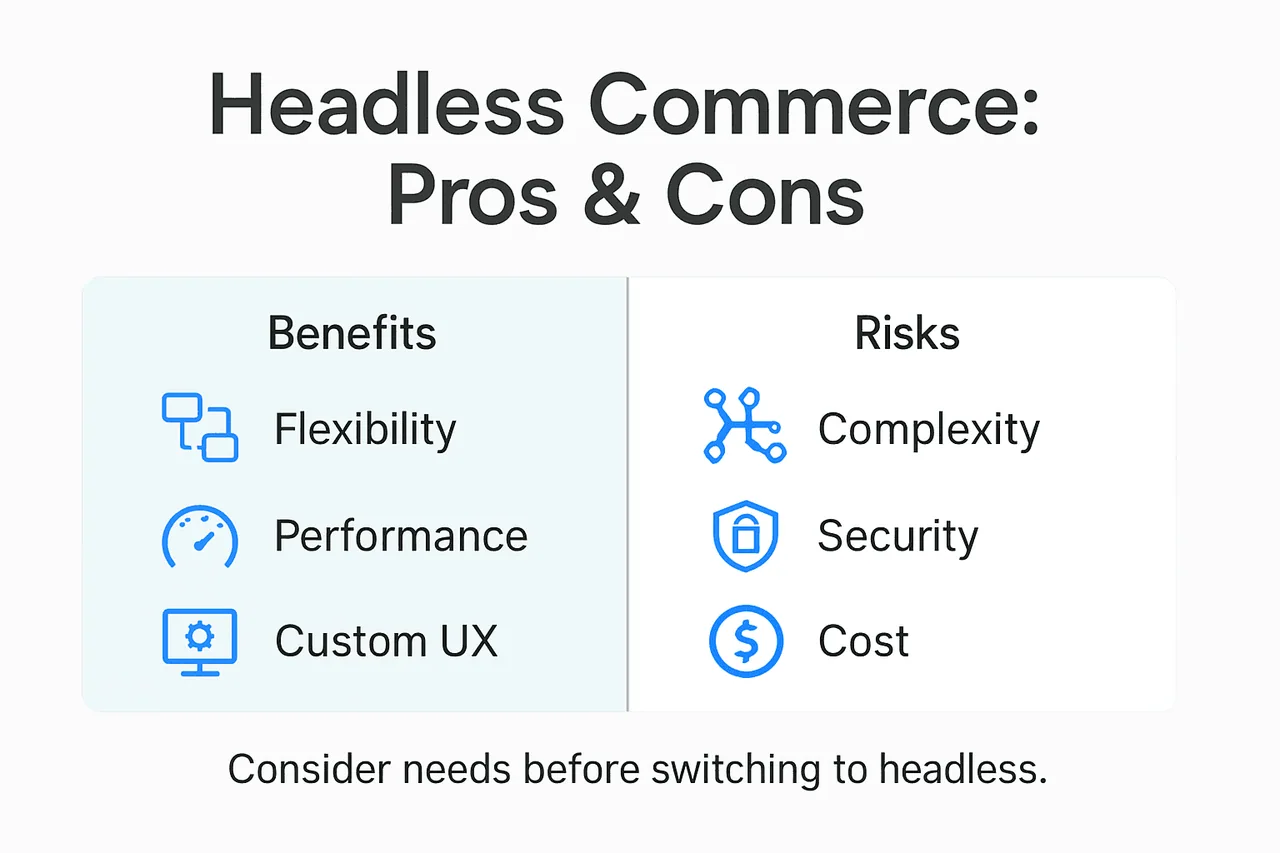
Risk management becomes crucial in headless commerce adoption. Technical challenges include potential API security vulnerabilities, the complexity of managing multiple interconnected systems, and the ongoing maintenance demands of a more sophisticated technological infrastructure. Retailers must carefully evaluate their organisational capabilities, technological maturity, and strategic objectives to determine whether a headless commerce approach aligns with their long-term digital transformation goals. The decision requires a comprehensive assessment of internal technical resources, budget constraints, and the potential return on investment from implementing such an advanced commerce platform.
Pro tip: Conduct a thorough capability assessment and pilot project before full-scale headless commerce implementation to validate technological fit and mitigate potential integration risks.
Comparing headless and traditional commerce
The fundamental distinction between headless and traditional commerce platforms lies in their architectural approach to digital retail infrastructure. Headless commerce represents a paradigm shift from monolithic, tightly integrated systems to a flexible, API-driven architecture, enabling businesses to create more dynamic and adaptable digital experiences.
Traditional commerce platforms operate with a rigid, interconnected front-end and back-end structure, offering predefined templates and limited customisation options. These platforms provide a straightforward setup suitable for smaller businesses with minimal technical resources. In contrast, headless commerce decouples the presentation layer from backend functionality, granting organisations unprecedented flexibility to design unique customer interfaces across multiple channels. This approach allows for independent development and rapid iteration of front-end experiences without disrupting core commerce operations.
The comparative landscape reveals significant differences in scalability, performance, and technological complexity. Traditional platforms excel in simplicity and ease of maintenance, making them attractive for businesses with limited digital transformation capabilities. Headless commerce, however, offers superior adaptability, enabling companies to create personalised omnichannel experiences, integrate emerging technologies more seamlessly, and respond quickly to changing market demands. The trade-off involves higher initial investment, more sophisticated technical requirements, and the need for specialised development expertise to fully leverage the platform’s potential.
Review the key differences between headless and traditional commerce platforms at a glance:
| Aspect | Headless Commerce | Traditional Commerce | Business Implication |
|---|---|---|---|
| Flexibility | Highly adaptable | Rigid structure | Enables unique customer experiences |
| Implementation Speed | Faster iteration possible | Slower updates | Rapid market response capability |
| Customisation Level | Extensive, unlimited | Limited | Supports advanced branding |
| Required Expertise | High technical skill needed | Basic knowledge sufficient | Influences resource allocation |
Pro tip: Conduct a comprehensive capability assessment of your current technological infrastructure and future business goals before selecting between headless and traditional commerce platforms.
Unlock the Power of Headless Commerce with Custom Digital Solutions
Headless commerce is redefining retail innovation by offering unmatched flexibility and scalability through API-driven architecture. If you are grappling with the challenge of creating personalised omnichannel experiences while maintaining seamless backend operations, this is where your digital transformation journey begins. Many businesses struggle with the technical complexity and integration demands that come with headless platforms. That is why partnering with specialists who understand both the technological and strategic requirements is vital.
At CloudFusion, we combine deep industry expertise with tailored web design and development services to build robust headless commerce solutions that align perfectly with your business needs. From smooth API integrations to scalable frontend experiences, our team helps you navigate the complexities and accelerate your innovation cycle. Don’t let technical hurdles hold back your retail vision. Explore how our Custom Web Design and Development Solutions can empower your enterprise with cutting-edge headless commerce technology.
Ready to transform your retail platform with flexible, scalable digital architecture Call us today to start your project or request your personalised quote through our Web Design and Development Quotation page. Take the first decisive step towards future-proofing your commerce ecosystem with CloudFusion’s expert digital solutions.
Frequently Asked Questions
What is headless commerce?
Headless commerce is a modern digital retail architecture that separates the front-end presentation layer from the back-end commerce functionality, allowing for more customisable and flexible online shopping experiences.
How does headless commerce improve scalability for retailers?
Headless commerce enhances scalability by employing microservices architectures which allow retailers to scale specific functions independently, leading to faster innovation cycles and improved performance.
What are the main benefits of adopting headless commerce?
The key benefits of headless commerce include improved website performance, faster updates to customer-facing experiences without disrupting back-end operations, and the ability to create unique digital experiences across various platforms.
What are the integration options available for headless commerce platforms?
Headless commerce platforms offer several integration options, including point-to-point integrations, middleware platforms for multi-system interactions, and microservices architectures that enable modular communication between different business systems.
Recommended
- Influencer Marketing for Ecommerce – Driving Sales Globally
- Understanding Automation in Ecommerce: Key Concepts Explained
- Ecommerce Conversion Optimization: Unlock Higher Sales Today
- Understanding Personalization in Ecommerce: A Complete Guide
- Understanding Customer Centric Thinking in Business | siift
- Top eCommerce APIs to Supercharge Your Store in 2026